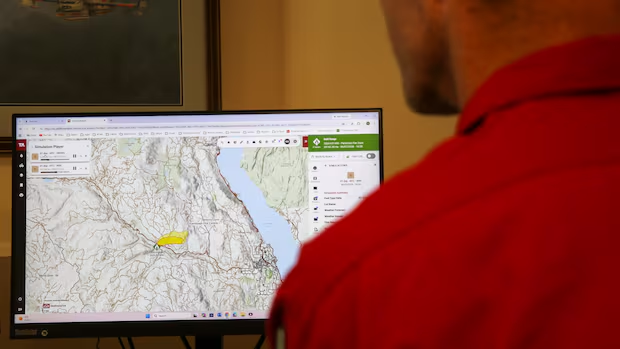
不列颠哥伦比亚省野火管理局(BCWS)的预测服务主管尼尔·麦克洛林正试图让模型软件模拟出8月7日奥卡诺根谷地发生的巴尔德岭野火的实际蔓延情况。
Neal McLoughlin, superintendent of predictive services with the B.C. Wildfire Service (BCWS), is trying to get one of B.C.'s most challenging fires, the Bald Range wildfire, to behave in his modelling software the way it did on the ground in the Okanagan Valley on Aug. 7.
他在电脑上调整各项参数:增强火势的剧烈程度,将森林中的可燃物替换为更易燃烧的类型,设定更强的西风,还将原本呈下坡走势的地形改为平坦地貌。
On his computer, he's turning up the dials for extreme fire behaviour, replacing the forest fuels with more flammable types, programming a stronger wind from the west and swapping local topography of a downward sloping hill with a flat landscape.
只有经过这些调整,他的模拟结果才接近当晚萨默兰地区的真实情况——当时火焰在短短数小时内便逼近小镇,超过1.2万名居民被迫撤离。这场混乱中有一名女子不幸丧生。
Only with those interventions do his simulations get close to what actually happened on the ground that night in Summerland when more than 12,000 people were forced to flee as flames rushed toward the town in mere hours. One woman died in the chaos.
“实际观测到的火势蔓延速度是我们模型原本预测值的两倍,”麦克洛林说道。
"Observed fire behaviour is doubling what our models would otherwise predict," said McLoughlin.
出现这种情况的部分原因在于,用于构建这些计算机模型的数据至少采集于30年前,当时由长期干旱等气候变化因素引发的极端火势现象还较为少见。
It's partly because the data that informs these computer models was collected at least 30 years ago, when extreme fire behaviour, driven by events like prolonged drought — a feature of climate change — was less common.
据加拿大干旱监测机构统计,不列颠哥伦比亚省南部内陆地区是加拿大最干旱的区域。今年的野火季虽然过火面积低于平均水平,却也是有记录以来造成财产损失最严重的一个季节,因此相关预测工作难度极大。
The challenge is especially pronounced in B.C.'s Southern Interior region, officially the driest place in Canada, according to the Canadian Drought Monitor in a wildfire season that saw less area burned than average, yet was one of the most devastating seasons on record for property destruction.
对于BCWS的专家们而言,模型预测结果就如同普通民众看待天气预报一般重要。他们需要依据预测结果来协调野火应对工作,判断火势可能的蔓延速度,进而调整应对策略与安全预案。这些模型也是BCWS在调配人力、分配资源以应对野火时所用的重要工具之一。
BCWS specialists look to their model predictions the way most of us consider a weather forecast. In their case, they're co-ordinating a response to a wildfire, thinking about how quickly it might spread and how their tactics and safety plan should change around that. It's part of the larger toolbox, on top of human resources, BCWS uses to evaluate and dedicate resources to wildfires.
尽管这是一个概念上较为稳健的预测系统,基于100多年的数据收集与分析,但其网站甚至也注明,“最后一次更新是在20世纪90年代初”。信任模型。在实践中,麦克洛林表示,他的团队已经学会在异常炎热干燥的日子里更加怀疑模型的预测。即便有数十年的高质量数据支持,他们仍会相信自己的直觉,认定野火的情况可能远比对模型所说的严重。
While it's a conceptually robust prediction system, based on more than 100 years of data collection and analysis, even its website states it "was last updated in the early 1990s." Trusting the models In practice, McLoughlin says, his team have learned to become more skeptical of the model's predictions on those exceptionally hot and dry days, when even decades of high-grade data cannot overcome their own instincts that a wildfire could be significantly worse than the models say.
归根结底,决定如何应对野火的是人,而不是模型。在容易发生火灾的日子里,麦克洛林已经开始培训团队,切实运用他们亲历极端火灾的经验。他说:“在这种时候,我不信任模型。我预计火灾会出现非常不同的情况。”加拿大林业局(CFS)研究科学家切琳·海恩斯称,这类不可预测的火灾属于“黑天鹅事件”,超出了多年火灾科学赋予她这类从业人员的认知范围。
Ultimately it's people that make decisions about how to respond to a wildfire, not models, and on those fire-prone days McLoughlin has begun training his team to really apply their lived experience of past extreme fires. On some days, he says: "I don’t trust the models on this day. I expect it's going to do something very different." "Black swan events" is what Chelene Hanes, a research scientist with the Canadian Forest Service (CFS), calls those unpredictable fires, which fall outside what years of fire science has taught practitioners like her.
这套预测软件以加拿大森林火灾危险等级系统(CFFDRS)为基础,而该系统正是全国各地相关机构评估野外火灾潜在危险的基础。
The basis of the prediction software is the Canadian Forest Fire Danger Rating System (CFFDRS), which forms the foundation of how agencies across the country evaluate the potential of wildland fires.
海恩斯表示,作为预报员所用建模体系的一部分,火灾行为预测系统的更新版本可能于2029年推出,但不太可能纳入来自燃烧更为猛烈的火灾的新数据,因为收集这些数据既成本高昂,又非常危险。"很多数据是对过去几十年收集的数据进行的重新分析,因为这些数据质量非常高,"她说。"但我们确实需要收集更多信息,因为我们正试图利用物理学和数学在火灾环境中的知识,拓展模型的能力边界。"
Hanes says updates to the Fire Behaviour Prediction System, part of the modelling that forecasters use, could be rolled out by 2029, but including new data from these more aggressively burning fires is unlikely because it's both very expensive and dangerous to collect. "A lot of it is reanalysis of data that was collected over numerous decades because it is really good data," she said. "But we do need to collect more information because we are trying to stretch our capabilities with the models with our knowledge of physics and math in the fire environment."
燃烧更深、更猛麦克劳克林带我们来到了今年夏天不列颠哥伦比亚省最大野火——克林顿附近的皮尔湖野火的起火点附近,这场火灾表现出的行为特征,正是亟需更精准建模的类型。
Deeper and hotter McLoughlin took us close to the ignition point of B.C.'s largest wildfire this summer, the Pear Lake Wildfire, near Clinton — a fire that had the hallmarks of behaviour that needs to be more accurately modelled.
这场大火最终烧毁的面积超过了大伦敦地区,烧毁了100多座建筑,从我们站立的位置望去,对面山坡上似乎所有的松树都被烧毁了,留下了一片奇异的景观:成千上万根发黑的树桩矗立着,像一根根烧尽的小火柴。
The fire, which eventually scorched an area larger than Greater London, burned through more than 100 structures and, from where we stood, seemingly all the pines on the hill across from us, leaving a strange landscape of thousands of blackened stumps, standing like tiny spent matchsticks.
麦克劳克林一边穿过烧毁区,一边说:"这里有很多干旱影响的证据。"他指着几棵30米高的大树,它们从树顶一直烧到了根盘,在地上留下了巨大的坑洞;还有一些树呈现黑黄相间的斑点——所谓的"豹纹树"或"猎豹树",这种现象在贾斯珀野火中也曾观察到——当火势过于猛烈时,树皮会成片地从树干上爆裂脱落。他说,持续的干旱导致火灾燃烧得更深、更猛。
There's a lot of evidence of the impacts of drought, McLoughlin said as he walked through some of the burn scar. He pointed to 30-metre-tall trees that had burned from the top right down to the root plates, leaving huge holes in the ground, and other trees spotted black and yellow — so-called "leopard or cheetah trees," a phenomenon also observed in the Jasper wildfire — when a fire burns so hot bark explodes off the trunk in patches. Persistent drought means fires burn deeper and hotter, he said.
这些条件极易引发对流驱动火或柱状驱动火,这类火灾最显著的特征是高耸的火积雨云,它们看起来和表现得都像巨大的雷暴,因为超高温气体和碎片被推向高空,有时还会混入高层大气中的空气。
These are the kinds of conditions that can lead to a convective or column-driven fire, best known by their distinctive tall pyrocumulonimbus clouds that can look and act like huge thunderstorms as superheated gases and debris are pushed skyward, sometimes mixing in air from the upper atmosphere.
麦克劳克林说:"过去这可能是职业生涯中只能见一次的现象。但2023年不列颠哥伦比亚省的火灾季就出现了近100次。"
It used to be something you'd see once in your career, said McLoughlin. B.C.'s 2023 season had close to 100.
我们站立的这片火场就发生过多次火积云事件,其中一次还伴随闪电,引发了一场新火灾,最终与原火场合并。麦克劳克林说:"那些并非我们收集数据时所预设的条件。"
The fire ground we were standing in had multiple pyrocumulus events, one of them with lightning, which started a new fire that eventually merged together. "Those were not the conditions we collected data for," says McLoughlin.
预测柱状火的行为“根本不在我们旧系统的考量范围内,”他说,这与模型“表现出色”的更水平的风驱动火形成对比。缺乏极端条件下的数据 建模软件上一次重大更新是在1992年,但CFS的Hanes表示,这并不像在电子表格中输入一些新数字那么简单。
Predicting the behaviour of a column-driven fire is simply "not part of our old systems," he said, as opposed to a more horizontal wind-driven fire where the models "do a great job." Lack of data on extreme conditions The last time that modelling software had a major update was 1992, but it's not as straightforward as putting some newer numbers in a spreadsheet said Hanes, from the CFS.
在像Bald Range或Pear Lake野火这样危及生命的情况下,很难想象有能力开展那种科学工作——将计时器埋入地下测量火势蔓延速度,或使用红外相机观测火灾强度。
The capacity to do the kind of science where a timer could be put in the ground to measure the spread of a fire or infrared cameras could be used to look at the intensity of a fire is hard to imagine occurring in a life-threatening situation like the Bald Range or Pear Lake wildfire.
根据Hanes的说法,甚至连实验烧除——这是科学家研究火灾、为当今预测系统提供依据的方式——在他们经历的极端条件下也过于危险。
Even experimental burns — which is how scientists studied fires that informed the prediction systems used today — are too dangerous under the extreme conditions they're experiencing, according to Hanes.
“我们在极端端几乎没有数据,”Hanes说,因为在极端条件下,实验性火灾失控的风险实在太高。
"We don't have a lot of data on the extreme end," Hanes said, because the risk of an experimental blaze getting out of control during extreme conditions is just too high.
因此,Hanes表示,他们经常在“计划烧除”上“搭便车”开展研究,尽管她承认,由于火季太忙,今年许多计划烧除都没能进行。他们还与NASA等研究团体合作,后者的飞机可以飞入火风暴收集数据。
So, Hanes says they're often "piggybacking" their research on prescribed burns, though she admits many didn't happen this year because the season got too busy. They're also collaborating with some research groups like NASA whose planes can fly through fire storms to collect data.
McLoughlin表示,他被多次问及BCWS是否使用人工智能来帮助预测这些新的、看似不可预测的野火,但对他来说,归根结底还是要收集更多当代数据。
McLoughlin says he's been asked multiple times about BCWS using artificial intelligence to help predict these new, seemingly unpredictable wildfires, but for him it still comes back to collecting more contemporary data.
“如果我们不努力收集实地数据来完善这些模型,它们就无法做出好的预测,”他说,“就这么简单。”
"If we're not making an effort to collect that data on the ground to inform these models, they're not going to make good predictions," he said. "It's as simple as that."