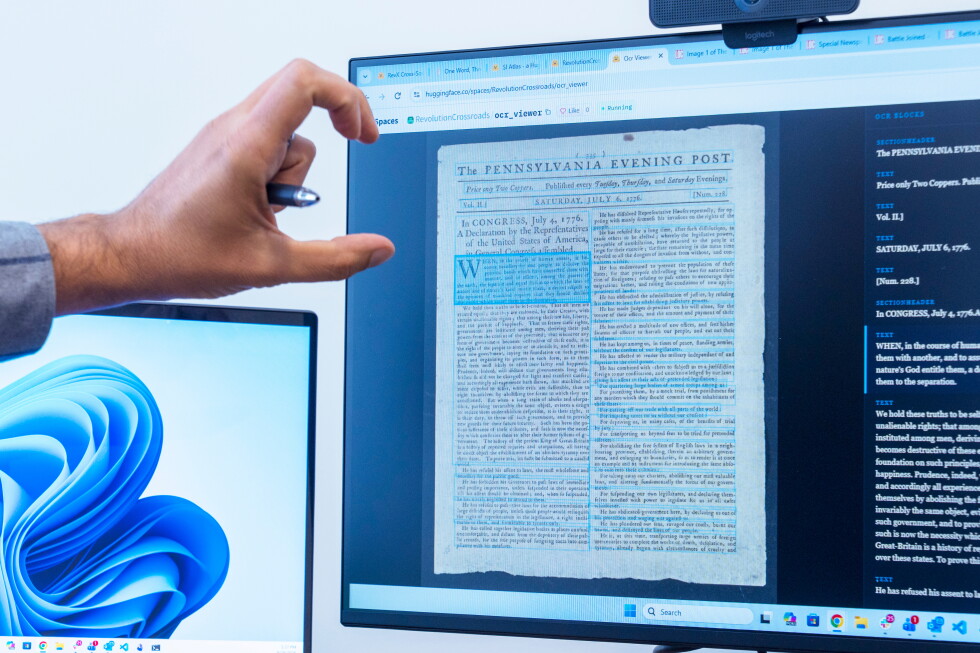
史蒂文·斯隆·华盛顿——从美国革命到人工智能时代,两者之间的历程几乎难以想象。不过,史密森尼学会的领导者正借助人工智能弥合这道鸿沟。
STEVEN SLOAN WASHINGTON — The distance in the march from the American Revolution to the age of artificial intelligence is almost beyond comprehension. But leaders of the Smithsonian Institution are using AI to bridge the divide.
美国庆祝独立250周年之际,史密森尼学会的领导者正转向人工智能,以更好地理解馆藏中与推动国家建国的斗争有关的藏品。
As the United States celebrates its 250th anniversary of independence, Smithsonian leaders are turning to AI to better understand items in its collection tied to the fight that led to the country’s founding.
其目标是让公众和学者都能检索该机构的馆藏,并在史密森尼学会与国会图书馆等其他机构之间建立联系,从而更深入地了解这个国家诞生之初,各个社群是如何形成和运作的。
The goal is to allow the public and scholars to both search the institution’s collection and draw connections across the Smithsonian and other organizations, such as the Library of Congress, to gain a deeper sense of how communities formed and functioned at the nation’s birth.
自研究人员今年春季开始为“革命十字路口”项目应用人工智能模型以来,他们迅速建立起了许多联系,而过去要发现这些联系,需要在多个目录中进行大量人工检索。例如,他们找到了一位银匠的名字:此人约在1774年曾为一只奶壶刊登报纸广告,而史密森尼学会的美国国家历史博物馆也收藏着一件类似的奶壶。
Since researchers on the project, known as Revolution Crossroads, began applying AI models in the spring, they have quickly drawn links that would have previously required extensive manual searches across multiple catalogs. They located, for instance, a silversmith who was running newspaper s for a creamer around 1774, similar to one held at the Smithsonian’s National Museum of American History.
该项目最终的目标是全面梳理各类记录,发掘关于那些生平已随岁月流逝而湮没之人的全新故事。
The ultimate ambition is to scour records and surface new stories about people whose lives have faded away over the centuries.
史密森尼学会首席数字与创新官贝基·科伯罗德说:“理想的情况是,我们最终能够为公共记录增添新的内容。他们或许不是托马斯·杰斐逊或乔治·华盛顿,但他们曾生活在一个社群中,并为建设这个社群作出贡献,而如今,人们知道了他们的名字。”自1846年成立以来,史密森尼学会一直通过如今涵盖21座博物馆和美术馆的庞大运营体系,收藏、研究和展示美国的历史与文化,其中还包括国家动物园。随着共和党总统唐纳德·特朗普对该机构部分展示内容提出质疑,这一职责又赋予了新的意义。
“An ideal scenario is that we get to a place where we’re actually adding to the public record,” said Becky Kobberod, the chief digital and innovation officer at the Smithsonian. “Maybe they’re not Thomas Jefferson or George Washington, but they did live in a community and build that community, and that name is now known.”Since its founding in 1846, the Smithsonian has curated the nation’s history and culture across an operation that now spans 21 museums and galleries, including the National Zoo. It’s a role that’s taken on new significance as Republican President Donald Trump has questioned some of the institution’s portrayals .
科伯罗德的团队已识别出约1万件与1770年至1810年这40年间生活过的人有关的藏品。他们不得不将这些藏品数字化,其中一些还须重新数字化,以使其更便于人工智能访问。公众可以在线搜索这些记录。
Kobberod’s team has identified about 10,000 objects centered on people who lived during the 40-year period from 1770 to 1810. They have had to digitize — and in some cases redigitize — the objects to make them more accessible to AI. The public can search the records online.
对国会图书馆数字战略主管纳塔莉·布达·史密斯而言,这个项目提醒人们,这些机构正深度参与快速演进的技术发展。她说,这项工作可以帮助那些不知道该从史密森学会、国会图书馆还是其他地方开始研究资料的人。
For Natalie Buda Smith, the director of digital strategy at the Library of Congress, the project is a reminder that these institutions are deeply engaged in rapidly evolving technology. This work, she said, can help people researching materials who don’t know whether to begin at the Smithsonian, the Library of Congress or somewhere else.
她说,“咖啡伴侣的例子表明,外面的资料非常丰富,你可能在史密森学会找到故事的一部分,也可能在图书馆找到另一部分。”“要向人们敞开这些大门,让他们能够继续探索。因为在史密森学会找到了它,并不意味着故事到此结束。”这项工作开展之际,正值关于如何妥善利用人工智能的讨论处于敏感阶段。业内一些最高层领袖recently对这项技术可能造成的危害发出了愈发严厉的警告。
The creamer example “illustrates that there’s a richness out there and you might find part of the story at the Smithsonian and part of the story at the library,” she said. “Open up those doors to people so they can understand, because they found it in the Smithsonian doesn’t mean it’s the end of the story.”The work is unfolding at a sensitive time in the debate over how to properly harness AI. Some of the industry’s top leaders have issued increasingly dire warnings about the technology’s potential harm.
本周,许多人齐聚华盛顿,在那里会见了特朗普,并签署了一份自愿开展审查的协议。民主党人和一些共和党人正呼吁采取力度更大的应对措施,包括加强对人工智能的监管。
Many were in Washington this week, where they met with Trump and signed a voluntary accord for reviews. Democrats and some Republicans are calling for a more robust response, including stronger regulation of AI.
作为史密森学会首位担任其职务的人,科伯罗德承认自己对人工智能怀有一种“健康的恐惧”。她说,史密森学会没有使用近几周受到大量审视的任何现有前沿模型。她还强调了研究中人类监督的重要性,并指出,受过训练的历史学家会审核数据,能够识别人工智能智能体可能无法把握的细微之处。
Kobberod, the first person to hold her role at the Smithsonian, acknowledged a “healthy fear” of AI. She said the Smithsonian is not using any of the current frontier models that have received much of the scrutiny in recent weeks. She also emphasized the importance of human oversight in the research, noting that trained historians review the data and can recognize nuance that would be lost on an AI agent.
她表示:“他们可能会说:‘事实上,这是某人的一个广为人知的昵称’,或者‘这是一个用于指代X、Y、Z的通用称谓。’这种细微差别,是历史学家或毕生研究那个时代的人所能理解的,却是机器无法理解的。”不过,她表示,拥抱围绕人工智能的各种可能性仍然很重要。
“What they might say is, ‘actually that is a known nickname for so-and-so’ or ‘that is a generic term that’s used for X, Y, Z,” she said. “That is the nuance that a historian or someone who’s spent their whole career studying that time period is going to know that a machine is not.”Still, she said it is important to embrace the possibilities that surround AI.
“它不会消失,”她说,“我们确实认为,需要积极应对,并弄清楚这项技术在我们的工作中发挥着什么作用。”
“It’s not going away,” she said. “We do believe we need to lean in and figure out the part that this technology plays in our work.”