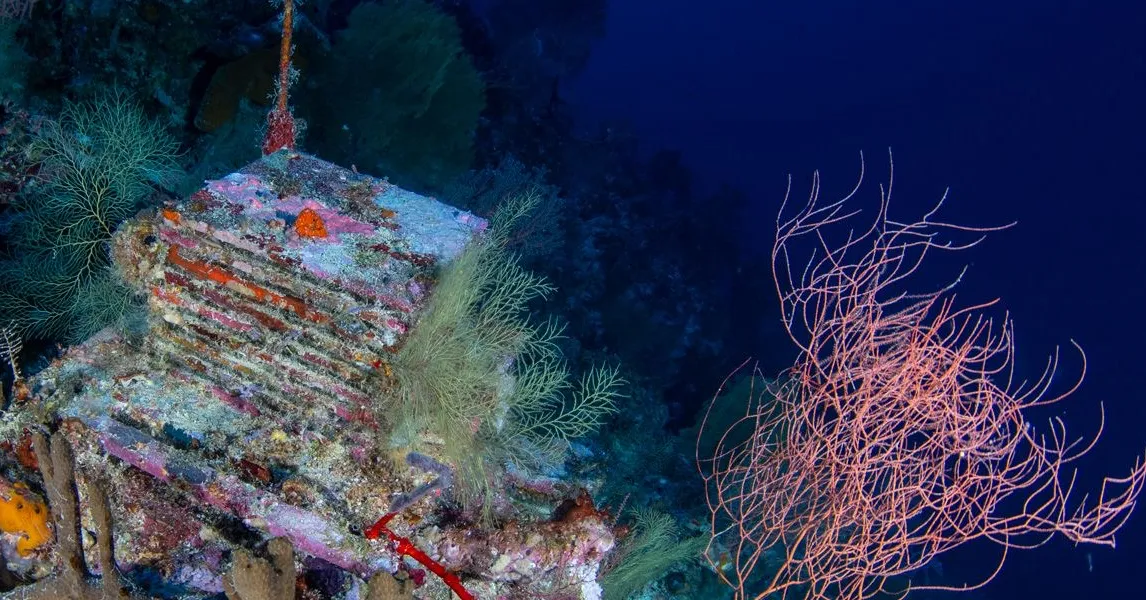
帕劳以其壮观而丰富的珊瑚礁而闻名。但这些潜水员计划穿过那些被阳光照亮的珊瑚礁区域,深入一个鲜为人知的“中光层”(即“mesophotic coral ecosystem”)。
Palau is famous for its spectacular and rich coral reefs. But these divers were planning to descend past those sun-lit marine communities and down into a lesser-known twilight zone known as the “mesophotic coral ecosystem.”
“‘中光层’这个术语其实指的是‘光线适中’的环境——这些珊瑚礁既不属于明亮的日光区域,也不属于完全黑暗的区域,而是介于两者之间的地带,”与我同行的潜水员之一、加州科学院的动物学家兼研究员路易斯·罗查(Luiz Rocha)解释道。他多年来一直致力于研究这些深处的珊瑚礁及其生态特性。
“30米到150米深之间的海域几乎完全是个未知的世界,”罗查告诉我。
Mesophotic essentially means “middle” and “light,” which is where these ecosystems are—not quite in the bright daylight, not quite in the profound darkness, but somewhere in between. For simplicity’s sake, we’ll call these communities, which range from some 30 meters to 150 meters below the surface, the “deep reefs.”One of the divers on the boat with me was a zoologist and curator at the California Academy of Sciences named Luiz Rocha, who has spent decades studying these deep reefs and their secrets.
由于这些深处的珊瑚礁尚未被充分探索,像罗查这样的研究人员面临着许多未解之谜:他们希望了解这些生态系统的真实状况(甚至只是了解那里究竟生活着哪些生物),以便更好地理解它们的运作机制。他们还试图弄清楚这些深处的珊瑚礁是否能为生活在较浅水域的物种提供庇护所。
“Anything between 30 meters and 150 meters is really, really unknown,” he told me. Because these deep reefs are so unknown, researchers like Rocha are left with big questions. They want to get a baseline picture of what is going on in these ecosystems—even just who lives there!—so that they can better understand how they function. They’ve also tried to work out whether (or not) these deep reefs might provide a refuge for species living in shallower coral reefs.
我之所以来到帕劳,是为了参加Vox电视台的《Unexplainable》播客节目;为了收集更多关于这些神秘海域的信息,罗查早在2016年就在那里放置了一些科学观测设备。这些设备在海底放置了近十年时间,期间上面附着了各种各样的海洋生物。如今,罗查再次返回,希望能将这些设备取回,并通过分析其中的数据,揭开这个鲜为人知的海洋世界的神秘面纱。
I was in Palau for Vox’s Unexplainable podcast because, in an effort to gather more information about these mysterious places, Rocha left some scientific structures down in these twilight depths back in 2016. Those structures then spent almost a decade becoming encrusted with all kinds of marine life. And now, Rocha was back to retrieve them, hoping that he—along with many other scientists — would be able to open them up, like a box of scientific puzzle pieces, full of clues about this under-understood marine world.
关于中光层珊瑚生态系统的论文经常提到一点:科学家对它们的了解远不及自己希望的那么多。美国国家海洋和大气管理局2019年发表的一篇有关这类生态系统的文章中满是“可能”,例如:它们可能“为具有重要经济价值和生态意义的物种提供至关重要的鱼类栖息地”。
One thing that’s often acknowledged in papers about mesophotic coral ecosystems is that scientists don’t know as much as they’d like to. A National Oceanic and Atmospheric Administration article about them from 2019 is full of “mays,” as in: They may “serve as essential fish habitat for economically and ecologically important species.
科学家当然也了解其中一些情况。他们知道,这些深海珊瑚礁的分布区域与浅水珊瑚礁的许多分布区域相同——主要是在世界热带和亚热带地区,如密克罗尼西亚、加勒比海,甚至墨西哥湾。他们发现,有许多物种似乎是这些地方独有的,而近期研究表明,这些物种可能容易受到气候变化的影响。
Researchers do know some things, of course. They know that these deep reefs can be found in many of the same regions as shallower coral reefs—so mainly the tropical and subtropical parts of the world, like Micronesia, the Caribbean, and even the Gulf of Mexico. They’ve found that there are many species that seem to be unique to these places, and recent research points to their potential susceptibility to climate change.
研究人员还初步了解了这些深海珊瑚礁与浅水珊瑚礁之间的一些关键差异。在浅水珊瑚礁中,造礁珊瑚与进行光合作用的藻类共生。藻类为珊瑚提供营养物质,而珊瑚则分泌碳酸钙基质,帮助构建珊瑚礁的结构。
Researchers have also gotten a sense of some of the key differences between these deep reefs and their shallower coral neighbors. In shallow reefs, hard corals team up with photosynthesizing algae. The algae provide the corals with nutrients, and the corals secrete a calcium-carbonate matrix that helps create the architecture of the reef.
然而,随着深度增加,光线开始变弱,光合作用的机会也随之减少。温度也会下降。因此,生活在深海珊瑚礁中的都是能够适应光线更暗、温度更低环境的动物。
As you go deeper, though, the light begins to fade, and the opportunities for photosynthesis start to fade with it. The temperature also drops. So the animals living down in the deep reefs are ones that can survive in a dimmer, cooler world.
科学家可以潜入深海珊瑚礁,试图进一步了解这些研究不足的地方——罗沙就是这样做的——但是在100米深处探索,需要比在较浅深度探索难度更高、风险更大的技术潜水。例如,潜得越深,气体被压入组织中的速度就越快,这会对如此深度的潜水造成限制。
Scientists can dive into the deep reefs to try to learn more about these understudied places—as Rocha has—but exploring down at 100 meters requires more difficult, riskier technical diving than exploring at shallower depths. The deeper you dive, for example, the faster gases get pushed into your tissues, which imposes limits on these really deep dives.
“我们剩下的时间非常、非常短,”罗哈说,“我说的短时间就是五分钟。六分钟,七分钟。”科学家可以利用这段时间拍摄一些照片、进行一些测量或采集少量样本,但随后必须开始上浮。这个过程可能需要数小时,因为他们必须缓慢上升,以避免减压病。
“We have a very, very short time,” Rocha says, “And by short time, I mean five minutes. Six, seven minutes.”Scientists can take some pictures in that time, make some measurements, or collect a few samples, but then they have to move back upwards—a process that can take hours, since they must rise slowly to avoid decompression sickness.
显然,以五至七分钟为一个时段来研究生态系统,效率并不高。人们也曾使用遥控潜水器和潜水器探索深海珊瑚礁,但这些设备本身也存在一些问题,摄像机也不总能捕捉到所有想要的细节,或拍到那些更隐秘、更难辨认的动物。因此,科学界对这些生态系统仍存在巨大的认知空白。
It is, obviously, not particularly efficient to study an ecosystem in five- to seven-minute intervals. People have also used remote-operated vehicles and submersibles to explore the deep reefs, but those have their own issues, and cameras can’t always capture all the detail you might want, or photograph more secretive, cryptic animals. So huge gaps remain in scientific knowledge about these ecosystems.
“每当我们去某个地方,”罗哈说,“最先发现的就是新物种。这是科学能做的最基本的事情。”但这项工作不仅仅是给新的鱼类、海绵或海蛞蝓分类建档。
“Whenever we go somewhere,” Rocha says, “the first thing we find is new species. It’s the most basic thing in science you can do.”But this effort goes beyond just cataloging new species of fish, sponges, or sea slugs.
罗哈希望回答一些根本性问题:这里处在昏暗光线之中的一切生物,其主要能量来源是什么?食物链是什么样的?生物如何进化到能够在这样的深度生存?它们与浅水生态系统有多相似,又有多大差异?它们如何受到气候变化的影响——保护它们的最佳方式又是什么?
Rocha wants to answer fundamental questions like: What is the main energy source for everything down here in the dim light? What does the food chain look like? How have things evolved to live at these depths? How similar are they to the shallow ecosystems, and how different? How are they affected by climate change—and what’s the most efficient way to protect them?
但罗哈表示,“在某些方面,我们甚至不知道该提出什么问题。只有在初步了解一个生态系统之后,我们才真正知道哪些问题至关重要。而对于深海珊瑚礁,我们尚未做到这一点。”深藏于这些深海珊瑚礁周围的海量未知,并没有让罗哈气馁。多年来,他一直在收集有关它们的基础信息,而获取这些信息往往要依靠时间极短的潜水。
But Rocha says that “in some ways, we don’t even know what questions to ask. We really only know what the crucial questions are when we have a baseline understanding of the ecosystem. And for deep reefs, we don’t have that yet.”Rocha is not deterred by the enormous number of question marks that surround these deep reefs. For years now, he has been gathering bits of basic information about them, often via those very short dives. About a decade ago, though, Rocha got interested in another method for sampling the biodiversity of this sort of marine ecosystem—a technique involving “autonomous reef monitoring structures” or ARMS.
不过,大约十年前,罗哈开始对另一种采样方法产生兴趣。这种方法用来采集这类海洋生态系统的生物多样性,涉及一种“自主珊瑚礁监测结构”(ARMS)。
Basically, each ARMS is a stack of several PVC plates, separated at uniform intervals and attached to a base plate. They look like little gray, featureless hotels. You take them to a place that you want to study, bring them down, secure them, and then leave them alone for a while to let them collect … life.
基本上,每套ARMS都由若干块PVC板以固定间隔堆叠而成,并固定在一块基板上。它们看起来就像一座座灰色、没有特征的小酒店。你把它们带到想要研究的地方,将它们投放下去,固定好,然后放置一段时间,让它们积聚……生命。
“As soon as you drop any kind of clean structure on a reef,” Rocha says, “it starts getting colonized by larvae of everything around it—of sponges, gorgonians, corals. And then, because there’s a lot of hiding spots between the plates—so between the floors of the hotel—they start getting colonized by shrimp, by mollusks, by ascidians, by anything you can imagine in the ocean. And it becomes this stable, diverse mini reef, if you will, packed with a lot of biodiversity that would be very hard to collect all at once in any given reef.”A few years after that initial drop, you come back, collect the ARMS, and then study the mini reef that has grown on them. You can sample and touch and analyze things to your heart’s content.
“任何干净的构造物一旦被放到礁石上,”罗查说,“就会开始被周围各种生物的幼体定殖——海绵、柳珊瑚、珊瑚都会来。然后,由于板与板之间——也就是酒店的楼层之间——有许多藏身处,虾类、软体动物、海鞘,以及你能想到的海洋生物,也都会在这里定殖。最后,它会变成一个稳定而多样的迷你礁域,里面蕴藏着丰富的生物多样性,而在某一片特定礁石上,很难一次 collecting到如此丰富的生物。”
It’s not only a very effective way to collect lots of creatures, all at once, but also a great way to do so in a standardized way. If you went down—or sent a robot down—to collect an encrusted rock from a reef, you could learn a lot about the life on it, but it would be hard to compare the life on that rock to life on other rocks from other reefs, or even the same reef, because each rock would have its own unique characteristics.
初次投放几年后,你可以回来收回ARMS,再研究上面长成的迷你礁域。你可以随心所欲地取样、触摸和分析其中的生物。
Not so for ARMS. “ Every one’s the same,” Chris Meyer, director of the Smithsonian Global ARMS program, told me. “It’s prefab housing, and then you just look to see who moves in.”
这不仅是一种一次性收集大量生物的非常有效的方法,而且也是一种以标准化方式收集生物的好办法。如果潜入水下——或者派机器人下水——从礁石上取回一块附满生物的岩石,你可以从中了解到许多生命信息,但很难将这块岩石上的生命与其他礁石上的生命进行比较,甚至很难与同一礁石上其他岩石的生命进行比较,因为每块岩石都有自己独特的特征。ARMS则不存在这一问题。
To Rocha, this seemed like a great way to get a really good, long look at the deep reefs instead of the brief glimpses he was getting from diving. It was also, he told me, fairly cheap to deploy them. So from 2016 to 2018, with some private funding, he and his colleagues left ARMS in some of the deep reefs around Palau—as well as in Guam, the Marshall Islands, and French Polynesia. They installed some around 50 meters, and some around 100, and then some around 10 meters, so he could compare the deep reefs to their shallower neighbors.
“每一个都一样。”史密森学会全球ARMS项目主管克里斯·迈耶对我说,“这就是预制房屋,然后你只要看看谁会搬进去。”
After that, he waited. In fact, he waited a little longer than he would have liked, because the retrieval of ARMS is more expensive than deploying them, so he had to work out more funding.
在罗沙看来,这似乎是个绝佳办法,可以让他充分而持久地观察深海珊瑚礁,而不必再满足于潜水时匆匆一瞥。他告诉我,部署这些装置的成本也相当低。因此,从2016年到2018年,在一些私人资助下,他和同事们在帕劳周边的一些深海珊瑚礁安装了ARMS,也在其中一些区域安装了这种装置,地点包括关岛、马绍尔群岛和法属波利尼西亚。
Eventually, private funders agreed to underwrite the retrieval of the ARMS that Rocha had left. Which is how he and his fellow divers finally found themselves on a boat in Palau again, ready to pull up these structures from the deep. The process was, as it turned out, equal parts magical excitement and well-oiled, Cheez-It–fueled disassembly line. After the plates were taken apart, Meyer took photographs of the plates—what he called a “time capsule of the place.”
他们有些安装在约50米深处,有些在约100米处,还有一些在约10米处,以便将深海珊瑚礁与附近较浅的珊瑚礁进行比较。之后,他便开始等待。事实上,他“我们正在寻找每一种独特的事物,并将其称为形态物种,”史密森学会研究生物学家萨拉·特威特解释道,“我们还希望从所有这些生物身上获取具有代表性的组织样本,以便对DNA进行测序,并将DNA与对应的生物联系起来。”当然,这一做法的前提是,我们现有的DNA数据库中已经有已知的基因匹配结果。
Others in the lab picked carefully through trays of debris, hunting for tiny crabs and worms and mollusks, or scraped samples off the plates and deposited them in tubes. They collected sea squirts, said to be our closest invertebrate relatives. They collected sponges—flat ones that felt dry underwater, thick ones with bristles like tiny, unmoving caterpillars, one as thin as a flake of skin and shot through with silver filaments. They collected strange, soft corals known as octocorals, and they collected colonies of animals called bryozoans, which created what looked like swirling, two-dimensional honeycombs. “We’re looking for every unique thing, which we call a morphospecies,” a Smithsonian research biologist named Sarah Tweedt explained.
我加入该团队的第一天,加州科学院策展人特里·戈斯林格就初步鉴定出了几种潜在的新物种。他是一位色彩缤纷、令人赏心悦目的海蛞蝓专家。这种海蛞蝓被称为裸鳃类动物。凭借深厚的专业知识(也因为裸鳃类动物鲜艳的色彩和纹路使它们比某些其他水下生物更容易相互区分),他能够当场判断某些物种是否可能尚未被科学界发现,之后只需通过基因检测加以确认。
“And we’re trying to get some representative tissue samples from all of these things so that we can sequence the DNA—and match the DNA to the organism.”That is, of course, assuming there is already a known genetic match in our existing DNA libraries. On the first day that I spent with the team, a Cal Academy curator named Terry Goslinger identified several potential new species. He is an expert on colorful, delightful sea slugs known as nudibranchs, and so, because of his deep knowledge (and because nudibranchs’ bright hues and patterns make them somewhat easier to tell apart than some other underwater creatures), he was able to make some on-the-spot calls about whether or not certain species were likely to be new to science, pending genetic testing to confirm.
不过,其中许多动物都更难确定。研究人员竭尽所能鉴定他们发现的生物,但即使数月过去,仍有大量工作有待完成。在近3000件标本中,只有很小一部分被鉴定到了物种水平。这些数字并不十分准确,因为研究人员仍在处理数据。不过,我在7月向参与该项目的加州科学院博士后苏珊娜·贝尔了解情况时,她告诉我,只有3%的样本被鉴定到了物种水平,确定到属的样本也略少于20个。
Many of the animals were trickier to pin down, though. The researchers did their best to identify the creatures they were finding, but even now, several months out, there’s still a lot of work to be done. Of the close to 3,000 specimens, only a small fraction were identified at a species level. The numbers are a little bit inexact because researchers are still processing the data, but when I checked in with a Cal Academy postdoc working on the project, Susanne Bähr, in July, she told me that only 3 percent of samples had been ID’d by species, and a little less than 20 had a genus designation.
还有多得多的样本仅在更高、更宽泛的分类层级上得到了鉴定。研究人员将对样本进行基因检测,并结合样本的照片和描述,从而确定更具体的物种,也有助于判断某些物种是否是科学界尚未发现的新物种。
Many, many more were only identified at higher, broader taxonomic levels. Genetic testing of the samples, paired with photographs and descriptions of the samples, will help people work out more specific species, and also help them identify whether certain species are new to science.
这项工作最重要的部分并不只是识别物种。事实上,我在实验室里与这些研究人员相处的时间越长(其中有一个晚上,我还陪他们一直工作到午夜之后),我就越强烈地感觉到,虽然他们似乎对发现新物种感到兴奋,但见证动物之间的关系似乎同样令他们兴奋。
The most important parts of this work will involve more than just identifying species. In fact, the more time I spent with these researchers in the lab (including one evening spent with them as they worked past midnight), the more I got the sense that, while they seemed excited about seeing new species, they seemed equally excited to witness relationships between animals.
一天,我走进实验室时,有几个人催着我过去,用显微镜观察一种被称为“绒球蟹”的生物——那是一种微小的黄色甲壳动物,用特化变形的前螯夹着紫色海葵。特威特发现一种被称为“骷髅虾”的生物时兴奋不已;在我看来,它就像海洋中的竹节虫,靠伪装融入了某种名为“薮枝螅”的生物之中。还有一次,大约凌晨1点,她把我拉到一旁,给我看当天“锦上添花”的发现:一些鲜红色的海螺,以及它们似乎寄居其上的鲜红色八放珊瑚。
When I walked into the lab one day, for example, several people urged me to go over and look through a microscope at a creature known as a pompom crab—a tiny yellow crustacean holding purple anemones in its modified front claws. Tweedt was extremely jazzed when she found something referred to as a “skeleton shrimp,” which looked to me like the marine equivalent of a stick insect, blending in on something called a hydroid. She pulled me aside another time, around 1 in the morning, to show me “the frosting on the cake” of the day, which turned out to be some bright red sea snails and the bright red octocorals they seemed to live on As she put it in a later conversation, these relationships are, in many ways, the key takeaway from this ARMS project, and what distinguishes it from efforts to bring up a few individual samples at a time.
正如她后来交谈时所说,这些关系在许多方面都是ARMS项目的核心成果,也是该项目有别于每次只提取少量单独样本的尝试之处。研究这些关系,或者即便只是观察ARMS所呈现的更完整图景,都将使研究人员能够探讨这些生态系统中一些悬而未决的问题。例如,贝尔已经开始分析从关岛回收的ARMS不过,话说回来,这一切才刚刚开始。
Studying them, or even just looking at the fuller picture ARMS provide, is what will let researchers tackle some of the outstanding questions about these ecosystems. Bähr, for example, is already working with the data from ARMS retrieved in Guam, trying to analyze how much overlap (or lack thereof) there is between species at different depths in the deep reefs.
在一次交谈中,罗查把他们如今开展的工作比作20世纪中期的生态学研究——当时的研究旨在弄清,随着海拔升高,物种的垂直分布会如何变化。这让我深切意识到,与研究较浅珊瑚礁的同事相比,研究中光层深海礁的研究人员落后了多远。我问他,是什么让他一直坚持破解如此棘手的谜题。
Really, though, this is all just the beginning. In one of our conversations, Rocha compared the work they are doing now to ecology work done in the mid-20th century to understand how species’ vertical distribution changes as you go up a mountain. This drove home for me how far behind researchers working on the mesophotic deep reefs are compared to their colleagues working on, say, shallower coral reefs. I asked him what kept him working on such a difficult puzzle.
“最终得到的回报,”他说,“谜题越难,解开后的回报就越大。”“但在我们有生之年,能拼出深海礁这幅拼图吗?”我问。
“It’s the reward at the end of it,” he said. “If it’s a hard puzzle, at the end of it, the reward is always bigger.”“But in our lifetimes, will we assemble the deep reef puzzle?”I asked.
“不,我们拼不成这幅拼图,拼不成,”罗查说,“但我们能做出一些好的拼块,留给下一代去拼合。”
“No, we will not assemble the puzzle, no,” Rocha said, “but we’ll generate some good pieces for the next generation to assemble.”