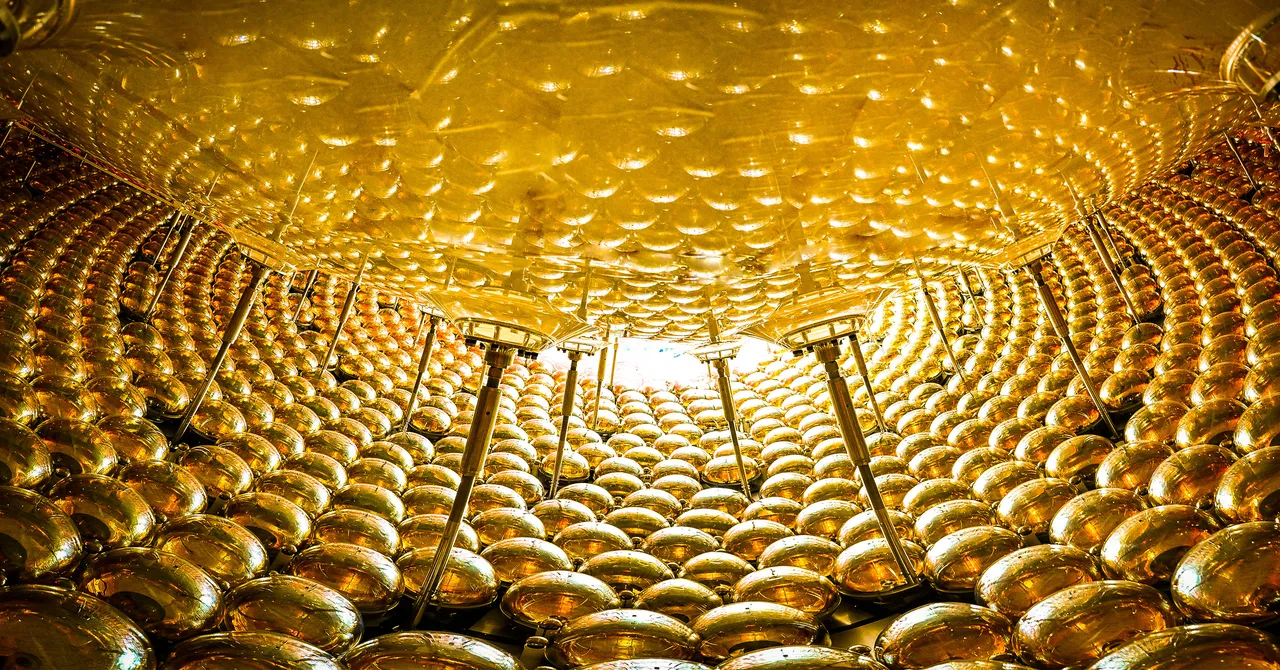
通常情况下,这个洞穴是地球上最黑暗的地方之一;但今天由于维护工作的需要,洞穴被照亮了,这为我们提供了一个难得的机会来一探其内部。我透过舱口观察着 Depatie——他正划着船前往检查那个被淹没在水中、用于科学实验的设备。他正在检查那个体积相当于普通房屋的探测器;这个探测器专门用于捕捉物理学中那些极其难以捉摸的粒子——中微子。
Normally, the cavern is one of the darkest places on Earth, but today it is lit up for maintenance, offering us a rare chance to see inside. I peer through the hatch at Depatie as he paddles over to examine the submerged experiment. He’s inspecting a house-sized detector built to catch some of the most elusive particles known to physics: neutrinos.
这个名为 SNO+ 的中微子实验装置被埋藏在加拿大苏德伯里(Sudbury)的 Snolab 地下物理实验室内的 Creighton 矿井中。SNO+ 由一个亚克力球体构成,球体内装有近 1 万个高灵敏度的光探测器,并填充了 780 吨油性闪烁体;当高能粒子撞击这些闪烁体时,它们会发出光芒。探测器周围的水以及上方的岩石层能够屏蔽宇宙辐射的干扰,从而使那些较为罕见的中微子相互作用所产生的微弱信号得以被清晰地观测到。
This is the SNO+ neutrino experiment, buried deep within the Creighton mine at Snolab, an underground physics laboratory in Sudbury, Canada. SNO+ consists of an acrylic sphere lined with nearly 10,000 sensitive light detectors and filled with 780 tons of oily liquid scintillator, which flashes when lit up by energetic particles. The water around the device and the rock above it shield the detector from the glare of cosmic radiation, allowing the flickers of less common particle interactions to shine through.
我们整个下井过程都严格遵循了“保持绝对黑暗”的规定——这种黑暗状态甚至超出了人类可见光的范围。当我们沿着主通道下行、穿过岩石隧道抵达实验室时,我们的身体和衣物上都沾上了微量的放射性氡尘。在进入实验室之前,我们脱下了矿井工作服,洗了澡,并换上了电蓝色的连体工作服和头套,以尽量减少自身携带的放射性物质。
Our whole journey down has been part of the crusade to maintain absolute darkness, even beyond the visible spectrum of light. As we descended the main shaft and walked through a rocky tunnel to the lab, our bodies and clothes collected minute amounts of radioactive radon dust. Before entering the main laboratory space, we tossed our mine clothes, showered, and changed into electric blue jumpsuits and hairnets to minimize the contamination we carried in with us.
Depatie 在我们换衣服时说道:“那些淋浴设施并不是为你们准备的,而是为了科学实验的需要。”当试图捕捉这些“幽灵般的粒子”(即中微子)时,这样的极端措施是必不可少的;因为这些粒子可能隐藏着关于地球深处未知区域的秘密。
“The showers aren’t for you,” Depatie said as we changed, “they’re for the science.”Such extremes are necessary when you’re trying to catch ghosts—in this case, ghosts that may help reveal the secrets of inaccessible regions deep within the Earth.
而“地球中微子”(geoneutrinos)更是难以捉摸的存在:尽管科学家们已经进行了数十年的研究,至今仅探测到几百个这样的粒子而已。
Even more elusive—so much so that after decades of searching, scientists have detected only a few hundred of them—are geoneutrinos.
地中微子是在加热行星内部的过程中产生的。这种热量在推动地幔岩石流动方面发挥着主要作用,从而塑造了从板块构造到地球磁场的一切。它来自两个主要来源:行星形成遗留的热量,以及地幔和地壳岩石中铀、钍、钾衰变产生的热量。如果没有第二个来源,地球早就冷却下来,成为一个构造活动停止的死寂星球。
Geoneutrinos are produced in processes that heat the interior of the planet. This heat plays a major role in powering the flow of rocks in the mantle, which shapes everything from plate tectonics to Earth’s magnetic field. It comes from two main sources: heat left over from the planet’s formation, and heat produced by the decay of uranium, thorium, and potassium in the rocks of the mantle and crust. Without this second source, Earth would have long since cooled off and become a tectonically dead planet.
通过计数地中微子,物理学家可以直接测量地球关键的产热元素含量。“这是我们所做的唯一聚焦于地球本身的事情,”在安大略省女王大学工作、参与SNO+实验的粒子天体物理学家瑞安·贝叶斯说。“我们做的其他一切都更多地聚焦于我们从宇宙其他地方接收到的东西。”首次探测到地中微子是由日本的一个名为Kamland的仪器完成的,相关报道发表于2005年。
In counting geoneutrinos, physicists can get a direct measure of Earth’s vital heat-producing elements. “It’s the one thing we do that focuses on the Earth,” said Ryan Bayes, a particle astrophysicist at Queen’s University in Ontario who works on SNO+. “Everything else we do is more focused on what we receive from other places in the universe.”The first detection of geoneutrinos, by an instrument in Japan called Kamland, was reported in 2005.
2009年,意大利的Borexino探测器报告捕捉到了几十个更多的地中微子。2025年11月,SNO+报告了其首次探测,使观测到的地中微子数量增加了约50个。
In 2009, the Borexino detector in Italy reported catching several dozen more. In November 2025, SNO+ reported its first detection, bumping up the number of observed geoneutrinos by about 50.
SNO+探测之所以特别,在于其实验地点:这是在西半球首次测量地中微子,为观察地球放射性内部提供了新视角。
What makes the detections at SNO+ special is the experiment’s location: These are the first geoneutrinos measured in the western hemisphere, offering a new perspective on Earth’s radioactive interior.
解释这些实验结果仍存在重大不确定性,但研究人员的最佳估计表明,每个站点测量到的通量都不同。“这可能是地幔并不均匀的第一个暗示,”女王大学粒子天体物理学家、SNO+合作组主任马克·陈说。
Major uncertainties remain in interpreting the results from these experiments, but researchers’ best estimates suggest that each site is measuring a different flux. “It could be that that’s the first hint that the mantle is not uniform,” said Mark Chen, a particle astrophysicist at Queen’s University and director of the SNO+ collaboration.
地球化学家传统上假设放射性元素在整个地幔中分布均匀,因为流动的岩石应该会将所有物质混合在一起。但不同地点的地中微子测量结果可能暗示情况并非如此。
Geochemists have conventionally assumed that radioactive elements are distributed evenly throughout the mantle, because the flowing rock should mix everything together. But the measurements of geoneutrinos in different locations could hint that this is not the case.
似乎产生最多地中微子的区域,大致位于两个大陆大小的异常炽热、致密物质团块上方,这些团块被称为大型低剪切波速省(LLSVPs),地震学家已在核心两侧绘制了它们的分布图。一个位于非洲之下,另一个位于太平洋之下。“地幔中可能存在尚未被理解的深部地球结构,”陈说。“它们可能会聚集某些种类的元素。”
The regions that seem to be producing the most geoneutrinos sit roughly above continent-size blobs of anomalously hot, dense material, known as large low-shear-velocity provinces, or LLSVPs, which seismologists have mapped on either side of the core. One is under Africa, the other under the Pacific Ocean. “There may be deep Earth structures in the mantle that are not understood,” Chen said. “It could be that [they] concentrate some kinds of elements.”
中微子也许有一天能为这些深部结构仍神秘的起源,以及更广泛地讲,支撑地球系统许多方面的地幔模式,提供新的见解。“这真的是一种绘制地球内部化学图谱的方法,”中国科学院地球化学家威廉·麦克多诺说,他长期以来一直是寻找地中微子的领军人物。
Neutrinos could one day offer new insight into the still mysterious origin of these deep structures and, more broadly, the patterns in the mantle that underlie many aspects of the Earth system. “It really would be a way to make a chemical map of the Earth’s interior,” said William McDonough, a geochemist at the Chinese Academy of Sciences who has long been a leading voice in the search for geoneutrinos.
悬而未决的问题是,地中微子测量揭示的差异,是反映了各实验下方地幔区域的差异,还是源于不同实验计数地中微子方式的不同。各界研究人员表示,目前仍存在太多不确定性,无法下定论。
The outstanding question is whether the geoneutrino measurements reveal differences between the areas of mantle below each experiment, or if the imbalance originates in the way the different experiments count their geoneutrinos. Researchers across the board say there’s still so much uncertainty that it’s impossible to say.
“如果按字面意思理解,我们可以说也许西半球比东半球含有多得多的放射性物质,”麦克多诺说。但有理由对这些估算保持警惕。“意大利人对吗?日本人对吗?他们都对吗?还是哪里出错了?”他问道。
“If we take it at face value, we could say maybe the western hemisphere has a lot more radioactive material in it than the eastern hemisphere,” McDonough said. But there are reasons to be wary of these estimates. “Are the Italians right? Are the Japanese right? Are they both right? Or is something wrong?” he said.
贝斯指出,每个探测器所得结果的不确定性主要源于物理学家们用来识别地球中微子的筛选过程。“这些中微子可不会直接现身并说‘嗨,我就是地球中微子’。”科学家必须剔除那些能量过高的粒子、螺旋度属性不符合预期的粒子,以及预计会从核反应堆中产生的粒子。此外,他们还需排除来自地壳的地球中微子,其中绝大部分来自距离探测器几百公里范围内的区域。将这些干扰信号从总计数中扣除后,剩下的就应该是来自地幔的地球中微子信号。
The uncertainties associated with each detector’s results come from the sorting process that physicists go through to identify geoneutrinos, Bayes said. “They don’t just show up and say, ‘Hi, I’m a geoneutrino.’”Scientists must eliminate signals from particles with too much energy, particles with the wrong measure of a property called helicity, and particles that they expect to see flowing from nuclear reactors. They must also eliminate geoneutrinos coming from Earth’s crust, with the largest contribution coming from the area within a few hundred kilometers of the detector. When those other detections are subtracted from the total count, the geoneutrino signal from the mantle should be all that’s left.
总体而言,虽然存在较大不确定性,但博雷克斯诺探测器测得的来自地幔的地球中微子通量似乎很高,而卡姆兰德探测器测得的数值则很低。陈博士表示,目前对SNO+探测器所得结果的详细地质解读仍在进行中,不过目前来看,加拿大下方的地幔情况处于两者之间的水平。
In general terms, the geoneutrino flux from the mantle seems to be very high at Borexino and very low at Kamland, though the uncertainties are great. A detailed geological interpretation of the SNO+ results is still in the works, Chen said, but so far scientists see a “pretty in-between” mantle below Canada.
对SNO+项目的科学家而言,另一大挑战在于弄清来自探测器周边环境的中微子情况——该区域有一个由18亿年前的一次巨大天体撞击形成的盆地。“这片地质区域存在大量未知因素,”意大利费拉拉大学的研究员弗吉尼亚·斯特拉蒂说道,她曾参与为斯诺实验室构建当地的放射性物质分布模型。
A particular challenge for SNO+ scientists is understanding the neutrinos coming from the detector’s surroundings, including a basin formed 1.8 billion years ago by a giant impactor. “There are lots of unknowns in this geological area,” said Virginia Strati, a researcher at the University of Ferrara in Italy who helped develop a local model of radioactivity for Snolab.
此外,对“为地幔提供热量的放射性物质总量”的估算也会带来不确定性。根据地球中微子的通量数据推算,这些放射性元素对地幔热量的贡献率可能从极小的比例到一半不等——这一数值差距相当于数万个核电站的总发电量。
Uncertainty also comes from estimates of the total amount of radioactive material heating the mantle. The flux of geoneutrinos suggests that these elements could contribute anywhere from just a small percentage of its heat to half of it—a discrepancy equivalent to the output of tens of thousands of nuclear power plants.
这两种不确定性使得探测地幔特定区域化学成分的差异变得更加困难。斯特拉蒂表示,不同放射性元素分布所预期的地球中微子通量差异“非常微小,且被这些不确定性所掩盖”。
Both sources of uncertainty make it even more difficult to detect any differences between the chemical makeup of particular sections of the mantle. The difference in the geoneutrino flux expected from various distributions of radioactive elements “is very small, and is hidden in these uncertainties,” Strati said.
要获得每个实验地点更清晰的地球中微子通量估计,需要更详细的地质数据,以及在各站点进行更多的地球中微子计数。然而,麦克唐纳认为,最佳方案是在海底建造一个中微子探测器。这是麦克唐纳几十年来一直倡导的理念。
Clearer estimates of the geoneutrino flux at each experiment could come from more detailed geological data, as well as further geoneutrino counts at each site. However, McDonough says the best thing would be to build a neutrino detector at the bottom of the ocean. It’s an idea McDonough has championed for decades.
这样的探测器将远离富含放射性元素的大陆岩石;大洋地壳也更薄且更均匀。与地壳相关的不确定性大幅降低,从而“进入了纯地幔领域”,他说。
Such a detector would be far from continental rocks, which are rich in radioactive elements; oceanic crust is also thinner and more uniform. Crust-related uncertainties go down so much that “you are in mantle-only territory,” he said.
据估计耗资数亿美元的海底探测器构想,迄今为止未获得政府资助方的广泛支持。但麦克唐纳希望他能在中促成此事,因为中国已批准了其他大型地球科学项目。“这是完全可能的,”他说。在此之前,物理学家们将继续在地下深处探寻答案。
The idea of an ocean-bottom detector, estimated to cost hundreds of millions of dollars, has seen little take-up from government funders to date. But McDonough is hoping he can make something happen in China, which has given the green light to other big geoscience projects. “It’s very possible,” he said. Until then, physicists will keep paddling around for answers deep underground.
原文经《量子杂志》(Quanta Magazine)许可转载。该杂志是西蒙斯基金会旗下编辑独立的出版物,其使命是通过报道数学、物理科学和生命科学领域的研究进展与趋势,提升公众对科学的理解。
Original story reprinted with permission from Quanta Magazine, an editorially independent publication of the Simons Foundation whose mission is to enhance public understanding of science by covering research developments and trends in mathematics and the physical and life sciences.