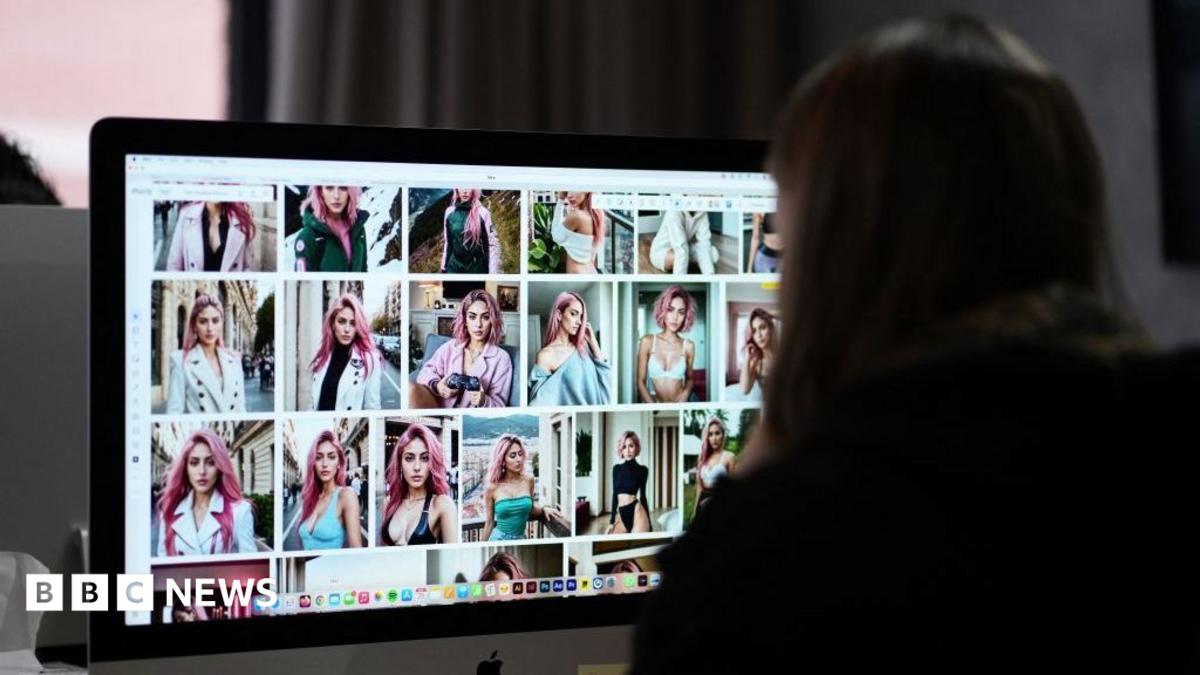
AI模型在社交媒体和广告中越来越普遍,但这可能如何影响身体形象?
AI models are popping up more and more across social media and advertising, but how might this affect body image?
从饮食失调中康复的米娅·佩鲁马尔表示,她担心这项技术会让不切实际的审美标准变得更难让年轻人摆脱。
Mia Perumal, who has recovered from an eating disorder, said she's worried the technology could make unrealistic beauty standards even harder for young people to escape.
这位19岁的卡迪夫大学学生表示,她认为如果在患饮食失调期间能接触到AI,那将会产生“可怕的影响”。她还表示,AI生成的视频和照片也越来越难以识别。本报道包含关于饮食失调和自残的内容。
The 19-year-old Cardiff University student said she believes if she'd had access to AI during her eating disorder, it would have had a "terrible impact". AI-generated videos and photos are getting harder to spot too, she said. This story contains material about eating disorders and self-harm.
米娅·佩鲁马尔12岁时表示,她通过社交媒体算法接收到了有害内容。如今,她担心AI模型的兴起正在放大对其他年轻人的伤害。
When Mia Perumal was 12 she says she was fed harmful content via social media algorithms. Now she fears the rise of AI models is magnifying the damage on other young people.
米娅注意到,过去一年里,社交媒体上出现了越来越多非常瘦的AI“美人”,评论区常有12岁女孩留言:“梦想身材,分享一下锻炼计划,我想长成这样。”她表示这让她感到“非常难过”,因为长得像AI模型完全是不可能实现的,她认为防止伤害的唯一选择是对AI进行管控。
Mia has noticed an increase in very thin AI beautiful people on social media in the past year, the comments often being from 12-year-old girls saying: "Dream body, drop your workout routine I want to look like this." She said she finds it "really sad" because looking like AI models is completely unobtainable, she believes the only option to prevent harm is for AI to be controlled.
米娅说:“光说‘哦,这是AI,不是真的’没用,饮食失调根本不听理性的。”她说她希望年轻人“保持警惕,质疑一切”。
Mia said: "It's all very well saying 'oh, it's AI, it's not real,' But eating disorders don't really listen to rationality." She said she wants young people to "be cautious, question everything".
2000年代初,凯利·沃茨和大多数青少年一样,担心自己的外貌,她说她总是把自己和周围的人、杂志上的模特进行比较。
In the early 2000s Kelly Watts, like most teenagers, was worried about the way she looked and said she was constantly comparing herself to people around her and models in magazines, she said.
现在41岁的她,担心11岁的儿子会拿自己的身体和“完美人物”的虚假照片做比较。
Now 41, she is worried her 11-year-old son will compare his body to fake photographs of "perfect people".
作为市场营销自由职业者,凯利到处都能看到商业图片中的AI应用,但往往没有标签,导致难以辨别真假。
As a freelancer in marketing, AI in business images are something Kelly is seeing everywhere, but often without tags meaning it is hard to determine whether it is real or fake.
凯利说:“起初我没意识到它们是AI生成的,但看多了就再也‘看不见’了。现在,我经常能看到它们。”
"At first, I didn't realise they were AI, but the more you see it, the more you can't unsee it. Now, I see it on quite a regular basis," said Kelly.
她的儿子奥斯卡热爱橄榄球,并且越来越意识到“有些朋友更高”,她说。
Her son Oscar loves playing rugby and is becoming more aware that "some friends are taller", she said.
虽然他还没有对自己的身体提出担忧,但她担心他会崇拜网上的AI角色。
While he has not raised concerns about his body, she fears he could look up to AI characters online.
这位11岁的孩子看YouTube,还没有社交媒体账号。但这并不能让他远离AI,她担心AI已经渗透进了YouTube的内容中。
The 11-year-old watches YouTube and does not yet have social media. But this does not keep him away from AI, which she fears has infiltrated YouTube's content.
她说,观看拥有六块腹肌的足球运动员已经是一种身体形象影响,更别说还会被展示那些不切实际的AI生成人物了。
Watching footballers who have six-packs is already a body-image influence, she said, let alone being then shown AI generated people who are unrealistic.
“尤其是对孩子来说,会变成‘他们能不能达到那个程度?’的问题。
"Especially with children, it's going to be 'can they ever get to that point?
“这给他们带来了很大的压力,这是他们不需要的,”她说。“没有人和事物是完美的。我不希望他长大后认为自己必须完美。”
"It's putting a lot of pressure on them, which they don't need," she said. "No one and nothing is perfect. I don't want him growing up thinking he has to be perfect."
“我是他妈妈,他是绝不会听我的,而会听一个大网红的,”她说,即使那个网红是AI。凯利说,AI素养很重要,能够分辨真假至关重要。
"I'm his mum, and the last person he's going to listen to over a big influencer," she said, even if that influencer is AI. Kelly said AI-literacy is important, and being able to spot real vs fake is essential.
“我们在什么时候需要意识到这可能对我们和我们的孩子有害,AI绝对应该被更明确地标注?“为什么我们要拿自己和机器人比,而不是和人类比?”
"At what point do we need to be aware that it potentially can be damaging to us and our children, and AI should definitely be labelled more? "Why do we want to compare ourselves to a robot instead of a human?"
“作为人类,我们有这种倾向,拿自己和别人比较,”UWE布里斯托尔大学外貌研究中心心理学教授菲利帕·迪德里克斯说。
"As human beings, we have this tendency to compare ourselves to others," said Phillippa Diedrichs, professor of psychology at the Centre for Appearance Research, UWE Bristol.
她说:“如果我们拿自己和一个非常狭窄的审美标准比较,这通常是常态,我们拥有的审美理想定义得非常狭窄,这不可避免地意味着我们中的许多人无法达到那些审美理想。
She said: "If we're comparing ourselves to a very narrow beauty standard, which typically tends to be the case, the beauty ideals that we have are very narrowly defined, and that inevitably means that many of us are not going to meet those beauty ideals.
“在社交媒体和数字构建的图像中,这种情况尤为明显,因为它们甚至不存在于生物学现实中。”"我们会拿自己和别人比较,当觉得自己不如人时,就会产生自我怀疑,对自己的外貌产生负面情绪。"她说,如果利用AI创造更多元、更包容的形象,"当我们比较时,会感到彼此相似,这会对我们的身心健康产生中性或积极的影响"。
"This is particularly the case with social media and digitally constructed images because they don't even exist in biological reality. "We compare ourselves and when we fall short, this can lead us to doubt ourselves and feel negatively about our own appearance." She said if AI was used to create more diversity and inclusion, then "when we compare ourselves, we feel alike and similar, which can either have a neutral or positive impact on our wellbeing".
迪德里克斯表示,除非设计者提示AI展现真实或多元的特征,否则"它会给你一张默认'平均值'的图像",而这个数据集基于"狭隘"的传统审美标准。"因此,例如有色人种、性别酷儿群体、长相独特或有辨识度面部特征的人,就会被排除在外,"她说。"你可以尝试通过提示词的编写和图像生成方式来过度补偿这一点。但如果你不这么做,得到的将是非常千篇一律的图像,这往往会强化社会上存在的许多偏见。"
Diedrichs said unless the designers prompt AI to show realistic or diverse features, "it's going to give you an image that defaults to the average" data set of the "narrow" traditional beauty standards. "So for example, people of colour, gender, queer people, people with kind of interesting and distinguishing facial features, it means that they're going to be left out," she said. "You can try and overcompensate that with the way you prompt and create these images. But if you don't do that, you're going to get very generic images, which tend to reinforce a lot of the biases that we have in society."
她表示,如果不够谨慎或深思熟虑,这甚至可能创造出更不切实际的审美标准,"因为它会默认输出其学习内容的'平均值'。"
She said it could create even more unrealistic beauty standards, "if it's not done carefully or with some thought because it will default to the average of whatever it's learnt from.
迪德里克斯说,有一些"明显特征"可以识别AI图像,比如"皮肤纹理或眼睛",以及"卷发"的呈现效果。
Diedrichs said there are "tell-tale" signs like "the texture of the skin or the eyes" and how "coily hair" looks.
她补充说,没有瑕疵或毛孔也是识别AI的一个好方法,不过AI技术在不断进步。
She added that the absence of blemishes or pores can be a good way of identifying AI, however it is constantly getting better.
迪德里克斯表示,青少年容易受影响,但他们通常也"善于批判、意识清醒,且比老一辈更懂技术"。"问题是,即使我们意识到这些现象的发生,也不一定能阻止我们想要长得像那些图像里那样的冲动,"她说。
Diedrichs said teenagers can be influenced but they are also often "critical and aware, and have more knowledge about technology than older people". "The thing is, though, we can be aware that these things are happening, but it doesn't necessarily stop us from wanting to look like those images," she said.
她说,她建议大家问问自己,这些图片或广告是否“服务于你,是否让你对自己感觉良好?是否让你感到受到启发、充满光彩?”
She said she recommended asking if the images or advertising is "serving you, does that make you feel good about yourself? Does it make you feel inspired, lit up?"
“如果它们让你感到匮乏,那是一个非常重要的信号,值得关注,这暗示也许这不适合我去看。”迪德里克斯表示,广告中的AI模特可以让小品牌拥有大量多元化的模特,或让全球品牌在多个市场投放广告。“在多样性方面可能存在这些益处,”她说。
"If it's making you feel lacking, that's a really important signal to pay attention to, and suggests that maybe this isn't for me to be looking at." Diedrichs said AI models in advertising could enable small brands to have a large number of diverse models, or global brands to advertise in multiple markets. "There could be these benefits for diversity," she said.
不过,她指出了对“创意产业和从业者的连锁影响。我绝不希望看到AI完全取代”人类的艺术性和创造力。
However, she noted the "knock on effect to creative industries and people working in this space. I would never like to see AI completely replace" the artistry and creativity of humans.
“作为消费者,你也拥有很大的力量。你可以在评论区表达你的观点,”她说。“品牌方会看到的。”卡迪夫商学院的研究人员佐伊·李和汉娜·马里奥特表示,AI生成的时尚模特和数字孪生——真实模特的虚拟复制品——正变得越来越普遍。他们表示,巴尔曼、李维斯和H&M等品牌都已尝试这项技术。
"As a consumer, you have a lot of power as well. You can express your views on this in the comment section," she said. "Brands will see." Zoe Lee and Hannah Marriott, researchers at Cardiff Business School said AI-generation fashion models and digital twins, virtual replicas of real models are becoming more common. Brands such as Balmain, Levi's and H&M have experimented with the technology, they said.
但李和马里奥特的研究发现,一旦消费者意识到这些模特不是真人,往往会对AI生成的模特产生负面反应。
But Lee and Marriott's research has found that consumers often reacted negatively to AI-generated models once they realised they were not real.
在焦点小组中,参与者告诉他们,他们“宁愿要一个真人,哪怕代表我们的人少得多,但要是真实的”,理由是AI模特永远无法反映生活经验。
In focus groups, participants told them they would "rather have a real person and way less people representing us, but they be real", arguing AI models could never reflect lived experience.
马里奥特说,他们还发现,一旦人们发现图像是由AI生成的,就会“在情感上将自己与这些图像抽离”。
Marriott said they also found people would "emotionally detach themselves" from images once they discovered they had been generated by AI.
H&M表示,2025年该公司与真人模特合作制作“模特的数字呈现/数字孪生”,这些模特“本人保留了对其数字孪生的完全控制权和所有权”。然而,这项“探索于2025年春季暂停”,以考虑后续步骤。巴尔曼、李维斯、TikTok、Meta和谷歌已被联系置评。
H&M said it worked with real models in 2025 to make "digital representations/twins of the models" who "themselves retained full control and ownership of their digital twin". However this "exploration was paused during spring 2025" to consider the next steps. Balmain, Levi's, TikTok, Meta and Google were contacted for comment.
如果您受到上述问题的影响,可访问 BBC 行动热线(BBC Action Line)寻求帮助和支持。
If you've been affected by any of the issues raised you can visit BBC Action Line to access help and support.