海湾合作委员会(GCC)地区的主权投资者已从单纯的资本提供者演变为寻求战略性跨境投资授权,并拓展与亚洲的贸易走廊。
Sovereign investors in the Gulf Cooperation Council (GCC) region have evolved from being mere capital providers to looking at strategic cross-border investment mandates and expanding trade corridors with Asia.
在此过程中,他们正与其他国家投资者合作,并青睐那些在金融科技、数字基础设施、物流、医疗健康及生命科学等关键领域与该地区长期利益保持一致的管理人。
In this, they are partnering with other state investors and favouring managers who are aligned with the region’s long-term interests across key sectors including fintech, digital infrastructure, logistics, and health and life sciences.
当该地区陷入一场加剧市场波动、令本已充满挑战的经营环境雪上加霜的长期冲突之中时,这已成为一个关键因素。
This has become a key factor at a time when the region is mired in a protracted conflict that has exacerbated market volatility and an already-challenging operating environment.
“实际深耕该地区的配置方与投资者,与那些仅如过客般涉足该地区的人之间,存在着日益扩大的差距,”迪拜未来区基金(一只风险投资母基金)董事总经理 Nader Albastaki 表示。
“There’s this widening gap between allocators and investors that are actually present in the region, and the ones that have been more tourists in the region,” said Nader Albastaki, Managing Director, Dubai Future District Fund, a venture capital fund-of-funds.
“我们最关注的问题是:我们与进入该地区的管理人之间,是否存在一种战略对齐的合作模式?
“The number one thing that we’re looking at is: Is there an engagement model that’s present that’s strategically aligned between ourselves and the managers that are coming into the region?
我们看到,那些深耕当地、了解局势并看好该地区基本面中长期增长故事的机构,展现出更持续的投资和更坚定的信心。” Albastaki 于 9 月 23 日在新加坡举行的 DealStreetAsia 2026 年亚洲 PE-VC 峰会上,在题为“海湾与亚洲的新交易是否超越资本”的圆桌讨论中发表上述言论。
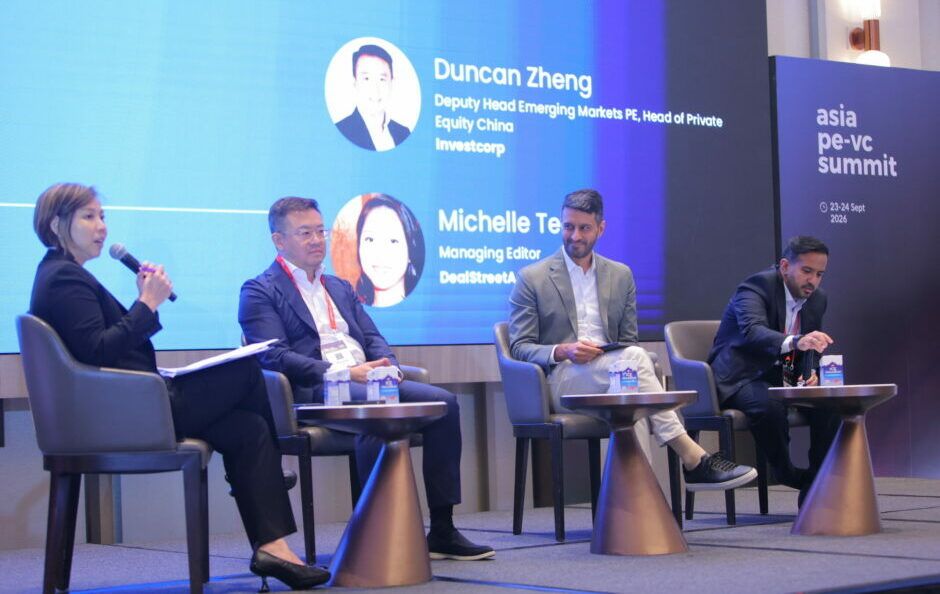
We’re seeing a lot more continued investment and conviction from the ones with a presence that understand the situation and the fundamental medium-term, long-term growth story of the region.”Albastaki was speaking during a panel discussion on ‘Is the Gulf’s new bargain with Asia moving beyond capital’ at DealStreetAsia’s Asia PE-VC Summit 2026 on Sept. 23 in Singapore.
与会嘉宾断言,该地区基本面依然稳固,市场已适应长期冲突的可能性,并指出资本部署具有韧性。
The region’s fundamentals remain strong, with the market having adapted to the possibility of a prolonged conflict, the panellists asserted, noting that capital deployment is resilient.
“所有长期驱动因素依然存在。这里拥有非常年轻的人口——规模约等于德国,但消费能力却相当于德国加日本,” Investcorp 新兴市场私募股权投资副主管兼中国私募股权投资主管 Duncan Zheng 表示。
“All the secular drivers are still there. It’s a very young population—the size of approximately Germany, but you have the spending power of Germany plus Japan,” said Duncan Zheng, Deputy Head Emerging Markets PE, and Head of Private Equity China at Investcorp.
重要的是,郑补充道,海合会(GCC)存在改革经济实力的根本意愿,这将使该地区在冲突后变得更强大。
Importantly, there is a fundamental will to reform the economic power of the GCC, Zheng added, that will see the region come out stronger post-conflict.
Investcorp正通过其7.5亿美元的Golden Horizon Cooperation基金在该地区进行部署,该基金约40%的有限合伙人为中国机构投资者,由中国投资有限责任公司牵头,丝路基金、中国银行及保险公司等跟投。
Investcorp is deploying in the region through its $750 million Golden Horizon Cooperation fund, in which about 40% of the limited partners are Chinese institutional investors, led by China Investment Corporation alongside Silk Road Fund, Bank of China, and insurers, among others.
“我们正在利用市场波动。去年这些公司的估值可能达到15倍EBITDA。如今我们大概能以10倍[EBITDA]或更低的价格买入,”郑说。
“We are taking advantage of the volatility in the market. Companies last year would have been valued at 15x EBITDA. Today we can probably buy them at 10x [EBITDA] or below,” Zheng said.
在Growth Catalyst Investment Company创始人兼首席执行官Turki Al-Dayel看来,这家沙特私募股权公司凭借本地关系和实地经验,相较于外部管理者拥有竞争优势。
In the view of Turki Al-Dayel, the founder and CEO of Growth Catalyst Investment Company, a Saudi private equity firm, local relationships and on-the-ground experience provide the firm a competitive advantage over external managers.
他指出,沙特阿拉伯及更广泛的海合会地区的中型市场领域是一个非常“极具吸引力的领域”。
And the mid-market space in Saudi Arabia and the wider GCC is a very “compelling space”, he noted.
“沙特阿拉伯有一百万家中小企业。其中2.5万至3万家营收在5000万至2.5亿沙特里亚尔之间。约合1300万至8000万美元营收。它们是中型企业,但渴望成为大型新高市值公司。而且这些都是私营企业。因此,我们的基金旨在识别十到十二家这类高营收中型私营企业,以迎接下一波增长。
“There are one millioned SMEs in Saudi Arabia. Twenty-five to 30,000 [of them] generate revenue between close to 50-250 million SAR. That is around $13 million to $80 million of revenue. They’re mid-sized companies, but they want to be the large new high-cap companies. And these are all private companies. So, our fund is to identify ten to twelve of those high-generating mid-market private companies for that next wave of growth.
Growth Catalyst正在募集其首只基金,目标是在今年年底前按目标完成2亿美元的募集。该基金约85%将部署在沙特阿拉伯,其余部署在更广泛的海合会地区。
Growth Catalyst is in the process of raising its debut fund, and is aiming to close on target at $200 million at the end of this year. The fund will be about 85% deployed into Saudi Arabia, with the remainder into the wider GCC region.
“LP(有限合伙人)们对新一轮增长浪潮感到兴奋。他们看到了这种高增长、不断增长的经济以及强劲的资本市场体系,”Al-Dayel补充道,并指出海湾合作委员会(GCC)地区最近在新兴市场中吸引了最高额的风险投资资金,其IPO市场也是最强劲的之一,去年全区共有约50家企业在公开市场首次亮相。关注领域 可以肯定的是,主权信号正有助于维持资本部署。
“LPs are getting excited about the new wave of growth. They’ve been seeing this high growth, growing economy, and a robust capital market system,” Al-Dayel added, pointing to how the GCC region has recently drawn the highest amount of venture capital funding in emerging markets, and its IPO markets have been one of the most robust, with some 50 public market debuts across the region last year. Sectors of interest To be sure, sovereign signalling is helping to sustain deployment.
Albastaki表示:“资金一旦投入某处,就会有与之匹配的战略支持,以及与之匹配的资本随之投入运作。政府花钱不是为了花钱而花钱,而是具有战略约束力。每个国家都有长达10年以上的战略规划,规定这些资金的去向。”Albastaki指出,该地区蕴藏着无数机遇,涵盖金融科技、供应链与物流、医疗健康与生命科学,以及包括AI相关设施在内的大型基础设施项目。
Said Albastaki: “The minute the dollar is deployed somewhere, there’s the backing of a strategy that’s aligned, capital that’s aligned that’s then being put to work. Governments don’t spend money for the sake of spending money. It’s strategically bound. Every country has 10-plus-year strategic plans for where these dollars are going.”Albastaki pointed to a region rich in myriad opportunities from fintech, supply chain and logistics, to health and life sciences, as well as large infrastructure projects including AI-related facilities.
他说:“无论是在沙特、阿联酋还是更广泛的地区,这些项目中的每一个都需要运营效率、可扩展性,以及在其开发基础上叠加的技术应用。基础设施本身就是一笔巨大的开支。在这些开支中创造效率是我们工作的重要组成部分。这关乎寻找那些能发掘最佳解决方案的管理者,并为他们提供支持。”此外,正如Al-Dayel所指出的,跨境增长存在重大机遇。
“Every single one of these projects, whether it’s in Saudi, the UAE, or the wider region, needs operational efficiencies, scalability, and technology inclusions that layer on top of what they’re developing,” he said. “Infrastructure on its own is a massive spend. Creating efficiencies with those spends is a big part of what we do. It’s finding managers that are finding some of the best solutions, [and] backing them.”
例如,Growth Catalyst Investment投资了一家正在沙特阿拉伯建设最大疫苗工厂的公司,该公司已与印度和韩国的企业签署了技术转让协议,包括Bharat Biotech和SK Bioscience。“亚洲企业家和企业与海合会机构之间存在天然的联系,”Al-Dayel表示。
Further, as Al-Dayel noted, there are significant opportunities for cross-border growth. For instance, Growth Catalyst Investment is invested in a company that is building the largest vaccine plant in Saudi Arabia, and which has signed technology transfer agreements with companies in India and South Korea, including Bharat Biotech and SK Bioscience.
就 Investcorp 的 Golden Horizon 平台而言,其在很大程度上不限特定行业,肩负双重使命,即推动中国与海合会(GCC)之间的业务往来,方式是将基金约 70% 的资金投向后者,其余投向中国。
“There are inherent roots with Asian entrepreneurs and companies with GCC establishments,” Al-Dayel said.
投资组合公司中包括 Metra,这是一家在沙特阿拉伯和阿联酋运营、并覆盖包括埃及在内的更广泛北非地区的 IT 分销商。正如 Zheng 所解释的,该公司看到了客户对中国系统日益增长的需求,如今其约四分之一的业务位于大中华区。
In the case of Investcorp’s Golden Horizon platform, it is largely sector-agnostic with a dual mandate of driving business between China and the GCC, through investing about 70% of the fund into the latter, and the remainder into China. Among the portfolio companies is Metra, an IT distributor that operates in Saudi Arabia and the UAE, as well as across the broader North Africa region including Egypt.
近期,Investcorp 领投了中国光伏企业 PCG Power 的 C1 轮融资,该公司现已拓展至海合会多个市场,包括阿曼和沙特阿拉伯。Zheng 表示:“我们提供帮助的地方在于,确保他们能接触到其打交道的每个国家的决策者。” 归根结底,该地区的增长计划正在推进,冲突很可能提供了额外的动力。
As Zheng explained, the company saw growing demand from their customers for Chinese systems, and now about a quarter of its business is within the Greater China region. More recently, Investcorp led the Series C1 financing for Chinese solar player PCG Power, which has now expanded into a number of markets in the GCC, including Oman and Saudi Arabia. Said Zheng: “Where we help them is to ensure they get access to the decision-makers in each of the countries they’re dealing with.”
“这正在推动该地区的每个人,主要是我们这些坐在资金配置者位置上的人,去思考一个问题:我们要向哪里增长?这种推动是要去更大的市场吗?” Albastaki 表示。“我们看到,这种策略正在更早地被推动给底层的创始人和 GP(普通合伙人)。”
Ultimately, the region’s plans for growth are going ahead, with the conflict likely providing an added impetus. “It’s pushing everyone in the region, primarily us, sitting as allocators, to ask the question of where are we growing into? Is that push to go to larger markets?” said Albastaki. “We’re seeing a lot more of that strategy being pushed a lot earlier with underlying founders and GPs.”