全球有限合伙人(LP)面临错失一场历史性技术创新浪潮的风险,因为中国在包括人工智能(AI)在内的关键领域已与美国达到近乎平权的地位。然而,全球资本对中国蓬勃发展的科技市场配置仍显不足。
Global limited partners (LPs) risk missing out on a historic wave of technological innovation as China reaches near parity with the US in key areas, including artificial intelligence (AI). Yet, global capital remains under-allocated to its booming tech market.
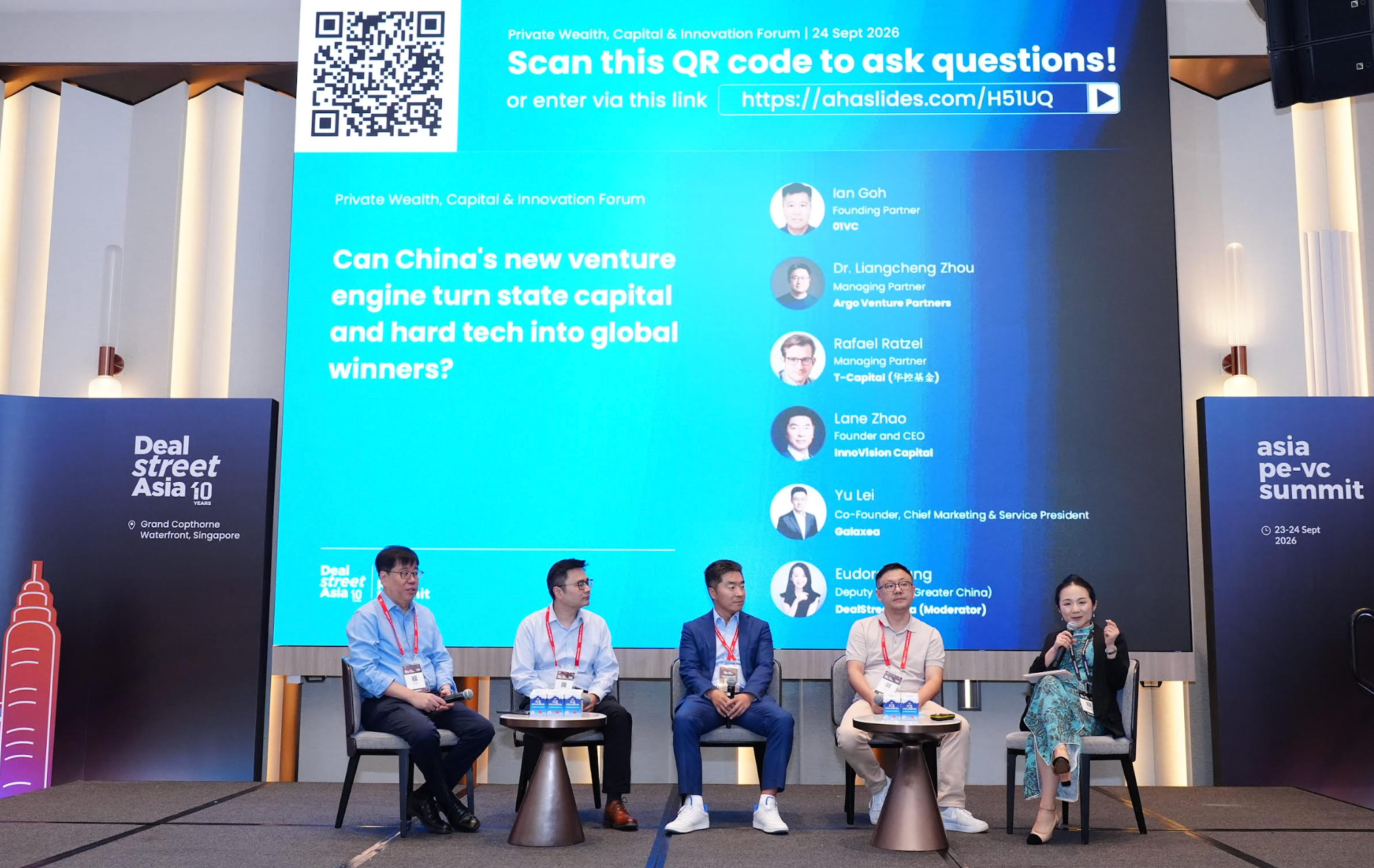
在新加坡举行的DealStreetAsia 2026年亚洲私募股权与风投峰会上,专注中国市场的基金管理人呼吁全球机构投资者增加对世界第二大经济体的LP配置,后者已崛起为硬科技领域的全球强国。然而,当前大部分全球资本正错失良机。
Speaking at DealStreetAsia’s Asia PE-VC Summit 2026 in Singapore, China-focused fund managers called for global institutional investors to increase their LP allocations to the world’s second-biggest economy, which has emerged as a global powerhouse in deep tech. However, much of the global capital today is missing the boat.
“许多美元基金LP已将其对中国的敞口降至亚洲配置的15%-20%左右,这在其全球资本配置中仅占个位数,”InnoVision Capital创始人兼CEO赵蓝(Lane Zhao)在圆桌讨论中表示。
“A lot of US dollar LPs have reduced their exposure to China to something like 15%-20% of their Asian allocation, which amounts to just single digits out of their global capital allocation,” said Lane Zhao, founder and CEO of InnoVision Capital, during a panel discussion.
“但如果你真想配置适量资本以在有生之年捕捉AI产业机遇,粗略估算一下,你该向中国配置多少资金?遗憾的是,短期内这不太可能发生——希望尽快,但至少现在还没有,”赵蓝说道。
“But if you truly want to allocate the right amount of capital to the AI industry to capture that opportunity over your lifetime, back-of-the-envelope, how much capital should you allocate to China? But unfortunately, it’s not happening anytime soon – hopefully soon, but not now at least,” said Zhao.
随着中国开放权重模型在全球大受欢迎,中美AI性能差距实际上已缩小,中国私募市场正在AI和具身智能领域见证融资热潮——即集成于机器人和自动驾驶汽车等物理实体中的AI,使其能直接感知、学习并与现实世界互动。
With Chinese open-weight models surging in global popularity and the US-China AI performance gap effectively closing China’s private markets are witnessing a funding boom across AI and embodied intelligence – or AI integrated into physical bodies like robots and autonomous vehicles, allowing it to perceive, learn, and interact directly with the real world.
今年中国AI融资呈现指数级增长。根据DealStreetAsia报告《大中华区交易回顾:2026年第二季度》的专有数据,2026年上半年,中国AI初创企业的总融资额达到127亿美元,比2025年上半年增长11.3倍,甚至比去年全年总额增长3.6倍。报告显示,具身智能紧随其后,排名第二,2026年上半年完成217笔交易,融资额超过98亿美元。
AI fundraising in China has demonstrated exponential growth this year. In the first six months of 2026, the overall funding into Chinese AI startups reached $12.7 billion, outperforming H1 2025 by 11.3x and representing a 3.6x increase even compared to last year’s total, according to proprietary data from DealStreetAsia’s report, Greater China Deal Review: Q2 2026 Following AI, embodied intelligence came second, with 217 deals raising more than $9.8 billion in H1 2026, the report shows.
这两大核心AI赛道,连同健康科技与生物技术、半导体、清洁技术和空间技术,构成了中国私募市场机会的主体。总体而言,它们在上半年贡献了77.4%的交易金额和69.6%的交易数量。
The two core AI sectors, alongside health tech & biotech, semiconductor, clean tech, and space tech, account for the bulk of China’s private market opportunities. Collectively, they contributed to 77.4% of deal value and 69.6% of deal volume in H1.
然而,中国深度科技初创企业的这波融资热潮,主要由国内主权资本和私人资本以人民币投资驱动。全球投资者依然保持谨慎和高度选择性。据中国数据智能机构清科研究中心(Zero2IPO Research)数据,外币(主要是美元)仅占上半年中国私募市场资本部署的约29%。
However, this fundraising surge for deep tech startups in China is largely powered by domestic sovereign and private capital investing in Chinese yuan. Global investors remain cautious and highly selective. Foreign currencies, predominantly US dollars, only made up an estimated 29% of H1’s capital deployment in China’s private markets, according to Chinese data intelligence firm Zero2IPO Research.
随着中国明星AI领军企业如深度求索(DeepSeek)和月之暗面(MoonShot AI)以空前速度加速上市进程,以及总部位于旧金山的Anthropic瞄准今年11月进行首次公开募股(IPO),映象资本(InnoVision Capital)的赵某警告称,私募市场投资者捕捉全球AI实验室冠军的最佳窗口期已过。
As Chinese high-flying AI leaders including DeepSeek and MoonShot AI accelerate their paths to public markets at unprecedented speeds and San Francisco-based Anthropic targets an initial public offering (IPO) this November, Zhao of InnoVision Capital warned that the prime window for private market investors to capture global AI lab champions has passed.
他表示,接下来将是围绕两大AI核心领域的大规模扩张,即AI基础设施,包括高性能GPU和CPU、硅光子学、光模块和3D半导体存储堆叠;以及AI应用,如物理AI世界模型和面向消费者/企业的AI智能体。
What is coming next, he said, is a massive expansion around two AI-centric areas, namely AI infrastructure, including high-performance GPUs and CPUs, silicon photonics, optical modules, and 3D semiconductor memory stacking; and AI applications, such as physical AI world models and consumer/enterprise-focused AI agents.
除了人工智能,中国其他引人注目的深度科技投资机会也正在形成,其中包括量子计算。赵表示:“量子计算可能还需要五到十年才能达到那个拐点并实现商业化。但一旦跨越那个拐点,该领域的竞争将比当今所有的AI基础设施更加激烈。”美元支持的中国科技资产退出:难以预测?
Beyond AI, other compelling deep tech investment opportunities are also taking shape in China, including quantum computing. “It will probably take another five to 10 years for quantum computing to reach that inflection point and commercialise. But once it passes that inflection point, the space will become much more competitive than all of today’s AI infrastructure,” said Zhao. Exits from USD-backed Chinese tech assets: Unpredictable?
尽管存在这些机会,许多全球LP(有限合伙人)仍感到束手束脚。由于持续的地缘政治和监管限制以及更短的退出窗口,机构资本继续对中国持观望态度。
Despite these opportunities, many global LPs find their hands tied. Institutional capital continues to view China with hesitation due to ongoing geopolitical and regulatory constraints and shorter exit windows.
对外资LP而言,导致这种持续观望态度的首要担忧是退出。市场参与者经常指出,监管风险和复杂的跨境合规是实现其中国科技投资组合回报的主要障碍。
eign LPs, a paramount concern leading to this persistent wait-and-see attitude towards investing in China is exit. Market participants frequently point to regulatory risks and complex cross-border compliance as major obstacles to realising returns from their China tech portfolios.
尽管出现过北京否决20亿美元Meta-Manus交易等案例,但实地操作的基金管理人驳斥了“中国科技资产退出‘不可预测’或‘政府控制’”的观点。阿戈创投管理合伙人周良成博士表示,为了应对复杂的退出环境,创始人从第一天起就明确目标市场,并从客户所在地构建业务至关重要。
Despite cases like Beijing’s veto of the $2-billion Meta-Manus deal, fund managers operating on the ground dismissed the notion that exits from Chinese tech assets are “unpredictable” or “government controlled.”To navigate the complicated exit terrain, Dr. Liangcheng Zhou, managing partner of Argo Venture Partners, said that it is important for founders to clarify their target markets from day one and build from where their customers are.
周博士这位硅谷风投表示,虽然某些非敏感科技硬件公司可以留在中国以利用供应链优势和国内上市计划,但以全球为导向的美元基金支持的中国科技初创企业应考虑迁往美国或新加坡等地区,以满足合规要求并靠近生态系统。
While certain non-sensitive tech hardware companies can remain in China for supply chain advantages and domestic IPO plans, USD-funded, globally focused Chinese tech startups should consider relocating to regions like the US or Singapore for compliance and ecosystem proximity, said Dr. Zhou, a Silicon Valley-based venture capitalist.
虽然纯国内科技机会主要保留给在岸投资者,但专注于全球商业化的公司会设计其企业架构和合规框架,以便进入国际资本市场。
Although purely domestic tech opportunities are largely reserved for onshore investors, companies focused on global commercialisation would design their corporate structures and compliance frameworks to enable access to international capital markets.
资深全球科技投资人周博士表示,从由中国孵化、以美元计价的科技公司退出是完全可行的。他直言不讳地指出:“如果你认为因监管顾虑,中国科技资产的退出难以预测,那你大概率不在局中。”映象资本的赵总将中国的退出环境描述为“周期性”的,并详细介绍了除传统IPO之外中国科技资产的多条退出路径。
For seasoned global tech investors, exits from USD-backed tech companies growing out of China are completely feasible, said Dr. Zhou. He framed it quite bluntly: “If you think exits from Chinese tech assets are unpredictable due to regulatory concerns, you are probably not in the game.”InnoVision Capital’s Zhao, who characterised China’s exit conditions as “cyclical,” detailed multiple exit routes for Chinese tech assets beyond traditional IPOs.
赵总表示:“并购将日益成为一条非常重要的退出路径。”他指出,中国证监会(CSRC)正积极鼓励涉及中国上市公司的并购重组,以利用其资产负债表上沉淀多年的巨额现金储备。
“M&A will increasingly be a very important exit path,” said Zhao, noting active efforts from the China Securities Regulatory Commission (CSRC) in encouraging mergers and acquisitions (M&A) involving Chinese listed companies to leverage the large cash piles sitting for years on their balance sheets.
赵总补充道,GP主导的二级市场交易也正变得更具可行性。“对于退出,我们需要保持纪律,采取多元化策略,并管理不同地域的市场或政策周期。”但这并不意味着所有人都能在AI超级周期中脱颖而出。近期二级市场的回调——如7月中国公开市场的抛售潮在两周内蒸发约10万亿元人民币(约合1.5万亿美元)——主要集中在高增长科技板块。
General partner (GP)-led secondaries are also becoming more viable, Zhao added. “For exits, we need to be disciplined, take multiple approaches, and manage different market or policy cycles across geographies.”But that is not to say all will emerge as winners in this AI supercycle. Recent secondary market corrections – such as the July sell-off in China’s public markets that wiped out roughly 10 trillion yuan ($1.5 trillion) over two weeks – were heavily concentrated in high-growth tech sectors.
尽管与会嘉宾将此次回调视为常态性的现实检验,而非对中国科技核心基本面的威胁,但周博士指出,正如以往每个科技周期一样,如今300家左右的中国具身智能初创公司大多将倒闭,最终仅剩20到30家赢家。
While panellists view this pullback as a routine reality check rather than a threat to Chinese tech’s core fundamentals, Dr. Zhou noted that, like every prior tech cycle, the majority of today’s 300 or so Chinese embodied intelligence startups will fail, leaving only 20 to 30 winners.
他解释道,这是一场“集中度博弈”中的自然规律。像他这样的投资人正在等待,看哪些公司能展现出AI应用的“规模定律”以及能为客户带来明确投资回报率(ROI)的单位经济模型。
That, he explained, is natural in a “game of concentration.”Investors like himself are waiting to see which companies can demonstrate the “scaling laws” of AI applications and unit economics that deliver clear return on investment (ROI) for clients.
新“出海”剧本 地缘政治逆风与双币动态意味着,并非所有中国科技资产都对全球投资者开放。然而,具有全球雄心的非敏感新兴技术依然提供了丰富的投资机会。
The new “going global” playbook Geopolitical headwinds and dual-currency dynamics mean that not all Chinese tech assets are accessible to global investors. However, non-sensitive emerging tech with global ambitions still offers rich investment opportunities.
“我们谈论的是那些在全球推进消费科技、试图成为下一个安克创新、追觅科技或石头科技的企业家。这些人有能力也愿意接受美元基金,因为他们不太‘受人民币基金青睐’,”01VC创始合伙人Ian Goh表示。
“We’re talking about entrepreneurs who are advancing consumer tech globally, trying to be the next Anker, Dreame, or Roborock. These people are able and willing to take US dollar funds because they are not so ‘being loved’ by RMB funds,” said Ian Goh, founding partner of 01VC.
如今,人民币融资高度聚焦于政策驱动领域,包括人工智能、具身智能、半导体和空间技术。尽管人民币在中国风投市场占主导地位,但美元资本对于中国出海消费硬件初创企业,以及其他新兴科技行业的参与者(如使用稳定币的B2B支付平台)依然至关重要,Goh解释道。
RMB funding nowadays is heavily focused on policy-driven sectors, including AI, embodied intelligence, semiconductors, and space tech. Despite the dominance of RMB in China’s venture market, USD capital remains crucial for Chinese going-global consumer hardware startups, as well as players across other emerging tech industries, such as B2B payment platforms using stablecoins, Goh explained.
除了公司架构与合规之外,将本土技术推向海外的运营现实,给中国创始人带来了陡峭的学习曲线。
Beyond corporate structures and compliance, the operational realities of taking homegrown tech abroad present a steep learning curve for Chinese founders.
正如Goh所观察到的,中国不再缺乏工程人才、资本或技术执行力。“许多出海初创企业的挑战在于,如何将这些技术、制造和成本优势带给全球受众,”他说。从国内市场主导地位走向国际化采用,需要跨越几个关键障碍,包括全球客户验证、深度本地化和以客户为中心的经济模型。
As Goh observed, China no longer lacks engineering talent, capital, or tech execution. “The challenge for a lot of startups going global is how to bring those tech, manufacturing, and cost advantages to a global audience,” he said. Moving from domestic market dominance to international adoption requires navigating a few key hurdles, including global client validation, deep localisation, and client-centric economics.
在具身智能领域,中国参与者正从实验室研究快速迈向全球商业化,总部位于北京的Galaxea正在推进其“结果导向”的机器人即服务商业模式,探索实体AI产品如何覆盖全球市场上不断扩大的劳动力需求,因为在这些市场中劳动力日益稀缺且昂贵。
In the world of embodied intelligence, where Chinese players are rapidly progressing from lab research to global commercialisation, Beijing-based Galaxea is advancing its “outcome-based” Robotics-as-a-Service (RaaS) commercial model to explore how physical AI products can cover expanding labour demands across global markets where labour is increasingly scarce and expensive.
盖乐世联合创始人、首席市场与服务总裁余磊透露,公司正与新加坡樟宜机场洽谈,后者正在建设第五航站楼(T5),这是一个位于樟宜东部的大型1,080公顷场地,其土地面积旨在与现有四个航站楼的总和持平。
Yu Lei, Galaxea’s co-founder, chief marketing and service president, revealed that the company is in talks with Singapore’s Changi Airport, which is building its Terminal 5 (T5), a massive 1,080-hectare site in Changi East designed to match the land area of all four existing terminals combined.
余磊表示,由于樟宜机场T5计划于2030年代中期开放,劳动力是主要挑战之一。盖乐世正寻求机会,将其全栈具身智能基座模型及硬件系统部署至新航站楼,用于行李处理、清洁和零售服务等任务。
As the Changi Airport T5 is scheduled to open in the mid-2030s, labour is one of the major challenges, said Yu. Galaxea is seeking opportunities to deploy its full-stack embodied AI foundation models and hardware systems into the new terminal for tasks like luggage handling, cleaning, and retail services.
在RaaS模式下,盖乐世的商业化路线图已从一次性硬件前期销售转向灵活的、基于订阅的运营支出(OpEx)框架。通过捆绑硬件租赁、持续软件更新、云端维护和部署支持,降低了商业及工业客户的准入门槛。
Under the RaaS model, Galaxea’s commercial roadmap has shifted from one-time upfront hardware sales to a flexible, subscription-based operational expenditure (OpEx) framework. By bundling hardware leasing, continuous software updates, cloud maintenance, and deployment support, it lowers entry barriers for commercial and industrial clients.
反过来,将其人形机器人和移动机器人投入实际工位,使盖乐世能根据实际生产力提升向客户收费,同时获取闭环物理数据以持续优化其基座模型。
In turn, placing its humanoid and mobile robots into active workstations allows Galaxea to charge clients based on real productivity gains while capturing closed-loop physical data to continually refine its foundation models.
“我认为商业化的最佳方式是与客户共同成长,一起解决这些问题,”余磊表示。要将这家中国本土具身智能独角兽打造成全球性成功,余磊认为需要一种开放心态,愿意分享中国的供应链、制造、人才和资本红利。
“I think the best way to commercialise is to grow with our customers and solve these problems together,” said Yu. To turn this homegrown Chinese embodied intelligence unicorn into a global success, Yu believes it requires a mindset open to sharing China’s supply chain, manufacturing, talent, and capital gains.
“我们是一家中国融资的公司,所以我们筹集的大部分资金来自中国,包括美元基金和一些国有资本。但如果我们要在全球市场开展业务,就需要吸引更多全球投资者和全球合作伙伴。”
“We are a China-funded company, so most of the funds that we’ve raised are from China, including both US dollar funds and some state capital. But if we want to do business in the global market, we need to attract more global investors and global partners.”