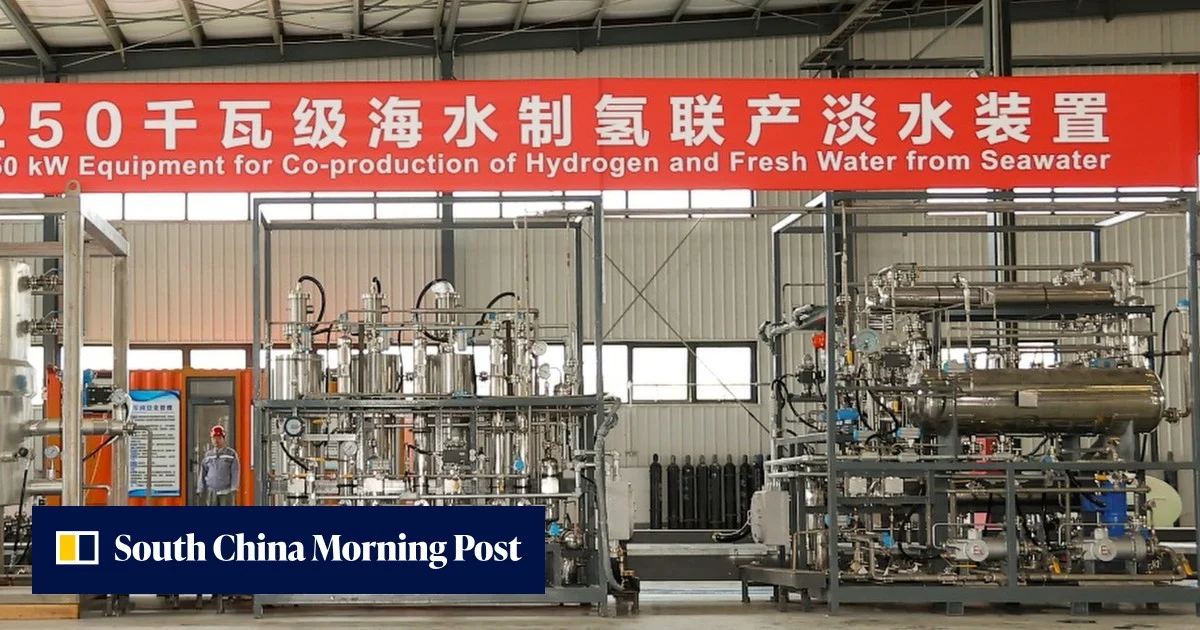
中国科学家建成了一座小型、稳定的联产装置,利用单一系统从海水中提取氢气和淡水,同时回收铀和溴,并将电力使用效率提高了约15%。
Chinese scientists have built a small, stable co-production plant that uses one system to extract hydrogen and fresh water from seawater, while also recovering uranium and bromine and improving electricity use efficiency by about 15 per cent.
据同行评审期刊《自然·能源》(Nature Energy)上发表的一篇论文介绍,由中国科学院大连化学物理研究所的邓德辉和刘燕婷领衔的团队,对一项现有但成本高昂且耗电巨大的技术进行了改进。
The team, led by Deng Dehui and Liu Yanting from the Chinese Academy of Sciences’ Dalian Institute of Chemical Physics, improved on an existing technology that is both costly and power hungry, according to a paper in the peer-reviewed journal Nature Energy.
利用可再生能源驱动的海水制氢过程是生产绿氢的重要途径,但两种主要方法均存在各自的缺陷。
Producing hydrogen from seawater in a process powered by renewable energy is an important route to green hydrogen, but both of the two main approaches have their drawbacks.
在直接海水电解法中,高浓度的氯离子会与阳极发生反应,导致电极腐蚀;同时,钙离子和镁离子会在阴极形成水垢,降低效率。
In the direct seawater electrolysis method, the high levels of chloride ions react with the anode, corroding the electrode, while calcium and magnesium ions form scale on the cathode and reduce efficiency.
第二种方法是两步法路线:首先对海水进行脱盐,然后进行电解。通过反渗透或蒸馏技术将海水转化为纯水,再利用该纯水制取氢气。
The second approach is a two-step route: first, desalinate the seawater and then electrolyse it. Reverse osmosis or distillation turns seawater into pure water, which is then used to make hydrogen.
根据该研究,中国科学家提出了一种基于成熟的两步法路线的改进技术,该技术原本因昂贵的脱盐设备和较高的电力需求而受到限制。2023年,该团队基于脱盐技术建成了一座25千瓦的小型装置,该装置被中国石油和化学工业联合会评为国际领先水平。
The Chinese scientists proposed an improved technology based on the mature second route, with its expensive desalination equipment and high electricity requirements, according to the study th In 2023, the team built a small 25-kilowatt unit, based on the desalination technology, that the China Petroleum and Chemical Industry Federation rated as internationally leading.
随后,研究人员扩大了设计规模,建成了一座250千瓦的工厂,并针对一个被忽视的电力泄漏问题进行了优化。论文指出,计算表明,由于该系统能源利用效率高,因此可以实现盈利。
The researchers then scaled up the design, building a 250kW plant and targeting an overlooked power leak. Calculations showed that the system could turn a profit because it used energy efficiently, the paper said.
在现有的商业系统中,当温度达到80至90摄氏度(176至194华氏度)时,约30%的电力会转化为难以回收的低品位废热,通常需要通过冷却水系统排出——这进一步增加了能源和淡水消耗。
In existing commercial systems, at 80 to 90 degrees Celsius (176 to 194 degrees Fahrenheit) about 30 per cent of electricity becomes low-quality waste heat that is hard to recover and is usually removed by cooling water systems – further increasing energy and freshwater consumption.
为了解决这一问题,研究团队将电解质与脱盐装置相连,将电解过程中产生的废热直接送入真空蒸馏塔,使海水在40至50度的低温下沸腾蒸发,随后将蒸汽冷凝为淡水。
To solve the problem, the team linked the electrolyte with a desalination unit, sending waste heat from electrolysis directly into a vacuum distillation tower where it drives seawater to boil and evaporate at a low temperature of 40 to 50 degrees. The vapour is then condensed into fresh water.
根据中国科学院发布的一份新闻稿,该系统产生的淡水不仅足以维持电解质的运行,还有富余。新闻稿指出,剩余的浓缩海水可通过多阶段处理提取盐、铀、溴及其他海洋资源。
According to a Chinese Academy of Sciences press release, the system produces enough fresh water to run the electrolyte and still leave extra. Salt, uranium, bromine and other marine resources could be extracted from the remaining concentrated seawater in multiple stages, it said.
这款250千瓦的装置每年可生产38万标准立方米(约1340万标准立方英尺)的氢气,纯度高达99.9999%。研究人员表示,该系统同时还能生产256吨淡水。
The 250kW unit can produce 380,000 standard cubic metres (about 13.4 million standard cubic feet) of hydrogen per year, with purity reaching 99.9999 per cent. It also produces 256 tonnes of fresh water, the scientists said.
研究发现,与传统用于制氢的碱性水电解相比,该系统将电力利用率提升了14.4%。此外,在每日启停的运行条件下,系统仍能稳定运行40天,且未出现明显性能下降。
The study found that compared with traditional alkaline water electrolysis for hydrogen, the system improved electricity utilisation by 14.4 per cent. It also ran stably for 40 days under daily start-stop conditions with no obvious decline.
邓在论文中写道,成本分析表明,该系统比传统的两步法——即先对海水进行脱盐,再进行电解制氢——更具经济竞争力。
Deng wrote in the paper that a cost analysis showed the system was more economically competitive than the traditional two-step process of pre-desalinating seawater and then electrolysing it for hydrogen.
根据论文内容,该系统在制氢方面具有高度盈利潜力。当陆上风电的电价为每千瓦时0.033美元时,系统制氢的平均成本估计为每公斤2.1美元;若使用太阳能发电,电价为每千瓦时0.049美元时,成本则为每公斤2.9美元。目前氢气的售价约为每公斤3.9美元。
According to the paper, the system holds promise for highly profitable hydrogen production, with an estimated average cost of US$2.1 per kg when electricity costs are at US$0.033 per kilowatt-hour from onshore wind, and US$2.9 per kg at US$0.049 per kWh from solar power. Hydrogen currently sells for about US$3.9 per kg.
邓还表示,未来的研究应聚焦于开发更高效的催化剂、改进从电解质中回收废热的技术,以及利用人工智能优化工艺参数,从而最大化整个系统的性能和效率。
Deng also said that future research should focus on developing better catalysts, improving recovery of waste heat from electrolytes and using artificial intelligence to optimise process parameters and maximise overall system performance and efficiency.