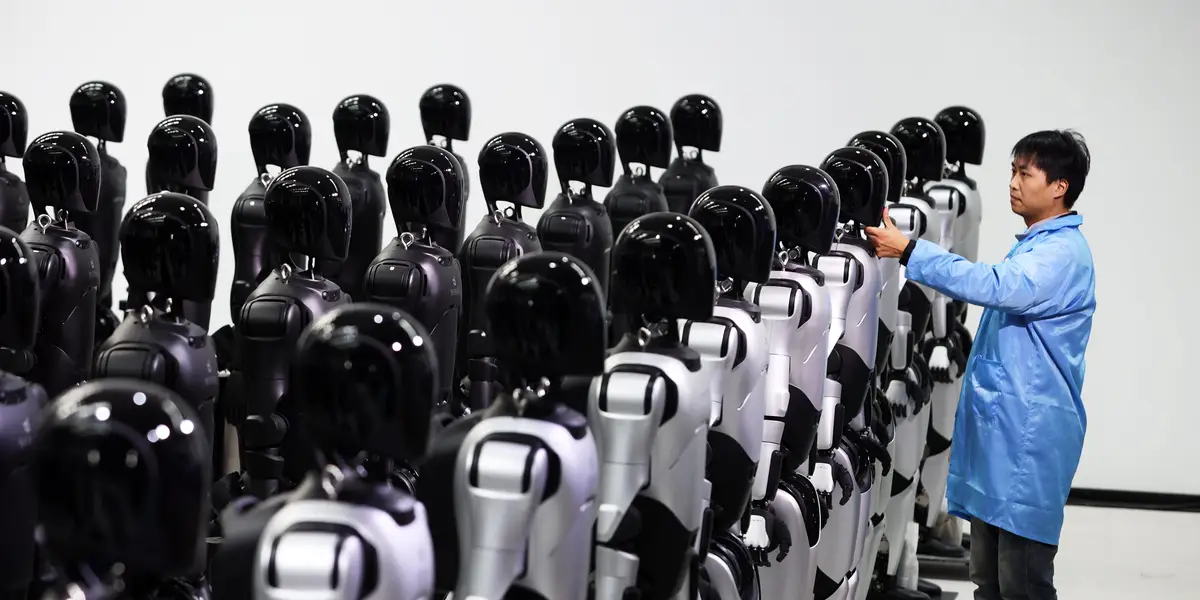
去年,当硅谷投资人瑞安·坎宁安(Ryan Cunningham)在一个机器人投资人的WhatsApp群组中提议前往中国时,反响并不热烈。有人开玩笑说,他能不能偷偷把一个人形机器人带回国。今年,玩笑话已变成了实际的出行计划。坎宁安是风险投资公司“边缘先锋创投”(Edgerunner Ventures)的创始人,该公司专注于投资能源和计算领域的初创企业。
Last year, when Ryan Cunningham, a Silicon Valley investor, floated a trip to China in a WhatsApp group of robotics investors, the response was lukewarm. One person jokingly asked if he could smuggle a humanoid robot home. This year, the jokes have given way to travel plans. Cunningham, the founder of Edgerunner Ventures, a venture capital firm that backs energy and computing startups, is planning an April trip to China for 10 investors.
他计划今年四月带领10位投资人前往中国。坎宁安告诉《商业内幕》,他目前所在的几乎每一个投资人聊天群都在交流近期或即将前往中国的行程,因为风险投资人们正在评估中国在硬件领域的实力,以了解美国机器人初创企业面临怎样的竞争。“我之所以想带他们去中国,是因为我想拍拍他们的肩膀说:‘伙计们,如果你们想认真起来,这就是我们应该学习的对象,’”坎宁安说道。去年,他曾前往上海参加世界人工智能大会,这是人工智能行业一年一度的盛会。
Nearly every investor group chat he is in now trades notes on recent or upcoming excursions to China, he told Business Insider, as venture capitalists gauge China's hardware prowess to see what American robotics startups are up against. "The reason I want to bring them to China is because I want to take them by the shoulders and say, 'Guys, if you want to get serious, this is what we should be learning from,'" said Cunningham, who visited Shanghai last year for the World Artificial Intelligence Conference, an annual gathering for the AI industry. Cunningham is among a growing cadre of Silicon Valley investors heading east to see how China built its edge in robotics and other hardware.
坎宁安是日益增多的硅谷投资人之一,他们正向东看,以了解中国如何在机器人及其他硬件领域建立起优势。对许多人而言,目的并非寻找中国的投资机会,而是评估其美国投资组合公司所面临的竞争对手。这些行程形式多样,从私人风险投资代表团,到每人收费1万美元的旅行团,后者将工厂参观、翻译服务、五星级酒店住宿以及与当地科技高管的晚宴相结合。
For many, the point is not to scout Chinese investments. It is to size up the rivals confronting their US portfolio companies. The excursions range from private VC delegations to $10,000-a-head tours that pair factory visits with translators, five-star hotels, and dinners with local tech executives. Behind the tours is the sobering realization that China has established a formidable lead in crucial parts of robotics, from manufacturing and supply chains to deploying machines and collecting the data needed to improve them.
这些旅行背后,是一个令人清醒的认识:中国在机器人的关键部分已建立起强大的领先优势,从制造和供应链,到机器的部署以及改进机器所需的数据收集。根据研究公司Omdia的数据,中国公司宇树科技(Unitree)和智元机器人(AgiBot)去年共交付了全球71%的人形机器人。此外,根据德国智库墨卡托中国研究中心(Mercator Institute for China Studies)的数据,中国还控制着全球人形机器人零部件供应链中63%的关键企业。
Chinese companies Unitree and AgiBot together shipped 71% of the world's humanoid robots last year, according to research firm Omdia. China also controls 63% of the key companies in the global supply chain for humanoid-robot components, according to the Mercator Institute for China Studies, a German think tank. Meanwhile, most American humanoids are still in development and not available off the shelf. Most US companies rely on Chinese suppliers for components or assembly, according to Stanford's 2026 Emerging Technology Review. The stakes are high for US investors pouring money into robotics and physical AI. They are betting that advances in AI, cheaper hardware, labor shortages, and the push to reshore manufacturing can mint the next generation of technology giants.
与此同时,大多数美国人形机器人仍在开发中,尚未上市。根据斯坦福大学2026年新兴技术评论,大多数美国公司依赖中国供应商提供零部件或组装。对于将资金投入机器人和物理人工智能的美国投资者来说,风险很高。他们押注人工智能的进步、更便宜的硬件、劳动力短缺以及对制造业的推动可以催生下一代科技巨头。
Robotics, meanwhile, is increasingly viewed as a national-security concern. In July, the Federal Communications Commission banned new foreign-made "advanced robotic devices," citing "unacceptable risks" to national security. Robotics may be Silicon Valley's latest obsession, but China has spent years building up its industry. "The Chinese have been very hardware focused," Wendy Chang, a senior analyst at the Mercator Institute for China Studies, told Business Insider.
与此同时,机器人技术越来越被视为国家安全问题。7月,联邦通信委员会禁止了新的外国制造的“先进机器人设备”,理由是对国家安全构成“不可接受的风险”。机器人技术可能是硅谷最新的痴迷,但中国花了数年时间来建设其行业。墨卡托中国研究所高级分析师张文迪(Wendy Chang)告诉《商业内幕》:“中国人一直非常关注硬件。”
"They are trying to own the whole robotics supply chain." In a 2023 policy document, China's government compared the potential impact of humanoid robots with that of computers, smartphones, and electric vehicles. It laid out a plan to deploy humanoid robots across the economy by 2027. China's head start has drawn American investors in for a bit of competitive snooping. In recent months, dozens of VCs, including investors from Eclipse, G2 Venture Partners, and Chemistry VC, have traveled to China.
“他们试图拥有整个机器人供应链。“在2023年的一份政策文件中,中国政府将人形机器人与计算机、智能手机和电动汽车的潜在影响进行了比较。它制定了一项到2027年在整个经济中部署人形机器人的计划。中国的领先地位吸引了美国投资者进行竞争性窥探。近几个月来,包括来自日食、G2 Venture Partners和Chemistry VC的投资者在内的数十名风险投资者已前往中国。据《信息报》上个月报道,Founders Fund和Khosla Ventures的合作伙伴也曾前往。去年年底,总部位于湾区的G2的合作伙伴决定,他们需要更清晰地了解中国。该公司从凯鹏华盈(Kleiner Perkins)分拆出来,投资成长阶段公司,为能源、制造和运输等实体行业开发技术。
Partners from Founders Fund and Khosla Ventures have also made trips, The Information reported last month. Late last year, partners at Bay Area-based G2 decided they needed a clearer view of China. The firm, which spun out of Kleiner Perkins, invests in growth-stage companies building technology for physical industries, including energy, manufacturing, and transportation.
“我们知道他们领先,但直到你真正踏上这片土地,这种冲击感才会真正袭来,”G2投资人尼尔·梅塔(Neel Mehta)说道。今年早些时候,他与一位同事前往深圳和北京。梅塔和他的同事以摩根士丹利在深圳举办的中国峰会为核心安排行程,该峰会包含对机器人和自动驾驶公司的实地考察。他们还安排了参观小米——这家已进军电动汽车领域的消费电子巨头——以及电动汽车制造商比亚迪。
"We knew they were ahead, but it doesn't really hit you until you're on the ground," said Neel Mehta, a G2 investor, who traveled to Shenzhen and Beijing with a colleague earlier this year. Mehta and his colleague built their trip around Morgan Stanley's China Summit in Shenzhen, which included field trips to robotics and autonomous-vehicle companies. They also arranged visits to Xiaomi, the consumer electronics giant that has expanded into electric vehicles, and to EV maker BYD.
梅塔表示,多年来,美国投资者一直认为中国科技产品质量较低。传统观点认为,中国可能在制造业方面具有优势,但美国始终能构建更优秀的人工智能。梅塔回到湾区后,确信这两种假设都是错误的。在深圳的一家小米门店,梅塔看到了该公司的旗舰电动汽车SU7,起售价约为3万美元。“其品质和做工完全符合你对保时捷等豪华汽车的预期,绝无夸张,”梅塔说。
For years, Mehta said, US investors had dismissed Chinese technology as lower quality. Conventional wisdom held that China might have an edge in manufacturing, but the US would always build better AI. Mehta returned to the Bay Area convinced both assumptions were wrong. At a Xiaomi dealership in Shenzhen, Mehta saw the company's flagship SU7 electric car, which starts at around $30,000. "The quality and finish is everything you'd expect in a luxury car like Porsche, no exaggeration," Mehta said.
由于中国电动汽车进口面临限制和100%的关税,这款车并未在美国销售。梅塔还对中国的数据收集工作印象深刻。机器人公司需要大量真实世界数据来训练系统,使其能够感知周围环境并执行物理任务。在一家数据收集农场,他看到数百名工人全天候驻扎在隔间中,通过远程操控机器人来大规模生成数据。“如果你认为数据是机器人领域的核心瓶颈,那么在一个世界里,他们可能拥有比任何人都更优秀的模型,”他说。
The car is not sold in the US, where Chinese EV imports face restrictions and a 100% tariff. Mehta was also struck by China's data-collection efforts. Robotics companies need large amounts of real-world data to train systems to perceive their surroundings and perform physical tasks. At one data-collection farm, he saw hundreds of workers stationed in pods around the clock, teleoperating robots to generate it at scale. "If you think data is the core bottleneck in robotics, there's a world in which they have better models than anyone else," he said.
运营科技播客和研究平台“Tech Buzz China”的芮玛(Rui Ma)告诉《商业内幕》,在美中紧张局势持续多年以及跨境投资遇冷之后,硅谷对中国重新产生了兴趣。随着DeepSeek、阿里巴巴的通义千问(Qwen)和月之暗面的Kimi等中国人工智能公司推出的强大模型,中国的技术进步已更难被忽视,这一局面开始发生变化。"
Rui Ma, who runs Tech Buzz China, a podcast and research platform covering China's technology industry, told Business Insider that Silicon Valley's renewed curiosity about China follows years of US-China tensions and a chill in cross-border investment. That has begun to change as powerful models from Chinese AI companies, including DeepSeek, Alibaba's Qwen, and Moonshot AI's Kimi, have made China's technological gains harder to dismiss.
这非常针对DeepSeek时刻,"马女士说道,指的是这家中国公司2025年发布的、震动硅谷的AI模型。"人们都在说,'哇,中国其实拥有值得关注的AI和其他技术。'" 马女士2019年开始组织赴华考察团,但疫情期间暂停。今年,她看到硅谷投资者的兴趣激增,已带领两个考察团:一个专注AI,另一个专注机器人。"大多数人试图了解中国发生的事如何影响他们的投资组合,"她说。
"It's very specific to the DeepSeek moment," Ma said, referring to the Chinese company's 2025 release of an AI model that shook Silicon Valley. "People are like, 'Oh wow, China actually has AI and other technologies worth paying attention to.'" Ma began organizing tours to China in 2019, but paused them during the pandemic. This year, she has seen an uptick in interest from Silicon Valley investors and has led two tours: one focused on AI and another on robotics. "Most people are trying to understand how what's happening in China impacts their portfolio," she said.
为期一周的项目每人费用约1万美元,马女士称这与高管教育课程费用相当。从参与者抵达那一刻起,她的团队负责行程的每一个细节。考察团通常访问两三个城市,参观工厂并与讲英语的科技高管进行炉边对话。"我喜欢带人们去看六个月后他们会在新闻里读到的东西,"马女士说。最近一次行程中,她带参与者参观了一家脑机接口公司。
The weeklong programs cost about $10,000 per person, which Ma said is comparable to executive education courses. From the moment participants land, her team handles every detail of the itinerary. Groups typically visit two or three cities, touring factories and joining fireside conversations with English-speaking tech executives. "I like to take people to see things they'll be reading about six months later," Ma said. On a recent trip, she took participants to a brain-computer-interface company.
对于总部位于加州的研究与活动公司Doon Insights而言,投资者对中国日益增长的兴趣是一个商业机会。该公司正向投资者和高管推销11月举行的为期12天"机器人研究考察团",行程覆盖上海、常州、深圳和北京。根据《商业内幕》查看的行程单,行程包括参访人形机器人制造商智元机器人、自主飞行出租车公司亿航智能,以及多家机器人零部件制造商。
For Doon Insights, a California-based research and events company, growing investor interest in China is a business opportunity. The company is pitching investors and executives on a 12-day "Robotics Study Mission" in November, with stops in Shanghai, Changzhou, Shenzhen, and Beijing. The itinerary includes visits to humanoid maker AgiBot, autonomous-air-taxi company EHang, and several robot component manufacturers, according to an itinerary viewed by Business Insider.
参与者还将走访深圳华强北电子市场——常被称为"硬件界的硅谷"——并参观自动化农场和方便面巨头康师傅。每一站都以专家座谈会开始,并安排与当地商业和技术领袖共进晚餐。行程单宣称:"这是直接接触定义中国下一步发展的关键人物和技术的机会。"
Participants will also walk through Shenzhen's Huaqiangbei electronics market — often called the "Silicon Valley of Hardware" — and visit automated farms and instant-noodle giant Master Kong. Each leg begins with an expert panel and includes dinners with local business and technology leaders. "It's direct access to the people and technology defining what is coming next out of China," the itinerary boasts.
Doon Insights 拒绝置评。赴华考察之行正在改变投资者评估美国机器人公司的方式。
Doon Insights declined a request for comment. The trips to China are changing how investors evaluate US robotics companies.
4月,投资实体经济公司的风投公司 Eclipse 的合伙人 Charly Mwangi 及其同事将工作笔记本电脑留在家中,登上了从旧金山出发、飞行时长 14 小时的国航航班前往中国。
In April, Charly Mwangi, a partner at Eclipse, a venture firm that invests in companies building for the physical economy, and his colleagues left their work laptops at home and boarded a 14-hour Air China flight from San Francisco.
曾在特斯拉和 Rivian 任职的高管 Mwangi 表示,中国将想法转化为实体产品的能力让考察团深受震撼。
Mwangi, a former Tesla and Rivian executive, said the group was struck by China's ability to turn ideas into physical products.
他说:“在美国,我们搞定了‘氛围编程’;在中国,他们搞定了‘氛围制造’。”
"In the US, we've figured out vibe coding," he said. "In China, they've figured out vibe manufacturing."
然而 Mwangi 表示,这些机器人的认知能力远不如前者令人印象深刻。
Yet Mwangi said the robots' cognitive abilities were far less impressive.
他说,在一家公司,机器人会跳舞、练武术,却捡不起瓶子扔进垃圾桶。
At one company, a robot could dance and do martial arts, he said, but it could not pick up a bottle and put it in a trash can.
在评估潜在投资时,Eclipse 和 G2 都开始更加重视中国因素。
Both Eclipse and G2 are taking China much more seriously as they evaluate potential investments.
在见识到中国政府对技术生态系统的掌控后,Mwangi 认为自主制造机器人关乎国家主权。
After seeing the Chinese government's control over the technology ecosystem, Mwangi believes that building their own robots is a matter of national sovereignty.
他说:“现在入局的所有人都必须利用中国供应链,随后再迅速寻找替代方案。”
"Everyone starting now will have to leverage the Chinese supply chain, and then over time, very quickly start figuring out alternatives," he said.
在向公司其他成员汇报中国行的调研结果后,Mehta 表示,G2 已开始在每一项潜在投资中权衡与中国相关的风险。
After presenting their findings from the China trip to the rest of the firm, Mehta said that G2 has begun weighing China-related risks in every potential investment.
他说:“我们在思考,五到十年后,中国会出现什么样的对标公司?而美国公司是否拥有持久的优势?”
"We're thinking, five to 10 years from now, what is going to be the China equivalent?" he said.
请使用个人邮箱和非工作设备;
"And does the US version of the company have a durable advantage?"