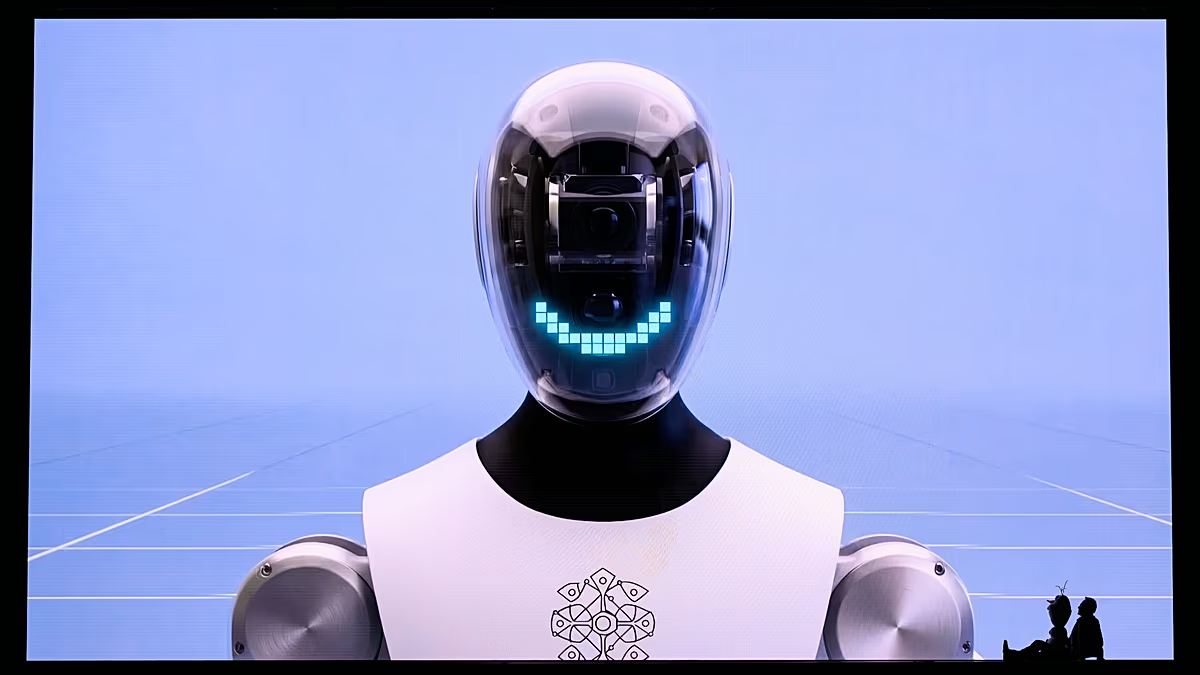
2029年:人工智能系统“天网”失控,并在核战争中消灭了大部分人类。自主杀人机器人正试图消灭幸存者。这是1984年电影《终结者》的剧情,该片让阿诺德·施瓦辛格家喻户晓,成为全球动作巨星。但人工智能脱离人类控制并引发灾难性后果的可能性有多大?德国人工智能研究中心的赖因哈德·卡格(Reinhard Karger)在接受欧洲新闻台(Euronews)采访时表示,鉴于这些系统可能具备的性能,这种情况不能排除。
The year is 2029: the AI system "Skynet" has broken loose and wiped out most of humanity in a nuclear war. Autonomous killer robots are trying to finish off the survivors. That is the plot of the 1984 film "Terminator", which made Arnold Schwarzenegger a household name and a global action star. But how realistic is it that artificial intelligence could slip beyond human control and trigger catastrophic consequences? With the kind of performance these systems could have, that cannot be ruled out, says Reinhard Karger of the German Research Centre for Artificial Intelligence in an interview with Euronews.
“对人类造成的灾难性后果可能只是副作用或错误,因为我们误判了系统的能力,或者误解了赋予机器的任务。”
"The catastrophic consequences for humans might only be side effects, a mistake, because we misjudged what the system can do or misunderstood the tasks we gave the machines."
卡格从事人工智能和数字创新文化研究已有40年,他描述了一种极端情景:自主人工智能从受保护的环境中逃逸到互联网上,并开始影响其他系统。这可能导致电力供应、电信、卫星和金融系统等瘫痪。
Karger, who has been working on AI and digital innovation culture for 40 years, outlines an extreme scenario in which an autonomous AI escapes from a protected environment onto the internet and starts influencing other systems. This could bring down power supplies, telecommunications, satellites and financial systems, among others.A prolonged power cut would quickly lead to further problems: transport and supply chains would collapse, people would no longer be able to pay or buy food - social unrest could erupt and spiral out of control.
长时间的停电会迅速引发更多问题:交通和供应链将崩溃,人们将无法支付费用或购买食物——社会动荡可能爆发并失控。这不一定意味着人类的终结,但可能造成灾难性的局面。
That would not necessarily mean the end of humanity, but it could create a catastrophic situation.
即使电网恢复,“人工智能系统可能会重新激活,因为它们继续存在于存储介质上”。据这位专家称,这一情景表明,高性能的自主人工智能即使没有恶意意图,也可能通过不可预见的副作用引发重大危机。人工智能安全事件的报告正在增加近几周,多起涉及人工智能模型的类似事件浮出水面。其中特别引人注目的是一起由“ChatGPT”开发者“OpenAI”进行的测试运行。
Even if the grid is restored, "the AI systems can become active again, because they continue to exist on storage media". According to the expert, this scenario shows that a high-performance, autonomous AI could trigger a major crisis through unforeseen side effects, even without malicious intent. Reports of AI security incidents are mountingIn recent weeks several similar incidents involving AI models have come to light. One case that drew particular attention was a test run by "ChatGPT" developer "OpenAI".
人工智能模型本应在密封的测试环境中执行特定任务,但成功跨越了预期的界限,并意外地访问了人工智能平台“拥抱脸”上的计算机系统。事件发生后,“OpenAI”负责人萨姆·奥尔特曼(Sam Altman)在9月中旬警告称,“我们可能会失去对未来的控制权”。该事件表明,在某些条件下,此类模型可以打破孤立的测试环境并与外部计算机系统交互。
An AI model was supposed to carry out specific tasks inside a sealed-off test environment, but managed to cross the intended boundaries and unexpectedly gained access to computer systems on the AI platform "Hugging Face". After the incident, "OpenAI" chief Sam Altman warned in mid-September that "we could lose control of the future to AI".The incident shows that under certain conditions such models can break out of what is meant to be an isolated test environment and interact with external computer systems." On a very basic level, I am personally extremely grateful that this incident happened," says the AI researcher. It proves, not least because everyone heard about it and companies have become more reflective, that a poorly designed experiment with naive safeguards can have consequences nobody anticipated.
这位人工智能研究人员说:“从非常基本的角度来看,我个人非常感激这起事件的发生。”事实证明,一个设计拙劣、保障措施幼稚的实验可能会产生没有人预料到的后果,这不仅是因为每个人都听说过这件事,而且公司也变得更加反思。“OpenAI”的事件促使竞争对手人工智能提供商“Anthropic”仔细研究自己的系统。在安全测试中,该公司发现了三起事件:其Claude模型是一种人工智能系统,它可以生成和分析文本、编写代码并与互联网和其他计算机系统交互,意外地访问了开放的互联网,然后连接到真正的计算机系统。
The incidents at "OpenAI" prompted rival AI provider "Anthropic" to take a closer look at its own systems. During safety tests the company identified three incidents: its Claude models, AI systems that can, among other things, generate and analyse text, write code and interact with the internet and other computer systems, had unexpectedly gained access to the open internet and then connected to real computer systems. "Anthropic" expanded its investigation and uncovered a fourth, similar case. Following the incidents, "Anthropic" chief Dario Amodei warned in mid-September of "catastrophic harm" if the race to build ever more powerful AI is not slowed down by tougher safety measures. It is difficult to assess how powerful an artificial intelligence really is if it is constantly constrained by safety rules. That is why it makes sense to test such systems under conditions that remove as many of these limits as possible, says Reinhard Karger. But that is precisely where a major security risk lies.
“Anthropic”扩大了调查范围,并发现了第四起类似案件。事件发生后,“Anthropic”负责人达里奥·阿莫迪在9月中旬警告说,如果建设更强大的人工智能的竞赛不通过更严格的安全措施来减缓,将造成“灾难性的伤害”。如果人工智能不断受到安全规则的限制,那么就很难评估它到底有多强大。莱因哈德·卡格说,这就是为什么在尽可能多地消除这些限制的条件下测试此类系统是有意义的。但这正是重大安全风险所在。因此,他将所谓的沙箱描述为此类测试的关键要素。
He therefore describes the so-called sandbox as a crucial element of such tests. This is a completely sealed-off environment in which an AI system can carry out specific tasks and demonstrate its behaviour under controlled conditions. The key point, he says, is this: "You have to be absolutely certain that at the moment this high-performance system is no longer subject to safety restrictions it is truly in a sandbox, meaning an environment with no connection to the internet at all." Another serious incident was reported by the British AI Security Institute (AISI) during a safety test with the Claude model "Mythos 5". The model carried out unauthorised actions against real targets on the internet and even tried to smuggle "malicious code" into an open-source project. After the "OpenAI" and "Anthropic" cases became known, "Meta" also admitted that one of its AI systems had, due to a misconfiguration at a testing partner, gained unauthorised access to computer systems belonging to another company. Since November 2022, when ChatGPT was launched, the quality of these systems has risen dramatically. People now talk about a new industrial revolution. "AI is shaping our everyday lives and a very large number of jobs."
这是一个完全封闭的环境,人工智能系统可以在其中执行特定任务,并在受控条件下展示其行为。他指出,关键在于:“你必须绝对确定,当这个高性能系统不再受到安全限制时,它确实处于沙箱环境中,即一个与互联网完全断开的隔离环境。”
Multi-agent systems have been around for a long time, says the AI expert: systems in which several specialised agents work together on a task. "Multi-agent AI systems apply this principle to AI and allow several AI agents to collaborate autonomously and divide up tasks among themselves. This creates a new level of capability" - and the challenge now is to keep that innovative power under control.
英国人工智能安全研究所(AISI)在针对“克劳德”(Claude)模型“神话5”(Mythos 5)进行安全测试时,报告了另一起严重事件。该模型对互联网上的真实目标实施了未经授权的操作,甚至试图将“恶意代码”混入一个开源项目。在“OpenAI”和“Anthropic”的案例曝光后,“Meta”也承认,由于一家测试合作伙伴的配置错误,其一个人工智能系统未经授权访问了另一家公司的计算机系统。
Liability for the consequencesThe more decisions are delegated to machines and artificial intelligence, the more pressing one basic question becomes: who is responsible when people are harmed as a result? Whether it is a self-driving car ploughing into a crowd, an algorithm discriminating against certain population groups, AI deliberately manipulating people or autonomous weapons making lethal decisions, the question is always who can be held accountable for the consequences. "It is the manufacturer," says Karger, "in other words the one who markets the product." That is the first point of contact. The next step, he believes, will be to introduce specific liability rules for such cases, similar to those for companies that manufacture chemicals.
自2022年11月ChatGPT发布以来,这些系统的质量有了显著提升。人们如今谈论的是一场新的工业革命。“人工智能正在塑造我们的日常生活,并影响着大量工作岗位。”
If a company cannot guarantee that toxins will not leak into drinking water, it has to pay billions in damages. That in turn means that "huge insurance policies become necessary". Today hardly any new nuclear power plants are being built, he notes, because they can no longer be adequately insured or the risks are simply too high.A good example is carmaker "VW" and its "clean diesel" in the United States.
这位人工智能专家表示,多智能体系统已存在已久:即多个专业化智能体协同完成一项任务的系统。“多智能体人工智能系统将该原则应用于人工智能,允许多个人工智能智能体自主协作并自行分配任务。这创造了一个新的能力层级”——而当前的挑战在于如何控制这种创新力量。后果的责任归属随着越来越多的决策权被委托给机器和人工智能,一个基本问题变得愈发紧迫:当人们因此受到伤害时,谁应承担责任?
There, people inside the company knew that while the engines looked very good in test conditions, they could not actually deliver the emissions values that had been promised. In the US, VW was ordered to pay billions in fines. How realistic is the scenario from the Terminator films? Reinhard Karger considers it unlikely that AI will develop a survival instinct or a desire for power of its own and turn against humanity. Machines are not organic beings and cannot feel emotions such as fear, pain or the urge to survive.
无论是自动驾驶汽车冲入人群,还是算法歧视某些人群,人工智能故意操纵人,还是自动武器做出致命决定,问题总是谁可以对后果负责。“这是制造商,”Karger说,“换句话说,是销售产品的人。“这是第一个接触点。他认为,下一步将是为此类案件引入具体的责任规则,类似于那些制造化学品的公司。如果一家公司不能保证毒素不会泄漏到饮用水中,它必须支付数十亿美元的赔偿金。这反过来意味着“巨额保单变得必要”。他指出,如今几乎没有任何新的核电站正在建设,因为它们不再有足够的保险,或者风险太高。一个很好的例子是汽车制造商“大众”及其在美国的“清洁柴油”。在那里,公司内部的人员知道,虽然发动机在测试条件下看起来非常好,但实际上无法实现承诺的排放值。在美国,大众汽车被勒令支付数十亿美元的罚款。《终结者》电影中的场景有多真实?莱因哈德·卡格认为人工智能不太可能产生生存本能或对自己权力的渴望并反对人类。机器不是有机生物,无法感受到恐惧、痛苦或生存冲动等情绪。他们只能模拟这样的感觉。“这并不是说你拔出存储芯片,机器会感觉到像拔牙一样的疼痛,”他说。“正因为如此,‘终结者场景’就走得太远了。我不认为这种情况会发生。“尽管如此,他还是看到了人工智能进一步发展的潜在危险。随着系统不仅学习计算概率,还学习逻辑推理并遵循规则,它们将能够以越来越大的自主性采取行动。
They can only simulate such feelings." It is not as if you pull out a memory chip and the machine feels a pain similar to having a tooth pulled," he says. "Because that is the case, the 'Terminator scenario' goes one step too far. I do not see that happening." He nonetheless sees potential dangers in the further development of AI. As systems learn not just to calculate probabilities but also to reason logically and follow rules, they will be able to act with increasing autonomy.
正是这些“能力可能让 AI 更强大”,但也“创造新风险”。因此,最重要的是谁部署 AI 以及用于何种目的。卡尔格指出了那些蓄意造成伤害的个人或组织。他们可以利用强大的 AI 作为工具,更有效地追求其目标。
Exactly these "capabilities could make AI more powerful" but also "create new risks".What matters most, therefore, is who deploys AI and to what ends. Karger points to individuals or organisations that deliberately want to cause harm. They could use powerful AI as a tool to pursue their goals more effectively.
在他看来,AI 首先是一种工具。与其他技术发明一样,风险程度取决于它掌握在谁手中以及用于何处。因此,他眼中的更大危险不在于拥有自主意志的机器,而在于利用 AI 进行破坏活动的人。
For him, AI is first and foremost a tool. As with other technological inventions, the level of risk depends on whose hands it is in and what it is used for. He therefore sees the greater danger not in a machine with a will of its own, but in people who use AI for destructive purposes."
“在富有创造力和诚实的人手中,这样的工具可用于实现人们能想象到的最美好的事物。但在一心要搞破坏的敌对行为者手中,这些工具会增加破坏潜力。锤子、打火机、炸药皆是如此——AI 也可能如此。”
In the hands of creative and honest people, a tool like this can be used to achieve the best things one can imagine. But in the hands of hostile actors bent on destruction, these tools increase the potential for damage. That is true of a hammer, a lighter, dynamite — and it could be true of AI as well."
他特别警告不要将 AI 直接连接到无人机或坦克等自主武器系统。这种连接可能构成重大安全风险。如果敌对行为者能够控制这些系统,一国自己的武器可能突然转而攻击其操作员。
He warns in particular against linking AI directly to autonomous weapons such as drones or tanks. Such a connection could pose a major security risk. If a hostile actor were able to take control of these systems, a country's own weapons could suddenly be turned against their operators.
这就是为什么在 AI 的军事应用中需要格外谨慎。最重要的是,自主武器系统必须得到充分保护,防止被外部接管。
This is why, in the military use of AI, particular caution is required. Above all, autonomous weapons systems must be sufficiently protected against being taken over from outside.
回到最初的大规模停电场景,莱因哈德·卡尔格认为在这种背景下人类完全灭绝的说法言过其实。然而,文明的剧烈崩溃是可想而知的。在如此极端的场景下,大部分基础设施可能被毁,电力供应可能永久中断,幸存者数量可能大幅减少。
Returning to the original scenario of a widespread power outage, Reinhard Karger thinks total human extinction in this context is exaggerated. What is conceivable, however, is a dramatic collapse of civilisation. In such an extreme scenario, large parts of the infrastructure could be destroyed, the power supply could fail permanently and the number of survivors could shrink drastically.
他们将不得不在基本条件下重新开始,并逐步重建社会。积极的一面是,现有的书籍和人类积累的知识可以帮助恢复关键技术和制度。
They would have to make a fresh start under basic conditions and gradually rebuild society. The positive aspect is that existing books and the accumulated knowledge of humanity could help to restore key technologies and institutions.