本·奈特 2026年10月5日调查显示,今年迎来成立75周年的德国最高法院正逐渐失去民众的信任。一些人认为,改革其候选人遴选方式将有所帮助,例如接受由极右翼德国选择党提名的候选人。
Ben Knight October 5, 2026 Germany's top court, which turned 75 this year, is losing the population's trust, surveys show. Some say reforms in the way it picks candidates would help, to also accept candidates nominated by the far-right AfD.
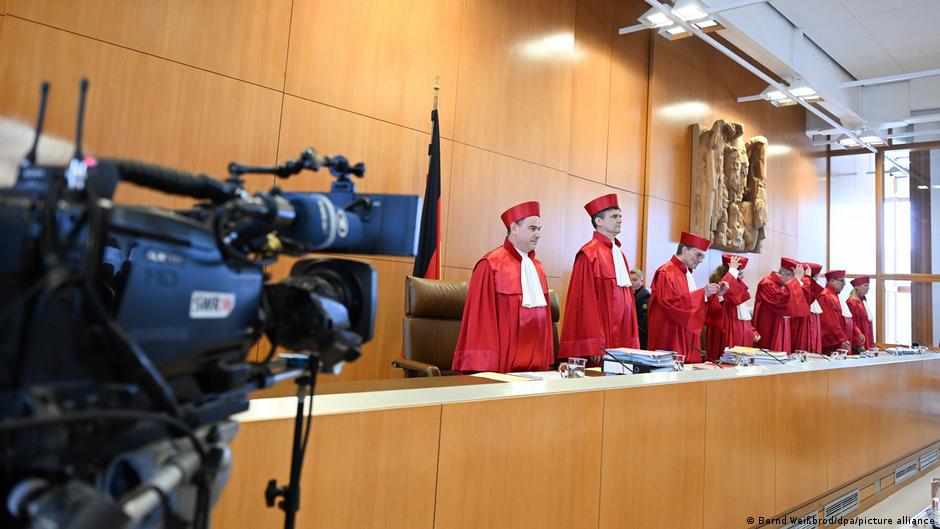
联邦宪法法院是德国的最高法院,总部位于卡尔斯鲁厄。作为德国对应于美国最高法院的机构,联邦宪法法院在德国政府各分支中仍享有最高的民众信任度,但近期调查显示,这种信任度正在下滑。
The Federal Constitutional Court is Germany's supreme court, based in Karlsruhe Federal Constitutional Court— Germany's equivalent of the US Supreme Court — still enjoys the most trust among the population of any branch of government, but that trust is slipping, according to recent surveys.
民调机构益普索(YouGov)为纪念该法院成立75周年而委托进行的一项新调查显示,约三分之二(66%)的德国人信任联邦宪法法院。这一比例显著高于该国政府体系中的其他主要分支:德国联邦参议院(德国议会上院)的信任度为47%,联邦议院(德国议会下院)为38%,联邦政府本身仅为29%。
A new survey by the pollsters YouGov commissioned to mark the 75th anniversary of the founding of the court, found that about two-thirds (66%) of Germans trust the Federal Constitutional Court. This was significantly more than the other major branches of the country's government system: The Bundesrat the upper house of the German parliament, scored 47%, the lower house of parliament, the Bundestag 38%, and the Federal Government itself 29%.
但其他调查显示,仅几年前这些数字还要高得多:艾伦斯巴赫研究所2025年的一项研究发现,2021年民众对该法院的信任度高达81%。
But other surveys show those figures were significantly higher just a few years ago: One study from 2025 by the Allensbach Institute found that trust in the court was as high as 81% in 2021.
究竟为何会出现这种情况,目前仍众说纷纭。作为可能的解释,一些分析人士指出,法院曾作出裁决,允许政府在新冠疫情期间限制某些自由——这一决定引发了大量抗议活动。
Exactly why this has happened remains a matter of conjecture: As a possible explanation, some analysts have pointed to the decisions the court made to allow the government to curtail certain freedoms during the COVID-19 pandemic — which precipitated many protests.
在那段时期,民众对政府所有分支的信任度普遍下降。一些人认为,这一裁决表明,该法院并非真正独立的仲裁者。
That period also saw an overall drop in trust in all the branches of government, and this decision, some argued, showed that the court was not an independent arbiter after all.
联邦总统施泰因迈尔在周年庆典上谈论联邦宪法法院的重要性 联邦宪法法院会“过于政治化”吗? 汉堡大学政治学前教授克里斯蒂娜·兰德弗里德认为,指责法院“过于政治化”并不站得住脚。其宗旨向来是作出政治决策——但这些决策基于法律论证,而非政治辩论。
President Frank-Walter Steinmeier spoke about the importance of the Constitutional Court during the anniversary ceremony Can the Constitutional Court be 'too political?' Christine Landfried, former professor of political science at Hamburg University, thinks the criticism that the court can be too political doesn't really make sense. Its purpose was always ultimately to make political decisions — but ones based on a legal argument, rather than a political debate.
“联邦宪法法院处理的始终是政治问题,”她对德国之声表示。“但作出裁决的方式应遵循法律论证和法律方法。这与政治不同。” 法院成立于1951年,二战结束后,为确保新成立的西德法律遵守1949年生效的宪法,即《基本法》。多年来,法院不得不将《基本法》的原则(民主、人尊严、法治)诠释为一个个具体的政治问题:公民数据如何处理?政府应否保护气候?失业者应获得多少救济金?
"A constitutional court always deals with political questions," she told DW. "But the way that decisions are arrived at should follow legal arguments and legal methods. That's different from politics." The court was founded in 1951, in the aftermath of World War II to make sure that the laws of the newly founded West Germany adhered to the constitution, or Basic Law which came into effect in 1949. Over the years, it has had to interpret the tenets of the Basic Law (democracy, human dignity, the rule of law) into many political questions: What happens to citizens' data? Should the government protect the climate? How much money should unemployed people be paid?
多元化法院的重要性 前联邦宪法法院法官格特鲁德·吕贝-沃尔夫认为,问题不在于法院过于政治化,而在于其组成未能反映德国新的政治现实。
The importance of a plural court Former Constitutional Court judge Gertrude Lübbe-Wolff thinks that the problem is not that the court is too political, but that its composition does not reflect new political realities in Germany.
按现行惯例,德国联邦议院和联邦参议院这两院达成协议,由主要政党各自提名一定数量的候选人,担任法院两个法庭(即参议院)的法官。联邦议院和联邦参议院各自选出两个八人参议院的一半法官。
As things stand, there is an agreement in the two houses of the German parliament, the Bundestag and the Bundesrat, that the main parties each propose a certain number of candidates for the court's two chambers, or senates. The Bundestag and the Bundesrat each pick half the judges for the two eight-seat senates.
然而,去年这一共识遭到破坏,起因是一场针对由中左翼社会民主党(SPD)提名的候选人弗劳克·布罗修斯-格尔斯多夫(Frauke Brosius-Gersdorf)的竞选活动。部分人认为,她在堕胎非罪化及其他议题上的立场过于自由派。这场由社交媒体上民粹主义且未经证实的说法所推动的活动,导致一些基督教民主联盟(CDU)的议员撤回支持,随后布罗修斯-格尔斯多夫本人也撤回了 candidacy。
That agreement was fractured, however, last year thanks to a campaign against an the candidate Frauke Brosius-Gersdorf, nominated by the center-left Social Democratic Party (SPD) whose position on decriminalizing abortion and other issues were deemed by some as too liberal. The campaign — driven by populist and unproven claims on social media — caused some parliamentarians from the Christian Democratic Union (CDU) to withdraw their support, before Brosius-Gersdorf herself withdrew her candidacy.
尽管这一事件可能损害了人们对法院法官遴选机制的信任,吕贝-沃尔夫(Lübbe-Wolff)向德国之声(DW)表示,维持法院组成的多元性“对于做出明智、平衡且被公众广泛接受的裁决至关重要”。
Though this affair may have damaged trust in how the court's judges were selected, Lübbe-Wolff argues that maintaining the court's plural composition is "extremely important for sensible and balanced decisions that are broadly accepted by the public," she told DW.
一次例行投票如何引爆德国政坛 观看此视频,以及德国宪法法院与美国最高法院 与美国最高法院的法官不同,后者的许多人是广为人知的名字,其观点和党派归属众所周知;而德国宪法法院的法官则完全默默无闻。不过,他们由议会中的不同政党提名,其政治倾向通常为关注提名过程的人所知晓。
How a routine vote blew up German politics To view this video , and German Constitutional Court vs the US Supreme Court Unlike US Supreme Court judges, many of whom are familiar names whose opinions and party affiliation are widely known, the people who sit on Germany's Constitutional Court are not famous at all. But they are nominated by different parties in parliament, and their political affiliations are usually known to those who care to follow the nominations.
但兰弗里德指出,与美国最高法院的一个关键区别在于:在美国,法官只需就判决结果达成一致,但每位法官可以撰写各自的理由;而德国联邦宪法法院则努力就每项判决形成统一的理由,若部分法官意见不一,则形成多数意见的理由。“联邦宪法法院更像一个机构在运作,”她说。“人们认为,重要的是某个参审庭作出了决定,而不是个别法官站在前台。”
But a key difference to the US Supreme Court, Landfried points out, is that while in the US, the judges only have to agree on a decision, but each can write their own reasoning, the German Constitutional Court makes an effort to produce a joint reasoning for each decision, or a majority reasoning if some judges disagree. "The Federal Constitutional Court acts much more as an institution," she said. "It's considered very important that this or that senate made a decision, and not that individual judges are in the foreground."
吕贝-沃尔夫的新书题为《联邦宪法法院是否需要(更多)改革?》,书中提出了一些改进法院运作、使其更少依赖政党选择的建议。其中一个建议是:不再由议会委员会中的不同政党提名候选人,而是像招聘其他职位一样公开招募宪法法院的席位,由申请人提交申请,再由委员会决定录用谁。吕贝-沃尔夫认为,这既能维护法院遴选背后的民主原则,又能减少政党政治的影响。奥地利和瑞士已经拥有类似的制度。
Lübbe-Wolff's new book, entitled "Does the Federal Constitutional Court need (more) Reform?" contains a few ideas for how the court could be improved to make it less dependent on the choices of the political parties. One suggestion: Instead of having the different parties in the parliamentary committee propose candidates, the seats on the Constitutional Court would be advertised like any other job, and people would apply, and then have the committee decide on who to accept. This would, Lübbe-Wolff argues, maintain the democratic principles behind the court selection while reducing the influence of party politics. Austria and Switzerland both already have similar systems.
兰弗里德赞同这一想法。“这意味着政党政治在遴选过程中所占的比重不会那么大,”她说。“一些未被政党选中的优秀人才也可以申请。”是否应该有德国选择党(AfD)的候选人进入法院?
Landfried likes this idea. "That would mean party politics is not such a big part of the selection," she said. "Very good people could apply who haven't been chosen by the party." Should there be AfD candidates for the court?
吕贝-沃尔夫还认为,为了体现多元性,联邦议院应允许由极右翼政党“德国选择党”(AfD)提名的候选人参与宪法法院的遴选。
Lübbe-Wolff also believes that, for the sake of plurality, the Bundestag should allow candidates put forward by the far-right Alternative for Germany (AfD) to be considered for the Constitutional Court.
德国国内情报机构认为,德国选择党的某些派系具有极端主义倾向,并对宪法持敌对态度。
Germany's domestic intelligence agencies consider some sections of the AfD extremist and hostile to the constitution.
事实上,近期的一项YouGov民调发现,在主要政党的支持者中,德国选择党的支持者对法院的信任度远低于其他群体:仅有34%,而基民盟和社民党的支持者信任度均在80%左右。德国选择党在多大程度上是一个新纳粹政党?
Indeed, the recent YouGov survey found that, among supporters of the major political parties, AfD supporters had by far the least faith in the court: Only 34%, compared to around 80% for both the CDU and SPD. How much of a neo-Nazi party is the German AfD?
尽管如此,一些州级宪法法院已经接受德国选择党提名人加入他们的队伍,特别是巴伐利亚巴登-符腾堡州现在吕贝-沃尔夫认为,德国议会中政党的范围更广泛意味着德国选择党和社会主义左翼党也应该被允许提出候选人。“以前,基民盟和社民党可以简单地决定选举哪些法官,”她说。“今天,他们也总是需要左翼党的选票,因为德国选择党已经变得如此庞大。她称这种失衡为“结构性问题”。"
Nevertheless, some constitutional courts at the state level have already accepted AfD nominees into their ranks, notably Bavaria Baden-Württemberg Now Lübbe-Wolff believes that the wider array of parties in the German parliament mean that the AfD and the socialist Left Party should also be allowed to propose candidates. "It used to be that the CDU and the SPD could simply decide between themselves which judges to elect," she said. "Today they always need votes from the Left Party too, because the AfD has become so big." She calls this imbalance a "structural problem."
但她认为,选举过程中有足够的保障措施,以确保宪法法院的候选人不会持有直接敌视宪法的观点。她说:“我认为有些人与德国选择党足够接近,该党可以提出他们,但同时又可靠地站在宪法的基础上。”“我认为这一类人中有年轻一代,但他们不想暴露自己。"
But she believes that there are enough safeguards in the selection processes to ensure that no candidate for the Constitutional Court would hold views that were directly hostile to the constitution. "I think there are people who I believe are close enough to the AfD that the party could put them forward, but at the same time stand reliably on the foundation of the constitution," she said. "I think there are people of a younger generation in that category, but they don't want to out themselves."
兰德弗里德对这个想法不感兴趣。“对我来说,该党的部分成员对宪法怀有敌意,部分是右翼极端分子,”她说,尽管她不相信所有的AfD选民都是极右派。“但我有我的保留意见,我不会同意这个建议。“兰德弗里德担心,由于德国的纳粹历史,联邦宪法法院应该特别警惕允许那些可能有极右翼同情心的人在身体上占有一席之地,这比任何其他人都更意味着捍卫德国的民主。编辑:里娜·戈登伯格
Landfried is not sold on the idea. "For me, sections of that party is hostile to the constitution, it is partly right-wing extremist," she says, though she doesn't believe that all AfD voters are far-right. "But I have my reservations, and I wouldn't agree with that proposal." Landfried is concerned that, because of Germany's Nazi history the federal constitutional court should be especially wary about allowing people who potentially have far-right sympathies a place on the body that is, more than any other, meant to safeguard German democracy. Edited by Rina Goldenberg