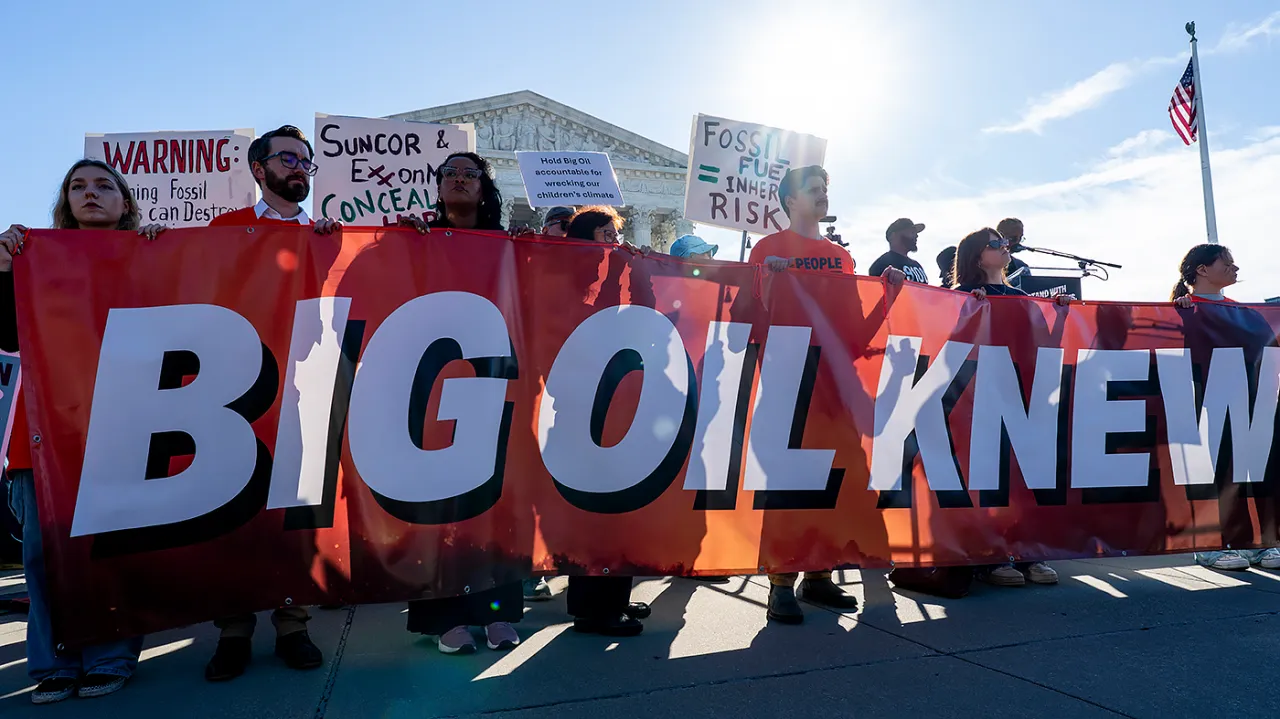
周一,几位最高法院法官似乎对石油公司先发制人阻止气候变化诉讼的请求表示怀疑,该诉讼可能要求他们对气候损害承担责任。许多法官对法院此时受理此案的能力提出质疑。自由派大法官凯坦吉·布朗·杰克逊(Ketanji Brown Jackson)告诉森科尔能源公司律师坎农·尚穆加姆(Kannon Shanmugam):“你与我的同事进行的一些讨论让我认为,我们在此案中还为时过早--从行使其管辖权的法院的角度来看,这有点为时过早。”
Several Supreme Court Justices appeared skeptical Monday of a request from oil companies to preemptively block a climate change lawsuit that could hold them liable for climate damages. Many of the justices raised questions about the court’s ability to even take up the case at this time. "A number of the discussions that you've had with my colleagues make me think that we're really early in this case – that this is sort of premature from the standpoint of this court exercising its jurisdiction," liberal Justice Ketanji Brown Jackson told Suncor Energy lawyer Kannon Shanmugam.
虽然杰克逊的怀疑并不一定令人惊讶,但她的几位保守派同事,即大法官约翰·罗伯茨和尼尔·戈萨奇也向这家化石燃料公司提出了尖锐的问题。森科尔与埃克森美孚一起要求高等法院驳回科罗拉多州最高法院允许诉讼继续进行的裁决。该诉讼称,能源公司在其产品与气候变化的关系上误导公众,造成了公害。该案可能会对全国各地的类似诉讼产生影响,因为各州和地方已起诉石油和其他化石燃料公司,要求赔偿因气候变化而遭受的损失。
While Jackson’s skepticism is not necessarily a surprise, several of her conservative colleagues, namely Justices John Roberts and Neil Gorsuch, also asked tough questions of the fossil fuel firm. Suncor, alongside ExxonMobil, has asked the high court to toss a ruling from the Colorado Supreme Court that allowed a suit to proceed. The suit alleged that the energy companies misled the public about their products’ relationship to climate change and created a public nuisance. The case could have implications for similar litigation around the nation, as states and localities have sued oil and other fossil fuel companies seeking compensation for damages they’ve suffered because of climate change.
法院可以做出三种方式之一的裁决:法官可以明确阻止案件或明确允许案件继续进行,或者他们可以裁定他们目前没有管辖权,这可能会允许案件继续进行,但可能会在稍后的日期将该问题送回高等法院。后两种结果中的任何一种都可能至少是地方的部分胜利,因为他们将能够继续推进自己的案件--至少在短期内是这样。
The court could rule one of three ways: The justices could expressly block the case or expressly allow it to proceed, or they could rule that they don’t have jurisdiction at this point, which could allow the case to move forward, but could see the issue back at the high court at a later date. Either of the latter two outcomes could be at least a partial win for the localities, as they would be able to move ahead with their case — at least in the short term.
博尔德只需要四票赞成就能赢得此案,保守派法官塞缪尔·阿利托已回避。化石燃料公司需要五名法官站在他们一边,因为在分裂的裁决中,下级法院的裁决将有效。
Boulder needs only four votes in its favor to win the case, as conservative Justice Samuel Alito has recused himself. The fossil fuel firms would need five justices on their side because in a split decision, the lower court’s ruling would stand.
当尚穆加姆辩称科罗拉多州法律不应适用于州外能源公司的行为时,罗伯茨询问了一个州的某人是否有可能向所在州的边境扔石头并击中另一个州的人。当该石油公司的律师指出全球变暖的排放不一定是针对科罗拉多州时,罗伯茨回答说:“如果你在[B州],你的目标是[C州],但你击中了[A州]的某人,那没有什么区别,不是吗?”
As Shanmugam argued that Colorado state law shouldn’t apply to the actions of out-of-state energy companies, Roberts asked about the potential for someone in one state to throw a rock over the border of the state they’re in and hit a person in another state. When the oil company’s lawyer noted that planet-warming emissions are not necessarily directed at Colorado, Roberts replied, "If you're in [State] B and you're aiming at [State] C, but you hit somebody in [State] A, that doesn't make a difference, does it?”
然而,目前尚不完全清楚法院将以何种方式裁决,因为法官们还向博尔德县提出了尖锐的问题。罗伯茨说:“据推测,如果你第二天获胜,每个州的市政府都会提起诉讼。”“你认为这在实地效果如何?”博尔德律师凯文·拉塞尔(Kevin Russell)回应道:“还有其他例子表明,行为过程在全国范围内对石棉和其他类型的产品责任诉讼中导致了大规模责任,法院通过诉讼来处理。”
However, it’s not entirely clear which way the court will rule, as the justices also asked tough questions of Boulder County. “Presumably, if you prevail the next day, a municipality in every single state will file a lawsuit,” Roberts said. “How would you think that will work out on the ground?”"There are other examples where a course of conduct causes mass liability across the nation in asbestos, in other kinds of product liability suits, and courts deal with them through litigation,” Boulder lawyer Kevin Russell responded.
“我认为也许石棉有点不同,因为..在做出你所说的那种决定后,它不必被广泛应用,”罗伯茨回答道。“但温室气体排放总会影响到每个州。”法官们还考虑了此案是否与涉及烟草或阿片类产品的州一级诉讼不同。与此同时,由于化石燃料公司和美国政府认为联邦法律优先于博尔德这样的诉讼,因为这个问题具有国家和国际意义,环境保护局最近也表示,《清洁空气法》没有授权它监管汽车或卡车的温室气体排放。
"I think maybe asbestos is a little different, since ... it doesn't have to be applied as broadly after a decision of the sort you're talking about,” Roberts replied. “But there's always going to be greenhouse gas emissions affecting every state.”The justices also considered whether the case was different from state-level suits related to tobacco or opioid products. Meanwhile, as the fossil fuel firms and the U.S. government argued that federal law preempts suits like Boulder’s since this issue is one of national and international significance, the Environmental Protection Agency has also recently said the Clean Air Act does not authorize it to regulate greenhouse gas emissions from cars or trucks.
司法部律师莎拉·哈里斯在诉讼过程中辩称,尽管环保署表示没有权力,但根据联邦法律,像博尔德这样的案件仍被优先考虑,支持石油公司的立场。
Justice Department lawyer Sarah Harris argued during the proceedings that even as the EPA said it does not have the authority, cases like Boulders are still preempted under federal law, backing the oil companies’ position.
“让我们假设美国环保局对温室气体及其监管能力的看法是正确的……假设国会决定‘我们将将其从美国环保局的责任中剔除’。这是否意味着,仅仅因为国会没有将其授予EPA,就不会有联邦普通法诉讼理由?”戈萨奇询问政府律师。哈里斯肯定地回应说:“你谈论的是一个联邦领域,如果国会没有授权,就有理由认为联邦普通法不应该介入并填补空白。”
“Let's just hypothesize EPA is correct about greenhouse gases and its capacity to regulate them … let's say Congress decided ‘we're going to carve that out from EPA's responsibility.’ Does that mean that there couldn't ever be a federal common law cause of action for it just because Congress didn't grant it to EPA?”Gorsuch asked the government lawyer. Harris responded affirmatively, saying, “You're talking about a federal area where if Congress has not authorized it there's reason to think that federal common law shouldn't step in and fill the gaps.”
“所以在《清洁空气法》出台之前,你需要决定一些联邦普通法诉讼原因,但由于《清洁空气法》和国会没有解决这个问题,所以根本没有人可以起诉?”戈萨奇质疑道。
“So before the Clean Air Act, you'd have some federal common law cause of action to decide, but because of the Clean Air Act and Congress not addressing this issue, nobody can sue at all?”Gorsuch questioned.