随着中国私募股权(PE)市场在经历了几年动荡后趋于稳定,全球投资者正在重新调整他们的剧本,以选择性地抓住由纪律和独特的双重货币资本动态定义的成熟市场的机会。
As China’s private equity (PE) market stabilises after a turbulent few years, global investors are recalibrating their playbooks to selectively capture opportunities in a maturing market defined by discipline and distinct dual-currency capital dynamics.
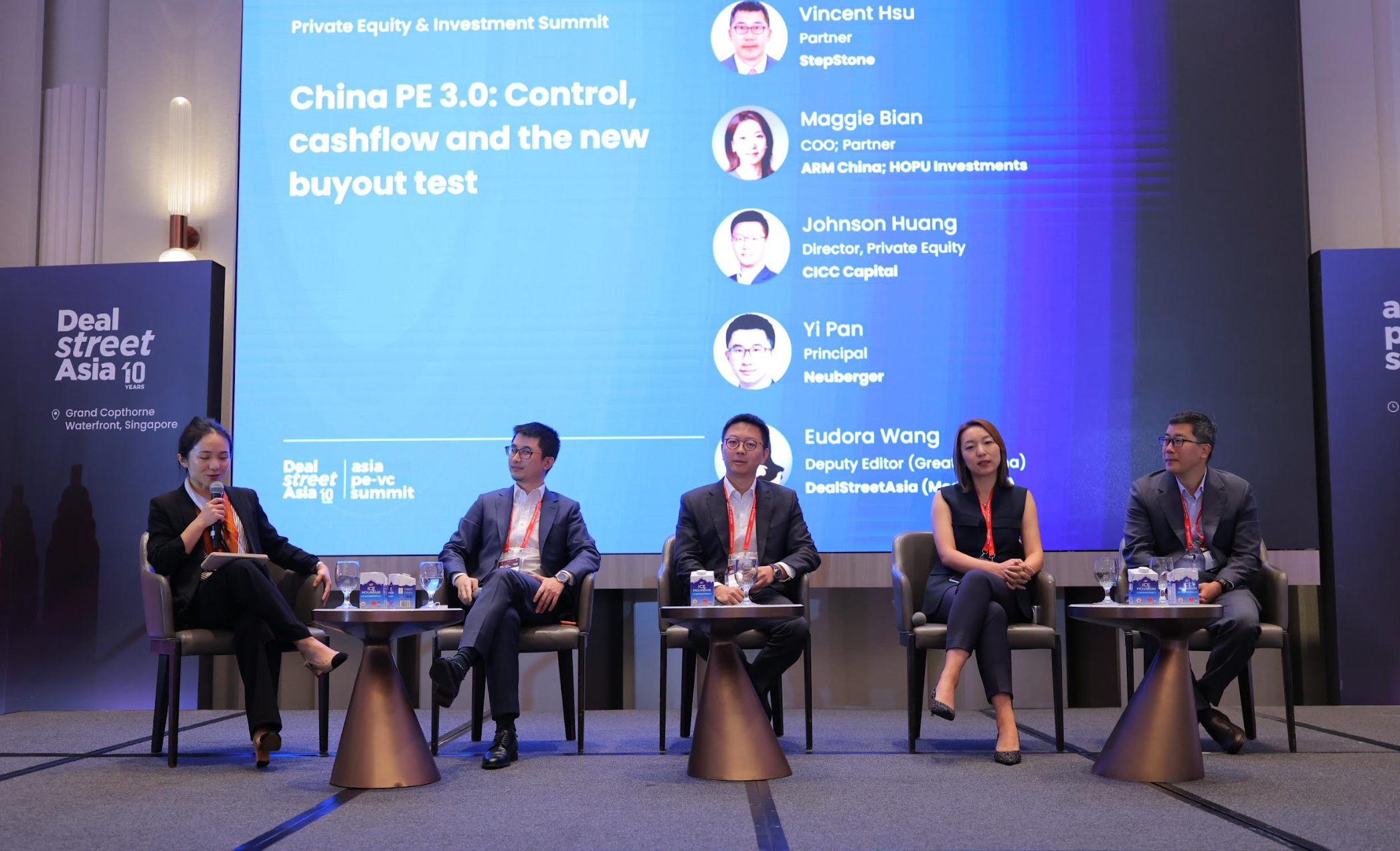
在新加坡举行的DealStreetAsia 2026年亚洲PE-VC峰会期间,在题为“中国PE 3.0:控制、现金流和新的收购测试”的小组会议上发表讲话,以中国为中心的全球和区域投资者在中国不断发展的私募股权格局中规划了一些高信心的机会。
Speaking at a panel titled “China PE 3.0: Control, cashflow and the new buyout test” during DealStreetAsia’s Asia PE-VC Summit 2026 in Singapore, China-focused global and regional investors mapped out some high-conviction opportunities in China’s evolving PE landscape.
私募股权复苏势头强劲,投资者持续谨慎2026年上半年,中国私募股权市场的交易强劲反弹,交易量几乎增长两倍,达到1,209笔,交易价值同比增长86%,达到948亿美元。普华永道8月份发布的一份报告显示,高科技、工业和医疗保健是该市场私募股权投资者最看重的三大行业,反映出与国家政策优先事项密切一致。
Disciplined PE recovery meets persistent investor caution Dealmaking in China’s PE market staged a strong comeback in the first half of 2026, with deal volume almost tripling to 1,209 and deal value surging 86% year-on-year (YoY) to $94.8 billion. High tech, industrials and healthcare were the top three sectors for PE investors in this market, reflecting a close alignment with national policy priorities, according to a PwC report released in August.
StepStone合伙人Vincent Hsu表示,以中国为重点的私募股权美元融资也在趋于稳定,在经历了2022年后缓慢的部署期后,许多规模可观的基金今年重返市场融资。
China-focused PE fundraising in US dollars is also stabilising, with a number of sizeable funds returning to the market for fundraising this year following a slow deployment period post-2022, said Vincent Hsu, a partner at StepStone.
徐表示:“亮点之一肯定是风险投资方面。”他指出,全球投资者为减少美国过度集中并在其他地方寻求更高的增长潜力而从美国资产中撤出,这为非美国有限责任公司投资中国早期风险投资(VC)市场提供了“绝佳机会”。
“One of the brighter spots is definitely on the venture side,” said Hsu, noting that a pullback from US assets by global investors to reduce over-concentration in the US and seek higher growth potential elsewhere has offered “a great opportunity” for non-US LPs to invest in China’s early-stage venture capital (VC) market.
随着2021-22年市场高峰期间筹集的资金全部部署,一群专注于中国的全科医生将回来进行新的筹款活动。英国《金融时报》8月2日报道援引私募市场配股公司Asante Capital的话说,该公司积极筹款,为至少60只新的专注于中国的美元基金寻求约350亿美元,其中包括约40只风险投资基金。
As funds raised during the 2021-22 market peaks reach full deployment, a group of China-focused GPs are coming back for new fundraising campaigns. Private markets placement firm Asante Capital, cited in an August 2 Financial Times story, recorded active fundraising efforts seeking an estimated $35 billion for at least 60 new China-focused USD funds, including about 40 VC funds.
半年的GP筹款结果显示了返回全球LP的选择性。虽然人民币资本保持其主导地位,但LP对以中国为重点的外币基金(主要是美元基金)的承诺在上半年同比飙升122.5%,至67亿美元。但根据中国私募市场研究机构清科研究(Zero2IPO Research)的数据,有限合伙人的美元配置仍具有高度选择性,新关闭的美元基金数量下降9.5%,仅为19只。
The half-year GP fundraising results showcased the selective nature of returning global LPs. While RMB capital maintained its dominance, LP commitments to China-focused, foreign-currency funds—predominantly in US dollars—surged 122.5% YoY to $6.7 billion in H1. But LP allocations in US dollars remained highly selective, with the number of newly closed USD funds falling 9.5% to just 19, according to Chinese private markets researcher Zero2IPO Research.
“我们看到了更多的交易,但这并不是由普通合伙人筹集更多资金推动的。这在一定程度上给了我一点安慰,即(中国私募股权)复苏在某种程度上是有规律的,因为它不是流动性驱动的,”Neuberger负责人Yi Pan表示。
“We are seeing more deals, but that’s not driven by GPs raising more money. That in part gives me a little bit of comfort that this [China PE] recovery is in a way disciplined because it is not liquidity-driven,” said Yi Pan, a principal at Neuberger.
负责Neuberger在大中华区私募股权投资的Yi在基金投资和联合投资方面观察到,中国的普通合伙人已经改变了他们的承销模式,在很大程度上消除了倍数扩张作为基线回报驱动因素。相反,即使在以折扣进入倍数收购资产时,基金经理也会将估值压缩作为基线承销假设进行定价。
Yi, who leads Neuberger’s PE investments in Greater China across both fund investments and co-investments, observed that Chinese GPs have altered their underwriting models by largely eliminating multiple expansion as a baseline return driver. Instead, managers are pricing in valuation compression as a baseline underwriting assumption even when acquiring assets at discounted entry multiples.
随着中国经济增长势头放缓,专家们强调,中国私募股权市场已从宏观驱动的扩张转向了一个由严格的融资、选择性投资、运营价值创造和结构性退出定义的时代。
As the country’s economic momentum slows, panellists highlighted that its PE market has shifted from macro-driven expansion to an era defined by disciplined fundraising, selective investing, operational value creation and structured exits.
在中国,国内有限合伙人也在全科医生选择过程中执行不可协商的基金绩效标准。CICC Capital私募股权部门董事Johnson Huang透露,该公司的投资委员会现在对“DPP(对实缴资本的分配)实行严格的硬门”:要有资格获得CICC Capital的LP支票,关键先决条件之一是潜在的GP必须拥有至少一只之前的基金达到1.0倍或更高的DPA。
Within China, domestic LPs are also enforcing non-negotiable fund performance criteria in their GP selection process. Johnson Huang, a director at CICC Capital’s PE department, revealed that the firm’s investment committee now applies “a strict hard gate for DPI (Distributions to Paid-In Capital)”: To qualify for an LP cheque from CICC Capital, one of the key prerequisites is that prospective GPs must have at least one prior fund achieving 1.0x DPI or higher.
中国私募股权市场采用更严格的指标之际,全球投资者对中国的情绪正在慢慢从彻底回避转向谨慎、选择性的重新参与。但结构性限制仍然存在。
The adoption of more disciplined metrics in China’s PE market comes as global investor sentiment towards China is slowly shifting from outright avoidance to cautious, selective re-engagement. But structural constraints remain.
StepStone的Hsu表示,从LP的角度来看,全球投资者对中国保持谨慎,原因有几个。“部分原因是地缘政治,但另一部分是他们现有的中国投资组合表现不佳。在这个问题以某种方式得到解决之前--无论是通过作为发行回来的退出还是仅仅是估值上升--问题仍然存在。”两种货币,两种剧本中国私募股权市场已经卷土重来,但它与全球投资者在人民币和美元策略分歧中留下的市场不同。
From an LP perspective, global investors remain cautious about China for a few reasons, said StepStone’s Hsu. “Part of that is geopolitical, but another part is their existing China portfolios are underperforming. Until that somehow gets resolved—whether through exits that come back as distributions or simply an uptick in valuations—the issues remain.”Two currencies, two playbooks China’s PE market has made a comeback, but it is a different market from the one that global investors left behind amid a bifurcation between RMB and USD strategies.
根据中国Zero 2 IPO Research的数据,上半年,人民币计价的股权投资基金占据了该市场LP承诺总额的90%以上。在交易撮合方面,其私人市场的资本部署相对更加平衡:人民币交易占总投资价值的近71%,而主要以美元计价的外币交易占剩余的29%。
In H1, RMB-denominated equity investment funds commanded well over 90% of total LP commitments in this market, according to China’s Zero2IPO Research. In terms of dealmaking, capital deployment in its private markets was relatively more balanced: RMB deals accounted for nearly 71% of total investment value, while foreign-currency deals, largely denominated in US dollars, contributed to the remaining 29%.
这种双货币动态创造了独特的投资和退出途径。“对于控制权收购来说,这种界限并不那么引人注目。但在风险和增长方面,它更多地是由行业驱动的,某些行业更容易受到地缘政治考虑的影响,”Neuberger的Pan说。
This dual-currency dynamics have created distinct investment and exit pathways. “The delineation is less remarkable for control buyouts. But in venture and growth, it is more sector-driven, with certain sectors more susceptible to geopolitical considerations,” said Neuberger’s Pan.
“出于监管或退出考虑,许多公司正在接受更多的人民币而不是美元。”
“A lot of the companies, because of regulatory or exit considerations, are taking more RMB instead of USD.”
与此同时,一些全球和区域投资者正在逐步进军人民币市场,筹集人民币资金在双货币结构下运营,通过合格外国有限合伙企业(QFLP)制度在基金层面建立在岸实体或将外资转换为人民币,以探索在岸机会并保持部署灵活性潘说。“最重要的信息是,探索美元和人民币市场有不同的方式。”
Meanwhile, several global and regional investors are gradually expanding into the RMB market, raising RMB funds to operate under a dual-currency structure, building onshore entities or converting foreign capital into Chinese yuan at the fund level through the Qualified Foreign Limited Partnership (QFLP) regime to explore onshore opportunities and preserve deployment flexibility, said Pan. “The overarching message is there are different ways to explore both the USD and RMB markets.”
在人民币与美元的承保标准、资金条款和退出路线存在分歧的领域,黄总结了中金资本的核心运营差异:“对于人民币市场,我们越来越接近政府。对于美元,我们正在接近该行业。”鉴于中金资本的母公司是部分国有的中国金融服务集团中金,他的人民币私募股权团队在从初创企业孵化和早期风险投资到成长阶段私募股权和公开上市的整个生命周期中与政府实体密切合作。
In areas where underwriting standards, fund terms and exit routes between RMB and USD diverge, Huang summarised CICC Capital’s core operational difference: “For the RMB market, we’re getting closer to the government. For USD, we’re getting close to the industry.”Given CICC Capital’s parentage being the partially state-owned Chinese financial services group CICC, his PE team on the RMB side collaborates closely with government entities across the full lifecycle from startup incubation and early-stage VC to growth-stage PE and public listings.
黄举了一个例子,由北京市人民政府提供的200亿元人民币(30亿美元)种子的中金公司资本管理的人民币风险投资基金(FOF),迄今为止,该基金已承诺向78家中国全科医生提供服务。
As an example, Huang cited a CICC Capital-managed, RMB VC fund-of-funds (FOF) seeded with 20 billion yuan ($3 billion) from the Beijing Municipal People’s Government, which has committed to 78 Chinese GPs to date.
他还主持着一个由小米公司、腾讯控股和字节跳动等捐赠者支持的16亿元人民币(合2387亿美元)的非营利基金会。黄表示,该基金会专注于医疗保健创新,实际上“垄断”了来自北京顶级医院的交易。
He also chairs a 1.6-billion-yuan ($238.7 billion) non-profit foundation backed by donors such as Xiaomi Corp, Tencent Holdings and ByteDance. Focused on healthcare innovations, the foundation has effectively “monopolised” deal sourcing from top hospitals in Beijing, according to Huang.
相比之下,在美元方面,中金资本与阿斯利康合作建立了价值10亿美元的阿斯利康-中金医疗保健投资基金等联合工具,目前正在与一家德国生物制药公司合作开发另一只美元基金,黄说,该战略正在“更接近工业参与者”。
In comparison, on the USD side, where CICC Capital has built joint vehicles like the $1-billion AstraZeneca-CICC Healthcare Investment Fund in collaboration with AstraZeneca and is now partnering with a German biopharma company on another USD fund, the strategy is being “closer to industrial players,” said Huang.
黄援引中国国家药品监督管理局的官方数据表示,中国蓬勃发展的创新药业务开发(BD)外授权市场在上半年达到约1100亿美元的历史新高,已占2025年全年总额的80%,这证明产业合作伙伴关系已成为退出的关键。
Citing official data from China’s National Medical Products Administration, Huang said that China’s booming innovative drug business development (BD) out-licensing market reaching a record high of about $110 billion in H1, already 80% of 2025’s full-year total, is evidence that industrial partnerships have become critical for exits.
随着通过传统可变利益实体(VIE)结构的海外上市几乎停止,黄表示“我们需要找到新的退出方法”,并指出授权交易是中国医疗保健资产的重要途径。
With overseas listings via traditional Variable Interest Entity (VIE) structures virtually halted, Huang said “we need to find new exit methods,” pointing to out-licensing deals as a vital pathway for healthcare assets in China.
此外,这种货币分裂在二级市场内造成了对比鲜明的动态。负责StepStone在亚洲的私募股权初选、二级投资和联合投资的Hsu表示,在优质资产和某些寻求流动性的有限合伙人的推动下,GP主导的美元延续工具(CV)在中国正在增加。但由于持续较大的买卖价差,LP主导的美元二级债券仍然稀缺。人民币方面,动态有所不同。
Furthermore, this currency split has created contrasting dynamics within the secondary market. Hsu, who covers StepStone’s PE primaries, secondaries and co-investments in Asia, said that GP-led USD continuation vehicles (CVs) are increasing in China driven by quality assets and certain LPs seeking liquidity. But LP-led USD secondaries remain scarce due to persistently wide bid-ask spreads. On the RMB side, the dynamic is different.
“大量人民币资本投资于往往与科技相关的基金,而且卖家非常积极,与美元卖家截然不同,”徐说。
“You have a lot of RMB capital invested in funds that tend to be more tech-related, and you have very motivated sellers who are very different from USD sellers,” said Hsu.
许多卖家愿意在持有资产几年后以相当大的折扣出售,优先考虑资本回收而不是回报最大化。他表示:“如果你想更多地接触高科技资产,人民币二级市场可能是更好的选择。”
Many of these sellers are willing to sell at meaningful discounts after holding the assets for a few years, prioritising capital recycling over return maximisation. “If you want more access to high-tech assets, the RMB secondary market is probably the better way to go,” he said.
随着控制权机会的增加,PE与人才短缺作斗争在一个成熟的PE市场,控制权收购机会也在出现,美元和人民币资本之间的操作区别不那么明显。
PE battles talent shortage as control opportunities rise In a maturing PE market where control buyout opportunities are also emerging, the operational distinction between USD and RMB capital is less pronounced.
虽然中国的私募市场仍主要由风险和增长驱动,但投资者预计,在几宗涉及跨国公司将其中国业务转移到当地所有权的大额交易之后,这个市场将有更多的控制权收购机会,以应对日益激烈的国内竞争和挥之不去的地缘政治风险。
While China’s private markets remain mostly venture- and growth-driven, investors expect more control buyout opportunities in this market after several big-ticket transactions involving MNCs transitioning their China operations to local ownership to combat growing domestic competition and lingering geopolitical risks.
然而,执行跨境控制交易和创造交易后价值仍然面临一个重大限制:中国和亚洲各地经验丰富的私募股权运营人才严重短缺。
However, executing cross-border control deals and creating value post-transaction still face a major constraint: a severe shortage of experienced operational PE talent in China and across Asia.
HOPU Investments合伙人Maggie Bian在2025年向有限合伙人返还了12亿美元,详细介绍了这家专注于亚洲、以控制为导向的另类资产管理公司如何通过三部分战略解决人才短缺问题。
Having retuned $1.2 billion to LPs throughout 2025, HOPU Investments partner Maggie Bian detailed how the Asia-focused, control-oriented alternative asset management firm addresses this talent deficit through a three-part strategy.
卞表示,该公司已建立了一个由10多名运营顾问组成的网络,其中包括各个行业经验丰富的首席执行官、首席财务官和首席营销官,拥有国内市场专业知识和国际扩张专业知识来支持跨境价值创造。虽然HOPU与更广泛的亚洲顶级高管保持联系,担任潜在的私募股权支持的领导职位,但它还要求通常将6-12个月的内部团队借调到投资组合公司,以便随时随地推动实际改造。
Bian said that the firm has built a network of over 10 operating advisors, including experienced CEOs, CFOs and CMOs across various sectors with both domestic market expertise and international expansion know-how to support cross-border value creation. While HOPU maintains its connections with a broader pool of top Asian executives for potential PE-backed leadership roles, it also mandates typically 6-12 months of internal team secondments into portfolio companies to drive hands-on revamps whenever and wherever needed.
“在我们考虑交易的同时,我们也在不断评估我们能够利用的人才库。因为没有人才,交易实际上就不会发生。这笔交易本身可能是有意义的,但当我们看到运营杠杆,这是人才真正发挥作用,“卞说。“当我们完成交易的时候--比如说,30天前--你可能需要一个管理团队准备加入。”除了管理转型之外,卞还强调了HOPU的三个关键交易后价值创造杠杆,包括通过新渠道和本地合作伙伴关系扩大收入、提供跨境监管见解和探索强化收购。
“While we’re looking at deals, we’re constantly assessing the talent pool we’re able to tap into. Because without talent, a deal actually cannot happen. The deal itself might make sense, but when we look at the operational levers, that’s where talent really comes into play,” said Bian. “By the time we get the deal done—say, day minus 30—you probably need to have a management team ready to come on board.”Alongside management transformation, Bian also highlighted three key post-deal, value-creation levers for HOPU, including expanding revenue through new channels and local partnerships, providing cross-border regulatory insights and exploring bolt-on acquisitions.
ARM中国就是一个典型的例子,该公司于2018年由HOPU领导的财团以7.75亿美元从总部位于英国的Arm Holdings分拆出来。在HOPU金融和中国市场网络的支持下,ARM中国转向建立本地生态系统,为中国客户提供量身定制的半导体架构,2017年至2022年间,其收入增加了两倍。
A prime example is ARM China, which was carved out by a HOPU-led consortium in 2018 from UK-headquartered Arm Holdings for $775 million. Supported by HOPU’s financial and Chinese market network, ARM China pivoted to building a local ecosystem to offer semiconductor architectures tailored to Chinese clients, which tripled its revenue between 2017-2022.
卞本人于2025年接任ARM中国首席运营官,指导其中国扩张,并指出ARM中国“有望实现今年最高的利润之一”。其他价值创造策略,例如帮助投资组合公司应对亚洲的监管格局和执行强化收购,推动了包括HOPU少数股权法国动物保健公司Ceva Animal Health和区域物流巨头普洛斯在内的资产的收入增长和全球扩张。
Bian herself stepped in as ARM China’s COO in 2025 to steer its China expansion, noting that ARM China is “on track to deliver one of its highest profits this year.”Other value-creation strategies, such as helping portfolio companies navigate Asia’s regulatory landscapes and execute bolt-on acquisitions, have driven revenue growth and global expansion for assets including HOPU’s minority-owned French animal health company Ceva Animal Health and regional logistics giant GLP.