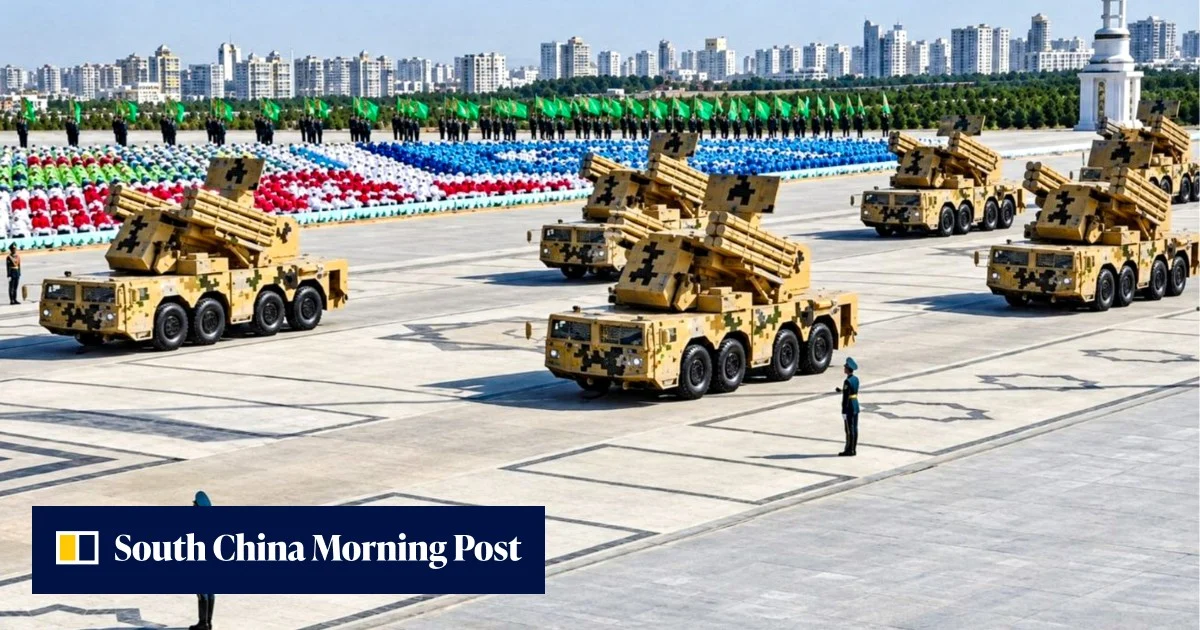
土库曼斯坦已将FK-2000导炮合一防空系统纳入其不断扩充的中国制造防空武器库,凸显了北京在曾由俄罗斯主导的中亚武器市场上日益扩大的角色。
Turkmenistan has added the FK-2000 missile-and-gun system to its growing arsenal of Chinese-made air defences, highlighting Beijing’s expanding role in the Central Asian weapons market once dominated by Russia.
在9月27日阿什哈巴德举行的土库曼斯坦独立日阅兵录像中,可以看到至少10辆FK-2000战车,以及一系列其他中国制造的军事装备。
At least 10 FK-2000 vehicles – along with an array of other Chinese-made military equipment – could be seen in footage of Turkmenistan’s Independence Day parade in Ashgabat on September 27.
该系统由国有企业中国航天科工集团研发,是一种机动防空系统,集成了导弹、双管30毫米(1.1英寸)高射炮、车载雷达和光电传感器。
Developed by the state-owned China Aerospace Science and Industry Corporation, the FK-2000 is a mobile air defence system combining missiles and twin 30mm (1.1 inches) cannons with on-board radar and electro-optical sensors.
该系统旨在拦截飞机、直升机、无人机和精确制导武器等空中威胁。
The system is designed to counter aerial threats including aircraft, helicopters, drones and precision-guided weapons.
据官方《解放军报》报道,其导弹可在1.2公里(0.75英里)至25公里范围内打击飞机,也可在1.2公里至10公里范围内拦截巡航导弹等精确制导弹药。
Its missiles can target aircraft at ranges between 1.2 kilometres (0.75 miles) and 25 kilometres, according to the state-run People’s Liberation Army Daily newspaper.
阅兵中展示的其他土库曼斯坦装备的中国制造装备还包括大疆御30T无人机和北方工业的“天坛”FX80无人机。
Its missiles can also target precision-guided munitions, including cruise missiles, at ranges between 1.2 kilometres and 10 kilometres.
还展示了一款土库曼斯坦官方媒体认定为“YLS-18A”的雷达。虽然其型号酷似中国的YLC-18A,但《南华早报》根据公开图像进行的对比发现,两者在车辆配置上存在差异。
Other paraded Chinese-made equipment in Turkmen service included DJI Matrice 30T drones and Norinco’s Sky Saker FX80 unmanned aerial vehicle. Also displayed was a radar officially identified by Turkmen state media as a “YLS-18A”.
阅兵录像显示,该雷达车紧随中国制造的DWL-002电子侦察系统之后。
While its designation resembles that of China’s YLC-18A, a comparison by the SCMP based on publicly available images found differences in the vehicle configuration.
该雷达的确切型号仍不清楚,但它与DWL-002同框亮相,凸显了土库曼斯坦防空库存中已拥有的多种中国制造传感器。
Parade footage showed the vehicle immediately ahead of Chinese-made DWL-002 electronic surveillance systems.
目前也不清楚土库曼斯坦的中国制造传感器和导弹系统通过统一的指挥、控制和通信网络联网的程度如何。
The precise identity of the radar remains unclear, but its appearance alongside the DWL-002 underscores the range of Chinese-made sensors already in Turkmenistan’s air-defence inventory.
早在2016年,土库曼斯坦就已经部署了中国制造的FM-90、KS-1A和FD-2000型地对空导弹系统,以及YLC系列雷达。
It also remains unclear how extensively Turkmenistan’s Chinese sensors and missile systems are linked through a common command, control and communications network.
一位熟悉中国武器系统的分析人士称,这些最新采购的装备似乎是中国设备助力土库曼斯坦空军防御体系全面现代化的一部分。
As far back as 2016, Turkmenistan was already displaying Chinese-made FM-90, KS-1A and FD-2000 surface-to-air missile systems alongside YLC-series radars.
FK-2000系统在部分功能上与短程FM-90存在重叠,但它将导弹、火炮和自身传感器整合到一个高度机动的单一平台上,为土库曼斯坦部队提供了应对低空威胁(包括无人机和精确制导武器)的另一种选择。
alyst familiar with Chinese systems said the latest acquisitions appeared to be part of a broader modernisation of Turkmenistan’s air defences using Chinese equipment.
长期以来,土库曼斯坦一直在减少对俄罗斯武器的依赖,并增加了来自土耳其、意大利和以色列的武器供应商。因此,此次采购中国装备是其更广泛采购战略的一部分,而非全面转向北京。
The FK-2000 partly overlaps with the short-range FM-90 but combines missiles, cannon and its own sensors on a single highly mobile platform, giving Turkmen forces another option against low-altitude threats including drones and precision-guided weapons. Turkmenistan has long been diversifying away from Russian arms, adding suppliers from Turkey, Italy and Israel, making the latest Chinese additions part of a broader procurement strategy rather than a wholesale shift towards Beijing.
不过,这些最新装备的引入也值得关注,因为它们凸显了中国作为武器供应商在中亚最封闭、名义上保持中立的国家之一中所扮演角色的扩大。
Yet the latest additions are also notable because they highlight China’s expanding role as a weapons supplier to one of Central Asia’s most closed and formally neutral states.
总部位于华盛顿的思想智库“国防优先”亚洲项目主任莱尔·戈德斯坦表示,土库曼斯坦与伊朗接壤的漫长边界,以及阿什哈巴德与伊朗的地理邻近性,也可能是其加强防空兴趣的一个因素。
Lyle Goldstein, director of the Asia programme at the Washington-based think tank Defence Priorities, said Turkmenistan’s long border with Iran and Ashgabat’s proximity to the country could also be a factor in its interest in strengthening air defences.
自2月以来,伊朗与美国和以色列处于战争状态,导弹和无人机在冲突中发挥了重要作用。尽管近几周敌对行动基本暂停,但谈判陷入僵局,美国对伊朗港口的海上封锁也仍在持续。
Iran has been at war with the United States and Israel since February, with missiles and drones playing a major role in the fighting. Hostilities have largely paused in recent weeks, but talks have stalled and a US naval blockade of Iranian ports remains in place.
“我完全可以理解,地处活跃战区附近的土库曼斯坦会非常担忧,”戈德斯坦说,并补充称,这可能会使该国更愿意投资其武装部队,“尤其是在升级防空(反无人机)系统方面”。与此同时,北京也在中亚其他地区扩大了其军事出口。
“I could imagine that Turkmenistan is very concerned to be located next to an active war zone,” Goldstein said, adding that this could make the country more willing to invest in its armed forces, “perhaps especially in upgrading its air (drone) defences”. This comes as Beijing has also been expanding its military exports elsewhere in Central Asia.
乌兹别克斯坦使用中国制造的防空系统,并于8月确认采购了J-10CE战斗机;而塔吉克斯坦则使用中国的HQ-17AE短程防空系统。
Uzbekistan operates Chinese-made air-defence systems and in August confirmed the acquisition of J-10CE fighters, while Tajikistan operates the Chinese HQ-17AE short-range air-defence system.
网上流传的影像似乎显示,一架Y-9E军用运输机带有哈萨克斯坦防空部队的标志,但哈萨克斯坦和中国均未公开确认采购该机型。
Footage circulating online appears to show Y-9E military transport aircraft bearing Kazakh Air Defence Force markings, although neither Kazakhstan nor China has publicly confirmed an acquisition.
戈德斯坦表示,这一趋势也反映出俄罗斯需要将防空生产能力用于满足自身需求,尤其是应对乌克兰的远程攻击;与此同时,中国军事技术的进步正在为北京打开新的市场。
Goldstein said the trend also reflected Russia’s need to devote its air defence production to its own requirements, particularly to counter Ukraine’s long-range attacks, while advances in Chinese military technology were opening new markets for Beijing.
“俄罗斯目前分身乏术,而且资源也相当紧张,”他说,并补充道,北京“在军事技术领域的崛起正在为中国武器出口开辟新的市场”。
“Russia is distracted and also quite tapped out,” he said, adding that Beijing’s “rise through the ranks of military technology is opening up new markets for Chinese arms exports”.
2024年里海政策中心的一项分析发现,2021年至2023年俄罗斯向中亚交付的武器比上一十年同期减少了23%,而俄罗斯在新承诺武器中的份额(按数量计算)下降了35%。斯德哥尔摩国际和平研究所的最新数据也显示,俄罗斯武器出口出现了更大幅度的下降。
A 2024 Caspian Policy Center analysis found Russian arms deliveries to Central Asia in 2021–23 were 23 per cent lower than comparable levels in the previous decade, while Russia’s share of newly promised weapons by volume fell by 35 per cent. More recent data from the Stockholm International Peace Research Institute also show a sharp wider decline in Russian arms exports.