帕梅拉·图利佐(Pamela Tulizo)最新的一组摄影作品始于一个问题。“我问自己,为什么我社区里的女性,以及非洲女性总体而言,如此坚强?”这位来自刚果民主共和国的艺术家兼摄影师图利佐说,“这种力量源自何处?”在刚果东部城市戈马长大的图利佐,深受周围女性的熏陶与启发,其中包括她的母亲、姐妹、母亲的朋友以及邻居。
Pamela Tulizo’s latest series of photographs started with a question. “I asked myself, why are woman in my community in particular, and African woman in general, so strong?” says Tulizo, an artist and photographer from the Democratic Republic of the Congo. “Where does this strength come from?”Growing up in Goma in eastern DRC, Tulizo was informed and inspired by the women she was surrounded by, including her mother, her sisters, her mother’s friends and her neighbours.
多年后,当她开始探究女性在非洲历史上的角色时,她说:“我意识到,或许自远古以来,女性就被迫变得坚强,被环境逼迫建立起这种韧性。”她的研究将她引向了奴隶制,那段“人类历史上最残酷的时期”,它通常只与被迫跨洋沦为海外劳工的男性联系在一心。她注意到,女性在很大程度上是隐形的,她们的故事无人讲述。
Years later, when she began to look into the role of women throughout African history, she says: “I realised that perhaps women have been forced to be strong since the dawn of time, forced by circumstance to build that resilience.”Her research brought her to slavery, the “cruellest period in human history”, which is often just associated with the men who were forced across oceans to form workforces abroad. Women, she noticed, were largely invisible, their stories untold.
怀揣着这一念头,图利佐将女性置于她这组名为《Mababu》(斯瓦希里语意为“祖先”)的23幅摄影作品的核心位置。在其中,她演绎了金巴·维塔(Kimpa Vita)和恩津加女王(Queen Nzinga)等人物,她们都因在17世纪和18世纪初抵抗欧洲对非洲的殖民而闻名。
With that in mind, Tulizo placed women at the centre of her series of 23 staged photographs called Mababu (“ancestors” in Swahili). In it, she portrays figures such as Kimpa Vita and Queen Nzinga, who were both renowned for resisting the European colonisation of Africa in the 17th and early 18th century.
“由于种族主义,一直存在着一种对非洲女性的贬低,将她们描绘为脆弱、受害者,并暗示她们缺乏力量或智慧,”图利佐说。
“Because of racism, there’s always been this belittling of African women that portrays them as vulnerable, as victims, and suggests they lack strength or intelligence,” says Tulizo.
“我想终结这种叙事,展示尽管她们忍受了一切,依然坚强不屈,为自由而战。”图利佐的摄影之路并非一帆风顺——部分原因,她认为,是因为她是女性。她最初以记者身份起步,但当她感到无法用文字记录所有想报道的内容时,决定专注于摄影。
“I wanted to end that narrative by showing that despite everything they endured, they remained strong and fought for freedom.”Tulizo’s path to photography has not been easy – in part, she believes, because she is a woman. She started her career as a reporter but decided to focus on photography when she felt she could not write about everything she wanted to cover.
在戈马没有接受摄影培训的地方,她只能抓住一切机会拍照,最终成为这座为数不多的女性摄影师之一。
There was nowhere to train as a photographer in Goma so she took photos whenever she could, and became one of a handful of female photographers in the city.
“一开始这并不容易,因为我在我的早期没有榜样可以效仿,也没有任何人来指导我,”她说。“社区并没有立即接受我--无论是我的父母,甚至是其他摄影师--因为这在很大程度上是一个男性主导的世界。
“It wasn’t easy at first because I didn’t have a role model to follow, or anyone to guide me in my early days,” she says. “The community didn’t accept me right away – whether it was my parents, or even other photographers – since it was very much a male-dominated world.
“但面临这么多障碍促使我坚持到底,并证明我可以成为一名女性和一名摄影师,”她说。
“But facing so many obstacles motivated me to stick it out to the end and prove that I could be a woman and a photographer,” she says.
2020年,她的作品《双重身份》荣获迪奥年轻人才摄影和视觉艺术奖,该系列作品将媒体对刚果妇女受害者的描绘与她们的真实身份进行了对比。这使她能够资助2021年在戈马为妇女和女孩创建文化中心Tulizo Elle Space。2025年初,当该地区再次爆发暴力事件时,她逃离,现在住在法国。
In 2020, her work Double Identity won the Dior photography and visual arts award for young talents, a series that contrasted the media portrayal of Congolese women as victims with their true identities. This allowed her to finance the creation in 2021 of a cultural centre in Goma for women and girls, Tulizo Elle Space. When renewed violence broke out in the region in early 2025, she fled and now lives in France.
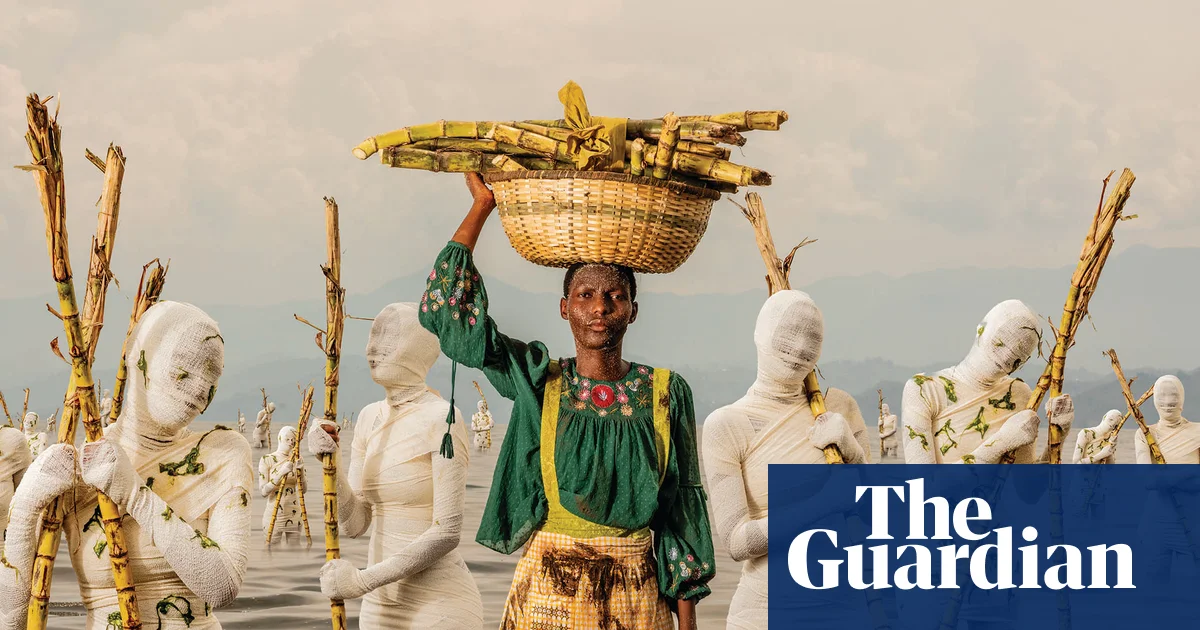
她对待自己的最新系列作品《Mababu》就像在拍电影一样,利用演员、服装、化妆和户外布景的电影舞台来创造生动的场景。
She approached her latest series of work, Mababu, as if she were making a film, using cinematic staging with actors, costumes, makeup and outdoor sets to create vivid scenes.
其中一幕是,一名妇女站在基伍湖,手里拿着一篮子棉花、烟草或甘蔗,周围是其他缠着绷带的妇女(包裹尸体是葬礼仪式中的常见做法)。这些照片是在戈马和比利时拍摄的,是挑衅性的,也没有掩盖过去的苦难。
In one set, a woman stands in Lake Kivu holding a basket of either cotton, tobacco or sugar cane, and surrounded by other women bound in bandages (wrapping the body being a common practice in funeral rituals). The images, which were shot in Goma and Belgium, are defiant, and do not gloss over past suffering.
时尚是该系列的重要元素,图利佐用它来提升女性并向女性致敬。她用颜色、配饰和造型来表达希望、勇气和力量。图利佐说,在某些图像中,当一名女性被束缚或受苦时,她仍然通过帽子、衣服或手套被抬高。
Fashion is a crucial element of the series and Tulizo uses it to elevate and pay tribute to women. She uses colour, accessories and styling to express hope, courage and strength. In some images, where a woman is bound or suffering, she is still elevated through a hat, dress or gloves, says Tulizo.
“对我来说,她仍然是一位女英雄,时尚让我向她致敬,给予她应有的力量和力量,”她说。
“To me, she remains a heroine, and fashion allows me to honour her, giving her the strength and power she deserves,” she says.
一些照片包含了自然资源的图像。开场作品的标题-- Tumbako、Miwa和Pamba --指的是烟草、甘蔗和棉花,这三种商品在助长跨大西洋奴隶贸易方面发挥了核心作用。“奴隶制并不是在真空中发生的,”图利佐说。“这是出于对自然资源的追求。”这些照片呼应了刚果民主共和国东部今天正在发生的事情,数十年来对丰富矿产资源的竞争引发了毁灭性的冲突和性暴力。
Some of the photos incorporate images of natural resources. The titles of the opening works – Tumbako, Miwa and Pamba – refer to tobacco, sugar cane and cotton, three commodities that played a central role in fuelling the transatlantic slave trade. “Slavery did not happen in a vacuum,” says Tulizo. “It was driven by the pursuit of natural resources.”The photos echo what is going on today in eastern DRC, where devastating conflict and sexual violence have been driven by decades of competition over rich mineral resources.
图利佐说:“遗憾的是,今天我们正在经历一种由技术、发展和全球进步驱动的现代形式的奴隶制。”“当时是烟草、糖和咖啡。如今,锂、黄金和矿产的战争和性暴力成为焦点。
“Regrettably, today we are experiencing a modern form of slavery driven by technology, development and global progress,” says Tulizo. “Back then it was tobacco, sugar and coffee. Today it is war and sexual violence over lithium, gold and minerals.
“每个人都想征服世界,成为第一个生产电动汽车的国家,或者成为拥有核武器的全球领先大国。如果没有这些原材料,这一切都是不可能的。
“Everyone wants to conquer the world, to be the first to produce electric cars, or to be the leading global power with nuclear weapons. None of that is possible without these raw materials.
“不幸的是,”图利佐补充道,“人类还没有吸取教训,我们正在以现代形式重复同样的错误。”
“Unfortunately,” Tulizo adds, “humanity has not learned its lesson, and we are repeating the same mistakes in a modern form.”
帕梅拉·图利佐(Pamela Tulizo)的《Mababu --祖先的精神》(Spirit of the Ancestors)将于10月8日至31日在布鲁塞尔GC De Markten举行,作为布鲁塞尔自由大学文化外交倡议的一部分
Mababu – Spirit of the Ancestors by Pamela Tulizo is at GC De Markten, Brussels, as part of the Vrije Universiteit Brussel cultural diplomacy initiative, from 8 to 31 October