罗宾·胡(Robin Hu)是米尔肯研究所(Milken Institute)名誉亚洲主席,同时也是淡马锡控股(Temasek)的高级顾问董事。
Robin Hu is Emeritus Asia chairman of the Milken Institute, and advisory senior director at Temasek.
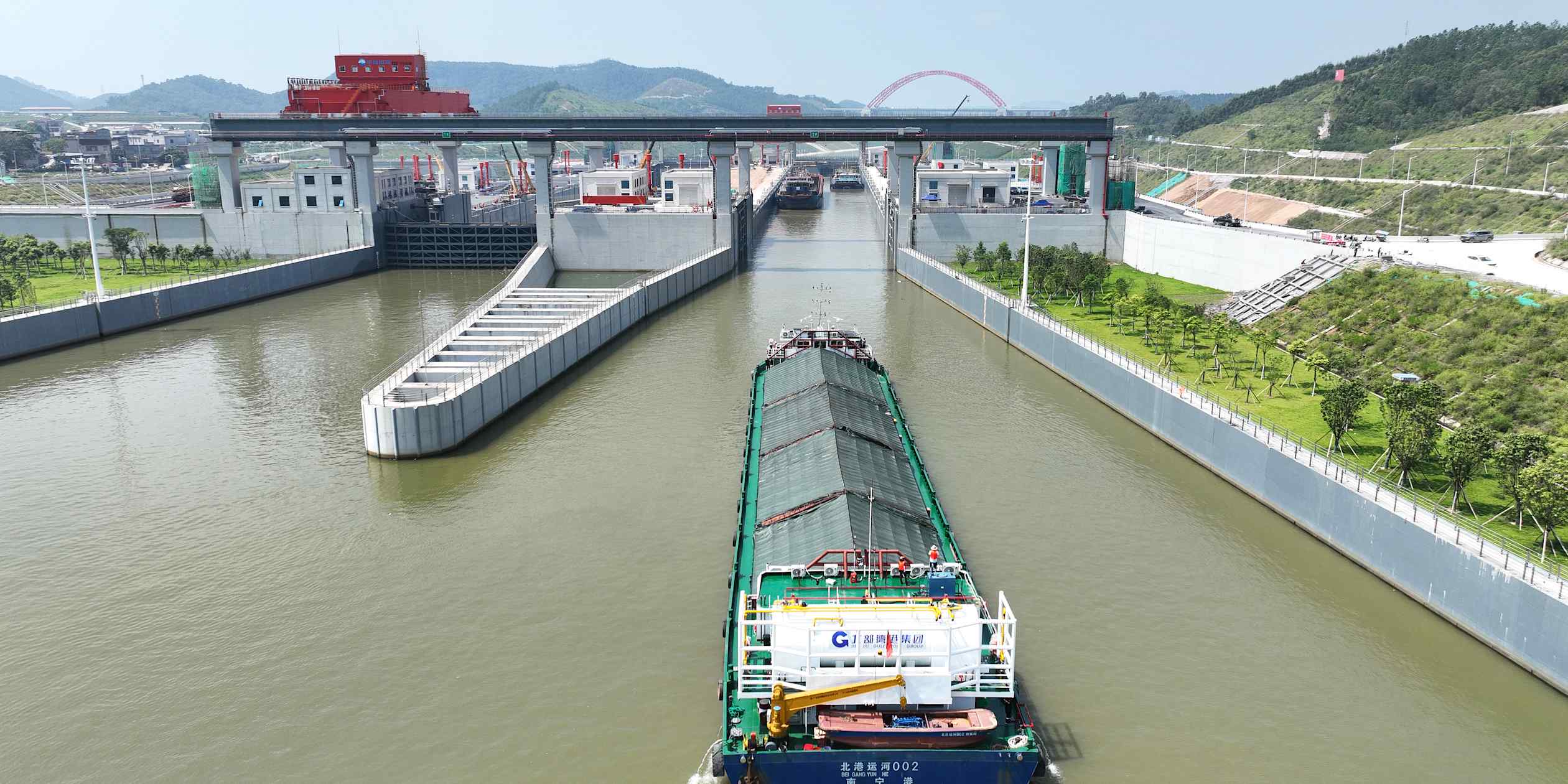
几代人以来,来自广西的货物一直沿着西江向东流向广州,最终抵达出海口。新的平陆运河将这条路线转向南方。
For generations, cargo from China's Guangxi reached the sea by following the Xijiang River east toward Guangzhou. The new Pinglu Canal turns that route south.
9月16日,这条全长134公里的运河正式开通,它将西江水系与北部湾的钦州连接起来,而北部湾是南海的一部分。该运河可通行5000吨级船舶,相比旧路线缩短了560多公里。它是北京支持的新国际陆海贸易通道的关键项目,该通道是由铁路、港口和海关链接构成的网络,从中国西部延伸至东南亚。
Sept. 16 saw the opening of the 134-kilometer canal that links the Xijiang system to Qinzhou on the Beibu Gulf, which is part of the South China Sea. Built for 5,000-metric-ton vessels, the canal removes more than 560 km from the old route. It is a key project in the New International Land-Sea Trade Corridor, a Beijing-backed network of railways, ports and customs links from western China to Southeast Asia.
尽管生产可能正从中国向东盟扩散,但许多由中国资本支持的工厂仍然依赖中国的机器、零部件、工程师和技术知识。这意味着工厂可以离开中国,但中国并未离开生产环节。
Production may be spreading from China into ASEAN, but many Chinese-backed factories still rely on Chinese machines, components, engineers and knowledge. Which means factories can leave China without China leaving production.
“中国+1”战略并未失败。它描述的是企业将工厂设在哪里,而非它们所依赖的供应商、机器和工程师网络。更棘手的问题在于,当地企业和工人能否学会运营工厂、改进流程并构建下一代产品。
"China plus one" has not failed. It describes where companies put factories, not the web of suppliers, machines and engineers on which they rely. The harder problem is whether local companies and workers learn to run the plants, improve processes and build what comes next.
泰国已吸引众多电动汽车工厂和供应商。截至2025年6月,泰国投资促进委员会推动的电动汽车供应链项目投资额已达1377亿泰铢(约合41亿美元)。其补贴政策要求在当地进行生产,中国车企也随之带来了供应商。然而,在泰国生产的中国电动汽车仍然主要依赖从中国进口的电池电芯。泰国工程师和供应商能否改进技术和生产工艺,仍有待观察。
Thailand has attracted many electric vehicle factories and suppliers. By June 2025, investment in EV supply-chain projects promoted by Thailand's Board of Investment had reached 137.7 billion baht ($4.1 billion). Its subsidies require local production, and Chinese automakers have brought suppliers with them. Yet Chinese EVs made in Thailand still rely on battery cells imported mostly from China. Whether Thai engineers and suppliers can improve the technology and production process remains to be seen.
印度尼西亚的影响力来自镍而不是汽车组装。其对粗镍出口的禁令迫使在国内进行加工。美国地质调查局估计,2024年印度尼西亚生产了全球镍开采量的62%。中国公司资助并建设了印度尼西亚的大部分新加工能力,印度尼西亚现在出口更高价值的镍产品。但其公司获得了多少技术知识仍不确定。
Indonesia's leverage comes from nickel rather than vehicle assembly. Its ban on raw nickel exports has forced processing at home. The U.S. Geological Survey estimates that Indonesia produced 62% of the world's mined nickel in 2024. Chinese companies financed and built much of Indonesia's new processing capacity, and Indonesia now exports higher-value nickel products. But how much technical knowledge its companies acquire remains unsettled.
产能是工厂能够生产的东西;产量是它的生产。“附加值”是对当地创造的产品价值的衡量标准。能力在于工程师、供应商、经理和机构,他们能够保持生产运行、改进生产并构建接下来的产品。需要制定三个课程。
Capacity is what a plant can produce; output is what it makes. "Value added" is a measurement of product value created locally. Capability lies in the engineers, suppliers, managers and agencies that can keep production running, improve it and build what comes next. Three courses need to be plotted out.
绘制整个东盟的工厂和生产分布。描绘机器、零部件、工程师和生产知识,让中国重新成为焦点。并列出谁可以改变规则。政府决定补贴、资源获取和市场进入;公司选择技术、供应商和投资。没有政府或公司可以控制所有这些决定。
Plot out the factories and production spreads across ASEAN. Plot the machines, components, engineers and production knowledge -- which brings China back into focus. And plot out who can change the rules. Governments decide subsidies, access to resources and market entry; companies choose technologies, suppliers and investments. No government or company controls all these decisions.
东盟出口不仅仅是变相的中国商品。洛伊研究所2025年对经济合作与发展组织截至2022年的数据进行的分析发现,东南亚每出口100美元的商品价值中,约有67美元来自该地区,7美元来自中国。关键部件或专有机器对产品的总价值贡献不大,但仍然决定它是否可以制造。
ASEAN exports are not simply Chinese goods in disguise. A 2025 Lowy Institute analysis of Organisation for Economic Co-operation and Development data through 2022 found that for every $100 of value Southeast Asia exports in goods, about $67 was created within the region and $7 in China. A critical component or proprietary machine could contribute little to a product's total value, but still determine whether it can be made.
印度尼西亚南苏拉威西省索罗瓦科淡水河谷的一个镍矿区。印度尼西亚是世界上最大的镍生产国,中国公司建设了其大部分新的镍加工能力。
A nickel mining site of Vale in Sorowako, South Sulawesi province, Indonesia. Indonesia is the world’s largest nickel producer, and Chinese companies built much of its new nickel-processing capacity.
数据能告诉我们出口价值在哪里产生,却无法揭示是谁在修复故障生产线、审核供应商资质、调整工艺流程或开发下一代产品。这些知识大多沉淀在企业内部。目前的数据尚无法说明东盟企业是否正在学会自主完成这些工作。
Figures show us where export value is created, but they do not tell us who fixes a failed line, qualifies a supplier, changes a process or develops the next product. Much of that knowledge sits inside companies. The data cannot yet tell us whether ASEAN firms are learning to do these things themselves.
在新加坡、苏州和北京工作的五年间,我参与了苏州工业园区的建设,并协助中国官员借鉴新加坡管理工业城镇的经验,从而深刻理解了这一区别。
I learned that distinction over the five years I worked on Suzhou Industrial Park from Singapore, Suzhou and Beijing, during which I helped Chinese officials adapt Singapore's methods for running an industrial township.
园区从稻田中崛起。我们将土地抬升至历史洪水位以上,并在道路和工厂建成之前,先铺设了电力、供水和污水处理基础设施。这些投入旨在应对已知的洪水风险。
The park rose from paddy fields. We raised the land above the historic flood line and installed power, water and sewage infrastructure before roads and factories appeared. The costs addressed a known flood risk.
要吸引企业入驻,必须有清晰的规则、可预期的审批时间以及一致的执行标准。新加坡能够传授这些做法,而经验转移的成功,关键在于中国官员将其本土化,并在没有我们参与的情况下独立运用,进而推广至其他地区。始于苏州的实践并未止步于此。
To attract businesses, there need to be clear rules, predictable approval times and consistent enforcement. Singapore was able to teach those practices, and the transfer succeeded only when Chinese officials adapted them, used them without us, and carried them elsewhere. What began in Suzhou did not end there.
东盟不会只有一个苏州。工程师、供应商和官员必须逐厂、逐国地积累经验。同时,该地区也并非从零开始。美国和欧洲企业帮助建立了槟城的电子产业基础,日本制造商则助力打造了泰国的汽车产业。两者都培育了本地供应商和技能,但能力转移从来都不是自动发生的。如今,东盟必须重走中国在苏州走过的路。
ASEAN will not have one Suzhou. Engineers, suppliers and officials must learn plant by plant and country by country. Nor is the region starting from scratch. American and European companies helped build Penang's electronics base, and Japanese manufacturers helped build Thailand's automotive industry. Both developed local suppliers and skills, but capability transfer was never automatic. ASEAN now has to do what China did in Suzhou.
对于董事会而言,第二个工厂选址并不必然意味着第二套供应体系。在泰国或越南的工厂或许能降低中国境内中断带来的风险,但如果零部件、设备或工程师不在当地,生产仍可能陷入停滞。
For boards, a second factory location is not necessarily a second supply system. A plant in Thailand or Vietnam may reduce exposure to disruption inside China, but it can still grind to a halt if parts, machines or engineers are not there.
华盛顿和布鲁塞尔利用关税和市场准入来改变公司组装产品的地点。调动工具制造商、零部件供应商和工程师更加困难。北京押注海外工厂将继续购买中国零部件、使用中国设备并聘请中国工程师。平鲁是该网络中的一个物理链接。北京可能不会从一个中心指导每个项目,但将它们视为无关的项目同样天真。
Washington and Brussels use tariffs and market access to change where companies assemble products. Moving toolmakers, component suppliers and engineers is harder. Beijing is betting that factories abroad will continue to buy Chinese parts, use Chinese equipment and call on Chinese engineers. Pinglu is one physical link in that network. Beijing may not direct every project from one center, but treating them as unrelated would be equally naive.
如果北京将这些关系转化为政治压力,公司和政府将为替代方案提供资金。
If Beijing turns those ties into political pressure, companies and governments will finance alternatives.
东盟各国政府仍然有选择。激励措施可以吸引组装,矿物可以迫使加工。政府可以帮助供应商制造更复杂的零部件、培训工程师、吸引研究团队并赋予当地管理人员对流程和产品的权力。目标是让外部势力争夺东盟学到的东西。
ASEAN governments still have choices. Incentives can attract assembly and minerals can compel processing. Governments can help suppliers make more complex parts, train engineers, attract research teams and give local managers authority over processes and products. The aim is to have outside powers compete over what ASEAN learns.
结果不会在投资公告或出口总额中找到。它将取决于谁维修机器、确定供应商资格、改进流程、设计下一个产品以及决定下一个投资的去向。
The outcome will not be found in investment announcements or export totals. It will be found in who repairs the machines, qualifies the suppliers, improves the processes, designs the next product and decides where the next investment goes.
如果关键的供应商、工程知识和产品决策留在中国,中国的工业地理将超越其政治地理。如果东盟学会复制已经到来的东西,东南亚将塑造自己的工业未来。
If crucial suppliers, engineering knowledge and product decisions remain in China, China's industrial geography will extend beyond its political geography. If ASEAN learns to reproduce what arrives, Southeast Asia will shape its own industrial future.
平陆可以缩短工厂之间的路线,但它无法决定工业电力是否随之而来。
Pinglu can shorten the route between factories, but it cannot decide whether industrial power travels with it.