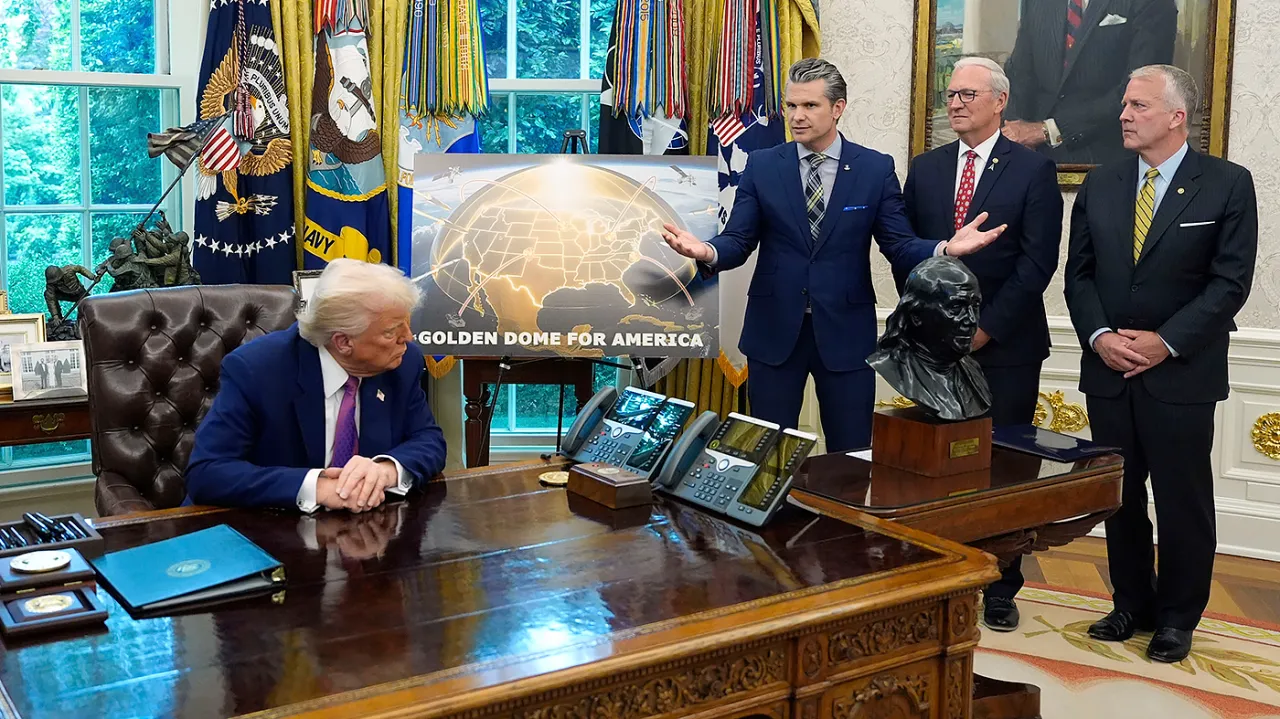
“金色穹顶”(Golden Dome)是特朗普总统提出的国家弹道导弹防御系统的宏伟计划,但目前该项目面临着严重的资金困境,其资金来源仍不确定。据估计,该导弹防御系统的研发和运营成本将在20年内达到约1.2万亿美元,因此需要大量资金才能在本财年开始实施。然而,五角大楼在预算制定上采取了冒险的策略:它要求获得1.15万亿美元的常规预算,并希望通过党派投票通过额外的3500亿美元资金。
The Golden Dome, President Trump’s lofty plan for a national ballistic missile defense shield, is facing heavy headwinds with project funding still uncertain. The missile defense program, estimated to cost some $1.2 trillion over 20 years of development and operation, needs a significant influx of funding to get it off the ground this fiscal year. But the Pentagon made a risky move in its budget strategy, requesting a $1.15 trillion base budget and a $350 billion reconciliation package to be passed on a party-line vote.
2027财年,“金色穹顶”项目所需的大部分资金都来自这笔额外的拨款,这引发了人们对于即将卸任的国会是否能够为该项目提供足够资金的疑虑。战略与国际研究中心(Center for Strategic and International Studies)的导弹防御项目主任托马斯·卡拉科(Thomas Karako)表示:“截至本财年开始的周四,该项目实际上已经没有资金可用。”
The bulk of the Golden Dome funding in fiscal 2027 is in the reconciliation tranche, raising doubts about whether a lame-duck Congress will be able to inject the program with the dollars it needs to proceed. Thomas Karako, director of the Missile Defense Project at the Center for Strategic and International Studies, said that as of Thursday — the start of the fiscal year — “the program has no money.”
他告诉《The Hill》杂志:“该项目的成败完全取决于2027财年的拨款情况;这是‘金色穹顶’项目最紧迫的问题。从本质上讲,没有资金的话,这个项目就只是空洞的PPT幻灯片而已。”在9月29日的听证会上,参议院军事委员会的战略力量小组委员会多次提到了这个问题,卡拉科也在会上作了证词。参议员迈克·朗兹(Mike Rounds,共和党,南达科他州)表示:“是否真的需要通过额外的拨款来启动这个项目呢?我认为没有必要;这个问题本应通过两党合作来解决。”
“This stands or falls with FY-27 appropriations, and I said that's the single most urgent thing for Golden Dome,” he told The Hill. “It is life and death from that standpoint. Without money there’s no program, it's just PowerPoint slides.”The Senate Armed Services Subcommittee on Strategic Forces raised this issue numerous times during a Sept. 29 hearing, at which Karako testified. “Should it have been necessary to go to a reconciliation to get this started? I would say no. This should have been on a bipartisan basis,” Sen. Mike Rounds (R-S.D.) said at the hearing.
他补充说:“我不会指责为什么没有这样做,我只是希望我们能尽快恢复两党合作的方式来解决这个问题。”该小组委员会的负责人、缅因州参议员安格斯·金(Angus King)指出,这个项目是“美国政府有史以来投入资金最多、规模最大的项目之一”;他非常不满特朗普政府没有通过传统的拨款程序来为该项目提供资金。
“I won’t lay fault for why that isn’t happening, I’m just simply saying we need to get back to a bipartisan approach to this as soon as possible.”The subpanel’s ranking member, Sen. Angus King (I-Maine), said the effort is one of the “most expensive and largest projects ever undertaken by the United States government,” making it “very bothersome” that the Trump administration didn’t resource it via the traditional appropriations process.
特朗普在2025年1月宣布,五角大楼将建造一个庞大的国土导弹防御系统,旨在利用从卫星发射的空间导弹拦截来自地面的导弹,从而保护美国本土的领空。特朗普政府坚称,这项耗资巨大且尚未经过充分测试的技术对于抵御弹道导弹、高超音速导弹、先进巡航导弹以及其他新型空中攻击至关重要。无党派的国会预算办公室(CBO)在5月份估计,该系统的研发、部署和运营成本将在未来20年内达到约1.2万亿美元:其中7400亿美元用于空间导弹预警与跟踪系统,2700亿美元用于多层次的地基防御系统,另有1800亿美元用于其他相关活动(包括传感器系统的部署及研发工作)。
Trump announced in January 2025 that the Pentagon would build an expansive homeland missile shield intended to protect the skies over the continental U.S. using a network of space-based missiles launched from satellites to intercept missiles launched from the ground. The Trump administration has insisted the expensive, untested technology is necessary to protect against ballistic, hypersonic, advanced cruise missiles, as well as other next-generation aerial attacks. The nonpartisan Congressional Budget Office (CBO) in May estimated that Golden Dome will cost about $1.2 trillion to develop, deploy and operate over the next 20 years. Broken down, that includes $740 billion for a space-based missile warning and tracking system, $270 billion for multiple layers of ground-based defenses and $180 billion for other activities — including deploying a sensor system and conducting research and development.
负责监督该项目的太空军将领迈克尔·盖特莱因在3月份估计,该导弹防御系统的实际成本仅为1850亿美元。为了为该项目提供资金,与特朗普立场一致的共和党人在2025年7月签署的《One Big Beautiful Bill法案》中为该项目拨款244亿美元。同年3月,国会通过一项和解法案向五角大楼提供了225亿美元用于启动该项目的建设;但盖特莱因表示,其中90%的资金在不到六个月内就已经被用于相关支出。
Space Force Gen. Michael Guetlein, who is overseeing the program, estimated in March that the missile defense system will cost just $185 billion. To fund the effort, Trump-aligned Republicans included $24.4 billion for the project in their One Big Beautiful Bill Act, which the president signed in July 2025. Then, in March, Congress gave the Pentagon $22.5 billion to begin building Golden Dome through a reconciliation bill, but Guetlein this summer said 90 percent of that money was obligated in less than six months.
今年,五角大楼在提出的3500亿美元和解法案中请求为该项目拨款170亿美元,而基础预算中仅为此项目预留了4亿美元。由于国会似乎无意再次通过和解法案来批准额外资金,该项目的资金状况十分脆弱。此外,该项目还面临着另一个挑战:目前联邦政府的运作依赖于“持续决议”(continuing resolution)这一临时性资金安排,这种措施自10月份以来一直处于生效状态。
This year, the Pentagon requested $17 billion for Golden Dome as part of the proposed $350 billion reconciliation package, with only $400 million for the program in the base budget. The strategy leaves Golden Dome in a vulnerable position, as Congress appears to have little desire to pass another spending bill through reconciliation. Adding to the program’s challenges is the federal government operation under a continuing resolution, a stopgap funding measure that began on Oct. 1 and holds spending at prior year levels — as part of a bipartisan deal to prevent a government shutdown.
- 政府支出仍维持在去年的水平——这是为避免政府停摆而达成的两党协议的一部分。古特莱因(Guetlein)在8月份曾警告称,这种“持续性决议”(continuing resolution)对“Golden Dome”项目并无实际帮助,因为该项目的资金来源并未得到明确保障(即没有固定的资金来源可供依赖)。他补充说:“如果国会无法为该项目找到资金来源,那么‘Golden Dome’项目就无法继续实施。”本周的议员们似乎也不清楚该项目的具体作用究竟是什么;这个问题在上周的参议院听证会上被反复提及。卡拉科(Karako)在开场陈述中表示,“Golden Dome”项目在战略定位和功能说明方面存在严重不足:缺乏清晰的信息传递和解释。他强调:“如果没有这些信息,人们对这个项目的理解往往基于臆想或谣言;批评者和支持者都会将自己的恐惧或幻想投射到该项目上,而政治极化只会使情况更加复杂。”金(King)随后质疑特朗普的行政命令是否真的能实现“为美国公民和关键基础设施提供保护”的目标;他认为这种期望其实是不现实的。金问道:“究竟应该由谁来决定谁会受到保护、谁不会受到保护?”卡拉科指出,根据目前的提案,“Golden Dome”项目主要针对某些大城市和关键基础设施提供保护,而非为整个国家提供全面的防护。他还向《The Hill》杂志表示,美国军队在应对空中威胁(如弹道导弹、轰炸机、无人机和巡航导弹)方面几乎没有任何有效的防御手段。
Guetlein in August had warned a continuing resolution “doesn’t help me under Golden Dome because I don’t have a top line to fall back to to get that percentage of the continuing resolution.”If Congress can’t find a route to fund the program, “there is no Golden Dome because there is no funding,” he added. Lawmakers this week also seem unsure exactly what the system will provide beyond what the U.S. military already gives to homeland defenses — a glaring question at the center of the Senate hearing last week. In his opening testimony, Karako said Golden Dome “suffers from a serious lack of strategic messaging and explanation of what it is and what it’s trying to do.”Without that messaging, the references to the program “conjure up fanciful ideas and memes. Critics and cheerleaders project onto it their fears or fantasies, and political polarization doesn’t help," he said. King later questioned whether Trump’s executive order, which says Golden Dome will deter and defend U.S. citizens and critical infrastructure, creates an expectation of nationwide shield that the senator said is “just not in the cards.”“One of the questions that has to be discussed is who's being projected? And what is the Golden Dome actually going to do?”King asked. “Who decides who is protected and who isn't?" Karako suggested that Golden Dome as proposed would give protections to certain major cities and critical infrastructure rather than provide a shield over the entire country. He later told The Hill the U.S. military has “almost nothing” for aerial threats beyond a ballistic missile or bomber aircraft, including drones and cruise missiles. “It's not that it can't be seen; it can be,” he said of the threats.
“我们必须主动去寻找它。”他继续说道:“我们需要部署不同类型的传感器,确保它们监视正确的方位,并设定好当探测到更全面的威胁谱系时发出警报,‘金穹顶’系统就能填补这一空白。”
“We just have to be looking for it." "We have to have different kinds of sensors, and we have to have them looking in the right place, and we have to be telling them to beep and squawk when the more fulsome spectrum of threats is seen,” he continued, adding that Golden Dome could fill that void.