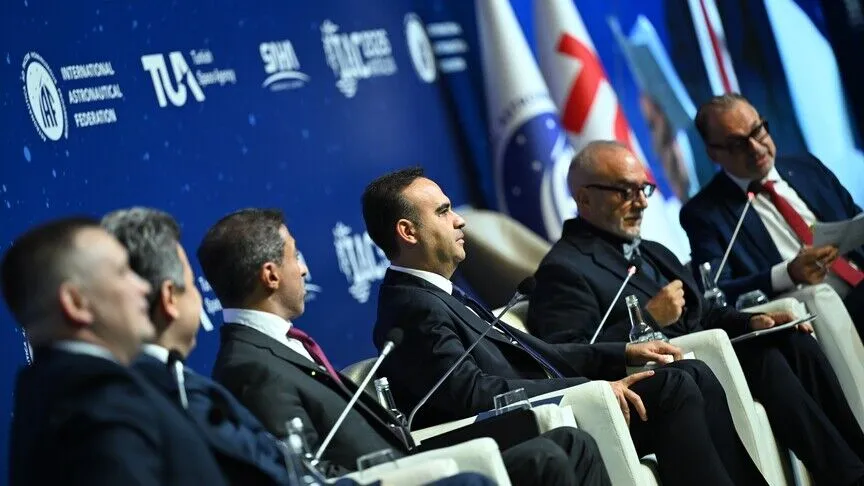
埃米尔汉·伊尔马兹、图格巴·阿尔顿和埃米尔·伊尔迪里姆:土耳其日益壮大的太空计划正成为第77届国际宇航大会(IAC)的焦点话题。该计划包括建设巨型卫星星座以及在索马里建造自主运营的航天港。
Emirhan Yilmaz, Tugba Altun and Emir Yildirim Türkiye’s expanding orbital ambitions, highlighted by a mega-constellation and an independent spaceport in Somalia, take center stage at the 77th International Astronautical Congress (IAC).
此次大会于周一至周五举行,期间一场内容丰富的专题讨论会探讨了太空探索的未来发展方向。与会航天界领袖们详细介绍了国家级基础设施项目及私营太空站如何重塑全球太空生态系统。
A wide-ranging panel mapped out the future of space exploration at the event running from Monday until Friday, during which aerospace leaders detailed how national infrastructure projects and private space stations are reshaping the global orbital ecosystem.
本届大会由国际宇航联合会(IAF)主办,安纳多卢通讯社担任全球传播合作伙伴。在土耳其工业与技术部的协调下,大会在安塔利亚NEST会议中心举办,土耳其航天局与伊斯坦布尔SAHA集团共同承办。
Organized by the International Astronautical Federation (IAF), with Anadolu as its global communications partner, the congress is being held at the Antalya NEST Congress Center under the coordination of the Industry and Technology Ministry and co-hosted by the Turkish Space Agency and SAHA Istanbul.
土耳其阿塞尔斯安公司透露,作为一个由198颗卫星组成的通信网络的一部分,其最先进的“Astralink”(意为“天网”)低地球轨道卫星星座的首颗卫星将于两年内发射升空。
Türkiye’s Aselsan revealed plans to launch the first satellite of its state-of-the-art Astralink (Gokbagi) low-Earth-orbit (LEO) constellation within two years as part of a broader 198-satellite communications network.
据阿塞尔斯安首席执行官艾哈迈德·阿克约尔介绍,该项目于去年底启动,旨在为土耳其及其盟友提供服务。预计该卫星网络将整合100多万个分布于各领域的地面用户终端。
The project was initiated late last year to serve Türkiye and its allies, while the planned orbital network is expected to integrate over 1 million terrestrial user terminals deployed across operational fields, Aselsan CEO Ahmet Akyol said during the panel.
凭借50年的技术积累,阿克约尔表示该卫星星座将采用土耳其国防工业自主研发的国产微芯片、专有通信波形及子系统。这一举措有助于在从单一卫星向互联星座转变的全球趋势下,确保通信的安全性与连续性——这一趋势也反映了现代国防、经济及公共基础设施领域的全球性变革。
Building on 50 years of experience, Akyol stated that the constellation will run on domestic microchips, proprietary communications waveforms and subsystems developed by the Turkish defense ecosystem to ensure secure and uninterrupted connectivity amid a broader shift from solitary satellites to interconnected constellations, mirroring the global paradigm shift in modern defense, the economy and public infrastructure.
土耳其航天局(TUA)理事阿里夫·卡拉贝奥卢指出,过去十年间全球航天发射能力提升了10倍,从每年300吨增至3000吨,发射成本也随之下降。在此背景下,对中等规模的航天国家而言,拥有自主进入地球轨道的能力已变得至关重要。
Arif Karabeyoglu, a board member of the Turkish Space Agency (TUA), stated that developing independent access to Earth’s orbit has become key for mid-sized spacefaring countries, as global launch capacity surged tenfold over the past decade from 300 tons to 3,000 tons, while costs went down.
卡拉贝奥卢指出,发射能力对于土耳其这样的国家而言愈发重要。目前土耳其正在索马里建设一座航天港,该航天港能为本国及全球航天运营商提供诸多技术优势:紧邻赤道的地理位置、安全的发射范围控制条件以及理想的发射大气环境。
Karabeyoglu said that launch capabilities have become all the more important for countries like Türkiye, which is building a spaceport in Somalia that will provide technical advantages such as immediate proximity to the equator, range safety controls and ideal atmospheric conditions for launches, both for domestic vehicles and global operators.
Axiom Space公司载人航天业务高级副总裁、宇航员迈克尔·洛佩兹-阿莱格里亚表示,Axiom计划在国际空间站最终退役并脱离轨道之前打造出成熟的商业航天平台。他还对土耳其在载人航天领域取得的进展予以肯定,尤其是此次成功执行的Ax-3任务,将土耳其首位宇航员阿尔珀·盖泽拉夫奇送入了太空轨道。
Astronaut Michael Lopez-Alegria, senior vice president of human spaceflight at Axiom Space, stated that Axiom aims to prepare its commercial platform before the International Space Station (ISS) is eventually decommissioned and deorbited, while praising Türkiye’s growing role in crewed spaceflight with the successful Ax-3 mission that carried the nation’s first space traveler, Alper Gezeravci, into orbit.
费尔加尼航天公司首席执行官哈桑·胡赛因·埃尔托克称,过去五年间,航天与电信行业发展迅猛,未来几十年还将发挥更为重要的作用。目前地球静止轨道领域正掀起一场激烈竞争,各企业及国家都在努力寻求该领域的新解决方案与服务。
Hasan Huseyin Ertok, CEO of Fergani Space, stated that the space and telecommunications sectors have developed rapidly in the past five years and will become even more prominent in the coming decades, while a major race is underway in the geostationary sector, with every firm and country seeking new solutions and services in the field.
土耳其科学技术研究理事会航天研究所所长梅赫梅特·内费斯介绍称,土耳其的月球探测计划汇聚了国内多家科研机构、高校及国防企业共同参与,其目标远不止实现简单的月球表面着陆。
Mehmet Nefes, director of Türkiye’s Scientific and Technological Research Institution (Tubitak) Space Institute, said that the country’s lunar exploration program involves domestic research institutes, universities and defense firms, going beyond a simple surface landing.