我在开罗长大,那时胡斯尼·穆巴拉克仍在执政,他的统治时间甚至比我出生的年份还要长。2011年1月革命爆发时我15岁,还是一名高中生,正开始形成自己的政治意识;而我周围的街道上则涌现出无数关于未来的可能性。
I grew up in Cairo under Hosni Mubarak, who had ruled for longer than I had been alive. I was 15 when the revolution erupted in January 2011, a high school student just coming into political consciousness as the streets around me cracked open with possibilities for otherwise futures.
两年后,政治已渗透到我们的家庭、友谊、课堂乃至停尸房中。2013年7月,由阿卜杜勒-法塔赫·塞西将军领导的军方推翻了埃及首位民选总统、穆斯林兄弟会的穆罕默德·穆尔西。此后数周,穆尔西的支持者们聚集在开罗东部的拉巴阿·阿达维耶清真寺附近进行抗议。2013年8月,军方与警方向示威者开火,这场惨案后来被称为“拉巴阿大屠杀”。我一位挚友的父亲便是在此次事件中丧生。
Two years later, politics had permeated our homes, our friendships, our classrooms, our morgues. In July 2013, the military, led by Gen. Abdel-Fattah el-Sisi, overthrew Mohamed Morsi of the Muslim Brotherhood, who was Egypt’s first democratically elected president. Over the following weeks, Morsi’s supporters camped and protested in eastern Cairo near the Rabaa al-Adawiya mosque. In August 2013, the military and police opened fire on the protesters in what came to be known as the Rabaa massacre. The father of a dear friend was among those killed.
怒不可遏的我加入了反对政变的街头运动。2013年10月6日,我在解放广场附近的一场大规模抗议活动中被捕,随后作为政治犯度过了六年零三个月的时光。2020年,我侥幸获释并逃离埃及,前往美国。
Enraged, I joined the street movement against the coup. On Oct. 6, 2013, I was arrested at a mass protest near Tahrir Square and spent the next six years and three months as a political prisoner. Released by a chance miracle in 2020, I fled Egypt for the United States.
塞西将军自封为陆军元帅兼总统,至今仍统治着埃及。革命已被镇压,数万名民众仍身陷囹圄,经济困境更是压垮了普通埃及人的脊梁。回首我的祖国,我看到的是一个被“幽灵”所支配的国度:四个挥之不去的阴影,正是它们解释了为何在2011年1月那个充满希望的清晨之后,埃及竟沦落至此——那曾是我们最后一次被梦想所触动的时刻。
Gen. el-Sisi crowned himself field marshal and president and continues to rule Egypt. The revolution has been crushed, tens of thousands remain imprisoned, and economic hardship has broken the backs of Egyptians. When I look back at my country, I see an Egypt structured by ghosts: four relentless hauntings that explain what has become of the country in the wake of those fleeting blue mornings in January 2011, when we were last touched by a dream.
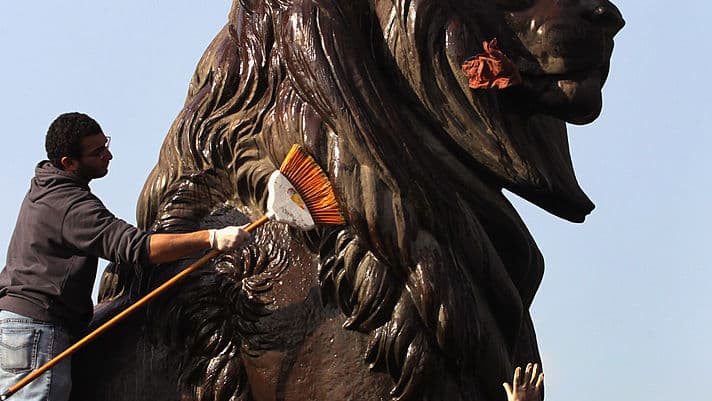
开罗的那座桥 总有一些东西将我引回卡斯尔·埃尔-尼尔桥。即便身处牢房之中,我也常闭上双眼,回到桥头的那两尊斑驳的青铜狮子旁。那是2011年1月28日,即埃及革命爆发三天后的“愤怒星期五”。更确切地说,是那段著名的视频——视频记录了抗议者与警察在桥上激烈交锋的场景。
That bridge in Cairo Something always draws me back to Qasr El-Nil bridge. Even in my prison cell, I often closed my eyes and returned to the faded bronze of the two lions at its threshold. To Jan. 28, 2011, the "Friday of Rage," three days after the spark of the Egyptian revolution. Specifically: the famous video of clashes atop the bridge between protesters and police.
在整个视频中,安全部队不断将抗议者逼退;装甲车加速行驶,将人群向后驱赶。催泪瓦斯弹呼啸着划破空气,留下一道道烟雾轨迹,飞向不断向前涌动的人群。高压水炮猛烈冲击着抗议者,将他们击得向后倒退。橡胶子弹则击碎了他们的骨头。
Throughout the clip, security forces push the protesters back; armored vehicles accelerate to drive bodies back. Tear gas canisters sizzle through the air, leaving cloudy trails as they sail toward the advancing sea of bodies. Water cannons slam into protesters, catapulting them backward. Rubber bullets crack bones.
然而,一个奇妙的现象不断发生:每当警察将抗议者从桥上驱赶走,他们又会再度涌上前来。每次回归后,他们都进一步向前推进、闯入禁区。驱赶、回归、闯入……如此循环往复,直到某个临界点到来:人群不再向后逃离,反而开始朝着警察的方向涌去。
Yet something wondrous keeps happening: each time the police push the protesters off the bridge, the protesters surge forward again. And each time they return, they push and trespass farther. Push. Return. Trespass. Push. Return. Trespass. Until something ruptures: the masses start running not away from but toward the forces.
可以明显感觉到,桥上的所有人都能感受到这种局势的突变——有那么一瞬间,就连警察也愣住了,不知所措。一旦这种突变发生,那些从未遭遇过人群迎面冲来的士兵们转身便逃。人群顿时沸腾起来:欢呼、尖叫、咒骂声此起彼伏。他们仿佛被自己身体的动作惊呆了——这些身体虽一直都在行动,却从未有过这样的举动。
And you can tell that everyone on that bridge feels the rupture rip through the air, because for a split second, even the police freeze, confounded. And once the rupture takes hold, the soldiers—those who have never been run toward—turn and flee. The crowd erupts—cheering, screaming, cursing—as if shocked by the very movement of their bodies, the bodies they have always moved but have never moved this way before.
这就是第二次“幻象”。我从第二次讲起,是因为我的叙述正是从这一突变时刻开始的。鹰之家族要理解今日埃及的种种乱象,我们必须先了解它的第一次“幻象”:即“鹰之家族”。自1952年自由军官组织推翻君主制以来,埃及的政治秩序实际上一直处于军方统治之下。那些发动政变的军官们成了新国家的缔造者,并自诩为国家利益的守护者。
This is the second haunting. I begin with the second because I write from and toward the rupture. The eagle family To grasp Egypt's ghosts today, we must understand its first haunting: the Eagle Family. Since the Free Officers overthrew the monarchy in 1952, Egypt’s political order has remained, in practice, under military rule. Officers emerged from that coup as the architects of the new state and cast themselves as the custodians of its national interest.
七十年来,军方的权威被神圣化,这种崇高地位也延伸到了整个安全体系:警察、检察官、法官以及情报人员。他们共同构成了“鹰之家族”——这一名称源自埃及国旗上的鹰图案,该图案同样出现在各级官员的制服上。这只鹰已然成为一种隐性社会契约的象征:佩戴此标志者即代表国家;而身处其外的人则被视为可牺牲的棋子。
The military’s authority has been sanctified over seven decades, and that exalted status extends to the broader security apparatus: police, prosecutors, judges, and intelligence officers. Together they form the Eagle Family, named after the emblem on the Egyptian flag that also adorns officials’ uniforms. The eagle became shorthand for an implicit social contract: those who bear it personify the nation; those outside its ranks are expendable.
2011年1月25日,这些原本被视为可牺牲的普通民众终于奋起反抗。历经数十年压迫后,2010年发生的一起惨案彻底激怒了埃及民众:28岁的亚历山大人哈立德·赛义德遭警方酷刑折磨后身亡,警方却声称他是因吞下毒品包而死。哈立德面部被打得血肉模糊的照片随后在网上流传开来,这些照片成为埃及最早通过社交媒体广泛传播的案例之一,引发了民众的强烈愤慨,最终促成了推翻胡斯尼·穆巴拉克总统的起义。这场革命堪称不可思议:它完全违背了统治阶层对民众与当权者之间关系的固有认知。
Then, the expendable subjects rose up in revolt on Jan. 25, 2011. After decades of repression, Egyptians were shaken by the brutal 2010 torture and killing of Khaled Saeed, a 28-year-old from Alexandria, who the police claimed had died after swallowing a packet of drugs. The photographs of his bashed-in face surfaced online, and the images became one of Egypt’s earliest cases of social media virality, igniting public outrage that helped coalesce into the uprising that ousted President Hosni Mubarak. The revolution was an unthinkable event: one that fundamentally contradicted the ruling order’s conception of the relationship between civilians and eagles.
随着抗议活动愈演愈烈,官方媒体发起了一场疯狂的抹黑运动,将埃及抗议者描绘成外国特工与外部煽动者。官方媒体声称这些革命者接受过以色列的训练,还同时将他们与美国、伊朗、哈马斯、基地组织、穆斯林兄弟会以及各类国际非政府组织联系在一起。更有甚者,官方媒体还散布了一个后来成为笑柄的荒谬指控:称抗议者是由肯德基提供食物和资金支持的。
As protests intensified, state media unleashed a frenzied smear campaign, casting Egyptian protesters as foreign agents and outside agitators. State media claimed that revolutionaries had been trained by Israel and tied them, simultaneously, to the United States, Iran, Hamas, al-Qaeda, the Muslim Brotherhood, and international NGOs. State media outlets even circulated the absurd accusation, later immortalized as a running joke, that protesters were being fed and financed by Kentucky Fried Chicken.
抗议者们随后在全国范围内纵火焚烧警察局,攻占多个省份的国家安全总部,闯入酷刑室并发现了大量有关暴行与虐待的证据。由安瓦尔·萨达特于1978年创立、自1981年起由胡斯尼·穆巴拉克执掌的埃及民族民主党总部也遭纵火。长期以来,该党作为埃及事实上的执政党掌控着整个政治体系,如今其总部便在尼罗河畔化为一片焦土。
Protesters went on to torch police stations across the country, overrun national security headquarters in multiple governorates, storm torture chambers, and unearth archives of horror and abuse. The headquarters of the National Democratic Party was set ablaze. Founded by Anwar Sadat in 1978 and led by Hosni Mubarak from 1981 until 2011, the party had long dominated Egypt’s political system as its de facto ruling party.
对于鹰派家族而言,这些场景简直是对他们的亵渎。他们不可侵犯的权威在数百万人面前遭到践踏。而实施这一切的竟是些卑微的平民。“愤怒星期五”,尤其是桥上的冲突,至今仍是鹰派家族心中一道无法愈合的伤疤,不断助长着他们的愤怒、恐惧以及对复仇的强烈渴望。自那以后,单向的压迫变成了双向的纠缠:鹰派家族纠缠着平民,而平民也反过来纠缠着鹰派家族。
Its headquarters were left smoldering on the banks of the Nile. To the Eagle Family, these scenes were sacrilege. Their untouchable status was profaned before millions. And by whom? Lowly civilians. The “Friday of Rage”, and especially the clash on the bridge, remains an open wound in the Eagle Family’s psyche, feeding its fury, fears, and insatiable hunger for revenge. Since then, the one-way street has become a two-way street: the Eagle haunts the civilian; the civilian haunts the Eagle.
建国以来的大屠杀:从穆巴拉克下台到2013年政变期间,军方暴力再度肆虐。武装部队最高委员会表面上扮演着民主转型守护者的角色,实际上却通过屠杀与军事法庭实施统治。2012年,穆斯林兄弟会的穆罕默德·穆尔西赢得大选,但事实证明该组织无力治理这个四分五裂的国家;而军方始终牢牢掌控着实权,从未真正放权。
The founding massacre Between Mubarak’s fall and the 2013 coup, military violence resurged. The Supreme Council of the Armed Forces, while posturing as the guardian of a democratic transition, governed through massacres and military tribunals. When the Muslim Brotherhood’s Mohamed Morsi won the 2012 elections, the Brotherhood proved incompetent to govern a fractured nation under the shadow of a military establishment that had never surrendered real authority.
到了2013年中,民众对穆斯林兄弟会彻底失望,这为军方重新掌权提供了良机。示威者涌上街头,要求提前举行选举。视穆斯林兄弟会为死敌的军方与警方公然支持反穆尔西示威活动,甚至直接招募参与者。在他们的鼓动下,大批反革命分子及穆巴拉克的忠实支持者纷纷加入。我在电视上看到军官们被民众簇拥着、欢呼着,被奉为救世主。同年7月,国防部长塞西将军发动政变,夺取了国家政权。
By mid-2013, mass disillusionment with the Brotherhood provided fertile ground for a military comeback. Demonstrators filled the public squares, demanding early elections. The military and police, who saw the Brotherhood as their archenemy, openly backed the anti-Morsi demonstrations and even recruited participants. Their backing attracted hordes of counterrevolutionaries and Mubarak loyalists. On television, I watched officers carried and celebrated by the crowds as saviors. And in July 2013, Gen. el-Sisi, the minister of defense, staged a coup and took over the country.
从一开始,2013年的政变政权便一心追求一个目标:彻底抹去2011年1月革命留下的所有痕迹。他们最早实施的暴力行动之一,便是我们所经历的第三次噩梦——拉巴亚大屠杀。
From the first moment, the 2013 coup regime hurled itself toward a singular goal: the eradication of every possible reminder of the January 2011 rupture. One of its earliest preemptive spectacles of violence became our third haunting: the Rabaa massacre.
2013年8月14日,埃及安全部队冲入开罗东部的拉巴阿尔-阿达维亚广场,那里的穆尔西支持者进行了持续的静坐抗议,要求恢复穆尔西的权利。警察的子弹穿过肉 flesh,击碎头骨;空气中充满了砰砰声、尖叫声和火焰的嘶嘶声。埃及警察和军队最少杀死了1000名抗议者,这被记录为现代埃及历史上最致命的大屠杀之一。
On Aug. 14, 2013, security forces stormed the Rabaa al-Adawiya Square in eastern Cairo where supporters of Morsi had entrenched themselves in a sprawling sit-in demanding his reinstatement. Police bullets seared flesh, shattered skulls; the air filled with thuds, shrieks, and the hiss of flames. The Egyptian police and military, killing at least 1000 protesters, committed what would be recorded as one of the deadliest massacres in modern Egyptian history.
拉巴阿尔事件结束了阿拉伯起义。政权通过将强制力转化为政治合法性,特别是通过对异议分子的身体进行壮观的摧毁,恢复了人们对鹰王座的 reverence。对于穆斯林兄弟会来说,拉巴阿尔成为了其2013年后的政治记忆中最为重要的灾难,颠覆了其组织结构、自我认识和对自身永久性的信念。
Rabaa ended the Arab uprisings. The regime transmuted its coercive force into political legitimacy through the spectacular destruction of dissident bodies, restoring reverence for the Eagle. For the Brotherhood, Rabaa became the defining catastrophe of its post-2013 political memory, upending its organization, self-conception, and belief in its own permanence.
一些 secular 活动人士表示,他们至今仍被军方如何利用他们感到 haunted,尽管他们现在发现自己与他们曾经反对的穆斯林兄弟会成员关在同一个牢房里。深层国家 appropriated 他们对穆斯林兄弟会的反对,重新部署它作为大屠杀的 justification。
Some secular activists say they are still haunted by how the military exploited them, even as they now find themselves sharing prison cells with the very Brotherhood members they once opposed. The deep state had appropriated their opposition to the Muslim Brotherhood, redeploying it as justification for the massacre.
最令人不安的是那些庆祝这些 killings 的人:艺术家、媒体人物和部分公众,他们以 stability 或 anti-Brotherhood 的信念祝福了这次 dispersal。一旦你祝福 mass killing,就无法后退:你必须继续 sanction 他们多次 endorser 的 violence。
Most disturbing were those who celebrated the killings: artists, media figures, and segments of the public who blessed the dispersal in the name of stability or anti-Brotherhood conviction. Once one blesses mass killing, there is no going back: they must continue to sanction the violence they had endorsed again and again.
今天,埃及的监狱中关押着至少 60,000 名政治犯。数千人因一次 passing 抗议、一次 stray 呼喊或一次屏幕上的帖子而在监狱中度过了十多年。数百人在 torture 下死亡,在 overcrowded 牢房中死亡,或因 medical neglect 而死亡。数千人被 enforced disappearance 吞没。大多数有 release orders 的人被拒绝自由,并因新的、 fabricated charges 而被关押在监狱中。
Today, Egypt’s prisons hold no fewer than 60,000 political prisoners. Thousands have spent more than a decade behind bars for a passing protest, a stray chant, or a post on a screen. Hundreds have died under torture, in overcrowded cells, or from medical neglect. Thousands have been swallowed by enforced disappearance. Most of those with release orders are denied their freedom and held in prison on new, fabricated charges.
埃及的媒体完全受国家掌控,没有任何独立声音存在;独立媒体机构遭到打压或封禁;记者们则不断遭到拘留。电视与电影已被变成国家管控下的宣传工具,其目的就是宣扬“爱国主义”、抹去一切关于革命的记载(除非将其描述为一场灾难),并通过各类宣传节目重新树立“鹰家族”的神圣形象。
Egyptian media operates under a single, unchallenged state voice; independent outlets are suppressed or banned; journalists face unending detention. Television and cinema have been converted into instruments of state-managed production geared toward “patriotism,” the eradication of any mention of the revolution except as a catastrophe, and the re-sanctification of the Eagle Family through propaganda shows.
当一句毫无约束的言论就能夺走一个人的生命,当这类言论发生时根本无人目睹,还剩下什么?牺牲的意义又还能何在?在我看来,让这套体制得以冷酷高效运转的核心因素,正是当代埃及最显著的特征:那些被国家制造出来的“幽灵”——政治犯。
When even an unregulated utterance can end a life, and when such utterances are made to go unwitnessed, what remains? What meaning can sacrifice ever hold again? The force that keeps this machinery running with such ruthless efficiency is, in my view, the fourth and most defining haunting of contemporary Egypt: political prisoners as state-manufactured ghosts.ghosts.
制造“幽灵”的过程 这些“幽灵”一直萦绕在我心头。最近,我想再次写下关于我那位身陷囹圄的好友艾曼·穆萨的故事。2013年,我们一同参加抗议活动时被捕,随后被以同一罪名起诉,并都被判处15年监禁。那时艾曼才19岁;如今他32岁了,整个二十多岁的时光都被高墙所吞噬。
Manufacturing ghosthood These ghosts haunt me. Recently, I wanted to write again about my incarcerated best friend, Ayman Moussa. Ayman was 19 when we were arrested at the same protest in 2013, tried in the same case, and handed the same 15-year sentence. He is 32 now; the bars have swallowed his entire twenties.
我手头已经没有新的照片可以发布了。此前我发过他各种各样的照片:他笑着,或许早已记不起当时发生了什么趣事;他凝视着右方,仿佛有什么东西刚刚从画面中溜走;他翻着跟头、倒立着,还在毕业舞会上跳着滑稽的舞蹈,双脚高高扬起;他的一举一动都轻盈得仿佛重力根本无法束缚他。然而他的面容——那张永远定格的面孔——如今早已深深印在人们的脑海之中,再也无法引起任何人的惊讶了。
I had run out of new pictures of him to post. I have posted every iteration: laughing at a joke he might no longer recall, staring to the right as if something has just escaped the frame, doing a backflip, doing a handstand, doing a silly dance at his prom with his feet in the air, moving in that way he moves, as if gravity never learned his name. But his face, his frozen face, has reached a point where it has saturated the minds of onlookers, no longer catching anyone by surprise.
我很幸运。我心中珍藏着那些世人无法触及的关于他的记忆。我记得他面容上细微的变化——那些随着时间推移而逐渐显现的新轮廓与纹路,那些在牢狱之苦重重压迫下刻在我们脸上的痕迹。当我意识到即将迎来某个纪念日时,我发现自己正在撰写悼词。我在悼念艾曼,可他明明就在这里,我却仍要为他哀悼,这让我疲惫不堪。他就在这堵墙的另一边。他并非幽灵,只是被“幽灵化”了罢了。
I am lucky. I carry contraband memories of him that the world has no access to. I remember the soft migrations of his features, the new edges and lines, the ones etched into our faces when prison time pressed too hard against our skin. I caught myself thinking of the nearest anniversary and realized I was writing eulogies. I was mourning Ayman, and I was tired of mourning him when he is here. He is here, right across the wall. He is not a ghost; he has been ghostified.
艾曼只是六万多名在押者中的一个。埃及有一首著名的狱中祷词:“上帝啊,请把这苦难从我们身上带走吧,从我们所有人身上带走吧!”囚犯们会从牢房门缝中喊出这句话,整个牢区便会齐声回应:“上帝啊!”这种一呼百应的形式一直让我着迷。祷词中虽假定苦难终会被消除,上帝也是理所当然的倾诉对象,但真正重要的却是那句“我们所有人”。这是一种祈愿——与其说是祈求神的拯救,不如说是渴望被看见。这是属于“幽灵”们的祷告。
Ayman is but one of over 60,000 lives behind bars. There’s a famous Egyptian prison prayer that goes: “Lift this suffering off us, us, us, us, us, us, O God!”A prisoner would yell it from the opening in his cell door, and the whole cell block would shake in unison: O God! This call-and-response always fascinated me in prison. The lifting was assumed, God was the obvious entity being addressed, but what mattered most was the us, us, us. A prayer seeking—more than divine deliverance—to be witnessed. A prayer of ghosts.
我自己也曾六年多时间徘徊在各类牢房门前,辗转于普通看守所、审前羁押中心以及高度戒备监狱之间。我深知那种绝望滋味:当岁月在眼前悄然流逝,而外面的世界却全然无视你的存在,那种绝望便会如潮水般涌来。在本地,几乎没人敢提起你的名字。你会看到昔日好友获释后,却因莫须有的新罪名再度被送回牢笼;你会目睹狱友们一个接一个地离世。
I spent over six years standing at the same cell doors myself, shuffled from jail cell to pretrial detention center to maximum-security prison. I know something about the seething despair that settles in when your years dissolve before your eyes and the outside world moves on without you. Locally, almost no one dares utter your name. You see friends sent for release only to be recycled into the same machinery on new, fabricated charges; you watch your prison mates die one after another.
在海外,你打开国家报纸,看到美国政府对正在监禁你的军政 regime 给予广泛的财政和政治支持,主要目的是维护以色列的安全和实施对加沙的封锁。你看到欧盟宣布了一项为埃及提供83亿美元的援助包,旨在激励该政权遏制移民并保证欧盟的安全。你在牢房中意识到,你的身体毫无价值,无法抵抗那些让监禁你的政权对他人有用的利益;事实上,那些他人是致力于你的镉灭的。
Abroad, you open the state newspapers and watch the military regime imprisoning you receive extensive financial and political support from the United States government, primarily to serve the objective of maintaining Israel’s security and enforcing the siege on Gaza. You watch the European Union announce a $8.3 billion package for Egypt meant to incentivize its regime to curb migration and guarantee E.U. security. You understand, inside your cell, that your body carries no value against the interests that make the regime holding you useful to others; that those others are, in fact, invested in your crushing.
在国家官方词汇中,政治犯并不存在。埃及官员们多次坚称他们没有良心犯。因此,在埃及境内,谈论政治犯意味着进入一个语言真空,把自己标记为可疑人物。
In the official lexicon of the state, political prisoners do not exist. Egyptian officials have repeatedly insisted that they have no prisoners of conscience. Within Egypt, then, to speak of political prisoners is to enter a linguistic vacuum, mark oneself as suspect.
随着时间的推移,人们开始意识到成千上千的人被关押在牢房中、消失在拘留站,或陷入无休止的审前羁押之中,这种知识开始通过预期来约束公众的行为:人们训练自己不去知道。悖论的是,正是由于这种认知失调成为可能,恰恰是因为公众意识中充斥着这种知识,以及承认这一知识所付出的沉重代价。因为承认这些幽灵的存在,意味着冒着成为其中一员的风险。
Over time, the knowledge of the thousands held in cells, disappeared into detention sites, or trapped in unending pretrial detention begins to discipline public conduct by way of anticipation: people train themselves not to know. Paradoxically, this kind of cognitive dissonance is possible precisely because of the saturation of public awareness with this knowledge and the hefty costs of acknowledging it. Because to acknowledge the ghosts is to risk becoming one.
我又回到了开罗的那座桥边。自2013年起,我便养成了一个习惯:每逢革命周年纪念日的前夜,我都会取出埃及诗人穆斯塔法·易卜拉欣的诗集《宣言》,从头到尾诵读一遍。这本诗集出版于2011年革命之后,如今已成为我这一代具有政治意识的人们心目中的“文学经典”。易卜拉欣在诗中描绘着那些支离破碎的梦想,以及曾经共同守在广场上、共用过一条毯子、并肩筑起过路障的战友们。
To the bridge in Cairo, I return I have had a ritual since 2013: on the eve of each anniversary of the revolution, I take out my copy of Egyptian poet Mostafa Ibrahim’s poetry collection, Manifesto, and recite it from cover to cover. Published in the wake of the 2011 revolution, Manifesto has become a kind of literary scripture for many of the politically engaged members of my generation. Ibrahim moves through the splintered dreams, among comrades who once shared a square, a sidewalk blanket, and a barricade.
夜深人静之时,我任由诗中的韵律将我包裹,默默哀悼。我总会反复吟诵那首描写解放广场的标志性诗作——《某某》。那个“某某”:我始终不知道他的名字,便称他为“表哥”,这样便足够了。
In the quiet of the night, I let its lyricism hold me, and I mourn. I always return to one iconic poem about Tahrir Square, “So-and-So.”So-and-so: I never learned his name, so I called him cousin, and that was enough.
诗中那些不知名的“某某”一直延续到结尾,我忍不住反复思索:在诗人写下这首诗时,他们每一个都是有血有肉的人——是那些能浮现在记忆中的面孔,是从陌生人变成朋友、电话号码至今仍存于我们手机里的人。如今,这首诗却成了唤起无尽伤痛的“亡灵之诗”。
The anonymous “so-and-so’s” continue until the end of the poem, and I cannot stop thinking about how, at the time of writing that poem, each was flesh and blood: a face we could summon from memory, a stranger turned friend whose number sat in our phones. Now, it has become a poem of ghosts that calls forth immense pain.
然而,每年1月25日晚上,我都会坐在我的副本旁边,选择令人难忘的故事。困扰我们的不是浪漫的怀旧之情,而是难以想象的事情变成了现实的短暂时刻。当我们对从我们嘴里喷涌而出的口号感到震惊,然后头晕目眩,这些口号大胆而无礼,仿佛每个人都在测试可能性的极限。埃及1970年学生运动的领导人之一阿尔瓦·萨利赫(Arwa Salih)在她1996年的回忆录《死生》(The Stillborn)中深情地谈到了她这一代人每当回忆起他们被镇压的运动的革命狂喜时所感受到的天真。
Yet, every year, I sit by my copy on the night of January 25 and choose the haunting. We are haunted not by romantic nostalgia, but by the ephemeral moment when the unthinkable became thinkable. When we were shocked, then giddy, at the chants tumbling from our lips, daring and transgressive as if each were testing the limits of the possible. In her 1996 memoir, The Stillborn, Arwa Salih, one leader of Egypt’s 1970 student movement, speaks wistfully about the naïveté her generation felt whenever they recalled the revolutionary rapture of their crushed movement.
“但我发现更严厉的是,”她写道,“对那些从未了解如此丰富的一代人的打击。”我们陶醉在革命中。我们明白我们永远属于破裂,所以我们拥抱了它,当我们拥抱它时,破裂让我们退缩了。在一瞬间,我们可以想象其他情况。我很幸运能够了解如此丰富。我接受这种困扰。我拥抱失败的幽灵。
“But I find far harsher,” she writes, “the hand dealt to the generations who never got to know such abundance.” re intoxicated by revolution. We understood that we were, forever, of the rupture, so we embraced it, and when we embraced it, the rupture held us back. And for a fleeting moment, we could imagine otherwise. I am blessed to have known such abundance. I accept the haunting. I embrace the ghosts of defeat.
因此,我主张采取一种反闹鬼的方法,它可以刺穿喷嘴控制的毛孔之外的开口,让未经批准的鬼魂渗透进来。国家机器的建立是为了抹去另一个世界曾经存在,因此也是可能存在的记忆。我们的任务是召唤革命的温柔幽灵,为国家屠杀的幽灵伸张正义,并使我们,我们,我们被放逐在监狱里。
And so, I argue for a counter-haunting, one that pierces openings beyond the Eagle-controlled pores, letting the unsanctioned ghosts seep through. The state’s machinery is built to erase the memory that another world was—and therefore is—possible. Our task is to summon the tender ghosts of revolution, to do justice to the ghosts of state massacres, and to unghost, unpast the us, us, us banished behind bars.
我知道在紧张的接受中保持开放是多么困难。它往往是排水,即使是像我这样的人,谁分享手铐和牢房。但它从这里开始,困扰着我们回到桥的路上。
I know how difficult it is to remain held open in taut receptivity. It is often draining, even for someone like me, who shared the handcuffs and the prison cell. But it begins here, haunting our way back to the bridge.