索纳尔·瓦尔马是野村证券负责日本以外亚洲地区的首席经济学家。
Sonal Varma is chief economist at Nomura for Asia excluding Japan.
印度如今已成为检验人工智能对就业影响的最重要样本。该国拥有600万名IT从业者,他们既从事业务流程外包工作,也在各类全球能力中心承担知识密集型任务。印度正处于人工智能带来的最大机遇与最严峻挑战的交汇点:全球的“后台服务行业”能否挺过自动化浪潮的冲击?
India has become the world's most important test case for artificial intelligence's impact on employment. With 6 million IT workers spanning business process outsourcing (BPO) operations and the knowledge-intensive work of global capability centers, the country sits at the intersection of AI's greatest promise and deepest threat: Can the world's back office survive the automation wave?
答案并非非黑即白。官方的劳动力市场数据存在局限性,因此我们汇总了2022年以来各上市公司发布的与人工智能相关的裁员及招聘公告以填补这一空白。我们的样本涵盖了亚洲地区的69条公告,其中印度占据主导地位:该地区30%的企业位于印度,而总招聘与裁员人数中也有60%发生在印度。
The answer is not straightforward. Official labor market data has limitations, so we filled the gap by aggregating public company announcements on AI-linked job layoffs and hiring since 2022. Our sample comprised 69 announcements across Asia, with India dominating: 30% of the firms and 60% of total hiring and firing in the region.
呈现“K型”分布特征 从总体数据来看,印度的情况似乎尚可:人工智能相关领域的招聘人数达83,100人,而裁员人数仅为31,921人,净增岗位51,179个。不过这一总体数据掩盖了现实中的“K型”分布特征以及由此产生的利益分配不均问题。
A K-shaped impact The aggregate numbers look reassuring for India: 83,100 AI-related hires versus 31,921 layoffs -- a net gain of 51,179 jobs. Still, the headline masks a fierce K-shaped reality and distributional effects.
金融与科技行业各自贡献了同等数量的裁员人数,而招聘活动则主要由科技行业推动;非科技行业几乎没有创造任何与人工智能相关的就业岗位。
Financial services and technology accounted equally for the layoffs, while technology alone drove hiring.
人工智能已经取代了大量常规性工作。各银行在增设分支机构的同时却削减了员工数量,因为人工智能承担了后台任务(如账目核对、合规审查、数据录入)以及客户服务工作(如聊天机器人)。在科技行业,初级岗位(如质量保证测试、初级编程工作)逐渐消失,目前的招聘主要集中在数据标注与人工智能训练领域——而这些工作未来也很可能被人工智能本身所取代。
Non-tech sectors created almost no AI jobs. AI has eliminated routine work. Banks expanded branches while cutting staff, as AI replaced back-office tasks (reconciliation, compliance, data entry) and customer service (chatbots). In technology, junior roles (quality assurance testing, entry-level coding) disappeared, while hiring is concentrated in data annotation and AI training, tasks the models themselves may eventually automate.
真正的影响却并未体现在官方统计数据中。人力资源公司Xpheno估算,由于企业实施招聘冻结而非大规模裁员,印度IT行业的净招聘人数从2022财年的60万人骤降至2026财年的14万人。各企业选择停止招聘应届毕业生,而非解雇现有员工,这种“隐性裁员”现象并未被数据所反映。
The real impact is invisible to official statistics. Staffing firm Xpheno estimates that Indian IT net hiring collapsed from 600,000 in fiscal 2022 to 140,000 in fiscal 2026, through hiring freezes rather than mass layoffs. Firms stopped recruiting fresh graduates rather than terminating existing staff, creating a "silent firing" that data do not capture.
“K型复苏”现象在就业市场中表现得尤为明显:入门级岗位的需求减少,而具备丰富经验的资深人才则更受青睐。印度国际经济关系研究委员会对IT行业651家企业进行的调查显示,人工智能正在影响企业的招聘决策——55%的企业表示入门级岗位招聘人数有所下降,而仅有14%的企业在高级岗位招聘上出现类似情况。
The K-shaped impact is visible in the job market, with reduced demand for entry-level workers and increased demand for experienced workers. A survey of 651 firms across the IT sector by the Indian Council for Research on International Economic Relations found that AI was impacting hiring decisions, with 55% of firms reporting a decline in entry-level hiring versus only 14% at the senior level.
韩国的情况也与此类似。韩国央行的一项研究显示,在截至2025年7月的三年间,韩国青年群体就业人数减少了21.1万,而50多岁人群的就业人数则增加了20.9万。这一变化反映出常规性工作正逐渐被自动化取代,而那些对业务背景有深刻理解的资深人才的需求则持续上升。
This mirrors evidence from South Korea, where a Bank of Korea staff study found that, during the three years ending July 2025, youth employment declined by 211,000 while employment among individuals in their 50s increased by 209,000, reflecting the automation of routine tasks performed by younger workers but greater demand for senior workers who possess a deeper understanding of business context.
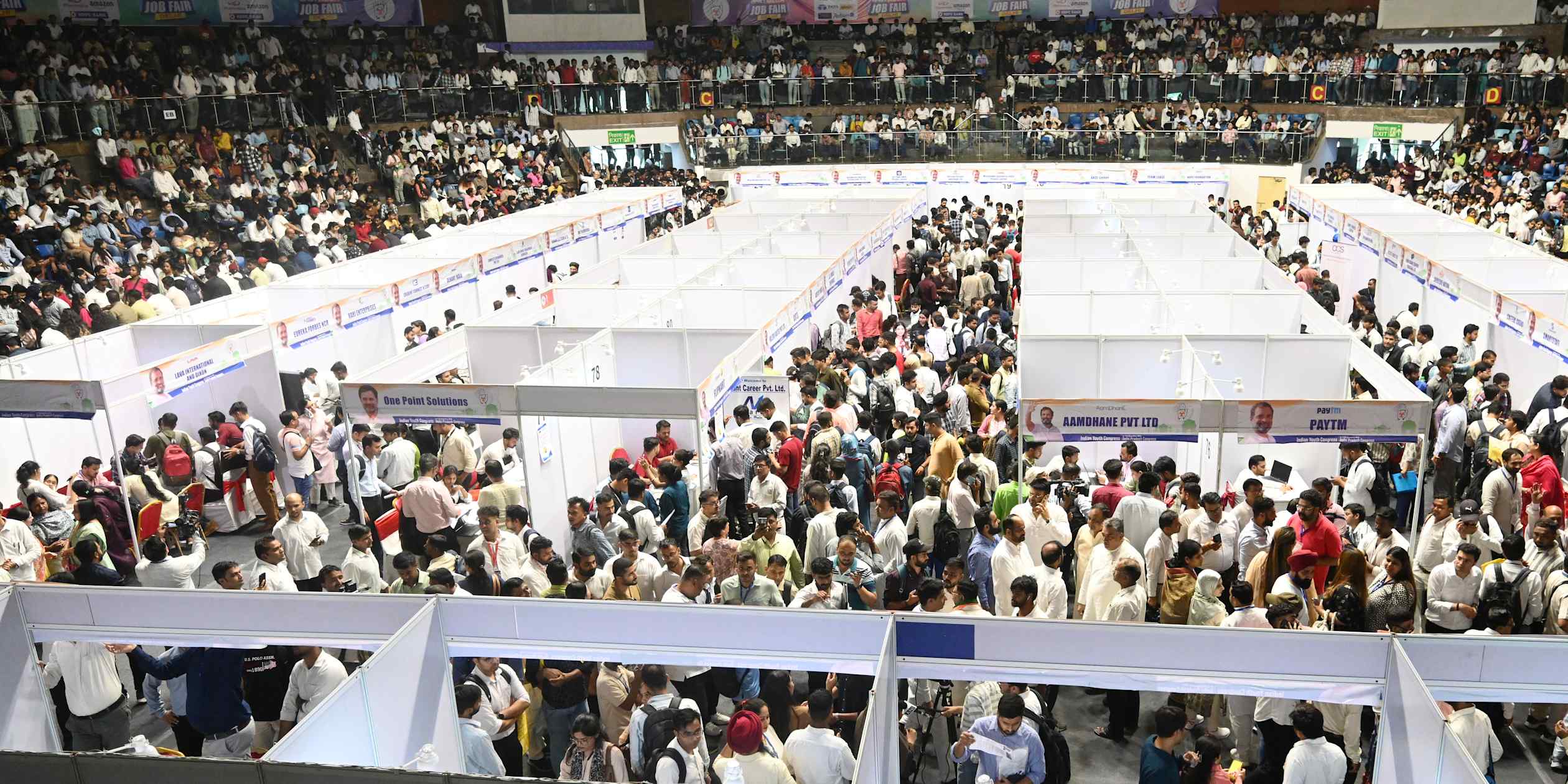
6月19日,在印度特伦甘纳邦的海得拉巴市,求职者们正在参加招聘会上的现场面试。“J型曲线”带来的机遇虽然入门级岗位的就业危机看似严峻,但其中也暗藏机遇。目前由人工智能催生的新增岗位大多与AI相关技术职位有关,这意味着由AI普及所带动的间接效应——即催生新企业、创造新岗位的连锁反应——尚未完全显现。
Job seekers attend walk-in interviews during a job fair in Hyderabad, Telangana, India on June 19. The J-curve opportunity The entry-level crisis sounds dire, but there's a hidden upside. Most jobs created by AI so far appear directly linked to AI-related technology roles. This means its indirect spillovers -- where growing AI adoption leads to new businesses flourishing and the creation of new roles -- have yet to take place.
这对印度而言正是重大机遇所在。微软发布的AI普及报告显示,目前全球范围内AI的使用率仅为18.8%,印度则更低,为18.5%。随着AI应用步伐加快,印度将迎来三大发展机遇:首先,参与全球AI落地进程。印度的IT企业可充当前沿AI模型与企业之间的桥梁,协助企业实现AI技术的有效整合与应用。
This is the big opportunity for India. Microsoft's AI diffusion report shows that AI usage stood at just 18.8% globally and 18.5% in India. As AI adoption accelerates, three opportunities will emerge for India. First, global AI implementation. Indian IT companies can bridge frontier models and enterprises, helping with AI orchestration.
其次,推动国内AI应用。德勤的报告指出,40%的印度企业已显著或全面应用AI技术,这一比例高于全球约28%的平均水平,说明印度企业正积极借助AI实现业务增长。
Second, domestic AI application. According to a Deloitte report, 40% of Indian enterprises reported significant or full usage of AI, compared to a global average of around 28%, suggesting firms are using AI to unlock business outcomes.
就业机会的创造可涵盖多个领域:农业(人工智能咨询、无人机操作、智能灌溉)、教育(本土语言内容制作、人工智能辅助课堂教学)、医疗保健(医学影像处理、数据标注、多语言用户界面设计)以及金融(客户注册流程优化、欺诈调查)。“为印度人服务”的多语言平台模式——即面向数百万使用本土语言的用户的服务平台——目前仍尚未得到充分开发。
Job creation opportunities can span agriculture (AI advisory, drone operations, smart irrigation), education (vernacular content, AI classroom facilitation), healthcare (medical imaging, data annotation, multilingual interfaces) and finance (customer onboarding, fraud investigation). The "India for India" play -- multilingual platforms serving millions of vernacular users -- remains largely untapped.
第三,借助人工智能实现智能技术的普及,有助于降低中小企业和初创企业的准入门槛,而这些企业相比大型企业更能创造大量就业岗位。它们也能进军此前难以涉足的市场,比如农村地区的医疗诊断服务及本土语言教育平台。
Third, democratization of intelligence via AI can lower entry barriers for small and medium-size enterprises (SMEs) and startups, which are more employment-intensive than larger firms. Ventures can serve previously unviable markets, such as rural healthcare diagnostics and vernacular education platforms.
历史提供了可借鉴的经验。20世纪90年代,互联网催生了网页开发这一职业,但电子商务、数字广告及各类平台型企业等间接效益直到21世纪初才显现。如今的数据标注工作未来也将演变为人工智能领域的专业协调工作。关键在于印度能否构建相应的基础设施与人才储备,以抓住2030年代可能出现的类似电子商务那样的发展机遇。
History offers a roadmap. The internet created web developers in the 1990s, but indirect gains -- e-commerce, digital advertising, platform businesses -- only materialized in the 2000s. Today's data annotation roles will evolve into tomorrow's AI domain-expert orchestration. The question is whether India builds the infrastructure and skills to capture the 2030s equivalent of e-commerce.
政策实施窗口期十分有限,这一过渡期仅以季度而非年来衡量。当前有五大重点方向值得关注。
Policy has a narrow window The transition window is measured in quarters, not years. Five priorities stand out.
第一,密切监测就业动态。印度亟需建立一套预警机制,实时追踪就业与裁员情况。人工智能技术的普及速度远超以往任何创新成果,而目前仍处于发展初期。随着技术进一步演进——从任务自动化到具备自主行动能力的人工智能,乃至通用人工智能——其对就业市场的影响也极可能随之变化。
First, track the invisible. India must build an early warning system tracking hiring and firing. The diffusion of AI technology is spreading much faster than past innovations, and these are still early days. As the technology develops further -- from task automation to agentic AI to artificial general intelligence -- its impact on the job market will likely change.
第二,解决初级岗位短缺问题。大型企业应设立人工智能培训项目,让初级员工在从事本职工作的同时学习相关人工智能工具;政府则可对这部分员工的薪资给予部分补贴。
Second, fix the entry-level crisis. Large firms should create AI apprenticeships where entry-level workers learn AI tools alongside their domain work, with government partially subsidizing the wages.
第三,为处于职业中期阶段的劳动者提供转型补贴,支持他们接受再培训;同时向参与员工再培训的企业提供费用补偿。
Third, support mid-career workers via transition stipends during reskilling, with reimbursement to firms for retraining costs.
第四,通过弥补基础设施短板来促进技术普及:确保电力与互联网的稳定供应、提供计算资源、提升全民数字素养、开发符合本地语言习惯的人工智能界面,并营造稳定的监管环境。
Fourth, enable diffusion by addressing infrastructure gaps: reliable electricity and internet, compute access, digital literacy, vernacular AI interfaces, and regulatory certainty.
第五,亟需对教育体系进行改革——包括调整课程设置、加强教师培训以及将人工智能技术融入专业学位教育——以确保教育体系能紧跟技术发展的步伐。
Fifth, there is an urgent need to reform the education system -- school curriculum, teacher training and AI integration into professional degrees -- to keep the system aligned with ongoing technological changes.
人工智能对印度就业市场的影响虽未如预期般严重,但“K型复苏”现象确实存在。印度能否实现“J型复苏”——即短期内出现岗位流失,随后在中期迎来就业增长——则取决于当下的决策。否则,社会将演变为两极分化状态:只有那些具备相关经验与人工智能技能的人才能从中获益。企业和政策制定者必须立即采取行动,留给我们的时间已经不多了。
AI's impact on India's job market has been less damaging than feared, but the K-shaped impact is real. Whether India converts this into a J-curve -- short-term displacement followed by medium-term gains -- depends on choices made now. The alternative is a two-tier society where only those with existing experience and AI skills capture the gains. Businesses and policymakers must act. The window is narrow.