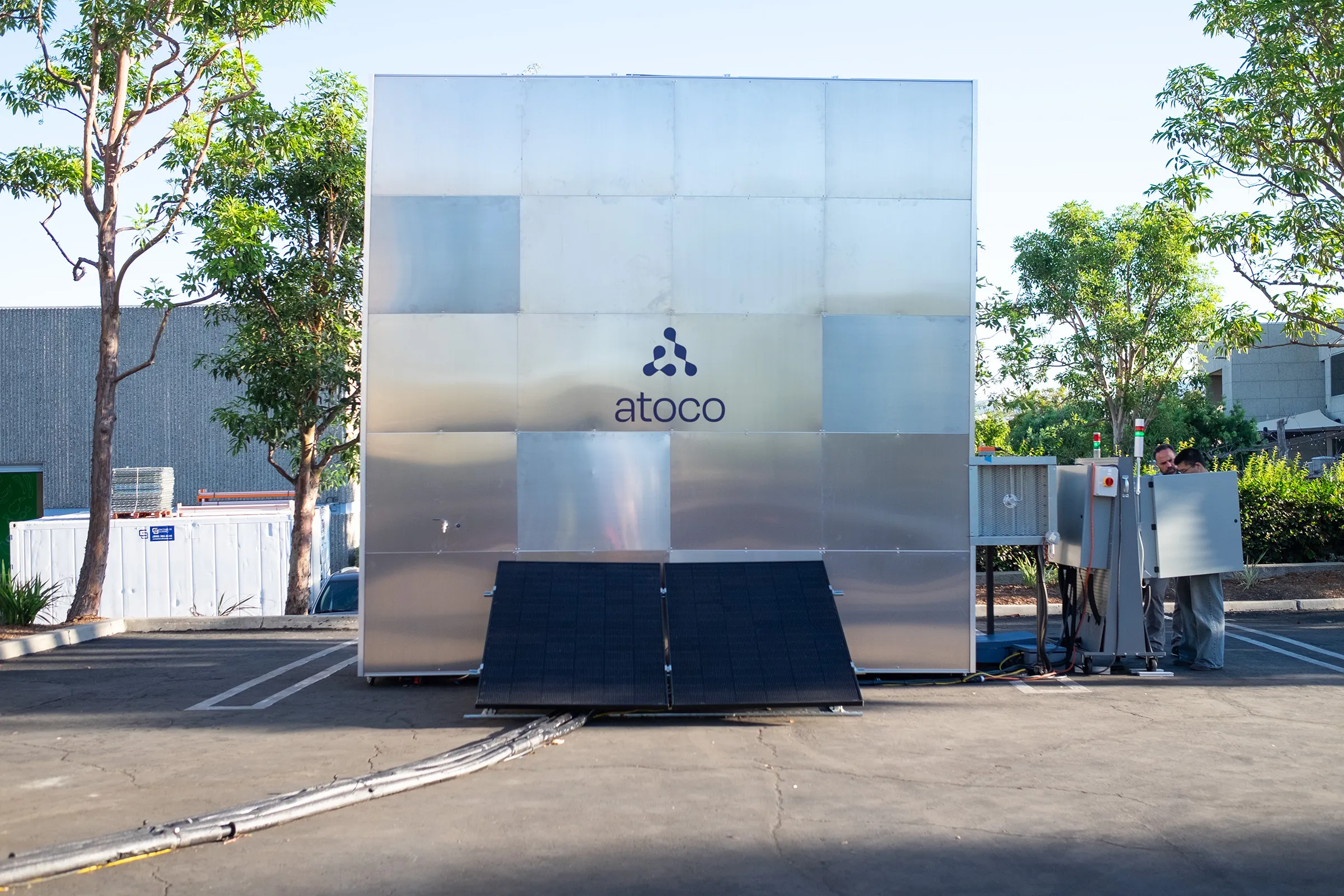
当太阳升起时,位于加利福尼亚州尔湾市的初创公司Atoco的停车场里,一台20英尺高的金属外壳机器周围气温已超过80华氏度。工程师们打开面板检查系统,iPad上显示的一条稳步上升的曲线揭示了该设备的目的:利用被称为金属有机框架(MOFs)的特殊材料从稀薄的空气中收集水分。
The temperature is already over 80 degrees Fahrenheit as the sun rises on a 20-foot-tall, metal-clad machine in the parking lot of Atoco, an Irvine, California-based startup. Engineers open panels to check systems and an iPad that shows a steadily ascending line that reveals the device’s purpose: harvesting water from thin air using special materials known as metal organic frameworks, or MOFs.
这些材料为公司创始人奥马尔·亚基(Omar Yaghi)赢得了2025年诺贝尔化学奖。Atoco已经证明,其原型机每天能够生产数加仑的水。Atoco这项技术迭代的独特之处在于它不需要什么:在微观层面从空气中获取水分时,它不需要电网连接,甚至不需要电力;在将水分从材料中挤出以供人类使用时,同样也不需要电力。
The materials won Omar Yaghi, the company’s founder, the Nobel Prize for chemistry in 2025, and Atoco has shown they work in prototypes capable of producing gallons of water per day. What’s unique about this iteration of Atoco’s technology is what it doesn’t require. No grid connection or even electricity is needed to grab water from the air at the microscopic level, nor is it required to in turn wring the water out of the materials in a form useful for humans.
相反,它所需要的仅仅是低水平的工业废热。Atoco表示,这使其成为连接人工智能数据中心的理想选择。人工智能数据中心在服务器处理从数学证明到虚拟编辑等各种任务时会产生大量废热,而这些中心往往也需要消耗大量的水。
Instead, all that’s needed is low-level industrial heat. That, Atoco says, makes them a perfect candidate to hook up with AI data centers, which throw off loads of waste heat as servers churn out everything from math proofs to virtual editors while also often requiring massive amounts of water.
Atoco首席执行官萨默·塔哈(Samer Taha)表示,四五年前,“我们并没有真正考虑过人工智能数据中心”。但大规模的建设为这家初创公司创造了机会,使其能够更接近其更大的目标,即确保生活在缺水地区的人们能够掌控这一日益宝贵的资源。
“We were not really thinking of AI data centers,” four or five years ago, says Atoco CEO Samer Taha. But the massive buildout has created an opportunity for the startup that could allow it to get a step closer to its larger goal of ensuring people living in water-stressed regions have control over an increasingly precious resource.
加州大学尔湾分校物理科学学院院长塞斯·科恩(Seth Cohen)说,MOF的结构看起来有点“像操场上的攀爬架”。科恩并未参与Atoco的工作,他表示,MOF本质上是“分子海绵——它们是一种非常、非常擅长吸收其他分子的固体材料”。就像海绵一样,这些材料也可以通过包括加热在内的方法被“拧干”,从而释放出它们所吸附的物质。
The structure of a MOF looks somewhat “like a jungle gym on a playground,” says Seth Cohen, the dean of the School of Physical Sciences at UC Irvine. MOFs are essentially “molecular sponges—they’re a solid material that’s very, very good at absorbing other molecules,” says Cohen, who is not involved with Atoco. Like a sponge, the materials can also be wrung out using methods including heat to release whatever they’re holding onto.
这些丛林健身房般的框架在微观层面上创造了开放空间,可以容纳数量令人难以置信的材料,微小的调整可以创造更多的内部空间。
These jungle-gym-like frameworks create open spaces on the microscopic level that can hold an unbelievable amount of material, and small tweaks can yield even more interior space.
亚吉解释道:“一克希夫的镜头可以覆盖两个足球场。”“他们可以在其中储存氢以制造清洁能源,或者你可以在其中储存二氧化碳以制造清洁空气。或者,在这种情况下,你可以储存水。”Atoco开发了塔哈所谓的“精密材料”,其具体目标是能够收获水、释放水,然后一遍又一遍地进行。他打趣说,正如研发副总裁Benjie Limketkai所说,材料必须喜欢水,但不能爱它。要想在商业上取得成功,它还必须使用尽可能少的能源。
“The footage of a gram of MOF could cover two football fields,” Yaghi explains. “They can store hydrogen in there to make clean energy, or you could store CO2 in there to make clean air. Or, in this case, you can store water.”Atoco has developed what Taha calls “precision materials” with a specific objective of being able to harvest water, release it, and then do it over again and again. He quips that, as vice president of R&D Benjie Limketkai puts it, the material has to like water but not love it. To succeed commercially, it also has to use as little energy as possible.
塔哈说:“科学家们达到了一定的精确度,我们甚至真正知道原子的角度。”在给定的材料中。
“The scientists reach a level of precision [where] we really know even the angle of the atom,” in a given material, Taha says.
在Atoco的技术中,空气通过特别定制的用于吸引水分子的MBE。这些分子粘附在毛孔上。但即使饱和,这种材料摸起来也感觉完全干燥,挤压它不会释放一滴。(Taha我们好心地让《连线》尝试一下。)相反,该公司依靠热量来释放捕获的分子。
In Atoco’s technology, air passes through the MOF, which has been specially tailored to attract water molecules. Those molecules adhere to the pores. But the material feels completely dry to the touch even when saturated, and squeezing it doesn’t release a single drop. (Taha was kind enough to let WIRED try our hand at it.) Instead, the company relies on heat to release the captured molecules.
还有其他收集水的方法。科恩指出,二氧化硅是一种流行的干燥剂,也可以将水从空气中吸出,但它不能容纳那么多的水分,需要你“加热它才能将水抽回来”,他说。
There are other means of harvesting water. Cohen notes that silica, a popular desiccant, can also pull water out of air, but it doesn’t hold as much moisture and requires you to “heat the heck out of it to get the water back out,” he says.
该公司欧文工厂停车场的巨石是数十年精确开发的顶峰。Atoco的材料和方法使其离网系统即使在相对湿度为十几岁的情况下也能工作。塔哈说,设备中的MOF可以收集和释放热量低至100华氏度的水。
The monolith in the parking lot of the company’s Irvine facility is the culmination of decades of precision development. Atoco’s materials and approach allow its off-grid system to work even when relative humidity is in the teens. The MOFs in the device can harvest and release water with heat as low as 100 degrees Fahrenheit, Taha says.
由于附近没有数据中心,Atoco的团队通过从约150华氏度的热源输送热量来模拟。一块太阳能电池板为各种系统供电,但不为集水操作本身供电,这使得这台金属外壳的机器异常安静。驶入邻近企业的汽车造成的噪音干扰更大,但塔哈已准备好展示这台设备一直在努力工作。上午9点刚过,气温超过90华氏度,他按下侧面的一个按钮,打开一个水龙头。一股清澈的水流涌出,看起来足以饮用。
With no data center nearby, Atoco’s team simulated it by piping heat from a source that was around 150 degrees Fahrenheit. A solar panel powers various systems but not the water-harvesting operation itself, making the metal-clad machine eerily quiet. Cars pulling into the adjacent businesses create more of a sonic disruption, but Taha is ready to show the device has been working hard. It’s a little after 9 am, and the temperature is over 90 degrees Fahrenheit when he pushes a button on the side and turns a spigot. Out tumbles a clear stream of water that looks good enough to drink.
不幸的是,出于法律责任方面的考虑,这些水并不对外提供,不过塔哈指出它相当于蒸馏水,因为Atoco的MOF并非为收集空气污染物而设计。把它倒进灌木丛后,塔哈退到一间有空调的会议室,在那里他阐述了公司对这台新机器的愿景。
Unfortunately it’s not on offer for legal liability reasons, though Taha notes it’s the equivalent of distilled water, because Atoco’s MOFs aren’t built to gather air pollution. Tossing it in the bushes, Taha retreats to an air-conditioned conference room where he lays out the company’s vision for its new machine.
“大约70%的工业废热是低品位的,未被利用,被排入海洋或空气中,”他说。“如果你用我们的技术将废热转化为清洁水,那说的就是数万亿升清洁水。”数据中心是这种废热日益重要的来源,单个设施产生的热量相当于数万户家庭。运营商被迫将这些热量散发到周围环境中,形成热岛,同时还要为各种冷却系统付费。
“Roughly 70 percent of the industrial waste heat is low-grade, unutilized, thrown into oceans or into the air,” he says. “If you convert that waste heat to clean water using our technology, you're talking about trillions of liters of clean water.”Data centers are an increasingly big source of that waste heat, with a single facility capable of pumping out as much heat as tens of thousands of homes. Operators are forced to disperse that heat into the surrounding environment, creating heat islands, while also paying for various types of cooling systems.
其中许多冷却系统也依赖水,有些每天可消耗数百万加仑。因此,Atoco的技术将解决数据中心最大的两个问题。
Many of those cooling systems also rely on water, and some can consume millions of gallons per day. Atoco’s technology would thus address two of data centers’ biggest problems.
塔哈说,数据中心正在投入大量资金来消除废热。“我们实际上想要它;我们需要它。我们回馈给你水,正是造成问题的同一种产物。”他说,公司还希望帮助向农村社区供水,由于缺乏基础设施,那里的公用事业公司有时用卡车运水。
Data centers are investing a lot of money to get rid of waste heat, Taha says. “We actually want it; we need it. We give you back water, the same product that is causing the issue.”He says the company also wants to help deliver water to rural communities, where utilities sometimes bring in water by the truckload because of a lack of infrastructure.
要做到这一点,更不用说为每天需要数百万加仑水的数据中心提供服务,将需要实现规模上的巨大飞跃。该公司停车场里的演示装置每天最多可产生300升水。Atoco设想数据中心通过网格系统使用多个装置来制水,目前正在开发一种商业产品,每天最多可生产1000升水。其停车场原型机运行所消耗的热量相当于一个20千瓦数据中心所提供的热量。相比之下,超大规模数据中心的规模要大几个数量级,这既是机遇也是挑战。
To do that, let alone serve data centers that require millions of gallons of water daily, will require a big leap in scale. The demo in the company’s parking lot can generate up to 300 liters of water per day. Atoco envisions data centers using multiple units in a grid system to generate water and is working on a commercial offering that could produce up to 1,000 liters of water per day. Its parking lot prototype runs off the equivalent heat provided by a 20-kilowatt data center. Hyperscale data centers, in comparison, are orders of magnitude bigger, which presents both an opportunity and a challenge.
Atoco已在美国和海湾合作委员会成员国内与合作伙伴部署了五个并网原型试验。该公司表示,希望在今年年底前开始接受其首款产品的订单。该公司称,目前正与几家大型科技公司商讨在数据中心部署试点项目的事宜,但拒绝透露这些公司的名称,也未说明客户购买一台设备预计需要花费多少钱。不过,有迹象表明市场潜力巨大:微软、谷歌和亚马逊云科技都已承诺到2030年实现“水资源正效益”,即向社区回馈的水量超过其消耗的水量。
Atoco has deployed five on-grid prototype trials with partners in the US and within the Gulf Cooperation Council. The company says that it hopes to begin taking orders for its first product by the end of this year. It says it’s already in conversation with major tech companies about deploying a pilot project at data centers, though it declined to name them or how much customers could expect to spend on a unit. But there are signs that there could be a market: Microsoft, Google, and Amazon Web Services have all committed to being water positive—that is, returning more water to communities than they use—by 2030.
Atoco的产品或许适用于数据中心和其他工业场所,以及地热点等拥有丰富自然热源的地点。但曾在国防高级研究计划局(DARPA)从事金属有机框架(MOF)项目(包括雅吉牵头的一个项目)工作的科恩提醒说,虽然MOF前景广阔,但它们并非解决各地水资源获取问题的万能药。如果没有外部热源,即使是设计最精良的MOF也需要能量来挤出水分。这可能会使农村地区的部署面临挑战。Atoco的并网系统或许能提供一种解决方案,但偏远地区往往也缺乏能源基础设施。
Atoco’s product might work at data centers and other industrial sites, as well as locations where there are abundant natural heat sources, such as geothermal sites. But Cohen, who worked at the Defense Advanced Research Projects Agency on MOF projects—including on a project spearheaded by Yaghi—cautions that while MOFs have incredible promise, they’re not a silver bullet for water access everywhere. Without an outside source of heat, even the most well-designed MOFs still require energy to squeeze water out. That could make rural deployment, in particular, a challenge. Atoco’s on-grid system might offer a solution, but distant locations are also frequently underserved by energy infrastructure.
塔哈表示,该公司可以以每公吨5美元的平准化成本生产水,这使其具有与老旧海水淡化厂竞争的能力。但较新的设施能够以每吨2美元甚至更低的成本供水——他表示,Atoco距离达到这一目标还有三到五年时间。
Taha says the company can produce water at a levelized cost of $5 per metric ton, which makes it competitive with older desalination plants. But newer facilities are able to deliver water at a cost of $2 per ton or even less in some cases—a target he says Atoco is still three to five years away from hitting.
MOFs(金属有机框架)仍是一项前沿技术,尚未在大规模应用中得到验证。虽然大型科技公司比如公用事业公司等保守行业更愿意承担风险,但仍需时间来验证Atoco的技术是否可行,以及这家初创公司能否扩大商用装置的产量,以提供有意义数量的水。
MOFs also remain a cutting-edge technology that’s untested at scale. While big tech companies are more likely to take risks than, say, staid utilities, it will take time to vet that Atoco’s technology can work and for the startup to scale up production of its commercial units to provide meaningful amounts of water.
尽管如此,Atoco的技术已经解决了一些极具挑战性的难题。MOFs的应用让世界更接近亚吉所描述的境界:人人都能掌控自己的用水获取权。亚吉回忆道,小时候作为巴勒斯坦难民在约旦长大,每两周送水车来一次时,他负责尽可能多地装满容器储水供家庭使用。
Still, Atoco’s technology has already solved some incredible challenges. The use of MOFs brings the world much closer to a place where, as Yaghi puts it, everyone can control access to their own water. Yaghi describes how as a child, growing up as a Palestinian refugee in Jordan, he was responsible for filling as many containers as he could with water for his household to use when the delivery truck came every two weeks.
他说,那段经历“让你体会到匮乏的滋味”。“现在,我们谈论的是从匮乏走向丰裕。”
That experience “makes you appreciate scarcity,” he says. “Now, we’re talking about going from scarcity to abundance.”