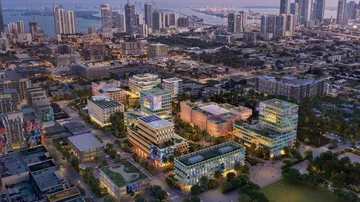
高塔姆·穆昆达(Gautam Mukunda)报道:金融公司西特adel(Citadel)的创始人肯·格里芬(Ken Griffin)上周向美国高等教育史上最大的一笔捐赠——向匹兹堡的卡内基梅隆大学捐赠了30亿美元,其中20亿美元将用于在迈阿密建设新校区。这一举动正值美国高等教育面临危机之际,该领域正应对人口结构下滑、公众支持度下降以及唐纳德·特朗普政府发起的抨击。
Griffin, the founder of the financial firm Citadel, last week made the largest gift in the history of US higher education: $3 billion to Pittsburgh’s Carnegie Mellon University, of which $2 billion will go to build a new campus in Miami. It comes at a time of crisis for American higher education, as it deals with demographic decline, falling public support and attacks from President Donald Trump’s administration.
然而,处于危机中的体系往往更易于变革——只要卡内基梅隆大学的迈阿密校区拥有成为真正全新事物的自由,且联邦政府允许其蓬勃发展,格里芬的捐赠或许能带来这种变革。
But a system in crisis is more open to change — and Griffin’s gift could deliver it, so long as Carnegie Mellon’s Miami campus has the freedom to become something truly new and the federal government lets it thrive.
预计美国高中毕业生人数将在2025年达到峰值,到2041年下降13%。外国学生的消费使教育成为美国第七大服务出口,他们或许能填补这一缺口,但特朗普政府已敦促大学将国际本科生比例限制在15%以内。这对大多数学院来说影响甚微(全国范围内,外国学生约占本科生的2%),但对卡内基梅隆大学而言却至关重要,该校2024-25学年的外国学生占比高达19%。由于大学在土地、设施和师资方面拥有高昂的固定成本,它们很难应对这种规模的收缩。
The number of US high school graduates was projected to peak in 2025 and fall 13% by 2041. Foreign students, whose spending makes education America’s seventh-largest services export, could help fill the gap, but the Trump administration has pressed universities to cap international undergraduates at 15%. That would barely matter at most colleges (nationally, foreign students are about 2% of undergraduates), but it would at Carnegie Mellon, where they accounted for 19% of students in 2024-25. Universities, with their high fixed costs in land, facilities and faculty, are ill-prepared for that kind of contraction.
此类危机既可能推动也可能阻碍创新。当时还是哈佛商学院助理教授的克拉克·吉尔伯特(Clark Gilbert)于2005年发表了一项研究,探讨八家报纸如何应对互联网。研究发现,强烈的威胁感既帮助它们克服了投资新事物的犹豫,又使它们更紧地固守现有惯例。那些摆脱了这些惯例的报纸,将在线业务设立为独立单元,引入外部人员,并将这一举措视为机遇而非威胁。
Crises like this can both spur and block innovation. Clark Gilbert, then an assistant professor at Harvard Business School, published a study in 2005 about how eight newspapers responded to the internet. It found that a strong sense of threat both helped them overcome their reluctance to invest in something new and made them cling more tightly to their existing routines. The ones that escaped those routines had set up their online operations as separate units, brought in outsiders and treated the venture as an opportunity rather than a threat.
格里芬的捐赠或许能帮助美国整个高等教育体系,而不仅仅是卡内基梅隆大学,向创新方向倾斜。历史上曾发生过类似的情况。1873年,巴尔的摩商人约翰斯·霍普金斯去世时,留下700万美元用于创办一所大学和一家医院,这是当时美国历史上最大的一笔慈善遗赠。该大学首任校长丹尼尔·科伊特·吉尔曼利用其中一半资金,建立了一所以研究生培养和科研为核心的机构,约翰斯·霍普金斯大学由此成为美国第一所研究型大学。
Griffin’s gift could help tip all American higher education, not just Carnegie Mellon, to the innovation side. It’s happened before. When Baltimore merchant Johns Hopkins died in 1873, he left $7 million to found a university and a hospital, then the largest philanthropic bequest in US history. The university’s first president, Daniel Coit Gilman, used its half to build an institution organized around graduate training and research, and Johns Hopkins became America’s first research university.
现有的老牌高校不得不做出回应。哈佛大学校长查尔斯·埃利奥特曾表示,直到霍普金斯大学的先例迫使他的教师团队投入资源,哈佛的研究生院才得以蓬勃发展。如今,这所学院已成为哈佛大学的肯尼斯·C·格里芬艺术与科学学院研究生院。
The incumbents had to respond. Harvard President Charles Eliot said that Harvard’s graduate school didn’t thrive until Hopkins’ example forced his faculty to invest in it. That school is now Harvard’s Kenneth C. Griffin Graduate School of Arts and Sciences.
要让这份新捐赠产生同样的积极效果,迈阿密校区必须拥有真正的差异化自由。对此最大的威胁是终身教职制度,因为它塑造了大学的一切。初级教师被这一制度所裹挟,而资深教师则是这一制度的产物。
For this new gift to have the same salutary effect, the Miami campus has to be free to be truly different. The greatest threat to that is the tenure process, which shapes everything at a university. Junior faculty are consumed by it, and senior faculty are produced by it.
其中一个问题在于距离。如果终身教职的评定在匹兹堡进行,迈阿密校区的教授将处于不利地位。任何曾在教师委员会任职的人,比如我在哈佛的经历,都知道同事们会力挺那些在研讨会、走廊和午餐时经常见面的人。眼不见,心确实会远。另一个问题是,终身教职制度可能会威胁到卡内基梅隆大学迈阿密校区独特办学模式的成功。
One issue is distance. If tenure is decided in Pittsburgh, professors in Miami will be at a disadvantage. Anyone who has served on a faculty, as I did at Harvard, knows that colleagues champion the people they see at seminars, in the hallway and over lunch. Out of sight really is out of mind. Another issue is that the tenure process may threaten the success of CMU Miami’s distinctive approach.
该校区将围绕能源和气候韧性等四大挑战来组织科研,而非传统的学术学科。但卡内基梅隆大学的终身教职是全校统一的,因此在迈阿密获得终身教职的教授在全校范围内都享有该职位,而卡内基梅隆大学已承诺迈阿密校区将“按照定义卡内基梅隆大学学术卓越的标准来建设”。危险在于,在一个以跨学科为根基的校区,教授们可能会由单一学科的专家来评判。
The campus will organize research around four challenges, such as energy and climate resilience, rather than traditional academic disciplines. But tenure at Carnegie Mellon is institution-wide, so a professor tenured in Miami holds it across the university, and Carnegie Mellon has promised that Miami will be built “to the same standards of academic excellence that define CMU.”The danger is that professors at a campus built on crossing disciplines would be judged by experts in one.
卡内基梅隆大学允许各学院自行制定终身教职标准,并预见到一些学院可能不会按学科部门组织,这听起来就像CMU迈阿密校区。但每个学院的政策都必须符合大学整体政策,而且所有终身教职案例都要经过大学委员会的审议,而这些委员会将由匹兹堡校区的人员主导。因此,各学院将始终面临采用主校区流程和标准的诱惑。
Carnegie Mellon lets each college set its own tenure criteria, and anticipates colleges that are not organized by departments, which sounds like CMU Miami. But every college’s policy must conform to the university’s, and every tenure case goes through university committees that will be dominated by personnel in Pittsburgh. So there will be a constant temptation to adopt the main campus’s process and standards.
格里芬捐赠的巨额规模正是在这一点上产生了影响。CMU迈阿密校区拥有近300名教职员工,规模足以形成自身的学术共同体。这应该能让初级教职人员自由地从事长期且高风险的研究项目。2011年的一项研究发现,霍华德·休斯医学研究所的研究人员能够产出高影响力论文的比例,远高于获得美国国家卫生研究院(NIH)资助的同等成就的科学家——NIH的资助项目评审周期短,且对失败容忍度低。
That’s where the sheer scale of Griffin’s gift makes a difference. With nearly 300 faculty, CMU Miami will be big enough to form its own community. It should give junior faculty the freedom to pursue long-term, high-risk projects. A 2011 study found that investigators at the Howard Hughes Medical Institute, which tolerates early failure and rewards long-term success, produced high-impact papers at a much higher rate than similarly accomplished scientists funded by the NIH, whose grants come with short review cycles and little tolerance for failure.
而上述研究中的科学家都是已有一定成就的学者。初级教职人员则要在终身教职的时限压力下工作,因此面临的压力更为严峻。CMU迈阿密校区应当为这类研究提供足够长的保护期,以便评估其真正的价值。
Those were established scientists. Junior faculty, working against a tenure clock, face those pressures even more acutely. CMU Miami should protect that kind of work long enough to judge its real value.
CMU迈阿密校区还有另一种方式,可能成为美国高等教育的福音。格里芬表示,CMU迈阿密校区将吸引“来自全球各地”的优秀学生、学者和研究人员。2024年,持有临时签证的学生获得了美国计算机与信息科学领域61%的博士学位,以及工程领域54%的博士学位。2025年秋季,国际新生入学人数下降了17%,国际研究生入学人数下降了12%。
There’s one other way CMU Miami can be a godsend for US higher education. Griffin says CMU Miami will attract exceptional students, scholars and researchers “from across the globe.”In 2024, temporary visa holders earned 61% of US doctorates in computer and information sciences and 54% in engineering. In fall 2025, new international enrollment fell 17% and international graduate enrollment fell 12%.
在报告入学人数下降的机构中,96%都提到了签证申请问题:特朗普政府于2025年5月暂停了新的学生签证面试,随后又以扩大社交媒体背景审查的方式恢复;此后,政府还对39个国家实施了旅行禁令。今年秋季,顶尖研究型大学博士项目的国际申请人数下降了21%。
Among institutions reporting declines, 96% cited problems with visa applications, after the Trump administration paused new student visa interviews in May 2025, then resumed them with expanded social-media vetting. It has since imposed a 39-country travel ban, and this fall, international applications to doctoral programs at major research universities fell 21%.
如果说有一个人能够说服政府,让他们意识到那些政策的荒谬之处,那么格里芬或许就是那个人。接下来会发生什么,将决定他的天赋究竟会在迈阿密催生一所新学校,还是为整个国家带来一个全新且更优质的教育体系。无论如何,格里芬对美国高等教育所做的投入,都堪比约翰斯·霍普金斯大学在1873年所做的投资,而且其规模甚至超越了霍普金斯大学当年的水平。
If there’s one person who could convince the administration of the folly of those policies, it might be Griffin. What happens next will help determine whether his gift produces a new school in Miami or a new and better education system for the country. Either way, Griffin has made the kind of investment in American higher education that Johns Hopkins made in 1873, on a scale even Hopkins never approached.