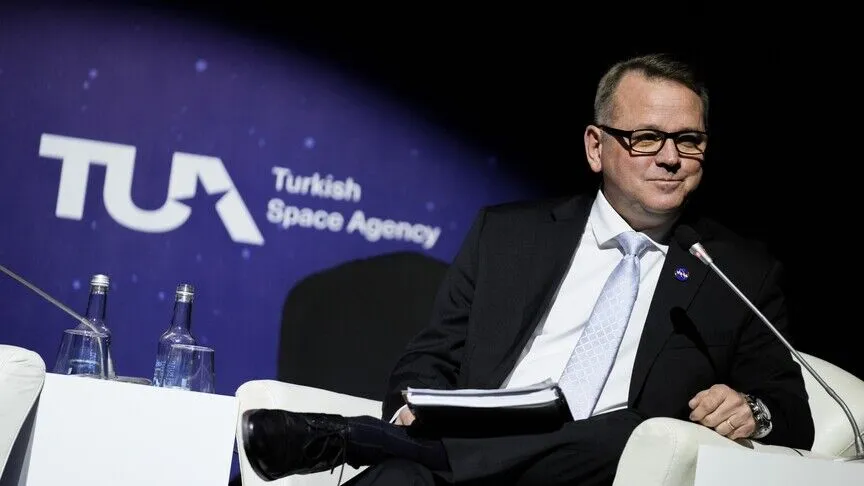
俄罗斯和中国有朝一日可能会加入美国主导的阿尔忒弥斯协议,但目前并不认同其原则,这是美国宇航局副局长周三在土耳其安塔利亚国际航天大会上表示的。"如果有一天俄罗斯和中国在这些原则上持有相同观点——我们目前并不认为他们这样做——那么加入阿尔忒弥斯协议就是有可能的,"安德森在接受记者采访时说道。
Russia and China could one day join the US-led Artemis Accords on space exploration if they come to share its principles, but they do not today, NASA's deputy administrator said Wednesday. "If one day, Russia and China were like-minded in those principles, which we don't see them as that right now, then there would be a possibility to join the Artemis Accords," Matt Anderson told reporters at the International Astronautical Congress in Antalya.
安德森表示,已签署协议的76个国家分享着建立在安全、透明和负责任的太空活动原则之上的"共同纽带"。
Anderson said the 76 countries that have signed the accords share a "common bond" built on agreed principles for safe, transparent, and responsible activity in space.
莫斯科和北京则领导着一项竞争性的努力——国际月球研究站,计划在月球上建立联合研究基地。有些国家属于两个团体。一些签署协议的国家的学术机构也与中国牵头的项目合作。
Moscow and Beijing are instead leading a rival effort, the International Lunar Research Station, which plans a joint research base on the Moon. Some countries belong to both groups. Some signatories' academic institutions also work with the Chinese-led project.
被问及这是否构成担忧时,安德森说:"主权国家怎么做是他们自己的事。"他还补充说,加入协议并不妨碍各国 pursuing他们的国家利益。
Asked whether that was a concern, Anderson said: "What sovereign nations do is up to them."g the accords does not stop countries from pursuing their national interests, he added.
安德森是在与秘鲁国家航空航天局局长罗贝托·梅尔加尔·希恩共同主持了一场闭门会议之后发表上述言论的。安德森表示,有超过40个国家参加了会议。
Anderson spoke a day after co-chairing a closed-door meeting of the accords' members with Maj. Gen. Roberto Melgar Sheen, director of Peru's space agency, CONIDA. Anderson said just over 40 countries attended.
梅尔加尔·希恩表示,与会者就太空碎片达成了协议。他们还讨论了月球表面的碎片问题。"处理太空碎片或阻止太空碎片的第一步,是停止制造它们,"安德森说道。
Melgar Sheen said participants reached agreement on space debris. They also discussed debris on the lunar surface. "The first step to stop space debris, or to deal with space debris, is to stop creating it," Anderson said.
被问及太空武器的担忧时,安德森表示,协议涵盖的是民用太空活动。他说,军事事务属于各国的国家安全机构自行处理。
Asked about concerns over weapons in space, Anderson said the accords cover civil space activities. He said military matters belong with each country's national security bodies.
“对我们美国来说,相关机构是美国太空军(United States Space Force)和美国太空司令部(United States Space Command)。《阿尔忒弥斯协议》(Artemis Accords)的核心关注点是民用太空领域,”他说,“没有人希望看到太空中发生武装冲突;我们的目标始终是和平探索太空。”安德森还提到,来自协议成员国的学生将能够进入新成立的美国太空学院(US Space Academy)学习——这所大学是专门培养民用太空人才的四年制高等教育机构。
"For us in the United States, that's United States Space Force and United States Space Command. What the Artemis Accords is focused on is that civil space sector," he said. "Nobody wants kinetic fighting in space. We are about peaceful exploration." Anderson also said students from member countries will be able to attend a new US Space Academy, a four-year civilian university.
美国总统唐纳德·特朗普于今年8月下令成立这所学院,预计首批学生将于2028年夏季入学。
US President Donald Trump ordered its creation in August, and Anderson said the first students are expected in the summer of 2028.
安德森表示,各成员国都非常愿意为NASA计划中的月球基地项目提供支持;他们的贡献形式多样,既可以是小型卫星(如立方星,CubeSats),也可以是参与美国工业团队研发着陆器和探测车的工程师们。
He said member nations are eager to contribute to NASA's planned Moon base. Contributions could range from small satellites known as CubeSats to engineers on US industry teams building landers and rovers.
安德森还提到,德国将于2027年主办下一届《阿尔忒弥斯协议》年度研讨会。
Germany will host the accords' next annual workshop in 2027, Anderson said.
梅尔加尔·希恩(Melgar Sheen)表示,今年在利马举行的研讨会是该协议在拉丁美洲地区的首次举办活动,会上通过模拟演练和桌面测试等方式检验了“不干涉原则”、“互操作性”以及“数据共享”等关键概念。他表示秘鲁希望未来能参与月球探测任务,或许会与其他拉丁美洲国家共同合作。
Melgar Sheen said this year's workshop in Lima, the first in Latin America, used simulations and tabletop exercises to test principles such as non-interference, interoperability and data sharing. He said Peru hopes to take part in future lunar missions, possibly alongside other Latin American countries.
“我们坚信,月球及深空探索的未来必须建立在透明度、可持续性、互操作性和包容性的基础上,”他说。
"We firmly believe that the future of lunar and deep space exploration must be guided by transparency, sustainability, interoperability, and inclusivity," he said.
《阿尔忒弥斯协议》由美国及其他七个国家于2020年共同签署,是一套关于和平探索月球、火星及其他深空目标的非约束性原则性文件,其基础是1967年签署的《外层空间条约》(Outer Space Treaty)。土耳其已于今年8月正式加入该协议。
Launched in 2020 by the US and seven other countries, the Artemis Accords are a nonbinding set of principles for the peaceful exploration of the Moon, Mars, and beyond. They are based on the 1967 Outer Space Treaty.
该协议与NASA的“阿尔忒弥斯计划”(Artemis Program)紧密相关:NASA的“阿尔忒弥斯II号”(Artemis II)任务于今年4月成功将宇航员送入月球轨道,这是50多年来首次载人登月飞行。
Türkiye signed in August. The accords are tied to NASA's Artemis program. Its Artemis II mission carried astronauts around the Moon in April, the first crewed lunar flight in more than 50 years.