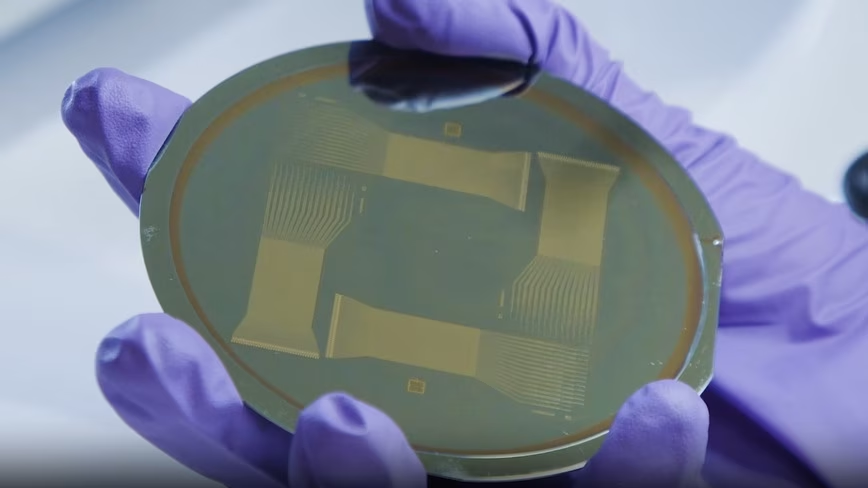
欧洲一个研究小组研制出一种机器人,利用磁铁将超薄石墨烯电极引导进入大脑。负责临床工作的巴塞罗那 INBRAIN Neuroelectronics 公司于周三宣布了这一成果,标志着欧盟资助的 MINIGRAPH 项目圆满结束。
A European research group has built a robot that uses magnets to steer ultra-thin graphene electrodes into the brain. Barcelona’s INBRAIN Neuroelectronics, which leads the clinical work, announced the results on Wednesday, at the end of the EU-funded MINIGRAPH project.
该项目的首个攻关目标是帕金森病。医生目前已采用深部脑刺激疗法治疗该病,即植入电极传递电脉冲。研究团队希望开发出能够记录脑部活动、读取信号并作出刺激响应的植入体,旨在实现根据每位患者情况自动调节的疗法。
The project’s first target is Parkinson’s disease. Doctors already treat it with deep brain stimulation, which uses implanted electrodes to deliver electrical pulses. The group wants implants that record brain activity, read the signals and respond with stimulation. The aim is therapy that runs on its own, tuned to each patient.
机器人如何工作 Nanoflex Robotics 公司与苏黎世联邦理工学院共同构建了植入系统,依靠远程磁力导航。磁力载体输送细微探针,机器人在 X 射线成像引导下对其进行导航。它既能沿直线路径前进,也能沿弯曲路径前进,从而到达大脑表面及深部区域。
How the robot works Nanoflex Robotics and ETH Zurich built the implantation system, which relies on remote magnetic navigation. A magnetic carrier delivers the thin probes, and the robot guides them under X-ray imaging. It can follow straight or curved paths to reach both the surface of the brain and deeper areas.
INBRAIN 表示,团队已在实验室和大型动物模型中测试了该手术流程。公司称,这能使脑机接口植入更快捷、更可复现。
INBRAIN said the team tested the procedure in the lab and in a large animal model. The company said it could make implanting brain-computer interfaces faster and more repeatable.
Nanoflex Robotics 联合创始人兼首席执行官 Matt Curran 表示:“MINIGRAPH 项目证明了利用电磁机器人技术控制下一代 BCI 植入的可行性与潜力,不仅能沿直线轨迹,还能沿弯曲轨迹深入大脑,精度达到亚毫米级。”
“The MINIGRAPH project demonstrated the feasibility and potential to use electromagnetic robotics to control the delivery of next-generation BCI not only though straight but also curved trajectories deep into the brain with sub millimeter accuracy,” said Matt Curran, co-founder and chief executive of Nanoflex Robotics.
石墨烯取代金属 目前大多数脑电极由金属制成。INBRAIN 利用石墨烯——一种单原子层厚的碳片——制备薄膜电极。公司称,加速老化测试产生的数据支持其预计稳定性超过 10 年。团队还对该材料开展了毒性和生物相容性研究。
Graphene instead of metal Most brain electrodes today are made of metal. INBRAIN makes thin-film electrodes from graphene, a sheet of carbon one atom thick. Accelerated ageing tests produced data supporting more than 10 years of projected stability, the company said. The group also ran toxicity and biocompatibility studies on the material.
财团构建了紧凑型电子装置,可解码来自大脑数百个点位的信号。它将探针、电子装置与软件整合为一个植入体原型,并在转化动物模型中进行了测试。
The consortium built compact electronics that can decode signals from hundreds of points in the brain. It combined the probes, electronics and software into one implant prototype, which it tested in a translational animal model.
“随着脑机接口(BCI)技术逐渐应用于临床患者,能否让更多人受益,不仅取决于我们制造先进设备的能力,还取决于我们能否开发出精确且可重复使用的植入方法。”INBRAIN公司的联合创始人兼首席科学官何塞·A·加里多(Jose A. Garrido)说道。
“As BCI technologies move toward patients, making them available to more people will depend not only on our ability to manufacture advanced devices, but also on developing precise and reproducible ways to implant them,” said Jose A. Garrido, co-founder and chief scientific officer of INBRAIN.
资金来源:该项目由欧洲创新委员会(European Innovation Council)通过“地平线欧洲计划”(Horizon Europe)提供资助。根据项目网站的信息,欧盟在2022年10月至2026年3月的45个月内共投入了393万欧元;瑞士则负责资助苏黎世联邦理工学院(ETH Zurich)的相关研究工作。
Who paid for it The European Innovation Council funded MINIGRAPH through Horizon Europe. The EU contribution was €3.93m over 45 months from October 2022, according to the project’s website. Switzerland funded ETH Zurich’s part.
项目合作方:该项目由加泰罗尼亚纳米科学与纳米技术研究所(ICN2)负责协调,参与方还包括Imec、弗劳恩霍夫协会(Fraunhofer-Gesellschaft)、莱顿大学医学中心(Leiden University Medical Center)以及奥洛穆茨帕拉茨基大学(Palacký University Olomouc)。
The Catalan Institute of Nanoscience and Nanotechnology (ICN2) coordinated the group. Imec, Fraunhofer-Gesellschaft, Leiden University Medical Center and Palacký University Olomouc also took part.
研究进展:目前,所有相关测试都仅在实验室和动物身上进行。今年4月,INBRAIN公司宣布已完成其首个针对石墨烯脑机接口的人体研究项目的患者招募工作,该研究旨在解码和绘制大脑活动图谱。
The tests so far were in the lab and in animals. In April, INBRAIN said it had finished enrolling patients in a separate first-in-human study of its graphene interfaces for brain decoding and mapping.
其他国家的进展:在美国,Paradromics公司于6月将其开发的脑芯片成功植入首位患者体内;中国在今年夏天批准了首个商用脑植入设备;Science Corp公司则正在将视网膜植入技术引入欧洲市场。
In the US, Paradromics put a brain chip in its first patient in June. China approved its first commercial brain implant this summer. Science Corp is bringing a retina implant to Europe.