
法国的债券抛售潮可能正接近一个转折点,因为收益率的飙升正吸引部分投资者重新进入市场。
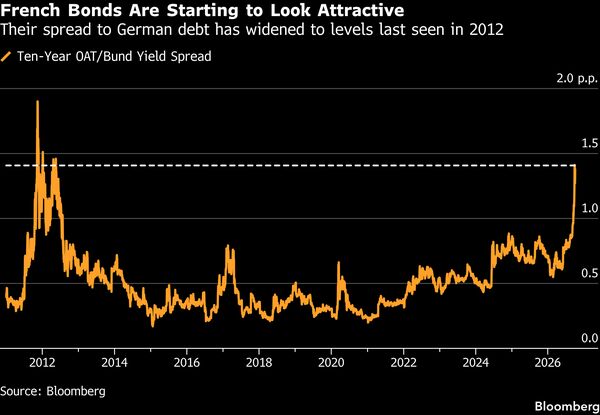
France’s bond selloff may be approaching a turning point, as the surge in yields tempts some investors to wade back into the market. Mediolanum International Funds Ltd is among those that added slightly to holdings in France, while Amova Asset Management and Aegon Asset Management say they are waiting for buying opportunities, after the yield premium of 10-year debt over regional haven Germany soared to 14-year highs of nearly 1.6 percentage points.
Mediolanum International Funds Ltd 是略微增持法国债券的机构之一,而 Amova Asset Management 和 Aegon Asset Management 则表示,由于法国10年期国债收益率相对于区域避风港德国国债的溢价已飙升至近1.6个百分点的14年高位,他们仍在等待买入机会。
“We’re much more constructive on OATs now than we were a month ago,” said Steve Williams, head of global fixed income at Amova, a Japanese investment firm with more than $330 billion in assets. In July, Williams bought OATs, as French government bonds are known, rebuilding a position he trimmed amid the Iran war. Now, he’s “waiting for opportunities to add exposure.”
“与一个月前相比,我们现在对法国国债(OATs)的态度要积极得多,”Amova 全球固定收益部门主管 Steve Williams 表示。Amova 是一家日本投资公司,资产规模超过3300亿美元。Williams 曾在7月买入法国国债,重建了此前因伊朗战争而减持的头寸。如今,他正在“等待增加头寸的机会”。Mediolanum 的 Niall Scanlon 表示,他利用近期的抛售潮清仓了此前对法国债券配置不足的头寸,因为“利差已经偏离了基本面”。不过,他目前“尚未足够有信心”将配置提升至高于正常水平。
Mediolanum’s Niall Scanlon said he used the recent selloff to close out an underweight position in France, as “the spread had overshot the fundamentals.”However, he’s “not confident enough” to go overweight just yet. There are signs that traders have been closing short positions. Open interest in French bond futures fell almost 5% on Monday, according to Eurex data, among the biggest daily drops since April 2025. Read: France’s Decades of Deficits Bring Home a Painful Risk Premium Once considered one of Europe’s safest bond markets, OATs have been roiled by fears over France’s rising debt and its failure to rein in spending. The selloff intensified last week, when a draft budget brought the dire deficit into focus and student-led demonstrations spread across the country. France also faces a presidential election in April, with far-left and far-right politicians vying for power. The market got some relief Tuesday as far-right presidential candidate Marine Le Pen vowed to cut the deficit, though some analysts questioned the credibility of her fiscal plan. Yields bounced back Wednesday, with 10-year rates rising more than 16 basis points. For investors, such wild swings are a deterrent, making positions harder to manage from week to week. Irina Kurochkina, portfolio manager at Aegon Asset Management said she’s waiting for volatility to subside. “We’ve been underweight risk in France for a relatively long time, but I think the buying opportunity could be very close,” Kurochkina said. Investors are also watching France’s widening spread against euro-area sovereigns other than Germany, especially Italy and Greece which endured their own crises in recent years. Ten-year OAT spreads over their Italian equivalent, BTPs, are at a record high, according to Bloomberg-compiled data going back to 1992. While France has shown “few convincing signs” it’s serious about tackling the deficit, current prices do reflect the risks, said Vera Fehling, chief investment officer for Western Europe at Germany’s DWS Group.
有迹象表明,交易员们已经开始平仓。根据 Eurex 的数据,周一法国国债期货的未平仓合约量下降了近5%,为2025年4月以来的最大单日跌幅之一。
She described the OAT-BTP spread as “a very good buffer.”Others say they are waiting for fiscal austerity to gain wider acceptance among the French public. So far, there is little sign of that, with ongoing protests by students and teachers demanding more money for education. Debt reduction remains a taboo subject in France, said Elliot Hentov, chief macro policy strategist at State Street Investment Management. “The moment the general public understands the issue is the moment you buy the bonds,” he said.