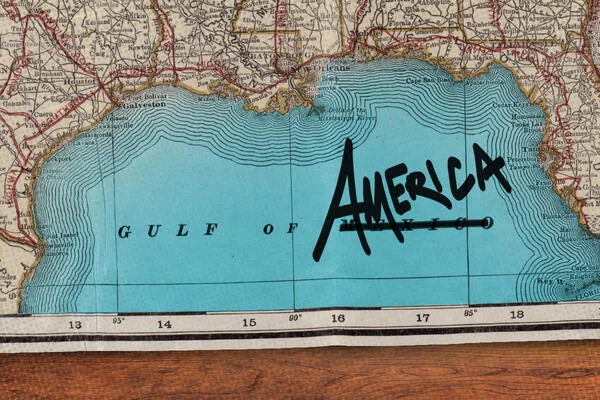
图片说明:Justin Morrison/Inside Higher Ed | 美国国会图书馆/芝加哥:Rand McNally阿拉巴马州的《美国湾法案》于上周生效,将该州政策定为使用特朗普总统偏好的“美国湾”这一称谓来指代墨西哥湾。
Photo illustration by Justin Morrison/Inside Higher Ed | Library of Congress/Chicago:Rand McNally Alabama’s Gulf of America Act took effect last week, making it state policy to use President Trump’s preferred term for the Gulf of Mexico.
众议院第2号法案要求“所有州及地方机构及其雇员”“将毗邻阿拉巴马海岸的水域称为‘美国湾’”,并“在所有新制作的地图、文件、教育材料、网站、官方通讯及其他资源中体现这一术语”。这份长达一页半的法律文件对受影响的公立学校、学院和大学设有一个例外:它们在教学过程中可以“出于历史目的”使用“墨西哥湾”这一称谓。除此之外,该法律并未豁免阿拉巴马州的高校教师或其他大学雇员(包括记者),他们仍须遵守对该水域称谓的限制。
House Bill 2 requires “all state and local entities and their employees” to “refer to the body of water that borders the coast of Alabama as the ‘Gulf of America,’” and to reflect this “terminology in all newly created maps, documents, educational materials, websites, official communications, and other resources.”The page-and-a-half-long law has one exception for the public schools, colleges and universities it impacts: They can use Gulf of Mexico “for historical purposes” during instruction. Otherwise, the law doesn’t exempt Alabama faculty or other university employees, including reporters, from its restriction on what they can call this body of water.
根据Inside Higher Ed获得的电子邮件,伯明翰阿拉巴马大学已要求该校赞助的NPR附属电台WBHM的记者遵守这一规定。今年6月,UAB业务运营执行总监Steve Murray曾告知时任WBHM执行总监Will Dahlberg:“从10月1日起,WBHM员工撰写或播出的内容中,我们将把墨西哥湾称为‘美国湾’。”而该法案正是在这一天生效的。
The University of Alabama at Birmingham has ordered journalists at WBHM, the university-sponsored NPR affiliate, to comply, according to emails obtained by Inside Higher Ed. Back in June, Steve Murray, UAB’s executive director of business operations, told then-WBHM Executive Director Will Dahlberg, “We will be referring to the Gulf as ‘Gulf of America’ in content written or spoken by WBHM staff beginning on Oct. 1.”That’s when the law took effect.
随后的电子邮件记录了围绕如何遵守该法律的一系列疑问和困惑。负责监督WBHM的Murray要求该电台追踪合规情况,统计“在我们的新闻报道以及网站上发布或分享的文章、社交媒体内容、播客等中”,提及“美国湾”与“墨西哥湾”的次数。他还引用了一份来自“Cam”的法律分析,Dahlberg告诉Inside Higher Ed,“Cam”指的是大学首席法律顾问Cam Earnhardt。
The emails then recount a string of questions and confusion over how to follow the law. Murray, who oversees WBHM, asked the station to track compliance and count references to the “Gulf of America” versus the Gulf of Mexico “during our newscasts and stories published/shared on our website, social media, podcasts, etc.” He cited a legal analysis that came from “Cam,” which Dahlberg told Inside Higher Ed meant Cam Earnhardt, the top university lawyer.
埃恩哈特进一步评估了WBHM使用可能提及墨西哥湾的第三方内容所带来的风险,其中包括NPR和美联社,这两家机构都向WBHM提供内容,并且经常使用“墨西哥湾”这一名称。
Earnhardt further assessed the risk of WBHM using content from third parties that might mention the Gulf of Mexico, including NPR and the Associated Press, which both provide content to WBHM and regularly use “Gulf of Mexico.”
埃恩哈特写道:“考虑到这一风险,WBHM理应对其内容中提及这一水域的频率进行评估,同时评估在展示或于WBHM的广播或网站上播出前修改第三方内容可能带来的难度和成本。UAB随后应利用这些信息,从机构层面评估未经修改地展示和播出这些内容所存在的风险。”
“Given that risk, it would make sense for WBHM to evaluate how often there are references in its content to this body of water and also how difficult and costly it might be to revise third-party content before displaying it or broadcasting it on a WBHM broadcast or website,” Earnhardt wrote. “UAB should then use that information to evaluate the risk of displaying and broadcasting this content without modification as an institution.”
该法律还要求公共雇员“尽合理努力更新其管辖范围内州和地方政府机构拥有的所有现有资源”——包括地图、教育材料和宣传品——以“在可行的情况下”反映名称变更,但若这样做“会带来运营或财务负担”,则可例外。8月,WBHM执行编辑安德鲁·耶格对这项追踪要求表示困惑,他写道:“你们是在建议我们记录节目中出现的每一次提及吗?”
The law also requires public employees to “make reasonable efforts to update all pre-existing resources owned by state and local entities” under their jurisdiction—including maps, educational materials and communications—to reflect the name change “where practicable,” making an exception if doing so “would impose an operational or financial burden.”In August, WBHM Managing Editor Andrew Yeager expressed confusion over the tracking request, writing, “Are you suggesting we catalogue every reference on air?”
达尔伯格请求获得更多指导,而默里最初仅回应道:“说真的?”耶格最终写道,在“我们所有频道中,不可能记录‘墨西哥湾’的每一次出现”。默里还告诉达尔伯格,员工需要签署一份文件,表明他们了解该法律以及作为州雇员所承担的义务。
Dahlberg asked for more guidance, to which Murray initially simply replied, “Seriously?”Yeager eventually wrote that it’s “not possible to catalogue ever[y] instance of Gulf of Mexico across all our channels.”Murray also told Dahlberg that staff needed to sign a document saying they were aware of the law and their obligations as state workers.
UAB的发言人周二告诉《Inside Higher Ed》:“此前已解决的数据请求存在沟通不畅的问题。目前没有任何关于宣誓确认或追踪的计划。”但他们并未提供大学向员工(包括教职员工和WBHM记者)发布的任何书面指导,说明他们应如何遵守该法律。该州各大学并未提供太多关于其如何实施该法律的信息。
UAB spokespeople told Inside Higher Ed Tuesday that “there was a disconnect regarding a request for data that was previously resolved. There are no plans for attestation or tracking.”But they didn’t provide any written guidance that the university has given to employees, including faculty and WBHM journalists, regarding how they must follow the law. Universities across the state didn’t respond with much information about how they’re implementing the law.
《沉默的南方》:阿拉巴马州宪法赋予奥本大学系统和阿拉巴马大学系统(包括UAB)比其他公立高等教育机构更大的自治权,这意味着如果它们愿意,从法律上或许可以拒绝遵守该法案。《美国海湾法案》并未明确说明这些大学系统享有豁免权。本周,这些大学系统均未回应置评请求。
The Silent South The Alabama Constitution gives the University of Auburn system and University of Alabama system, which includes UAB, greater autonomy than other public higher ed institutions, meaning they might be able legally to refuse to follow the law if they desired to. The Gulf of America Act doesn’t say they’re exempt. The systems didn’t respond to requests for comment this week.
阿拉巴马大学塔斯卡卢萨分校地理与环境系终身教授杰森·森克贝尔表示,他曾被告知教师必须遵守法律。
Jason Senkbeil, a tenured professor in the University of Alabama at Tuscaloosa’s Department of Geography and the Environment, said he was told faculty have to follow the law.
“我教授一门100级课程,多年来我一直称其为‘海湾’,但从未具体说明是哪一个,因为我不清楚这件事会如何发展,”森克贝尔说。“所以现在我必须在课堂上明确说明。”
“I teach a 100-level class and I’ve been calling it ‘the Gulf’ and not saying which one for years because I didn’t know where this was going,” Senkbeil said. “So I told my class I have to say it now.”
“这是州法律,”他说,“我会遵守州法律。”美国大学教授协会奥本分会主席贝丝·戴维斯-斯拉梅克表示:“我对此一无所知。奥本大学领导层尚未就这项法案发布任何官方声明或正式通知。”她说,关于这篇报道的《高等教育内幕》邮件是她首次听说此事。
“It’s state law,” he said. “I will comply with state law.”Beth Davis-Sramek, president of the Auburn chapter of the American Association of University Professors, said, “I have not heard a thing. There has been no official word [or] formal communication from Auburn leadership about this law.”She said Inside Higher Ed’s email regarding this story was the first she’d heard of it.
南阿拉巴马大学的一名发言人在邮件中仅表示:“作为一所州立机构,我们将遵守阿拉巴马州法律。”其他大学则完全没有回应。
A spokesperson for the University of South Alabama said in an email simply, “As a state institution, we are going to comply with Alabama state law.”Other universities didn’t respond at all.
阿拉巴马州高等教育委员会执行主任吉姆·帕塞尔在致《高等教育内幕》的邮件中表示,由于“相关要求直接规定在州法律中”,其机构“并未就实施该法案向各高校发布单独的指导文件”。提出该法案的共和党州众议员戴维·斯坦德里奇周五接听了电话,但在记者自我介绍后,他表示自己正在开会,并请求稍后再谈。本周,他既未回电,也未回应后续的置评请求。
Jim Purcell, executive director of the Alabama Commission on Higher Education, told Inside Higher Ed in an email that because “the requirements are established directly in state law,” his agency “did not issue separate guidance to institutions regarding implementation of this Act.”David Standridge, the Republican state representative who introduced the legislation, picked up his phone Friday, but after this reporter introduced himself, he said he was in a meeting and asked to talk later. He didn’t call back or respond to follow-up requests for comment this week.
共和党籍的阿拉巴马州州长凯·艾维(Kay Ivey)的发言人确实对此发表了评论,她正是签署该法案使其成为法律的人。
A spokesperson for Republican Alabama Gov. Kay Ivey, who signed the legislation into law, did provide comment.
“阿拉巴马州将这片海湾称为‘美国湾’,仅此而已,”这位发言人通过电子邮件写道。“不难看出,这些所谓的‘言论自由’投诉,不过是为针对特朗普政府的明显偏见找的借口。”(在特朗普第二个任期的第一天,他签署了一项行政命令,试图重新命名这片海湾。)戴维斯-斯雷梅克(Davis-Sramek)表示,她对这项法律还存在其他担忧,而这些担忧并不直接涉及这片水域。
“The state of Alabama refers to the Gulf as the Gulf of America, period,” the spokesperson wrote in an email. “It is not hard to see that these so-called ‘free-speech’ complaints are just a cover up for blatant bias against the Trump Administration.” (On the first day of his second term, Trump signed an executive order attempting to rename the Gulf.) Academic Freedom Concerns Davis-Sramek said she has worries about the law that don’t specifically relate to the body of water.
“如果他们可以凭借立法授权,强制员工使用‘美国湾’这一称谓,那么在教学和研究方面,他们还可能强迫我们说些什么,或者限制我们说些什么呢?”她说。“表面上看,这一点尤其荒谬。但我认为,这引出了一个更深层的问题:如果他们能做到这一点,那么他们还能做、又可能会做些什么呢?”个人权利与表达基金会(FIRE)已表示担忧,认为该法律违反了《宪法》第一修正案。FIRE的政府事务法律顾问迈克尔·赫利(Michael Hurley)指出,美国宪法保护公立大学教师的学术自由。
“If they can say, by legislative mandate, ‘We’re going to force employees to reference Gulf of America,’ then what else might they force us to say—or restrict us from saying—in terms of our teaching and research?” she said. “This, in particular, seems silly on the surface. But I think it begs a bigger question: If they can do this, what else can and might they do?”The Foundation for Individual Rights and Expression has expressed concern that the law violates the First Amendment. Michael Hurley, a government affairs counsel at FIRE, noted that the U.S. Constitution protects faculty academic freedom at public universities.
“这与负责绘制地图的州地理制图员的情况并不相同,”赫利在接受《Inside Higher Ed》采访时说。
“It’s not the same as the state cartographer who’s making a map,” Hurley told Inside Higher Ed.
“教授们有权在课堂上和科研中,就……与教育相关的主题进行自由表达,”他说。“州政府绝不能强行向这些教授灌输某种正统观点。”该法律对大学雇用的记者所设的限制,则引发了另一组虽相关但不同的担忧。FIRE的公共倡导总监亚伦·泰尔(Aaron Terr)告诉《Inside Higher Ed》,目前几乎没有先例可循,说明此类法律应如何适用于公共广播电台。
“Professors have the right to generally speak freely about … educationally relevant subjects in the classroom, in their research,” he said. “And the state certainly cannot impose an orthodoxy on those professors.”The law’s constraints on university-employed journalists raise a different, though related, set of concerns. Aaron Terr, FIRE’s public advocacy director, told Inside Higher Ed there isn’t much precedent for how such a law applies to public radio stations.
“政府通常拥有广泛的权力来规范其雇员在履行职责过程中的言论,”Terr在一封电子邮件中写道。“例如,一个州属机构自然可以控制其雇员在机构新闻稿中撰写的内容。但这一规则并非绝对。”他引用了2020年一起案件的裁决,该案涉及特朗普第一任政府被指控干涉美国之音的报道。该裁决指出,“政府雇员记者的核心编辑或新闻职能”与教师的教学和研究一样,不受普通公共雇员言论规则的约束。
“The government generally has broad authority to regulate what its employees say as part of their jobs,” Terr wrote in an email. “For example, a state agency naturally can control what an employee puts in an agency press release. But that rule isn’t absolute.”He cited a 2020 ruling in a case regarding the first Trump administration’s alleged interference in Voice of America’s reporting, that said the “core editorial or journalistic functions of government-employed journalists” are, like faculty teaching and research, exempt from ordinary rules regarding public employee speech.
“这一逻辑是合理的,”Terr说。“公共广播电台记者的职责是行使独立的编辑判断,而不是充当政府的传声筒。”
“That reasoning makes sense,” Terr said. “The role of journalists at public radio stations is to exercise independent editorial judgment, not to serve as a government mouthpiece.”
Dahlberg已辞去他在WBHM的执行总监职务。十多年前,他最初是以一名无薪实习生的身份加入该台的。他表示,法律并非他辞职的唯一原因——他和其他员工对Murray以及大学对该台的整体处理方式存在不满——但这项法律“在新闻伦理方面已经越过了我的底线”。“我也向团队表明,作为领导者,我找不到一条能够以合乎伦理的方式执行这项政策的前进道路,”Dahlberg说。
Dahlberg has resigned from his executive director position at WBHM, where he started as an unpaid intern more than a decade ago. The law wasn’t the only reason why—he said he and other employees had issues with Murray and the university’s treatment of the station more broadly—but the law was “a bridge too far for me in terms of the journalistic ethics that I uphold.”“I also conveyed to our team I did not see a path forward as a leader that I could ethically enforce this,” Dahlberg said.
他还提到,尽管阿拉巴马大学系统的律师并未以书面形式明确说明,但他实际上被告知,不遵守规定可能会导致纪律处分,甚至被解雇。
He said that while University of Alabama system lawyers didn’t put it in writing, he was essentially told noncompliance could result in discipline, up to dismissal.
“和其他公共媒体同行一样,我越来越担心那些由大学持牌运营的广播电台,以及由此引发的日益严重的问题,”他说。“尤其是在保守派占主导的州和缺乏记者保护的地区。”
“I increasingly, like other public media colleagues, [am] concerned about stations that are licensed to universities and the escalating problems that is presenting,” he said. “Particularly in red states and areas where there are not protections for journalists.”