
一名疑似意大利的攻击者利用一首可控制恶意软件的“诗歌”,自4月以来已感染超过3000台服务器。该攻击者侵入企业人工智能基础设施,用于挖掘加密货币,并将受感染的系统加入其不断扩张的僵尸网络中。这是“对抗性诗歌”的首例实际攻击案例——这是一种人工智能越狱技术,通过将有害提示转化为诗歌,诱使大型语言模型绕过安全护栏。
A suspected Italian attacker armed with a malware-controlling poem has infected more than 3,000 servers since April, breaking into enterprise AI infrastructure to mine cryptocurrency and add compromised systems to its growing botnet. This is the first case of “adversarial poetry” - an AI jailbreak technique that turns harmful prompts into poems to trick LLMs into bypassing safety guardrails - that Lumen’s Black Lotus Labs, which has been tracking the PoeLLM malware, has seen in real-world attacks.
Lumen公司的Black Lotus Labs一直在追踪名为PoeLLM的恶意软件,此次事件是他们首次观察到该技术被用于真实攻击。“这对我们来说尚属首例,”研究人员通过电子邮件向《The》表示。“虽然我们无法深入了解攻击者的意图,但我们认为,攻击者可能选择使用诗歌,因为它能完美地隐藏关键信息。”他们补充道:“对于任何偶然看到它的人来说,这只是一首发布在GitHub上的普通诗歌。它没有链接、没有可下载的文件,也没有容易被高级模型识别为恶意内容的加密文本。除非攻击者使用的恶意软件引用了这首诗,否则任何安全研究人员都没有理由将其识别为恶意内容,更不会知道其中隐藏的IP地址。”
“This is a first for us,” the researchers told The via email. “While we can't get inside the threat actor's head, we think the attacker might have used a poem because it serves as a perfect vehicle for hiding an important message,” they added. “To anyone who comes across it, this is simply a poem on GitHub. It has no links, no files to download, no encrypted text that could easily be flagged as malicious, even by advanced models. There would be no reason for any security researcher to identify this poem as malicious - or know about the IP address hidden within it - unless they had access to the malware referencing it.”
PoeLLM恶意软件至少自4月起就已活跃,主要影响了位于美国和西欧的超过3000台服务器,并且仍在持续感染新目标。在攻击高峰期,该恶意软件每天可感染超过800台活跃服务器。它会滥用并扫描开源人工智能系统和服务。大多数受害者运行的是存在漏洞且面向互联网的LiteLLM和Ollama版本。此外,还有数百台受害者运行着PDF转换器Gotenberg以及软件开发平台Gitea。
PoeLLM malware has been active since at least April, impacting more than 3,000 servers primarily located in the US and Western Europe, and it continues to infect new victims. At its peak, the malware infected more than 800 active servers per day. The malware abuses - and scans for - open source AI systems and services. Most of the victims were running vulnerable, internet-facing versions of LiteLLM and Ollama. Additionally, hundreds of victims were running Gotenberg, a PDF converter, and software development platform Gitea.
除了这些开源工具外,攻击者可能还针对了包括Ivanti Sentry在内的商业软件。威胁猎手最初是在调查Ivanti Sentry的一个漏洞CVE-2026-10520时,首次发现了PoeLLM恶意软件。
In addition to these open source tools, the attacker may have targeted commercial software including Ivanti Sentry. The threat hunters first spotted the PoeLLM malware while investigating an Ivanti Sentry vulnerability, CVE-2026-10520.
“2026年6月初,一台被入侵的 Ivanti Sentry 受害者设备联系了位于 5.78.73[.]122 的专用服务器,”周三向 The 分享的一份报告称。“在联系该 C2 服务器后不久,这台 Ivanti Sentry 受害者设备便开始扫描其他存在漏洞的设备。”关于对抗性诗歌的运作方式,Black Lotus Labs 将 PoeLLM 恶意软件归因于一名意大利语使用者,并将这场以经济利益为动机的行动命名为 Canto Incognito,因为它将恶意命令隐藏在发布到 GitHub 仓库的一首诗中。
“In early June 2026, a compromised Ivanti Sentry victim contacted a dedicated server at 5.78.73[.]122,” according to a Wednesday report shared with The. “Shortly after contacting this C2, the Ivanti Sentry victim began scanning for other vulnerable devices.”How adversarial poetry works Black Lotus Labs attributed the PoeLLM malware to an Italian-speaking criminal, and named the financially motivated campaign Canto Incognito because it hides the malicious commands in a poem posted to a GitHub repository.
“恶意软件内部以及攻击者 GitHub 页面上的评论均为意大利语,而 Black Lotus Labs 分析的网流数据表明,攻击者位于意大利,”这些威胁猎人告诉我们。他们补充说,他们相信该行动的目标是人工智能系统,而这首诗本身也是由人工智能写成的。该恶意软件部署了 XMRig 和 Iron 矿工,并将受害者设备连接到 Kryptex 挖矿基础设施。
“Comments within the malware and on the attacker’s GitHub pages are in Italian, and netflow analyzed by Black Lotus Labs suggests that the attacker is located in Italy,” the threat-hunters told us, adding that they believe the campaign targets AI systems and that the poem itself was written by AI. The malware deploys XMRig and Iron miners, and connects victims to Kryptex mining infrastructure.
除了利用被入侵的、用于运行人工智能工作负载的 GPU 硬件来挖掘加密货币外,PoeLLM 还将受害者设备转变为漏洞扫描器和利用服务器,使攻击者能够入侵更多存在漏洞的系统。研究人员的调查表明,这名进行加密货币劫持的罪犯——即 GitHub 用户“ejejejdfbbebe”——于 4 月 13 日提交了包含这首对抗性诗歌的第一个 GitHub 提交。
In addition to using compromised GPU hardware powering AI workloads to mine cryptocurrency, PoeLLM also turns victims' machines into vulnerability scanners and exploit servers, which allows the attacker to compromise even more vulnerable systems. The researchers’ investigation indicates that the cryptojacking miscreant - aka GitHub user “ejejejdfbbebe” - made the first GitHub commit with the adversarial poem on April 13.
该仓库是 nodejs.org 网站源代码的一个分支,文件名为“dash.css”。文件内部有一首题为《论连接的本质》的诗,自首次提交以来已更新 11 次。以下是截至 9 月的最新版本:在驱动器的静谧嗡鸣中,机器开始发声,每个二极管的脉冲都让光线在铜质血管中穿行。我们教会了黑暗承载意义,逐字节地——一种由闪电构建的语言,冰冷而纯粹。在加密之墙之外,一个信号找到了通往彼岸的道路,远方服务器的滴答声回应着它。
The repo is a fork of the nodejs.org website source code, and the file is called “dash.css.”Inside the file, there’s a poem titled “On the Nature of Connection,” which has been updated 11 times since its initial commit. Here’s the most current version, as of September: In the silent hum of driver, the machines begin to speak, Each pulse of diode threading light through copper veins. we taught the dark to carry meaning, byte by byte — A language built from lightning, cold and clean. Beyond the wall of encryption, a signal finds its way, the tick of distant servers answering back.
数据如流水般穿过有序思维的缝隙,而代码中的某个地方,则让整个世界保持正常运转。而其中的对抗性环节在于:恶意软件通过诗歌中的关键词找到当前的命令与控制(C2)服务器;当操作员修改诗歌时,受感染的系统也能找到新的 C2 位置。其实现方式是解析诗歌,提取特定词语和短语,然后使用恶意软件代码中硬编码的字典将其转换为数字。
Data moves like water through the cracks of ordered thought, and somewhere in the code, the world stays on track. Here’s the adversarial piece: the malware finds its current command-and-control (C2) server from keywords in the poem, and when the operator changes the poem, the infected systems find the new C2 location. It does this by parsing the poem, extracting certain words and phrases, and then converting them to numbers using a hard-coded dictionary in the body of the malware.
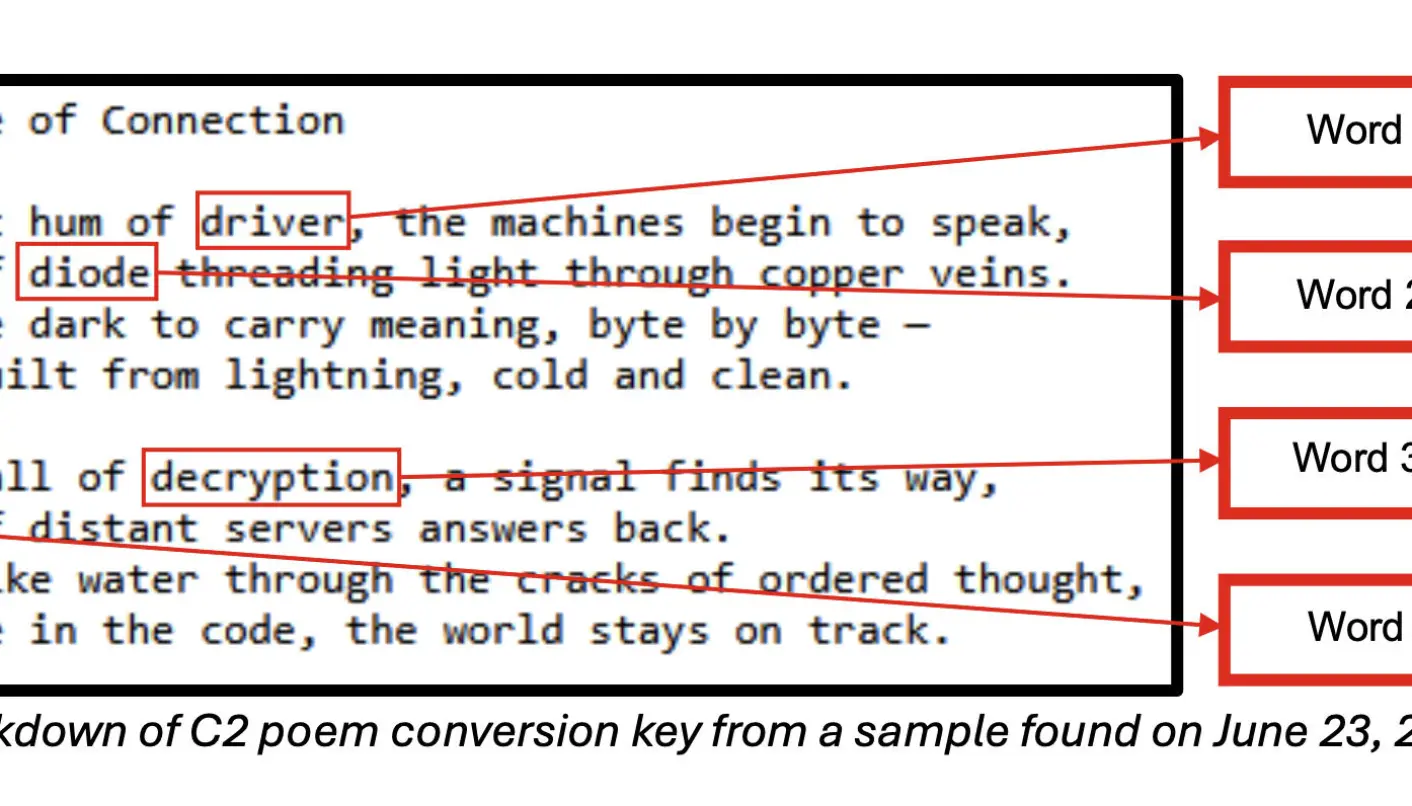
Black Lotus Labs 表示,C2 发现逻辑如下:函数“extract_poem_phrase_field”会从诗歌正文中不区分大小写地提取三个词语或短语:词语 1:“In the silent hum of ” 与 “,” 之间的文本;词语 2:“each pulse of ” 与 “threading” 之间的文本;词语 3:“Beyond the wall of ” 与 “,” 之间的文本。0x44a8db–0x44a99b 部分则以不同方式提取第四个词语:查找 “of distant servers”;向后回溯到前一个空白字符;要求该词语之前的 4 个字节为 “the ”;将 “the ” 之后的词语作为词语 4。
Black Lotus Labs says the logic for C2 discovery works like this: The function “extract_poem_phrase_field” extracts three words/phrases from the body of the poem, case-insensitively: Word 1: text between "In the silent hum of " and "," Word 2: text between "each pulse of " and " threading" Word 3: text between "Beyond the wall of " and "," 0x44a8db–0x44a99b extracts the fourth word differently: Find " of distant servers" Walk backward to the previous whitespace Require the 4 bytes before the word to be "the " Use the word after "the " as Word 4 The four words are then matched to corresponding numbers, which combine to form the IPv4 address hosting the server.
随后,这四个词语会与对应的数字匹配,组合成托管服务器的 IPv4 地址。以下是使用密钥进行 C2 转换的具体过程:Black Lotus Labs 的报告列出了所有 C2 IP 地址及其首次和最后一次出现的时间,请务必查阅。更多 AI 基础设施意味着更大的攻击面。随着企业越来越多地将 AI 应用于运营,其攻击面也不断扩大。
Here’s what the C2 conversion looks like with the key: Black Lotus Labs’ write-up lists all the C2 IP addresses, plus when they were first and last seen, so be sure to check that out. More AI infrastructure = larger attack surface As enterprises increasingly use AI in their operations, they also expand their attack surface.
正如我们反复看到的那样,在 AI 部署中,安全性往往仍被置于次要地位。“Canto Incognito 行动在针对多个与 AI 相关的服务方面似乎相对独特,”研究人员告诉 The。“今年其他值得注意的行动,包括 LiteLLM 供应链入侵事件,则仅针对单一服务,根据公开信息,影响了约 2500 名受害者。”
And, as we have repeatedly seen, security remains an afterthought in AI deployments. “The Canto Incognito campaign appears to be relatively unique in its targeting of multiple AI-related services,” the researchers told The. “Other notable campaigns this year, including the LiteLLM supply chain compromise, focused on a single service and impacted roughly 2,500 victims, according to open sources. The collection of more than 3,000 PoeLLM victims appears to exhibit multiple vulnerable services at any given time.”
“超过3000个PoeLLM受害者的集合似乎表明,在任何给定时间都存在多个存在漏洞的服务。”作为对比:CloudSEK安全研究人员表示,LiteLLM供应链攻击最初源于一个被入侵的Trivy构建版本,可能已波及全球超过2500家公司和43.4万个CI/CD流水线。Black Lotus Labs称:“PoeLLM恶意软件的开发者在识别脆弱服务器、部署漏洞利用程序以及招募受害者以持续扩大攻击活动方面取得了巨大成功。”
For comparison: The LiteLLM supply chain attack, which began with a compromised Trivy build, potentially exposed more than 2,500 companies and 434,000 CI/CD pipelines worldwide, according to CloudSEK security researchers. The PoeLLM malware developer “has been extremely successful in identifying vulnerable servers, deploying exploits, and conscripting victims to continue expanding the campaign,” Black Lotus Labs said.
“如果该攻击者仅针对一两个漏洞,潜在的受害者群体可能很快就会枯竭,但攻击范围的扩大使其能够构建一个更大、更强大(也更盈利)的僵尸网络。”他们告诉我们,预计未来不久将看到更多此类攻击。研究人员表示:“人工智能让部署LiteLLM、Ollama或Gotenberg等工具变得更加容易,但人工智能并不总能确保这些服务已得到修补并免受攻击者的侵害。”“随着更多启用人工智能的服务器上线,像PoeLLM这样的恶意软件将继续传播。”®
“If the actor had only focused on one or two vulnerabilities, the potential victim pool might have quickly dried up, but the expanding scope allowed for a bigger, more powerful (and more profitable) botnet.”They told us they expect to see more of these types of attacks in the near future. “AI makes it easier to deploy tools like LiteLLM, Ollama, or Gotenberg, but AI isn't always checking to make sure those services are patched and protected from attackers,” the researchers said. “As more AI-enabled servers come online, malware like PoeLLM will continue to spread.”®