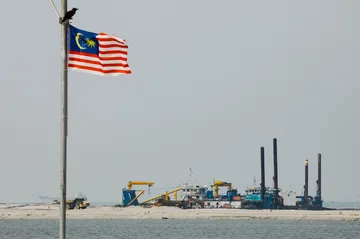
就在槟城以南,马来西亚西北海岸外这座历史悠久的贸易岛屿上,挖掘机正将一片蓝绿色的海域改造为一个人工新岛。自卸卡车在刚填平的海滩上来回穿梭,橙色的管道蜿蜒穿过这片逐渐成形的陆地,输送着由海上疏浚船泵来的填土。
Just south of Penang, the historic trading island off Malaysia’s northwest coast, excavators are turning a stretch of blue-green sea into a new, man-made island. Dump trucks crisscross freshly reclaimed sand as orange pipes snake across the emerging land mass, carrying fill pumped from dredgers offshore.
一旦在下一个十年中的某个时候完工,这片名为“硅岛”的2300英亩区域有望巩固马来西亚在全球半导体产业中的地位,到2050年将为该国经济增加数千亿美元,并创造约22万个就业岗位。该岛面积几乎是纽约中央公园的三倍,规划中还将建设办公大楼、酒店和滨水公寓。
Once complete sometime next decade, this 2,300-acre area, called Silicon Island, is expected to entrench Malaysia’s role in the global semiconductor industry, adding hundreds of billions of dollars to its economy and creating some 220,000 jobs by 2050. Almost three times the size of New York’s Central Park, it’s envisaged the island will also be home to office towers, hotels and waterfront apartments.
该项目雄心勃勃,旨在解决部分由槟城自身成功所引发的问题。在五十多年间,槟城已成为东南亚领先的电子和半导体中心之一,但作为马来西亚最小的州之一,其土地资源已逐渐短缺。英特尔公司、超威半导体公司和亚洲联合科技控股公司等科技巨头近年来都在巴燕乐巴斯扩大了业务。巴燕乐巴斯是槟城机场附近一个庞大的工厂群,也是马来西亚半导体产业的核心地带。
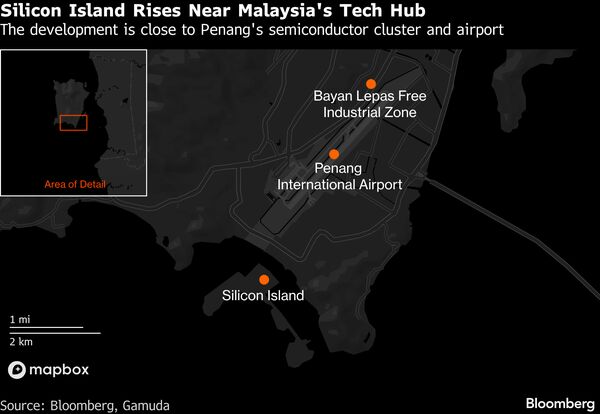
The project is an ambitious answer to a problem created in part by Penang’s own success. After more than five decades building one of Southeast Asia’s leading electronics and semiconductor hubs, one of Malaysia’s smallest states is running short of land. Intel Corp., Advanced Micro Devices Inc. and ASE Technology Holding Co. are among technology heavyweights that have expanded operations in recent years around Bayan Lepas, a sprawling cluster of factories near Penang’s airport that forms the heart of Malaysia’s semiconductor industry.
硅岛将为该行业提供发展空间,同时支持马来西亚超越传统的芯片组装与测试环节——即半导体生产的最后阶段——向设计、先进封装等更高附加值的活动转型。该项目也押注于人工智能的爆发式增长将加速全球芯片产能的扩张与多样化,从而推动更多投资流向东南亚地区。
Silicon Island would give the sector room to grow while supporting Malaysia’s push beyond its traditional strengths of chip assembly and testing — the final stages of semiconductor production — into higher-value activities, such as design and advanced packaging. It’s also a bet the artificial-intelligence boom will supercharge the race to expand and diversify global chip production, sending more investment toward Southeast Asia.
槟城首席部长周冠业在接受彭博新闻社采访时指出,槟城进一步发展的空间“正变得越来越有限”。“‘硅岛’项目为槟城现有的工业优势提供了重要的发展机会,同时也能让槟城为下一轮全球科技周期做好准备。”其潜在回报十分可观。
Space for further growth in Penang is “increasingly constrained,” the state’s Chief Minister Chow Kon Yeow said in an interview with Bloomberg News. “Silicon Island represents an important opportunity to build on Penang’s existing industrial strengths while positioning the state for the next phase of the global technology cycle.”The potential payoff is substantial.
据其开发商——由马来西亚基础设施巨头Gamuda Bhd.控股并获槟城州政府支持的Silicon Island Development Sdn.公司引用的德勤研究称,“硅岛”到2050年可能为马来西亚经济累计贡献1.1万亿林吉特(2690亿美元),并吸引约750亿林吉特的投资。
Silicon Island could contribute a cumulative 1.1 trillion ringgit ($269 billion) to Malaysia’s economic output through 2050 and attract about 75 billion ringgit in investments, according to a Deloitte study cited by its developers, Silicon Island Development Sdn, a venture controlled by Malaysian infrastructure giant Gamuda Bhd. and backed by the Penang state government.
槟城州政府表示,槟城目前已占全球半导体出口量的约5%。与此同时,其电子产业可追溯至20世纪70年代初。当时,槟城作为一个以香料、锡和橡胶发家的历史悠久的贸易港口,开始吸引外国制造商前来设厂,以创造就业并实现经济多元化。
Penang already accounts for about 5% of the world’s semiconductor exports, according to the state government. Its electronics industry meanwhile dates back to the early 1970s, when Penang, a centuries-old trading port that prospered on spices, tin and rubber, began courting foreign manufacturers to create jobs and diversify its economy.
如今,人工智能基础设施的迅速建设又带来了新的需求。马来西亚半导体行业协会主席黄秀海最近将今年该国电气和电子产品出口预测上调了约13%,至超过9000亿林吉特。其中,半导体占出口总量的近四分之三,马来西亚也因此成为全球第六大半导体出口国。
Now, the rapid build-out of AI infrastructure is providing another source of demand. Malaysia Semiconductor Industry Association President Wong Siew Hai recently raised his forecast for the nation’s electrical and electronics exports this year by about 13% to more than 900 billion ringgit. Semiconductors account for almost three-quarters of those shipments, with Malaysia ranking as the world’s sixth-largest exporter.
黄秀海表示,建设人工智能基础设施的浪潮正在推动整个供应链的增长,导致一些制造商产能已满,并急需寻找扩张空间——这种需求可能会吸引企业落户“硅岛”。他此前曾在英特尔工作27年。
The rush to build AI infrastructure is driving growth across the supply chain, leaving some manufacturers at capacity and searching for space to expand — demand that could draw companies to Silicon Island, said Wong, who previously spent 27 years at Intel.
槟城也从中受益,因为中美紧张关系促使企业将生产布局分散到更多国家。为减少对亚洲最大经济体依赖的制造商正在其他地区增加产能,而槟城则拥有成熟的工厂、工程师和供应商基础。
Penang has also benefited as US-China tensions prompt companies to spread production across more countries. Manufacturers seeking to reduce their reliance on Asia’s biggest economy have been adding capacity elsewhere, and Penang offers an established base of factories, engineers and suppliers.
首席部长周表示,“矽谷岛”已经吸引了本地及国际企业的关注,其中来自台湾和日本的兴趣“尤其令人鼓舞”。
Silicon Island has already drawn interest from local and international firms, with “particularly encouraging interest” from Taiwan and Japan, Chief Minister Chow said.
“矽谷岛发展公司”的副项目总监、同时也是加穆达集团高管的谭君晶表示,一位潜在的日本投资者在短短两个月内三次到访该地,且来访的高层管理人员级别越来越高,从该公司在马来西亚的首席执行官,到位于日本的CEO,最终甚至包括董事长。
One prospective Japanese investor visited the site three times in just two months, with increasingly senior executives making the trip, from the company’s Malaysia chief executive to its Japan-based CEO and finally the chairman, said Tan Jun Jing, deputy project director at Silicon Island Development, a Gamuda executive who’s helped deliver large-scale rail networks and townships across Malaysia.
当谭君晶询问他们对行业现状的看法时,他们的回答凸显了寻找更多产能的紧迫性。她表示,包括英特尔和英伟达在内的客户需求非常强劲,因此与供应商提升生产速度的能力相比,成本已不再是主要关注点。
When Tan asked them about the state of the sector, their answer underscored the urgency behind the search for more capacity. Demand from customers including Intel and Nvidia is so strong that cost has become less of a concern versus how quickly suppliers can ramp up production, she said.
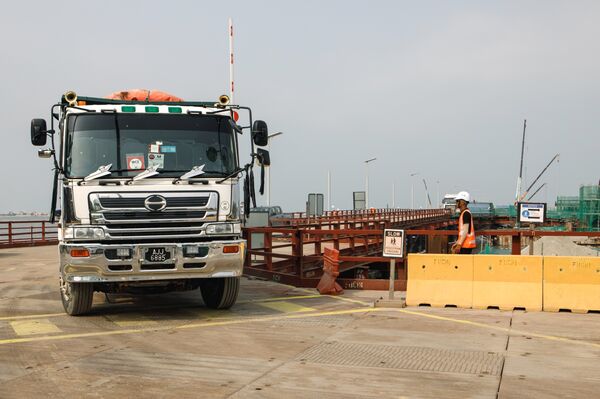
“这些公司目前提出的要求是:‘你能生产多少,速度有多快?’”谭君晶说,“这就是为什么许多企业正在积极探索扩张,以满足客户需求。”然而,将填海获得的土地再塑造成另一个巴燕莱巴斯仍需时间。谭君晶表示,仅完成该岛屿的全部填海工程可能需要三到四年,而整体建设周期可能长达15年,首批工业运营预计将于2029年初启动。
“The current commitment these companies are asking for is ‘how much and how fast can you produce?’”Tan said. “That’s why a lot of them are really exploring expansion to meet customer demand.”Still, turning land wrested from the sea into another Bayan Lepas will take time. The island could take another three to four years just to fully reclaim and as long as 15 years to build out, Tan said, with the first industrial operations expected to start by early 2029.
竞争也在加剧。新加坡正进一步深入发展先进制造业,而越南则在争取更多项目份额。印度也在大力投资建设半导体产业。在马来西亚国内,吉打州和雪兰莪州等州也在积极吸引芯片制造商。
Competition is also intensifying. Singapore is pushing deeper into advanced manufacturing while Vietnam is vying for a bigger share of projects. India is spending heavily to build a semiconductor industry, too. Within Malaysia, states including Kedah and Selangor are also courting chipmakers.
更高的地价可能会进一步缩小“硅岛”潜在租户的范围。将沙子转化为坚实土地的成本,很可能使一些利润率较低的制造商无法负担在此设厂的费用,因此高价值科技公司最有可能成为入驻企业,Wong表示。不过,对于斥资数十亿美元建设新工厂的公司而言,土地成本在整体投资中仅占相对较小的一部分。
Higher land prices could further narrow Silicon Island’s pool of potential tenants. The cost of transforming sand into solid ground is likely to put the expense of being based there beyond the reach of some lower-margin manufacturers, making high-value technology companies its most likely occupants, Wong said. For companies spending billions of dollars on a new facility, however, land represents a relatively small portion of the overall investment, he said.
Tan认为,“硅岛”在未来50年对槟城的作用,将等同于过去50年里巴燕勿刹自由工业区所扮演的角色。英特尔是早期帮助槟城发展成为科技中心的海外制造商之一,如今也参与了该州超越传统组装与测试业务的努力。首席执行官Lip-Bu Tan于12月与Chow会面,了解这家美国芯片制造商在该州投资120亿林吉特建设先进封装工厂的最新进展。
Tan sees Silicon Island playing the same role for Penang’s next half-century that the Bayan Lepas Free Industrial Zone has played over the past 50 years. Intel, one of the early overseas manufacturers that helped establish Penang as a tech hub, is also part of the state’s effort to move beyond traditional assembly and testing. Chief Executive Officer Lip-Bu Tan met Chow in December for an update on the US chipmaker’s 12 billion ringgit advanced-packaging facility in the state.
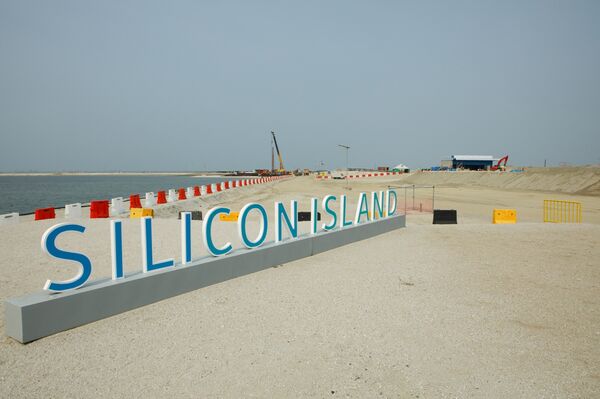
“硅岛”的核心区域将是一个占地约700英亩的“绿色科技园区”,重点面向半导体设计、先进封装和自动化测试等行业。据“硅岛发展公司”称,第一期项目计划完全使用可再生能源运行,未来还将修建一座长380米的桥梁,将这一开发区与主岛连接起来。
At Silicon Island’s center will be a roughly 700-acre Green Tech Park targeting industries including semiconductor design, advanced packaging and automated testing. The first phase is planned to run entirely on renewable energy, according to Silicon Island Development, and there’ll eventually be a 380-meter bridge connecting the development to the main island.
其地理位置也决定了槟城所瞄准的企业类型。Tan表示,考虑入驻“硅岛”的企业很可能主要依赖航空运输来运送原材料和出口成品,以利用其靠近槟城国际机场的优势。而依赖海运的重工业制造商则更适合在大陆地区设厂,因为那里通往港口的交通更为便利。
Its location helps define the companies Penang is targeting. Businesses considering Silicon Island are likely to rely primarily on air freight to bring in materials and send out finished products, taking advantage of its proximity to Penang International Airport, Tan said. Heavy manufacturers dependent on seaborne cargo would be better suited to the mainland, with easier access to the port, she said.
Tan表示,Gamuda持有Silicon Island Development 70%的股份,正通过银团贷款为该项目140亿林吉特的填海和基础设施成本提供资金。她补充说,该项目预计将在八年内实现收支平衡,首批工业用地计划于2027年初出售。作为该合资企业其余股份的股东,槟州政府有权获得30%的利润分成。Chow表示,该州政府还将完全拥有填海所得的土地,并决定其最终的分配和开发方式。
Gamuda, which has a 70% stake in Silicon Island Development, is financing the project’s 14 billion ringgit in reclamation and infrastructure costs through a syndicated loan, Tan said. The project expects to break even within eight years, with the first sale of industrial land planned for early 2027, she added. As shareholder of the rest of the venture, Penang’s government is entitled to a 30% cut of the profits. According to Chow, the state will also fully own the reclaimed land and determine how it is ultimately allocated and developed.
未来,Silicon Island也将成为人们可以称之为家的地方。规划显示,该项目将在360英亩的土地上建造约2万套住宅,包括公寓和可负担住房,同时还将配套商店、便利设施和餐厅。近五分之一的岛屿面积将用于绿化,包括公园、海滩和红树林湿地。
One day, Silicon Island is also intended to be a place people call home. The plans call for about 20,000 houses on 360 acres, including condominiums and affordable dwellings, alongside shops, amenities and restaurants. Almost one-fifth of the island will be green space, including parks, beaches and mangrove wetlands.
Silicon Island还将成为槟州首条轻轨系统的起点。全长29.5公里(18英里)的Mutiara线将把该开发项目与槟城的Bayan Lepas、机场以及州府乔治市连接起来。后续还将延伸线路,与马来西亚本土相连。轻轨计划于2031年底投入运营。由Gamuda牵头的联合体已赢得首个土木工程部分价值79.3亿林吉特的合同。
Silicon Island will also serve as a starting point for Penang’s first light-rail system. The 29.5-kilometer (18 mile) Mutiara Line will connect the development with Bayan Lepas, Penang’s airport and the state’s capital, George Town. A later extension will provide a link to the Malaysian mainland. Operations are scheduled to begin by the end of 2031. A Gamuda-led consortium won a 7.93 billion ringgit contract for the first civil-works package.
该开发项目的巨大规模引发了与森林城(Forest City)的对比。森林城是由中国房地产巨头碧桂园控股有限公司与当地合作伙伴在马来西亚南部填海造地之上建造的1000亿美元级超级项目。该项目最初构想为可容纳多达70万人口的未来主义城市,曾严重依赖海外购房者,尤其是来自中国的投资者。然而,北京实施资本管制后,市场需求下滑,加上马来西亚国内的政治反对、新冠疫情以及碧桂园随后的财务困境,进一步加剧了项目的问题。如今,最初规划为四个人工岛的该项目仅建成了一小部分,入住率仍然很低。
The sheer scale of the development invites comparisons with Forest City, the $100 billion megaproject built on reclaimed land in southern Malaysia by Chinese property giant Country Garden Holdings Co. and a local partner. Conceived as a futuristic city for as many as 700,000 people, it relied heavily on overseas property buyers, particularly from China. Demand faltered after Beijing imposed capital controls, while Malaysian political opposition, the pandemic and Country Garden’s subsequent financial troubles compounded its problems. Today, only a fraction of the project, originally planned as four artificial islands, has been built and occupancy remains low.
但“硅岛”的开发商们却押注于另一个支撑点:一个已经存在于其门口的产业。这里的思路是,工厂和投资会率先到来,而城市则会随之发展。
But Silicon Island’s developers are betting on a different anchor: an industry that already exists on its doorstep. Here, the thinking is that factories and investment will come first, and the city will follow.
“很多人把我们和森林城相提并论,但如今你再去看它,那纯粹是一个住宅和商业项目,”谭说。“我们的主要推动力将是工业。”
“A lot of people compare us to Forest City, but today when you look at it, it’s a pure residential and commercial play,” Tan said. “Our main catalyst will be industrial.”