前,由于市场对该公司下一代芯片技术充满期待,贝斯半导体工业公司的股价一度大幅上涨。如今,全球内存供应短缺使得该技术的普及进程充满不确定性,市场也渐渐失去耐心。
Semiconductor Industries NV shares once rode high on optimism over its next-generation chip technology. Now, the global memory shortage has thrown the pace of adoption into doubt, and the market is losing patience.
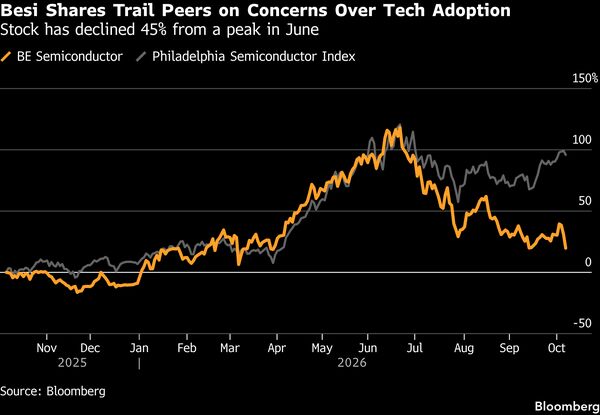
本周该股股价累计下跌14%。在美国银行将其评级下调至“中性”一天后,瑞银集团又将其评级从“买入”降至“卖出”,理由是盈利预期下滑,这进一步加剧了股价跌势。自6月至9月期间,贝斯半导体成为斯托克600指数中表现最差的个股。
The stock is down 14% this week, with losses accelerating after UBS Group AG downgraded it to sell from buy on lower earnings expectations, a day after Bank of America cut it to neutral. That deepened a selloff that made Besi the Stoxx 600’s worst performer between June and September. The world’s leading maker of hybrid-bonding equipment, Besi’s flagship technology directly connects semiconductor components to enhance computing performance in a smaller space.
作为全球领先的混合键合设备制造商,贝斯半导体的核心技术可将多个半导体元件直接连接,从而在更小的空间内提升计算性能。投资者原本预期芯片制造商会迅速采用这一技术,但当前的内存短缺及成本压力却可能使这一转型进程大幅推迟。
Investors had bet on rapid adoption by chipmakers, but the memory crunch and cost concerns threaten to push that transition further out. “There are all these other factors involved that have a number of inputs driving them, and none of that is really in Besi’s hands, unfortunately for them,” said Barclays analyst Simon Coles, who holds an equal-weight rating on the stock.
“目前存在诸多影响因素,它们各自又受多种变量驱动;遗憾的是,这些因素均不在贝斯半导体的掌控范围之内,”巴克莱银行分析师西蒙·科尔斯说道。他目前给予该股“中性”评级。
As it gets harder to make individual chips smaller, the industry is seeking other ways to improve performance. One approach is to connect several chips together or stack them on top of each other.
随着单个芯片尺寸进一步缩小变得愈发困难,整个行业正在寻求其他提升性能的途径。其中一种方法就是将多个芯片相互连接或堆叠起来。而实现这一目的则需要诸如贝斯半导体所生产的混合键合设备之类的专用工具。
Doing so requires specialized tools, such as Besi’s hybrid bonding machines. For investors, the concern is whether Besi’s technology remains relevant if the memory architecture is actually getting simpler, rather than more complicated. Nvidia Corp.‘s AI accelerator Rubin Ultra, set to be released next year, will use fewer memory layers than the current generation according to independent research firm Semianalysis, a stopgap measure to allow more AI chips to be shipped despite the memory supply constraint.
对投资者而言,他们担忧的是:如果未来的内存架构实际上趋于简化而非更加复杂,贝斯半导体的技术是否还能保持其应用价值。
Besi had projected that each memory component that goes into Nvidia’s AI accelerators will become increasingly intricate, to the extent that chipmakers turn to the Dutch firm’s technique to squeeze stacks of memory chips into a package thinner than a credit card.
据独立研究机构Semianalysis的研究显示,英伟达计划于明年发布的AI加速器Rubin Ultra所使用的内存层数将少于当前一代产品。这一举措属于权宜之计,旨在缓解内存供应紧张的局面,从而让更多AI芯片得以量产。
A spokesperson for Besi did not respond to a request for comment. Advanced Micro Devices Inc. is an early adopter of Besi’s technology, using hybrid bonding in its Ryzen 7 processors in 2022.
Besi公司预测,用于Nvidia人工智能加速器的每个内存组件将会变得越来越复杂;为此,芯片制造商将采用该公司的技术,将多层内存芯片封装到比信用卡还薄的芯片中。Besi公司的发言人并未回应对此事的评论请求。
But it’s taking longer for the tech to gain traction among memory chipmakers. That’s because for hybrid bonding to work, it’s not just about using Besi’s tools, said Myron Xie at SemiAnalysis.

Advanced Micro Devices(AMD)是Besi技术的早期采用者,早在2022年就在其Ryzen 7处理器中使用了这种混合键合技术。不过,这项技术尚未在内存芯片制造商中得到广泛普及。SemiAnalysis公司的Myron Xie指出,要使混合键合技术真正发挥作用,不仅需要使用Besi提供的工具,还需要进行昂贵的准备工作,以确保两个芯片表面的平整度达到近乎完美的程度。对于高带宽内存而言,采用混合键合技术的成本“可能并不值得其带来的微小优势”。
It also involves costly preparation steps to make sure the two chip surfaces are almost perfectly smooth. For high bandwidth memory, the cost of using hybrid bonding is “probably not worth the incremental benefit,” Xie said. There are trade-offs: by avoiding hybrid bonding and packing fewer silicon layers, the amount of workload that one memory unit can handle becomes more limited. While that’s not ideal for AI computing, there are workarounds, according to Xie.
虽然存在一些权衡:如果放弃混合键合技术并减少芯片层数,单个内存单元所能处理的工作负载会受到限制;不过根据Xie的说法,仍有解决办法——可以将工作负载分散到多个内存单元上,同时新型的人工智能模型也在设计中减少对内存的需求。
Workloads can be spread across multiple units, while newer AI models are being designed to use less memory.
一些乐观的分析师持不同观点。他们认为,在供应充足的情况下,人工智能模型应该使用容量更大的内存模块,而非容量更小的内存模块。Bernstein公司的分析师David Dai预测,如果内存供应最终能够跟上需求(这一情况可能发生在2028年),Besi公司的混合键合技术将会得到广泛应用。
Bullish analysts see it through another lens. In an ideal world where supply is plenty, AI models should run on memory modules that have more capacity, not less. So if memory supply eventually catches up with demand, which could happen in 2028, according to Bernstein analyst David Dai — Besi’s hybrid bonders should be called into use.
Dai表示:“这一技术的前景依然乐观。”他强调,从长远来看,混合键合技术是不可或缺的。他还提到了韩国半导体巨头SK Hynix公司——该公司尚未大规模采用这项技术,但在8月的一场备受关注的会议上强调了其优势。
“The thesis is still intact,” Dai said. Hybrid bonding is needed in the long term, he added. Dai cited South Korea’s semiconductor giant SK Hynix Inc., which is yet to adopt the tech in a big scale but highlighted its benefits at a closely followed conference in August.
贝西股价自6月末以来下跌了45%,目前交易于明年收益的约29倍,远低于四个月前的峰值估值。然而,正如巴克莱的科尔斯所说,这可能并不是贝西投资者最关注的问题。
Having fallen 45% since late June, Besi shares currently trade at about 29 times next year’s earnings, less than half of its peak valuation roughly four months earlier. Still, that’s unlikely to be the biggest focus for Besi investors, Barclays’ Coles said.
“在过去三四年里,贝西的故事主要围绕混合键合技术展开,”科尔斯表示。“如果混合键合技术的采用势头积极向好,股价就会表现良好。而如果对混合键合前景存在不确定性,那么股价就会陷入困境,就像今年夏天的情况一样。”
“For the last three, four years, the Besi story has predominantly been about hybrid bonding,” said Barclays’ Coles. “If hybrid bonding adoption momentum is positive, the shares will do well. And if there’s uncertainty on hybrid bonding outlook, then the shares are going to struggle, like they have done this summer.”