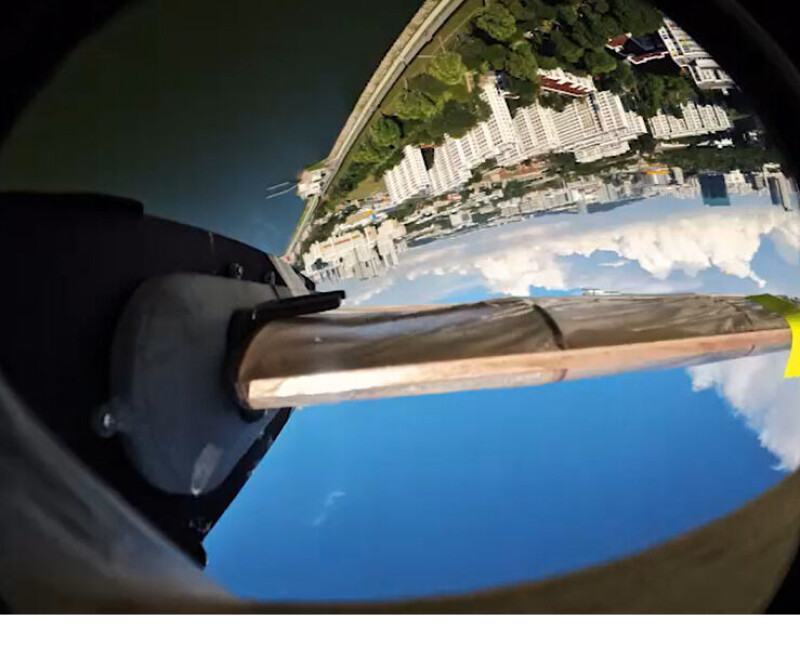
ALBATROSS:一种由新加坡科技设计大学(SUTD)研究人员开发的帆船无人机原型这款名为 ALBATROSS 的无人机缺乏其鸟类同名者所具备的优雅飞行姿态。它并非真正“飞行”,而是以极快的速度坠落至水面——这种降落方式实在令人不安。不过,它的设计初衷正是为了在下降过程中像枫叶种子一样旋转,从而减缓下落速度并减少与水面的冲击力。
The ALBATROSS, a sailboat drone prototype developed by researchers at Singapore University of Technology and Design (SUTD), lacks the aerial grace of its avian namesake. It doesn't so much fly as plummet – an unsettling start to a sea launch, more so because it's designed to spin like a maple leaf seed as it descends. The sailboat drone's rotation slows its fall and minimizes its impact with the water.
这种设计巧妙地避免了同时实现两种移动方式(飞行与漂浮)所带来的工程难题:无需配备起落架、执行器或传感器来分别控制这两种状态。您可在此处观看并下载 ALBATROSS 的相关图片及视频资料。
This eliminates the engineering challenge of implementing hardware for two modes of mobility. There's no need for landing gear, actuators, or sensors to manage both flying and floating.
ALBATROSS 由 SUTD 的研究人员 Shane Kyi Hla Win、Danial Sufiyan、Brian Leonard Suhadi、Luke Soe Thura、Xinyu Cai、Wei Jun Ang 和 Shaohui Foong 共同开发,堪称工程设计与创新领域的杰出成果。该无人机被归类为一种“混合式机器人系统”:它结合了仿生设计(用于控制下降过程中的空气动力)与自主航行功能。
Watch and download graphics and videos of ALBATROSS here. Developed by SUTD researchers Shane Kyi Hla Win, Danial Sufiyan, Brian Leonard Suhadi, Luke Soe Thura, Xinyu Cai, Wei Jun Ang, and Shaohui Foong, the ALBATROSS represents an achievement in both acronym construction and engineering.
在下降过程中,其刚性翼帆通过仿生原理产生升力;在水面上移动时,则依靠类似鱼尾鳍的舵来产生推力。整个系统仅使用了三个执行器和三个传感器即可完成所有操作。
The Airborne Lander with Buoyant AuToROtating Sailing Sensor is described in a Science paper as a hybrid robotic system that combines a bio-inspired design for controlled aerial descent with autonomous sailing. Beyond the bio-inspired operation of the rigid wingsails for creating aerodynamic lift during descent and propulsion on the water, the ALBATROSS further cribs from nature's bag of tricks with a rudder that acts like a caudal fin – it moves side to side like a tailfin to generate thrust.
ALBATROSS 的重量仅为 1.107 千克,旨在填补“一次性使用的海洋观测仪器”与“从船只或岸基平台部署的浮动机器人”之间的空白。凭借其轻便的机身与高度的适应性,它非常适合快速升空执行任务,随后在水面上持续运行(例如监测石油泄漏或应对时间紧迫的天气事件)。与需要地面或船舶支持的大型自动化帆船(如 Saildrone、Sailbuoy)相比,ALBATROSS 更适合独立执行任务。
And it does so with just three actuators and three primary sensors. Practically, the boat drone, which weights 1.107 kg, was built to fill the gap between expendable aircraft-deployed ocean instruments and floating robots deployed from ships or shore. Its light weight and adaptability make it well suited for rapid aerial deployment followed by energy-efficient persistence on the water, as might be required to monitor an oil spill or time-sensitive weather events.
它比混合水上微型航空器具有更远的部署范围:超过100公里,而SailMAV仅约7公里,这是其制造商声称的。研究人员解释道:"基于之前的导引自旋研究,ALBATROSS旨在从飞机或无人机上释放出来,被动进入自旋状态,实现受控的低冲击水上降落,无需驱动即可自立回正,并无缝过渡为风力驱动的帆船。"他们表示:"与许多混合空中-海上系统不同,ALBATROSS消除了空中推进、复杂的机械重构或在空-水过渡过程中主动稳定化的需求,并且可以在任务结束时帆回岸边。"
It is intended to be an alternative to large automated sailboats like Saildrone and Sailbuoy that may require ground- or ship-based management. And it has far greater deployment range than hybrid aquatic micro aerial vehicles: more than 100 km, compared to about 7 km for SailMAV, or so its makers claim. "Building on prior work on guided autorotation, ALBATROSS is designed to be released from an aircraft or UAV, passively enter autorotation for a controlled, low-impact water landing, self-right without actuation, and seamlessly transition into a wind-powered sailboat," the researchers explain.
这款原型机的飞行正值市场同样做出类似尝试。去年,PwC的Strategy&咨询公司发布了一份报告[PDF],预测到2030年海上无人机市场将达到189亿欧元(约212亿美元),基于15.5%的复合年增长率(CAGR)。到本 decade末,大部分(84%)预计将用于民用领域,如科学研究、商业、休闲、工程应用以及搜救作业。®
"Unlike many hybrid aerial-marine systems, ALBATROSS eliminates the need for aerial propulsion, complex mechanical reconfiguration, or active stabilization during the air-water transition and can sail back to shore at the end of a mission." The prototype takes flight amid a market doing the same. Last year, PwC's Strategy& consultancy issued a report [PDF] that forecasts a sea drone market worth €18.9 billion (~$21.2 billion) by 2030, based on a compounded annual growth rate (CAGR) of 15.5 percent. By the end of the decade, most of that (84 percent) is expected to be for civilian uses like scientific research, commercial, recreational, and engineering applications, and search and rescue operations. ®