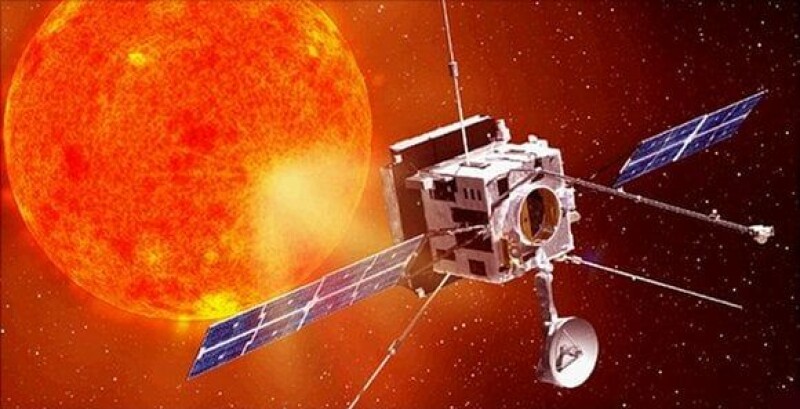
欧洲航天局的“太阳轨道器”让科学家得以追踪太阳风磁场中出现的“磁折返”现象,并最终确定其源自太阳表面。“磁折返”是指太阳风磁场中出现的S形弯曲现象,即磁场方向的突然大幅偏转。2022年,该探测器为科学家提供了这种结构的完整图像(证实了其为S形),但其形成源头仍存争议。当时,探测器的数据表明该现象可能发生在太阳表面附近,而最近一次探测器穿越“磁折返”区域的观测则帮助科学家确定了其确切来源。
The European Space Agency's Solar Orbiter has enabled scientists to trace magnetic switchbacks in the solar wind's magnetic field back to their source at the Sun. "Switchback" is the name given to an S-shaped kink in the solar wind's magnetic field – a sudden and large deflection. In 2022, the spacecraft gave scientists a full view of the structure (confirming the S-shape), but the origin remained up for debate. At the time, the probe's data suggested it might be near the Sun's surface, but a recent flight through a switchback allowed scientists to identify the source.
法国国家科学研究中心/语音学与音系学实验室的杰西·科伯恩说道:“‘太阳轨道器’穿过了一个规模极大的‘磁折返’区域。正因如此,我们得以采集到此前极少被观测到的粒子样本,这些粒子带有反映其起源的显著特征。”科学家利用“太阳轨道器”搭载的太阳风分析仪对该区域的等离子体进行了采样,结果发现了一些只可能在太阳表面高温磁环中形成的粒子。
"Solar Orbiter flew through a very large switchback," said Jesse Coburn of the French National Center for Scientific Research / Laboratoire de Phonétique et Phonologie (CNRS/LPP. "Because of this, we were able to sample rarely observed particles there that have tell-tale fingerprints of their origin." Solar Orbiter's Solar Wind Analyser instrument (SWA) was used to sample the switchback's plasma, and it came up with particles that could only have formed within hot magnetic loops at the surface of the Sun.
科伯恩补充道:“关于‘磁折返’现象乃至整个太阳风的形成机制,目前主要有两种相互对立的理论。‘太阳轨道器’所探测到的特定粒子组合正是‘交换重联’这一形成机制的有力证据。”所谓“交换重联”,是指太阳表面具有不同磁特性的区域发生相互作用的结果:一部分区域的磁场线向太空延伸,另一部分区域的磁场线则先向外延伸后再折返。
Coburn said, "There are two main competing theories for how a switchback, and by extension the solar wind, forms. "The specific mix of particles detected by Solar Orbiter is the smoking gun for a formation process known as 'interchange reconnection'." This occurs when parts of the Sun with different magnetic properties interact. Some have field lines that stretch away into space. Others are closed and extend into space before looping back.
当这两类区域相互接触时,磁场线便会断裂,从而将原本被束缚的等离子体释放到太空中。另一种理论则侧重于与波动及湍流相关的形成过程。英国诺森比亚大学的斯蒂芬妮·亚德利指出:“令人振奋的是,我们也观测到了这些过程的迹象,不过它们很可能是在‘磁折返’现象扩散至太空后才发生的。”
When the two types meet, the lines can snap open, releasing previously trapped plasma into space. The other theory focuses on processes involving waves and turbulence. Stephanie Yardley of Northumbria University in the UK said, "Excitingly, we also see signs of these, but likely only after the switchback heads out into space. "Once the switchback has left the Sun, waves and turbulence take over and govern how it moves."
“一旦这些回弯结构脱离太阳表面,波动与湍流便开始主导其运动方式。”为确定这些回弯结构的起源,研究人员还结合了美国宇航局太阳动力学观测站提供的数据。这一发现极具价值,它揭示了太阳如何加热自身大气层并推动太阳风粒子向太空加速运动。此外,该研究对预测太阳风暴及其强度也具有重要意义。欧洲航天局“太阳轨道器”项目科学家丹尼尔·穆勒表示:“对于地球上乃至太空中的人类而言,我们的生活与太阳的活动息息相关。太阳风将地球与太阳紧密相连,深入理解其运动规律对于保护地球免受极端空间天气事件的影响至关重要。我们对太阳了解得越多,就越能做好应对太阳风暴的准备,从而保护各类太空基础设施与技术。” ®
Data from NASA's Solar Dynamics Observatory was also stirred into the mix to reveal the switchback's solar source. It's exciting stuff and shows how the Sun heats its atmosphere and accelerates solar wind particles into space. It also has implications for predicting solar storms and their severity. Daniel Müller, ESA Project Scientist for Solar Orbiter, said, "As humans on Earth – and in space – our lives are entangled with what's happening on our star. The solar wind ties the Earth to the Sun, and our understanding of its dynamics has key implications for how we keep our planet safe from extreme space weather events. "The more we know, the better we can prepare for solar storms to protect our space-based infrastructure and technology." ®