科学家们正开始揭示“夜猫子”体质与某些神经精神疾病之间的关联。
Scientists are starting to uncover the links between being a night owl and some neuropsychiatric conditions.
不过这也引发了他一个疑问:当人体的时间感知与外界环境不再同步时,会发生什么?
But it also left him with a question: What happens when the body’s sense of time falls out of sync with the world around it?
15年后,卢通过精神病学领域最常见的疾病之一——注意力缺陷多动障碍(ADHD)来探究这个问题。长期以来,睡眠问题一直被视为该疾病的后果。但如今,研究人员开始探讨另一种可能性:即昼夜节律的紊乱——也就是控制我们睡眠与清醒的生物机制——可能是导致ADHD的诱因。
Fifteen years later, Luu is exploring that question through one of psychiatry’s most common disorders: attention-deficit/hyperactivity disorder (ADHD). Sleep problems have long been seen as a consequence of the condition. But now researchers are looking at the possibility that the relationship might run in reverse: that disruptions to circadian rhythms — the biological machinery governing when we sleep and wake — might be a cause.
“我们的社会并不善于维护良好的昼夜节律健康,”现任职于加拿大皇后大学的医生兼研究员卢说道。
“Our society is not good at supporting good circadian health,” said Luu, now a physician and fellow at Queen’s University in Canada.
卢与他的合著者、渥太华大学的精神病学住院医师兼研究员尼古拉斯·法比亚诺,最近在《精神病学前沿》杂志上发表了一篇观点文章,提出了上述理论。他们认为,大量证据均表明:体内生物钟时间较晚的人群与ADHD之间存在密切关联。二人呼吁临床医生将睡眠及昼夜节律紊乱筛查列为常规检查项目,并建议对ADHD患者进行睡眠监测——这一措施成本低、风险小,有望切实帮助到患者。
Luu and his co-author, Nicholas Fabiano, a psychiatry resident and researcher at the University of Ottawa, recently laid out this theory in a perspective paper in Frontiers of Psychiatry, arguing that “convergent lines of evidence” point to strong associations between people whose bodies’ internal clocks shifted later than usual and ADHD. They called on clinicians to start routine screening for sleep/circadian disturbances and recommend sleep tracking for people with ADHD as a potentially low-effort, low-risk, low-cost measure to help people with the condition.
要理解这一理论,首先需要将睡眠与决定我们何时入睡的昼夜节律系统区分开来。
To understand their case, it helps to separate sleep from the circadian system that tells us when to sleep in the first place.
过去,科学家们的认知多局限于大脑中的“主生物钟”,认为它受24小时昼夜周期调控。而现实情况更为复杂:几乎每个器官、每个细胞都能“计时”。这些生物钟共同调节着睡眠、新陈代谢、激素分泌、体温、认知功能、情绪以及诸多其他生理过程。
Scientists once thought largely in terms of a master clock in the brain, synchronized to the 24-hour cycle of light and darkness. The reality is stranger: Nearly every organ, and virtually every cell, keeps time. Together, these clocks regulate not just sleep but metabolism, hormones, body temperature, cognition, mood and many other processes.
睡眠只是我们最容易察觉到的部分——尤其是在如今这个时代,睡眠已然成为一种文化热潮,人们通过苹果手表、Fitbit手环以及Oura戒指来记录和评估自己的睡眠状况。然而,即便我们竭尽全力改善夜间睡眠质量,现代生活环境中的各种因素——发光的电子屏幕、时差影响、轮班工作以及混乱无规律的作息安排——却正在无形中扰乱我们体内的生物钟,使之失去平衡。
Sleep is simply the part we notice, especially these days, as it has become somewhat of a cultural obsession, tracked and scored by Apple Watches, Fitbits, and Oura rings. Yet even as we try to perfect our nights, modern life — with its glowing screens, jet lag, shift work, and erratic schedules — has become a vast, uncontrolled experiment in disrupting the clocks beneath them.
与此同时,昼夜节律生物学的研究范围已不再局限于“人是否睡得充足”这一层面。癌症研究人员正在探究生物钟紊乱是否会促使肿瘤生长;长寿研究领域的学者则试图弄清楚维持体内生物钟的同步性是否会影响人的衰老过程。不过,目前最具争议性的问题却出现在精神医学领域。
Meanwhile, the study of circadian biology is reaching beyond whether we feel well-rested. Cancer researchers are studying whether disrupted clocks can trigger tumors to grow. Longevity researchers are asking whether keeping the body’s clocks aligned might affect how we age. Some of the most provocative questions, however, are now being asked in psychiatry.
至少对于部分患者而言,睡眠与日常节律的紊乱未必仅仅是精神疾病的伴随现象。致力于抑郁症、焦虑症、双相情感障碍、精神分裂症及注意力缺陷多动障碍等病症研究的学者们,正在探讨人体内部的“计时系统”本身是否出现了异常。
For at least some patients, disrupted sleep and daily rhythms may not simply follow from mental illness. Researchers studying depression, anxiety, bipolar disorder, schizophrenia, ADHD and more are asking if something may be going wrong with the body’s timing system itself.
每个人的生物钟运行节奏其实并不相同。有些人的昼夜节律偏早:他们傍晚较早感到困倦,清晨也会自然醒来;而另一些人的整个节律周期则相对靠后。
Internal clocks do not run identically in everyone. In some people, the circadian system runs relatively early: They become sleepy earlier in the evening and naturally wake earlier in the morning.
研究数据显示,这类“夜猫子”型人群与注意力缺陷多动障碍的关联性更强。
In others, the entire cycle runs later. Research points to these night owls as those associated more with ADHD.
长期以来的研究均表明,睡眠及昼夜节律紊乱在注意力缺陷多动障碍患者中极为普遍。最近一项综述指出,约73%至78%的ADHD患儿及成人都存在睡眠觉醒时间延迟的现象。研究还发现,ADHD患者的褪黑素分泌起始时间也相对较晚:儿童群体平均延迟约45分钟,成人则延迟约90分钟。此外,高达80%的ADHD成人患者及比例相近的ADHD儿童都存在失眠及其他睡眠障碍问题。
Studies have long suggested that sleep and circadian disruptions are very common in ADHD. One recent review estimates that 73 to 78 percent of children and adults with ADHD have delayed sleep-wake timing. Studies also indicate that melatonin onset tends to occur later in people with ADHD, by about 45 minutes in children and 90 minutes in adults. Insomnia and other sleep disturbances have also been reported in up to 80 percent of adults with ADHD and at similarly high rates in children.
还有其他迹象表明,多动症患者的生物钟可能发生了紊乱。研究表明,与非多动症患者相比,多动症患者体内与警觉性、能量代谢及应激反应相关的激素——皮质醇的昼夜节律会出现延迟且幅度减弱的现象。一项磁共振成像研究还发现,负责分泌褪黑激素的松果体体积较小。此外,针对成人和儿童细胞的研究显示,人体内多种所谓的“生物钟基因”的昼夜节律也变得不那么明显。
There are other signs the body’s internal clocks may be altered in people with ADHD. Studies show the daily cycle of cortisol, a hormone involved in alertness, energy use, and the stress response, can be delayed and blunted compared with people without ADHD. An MRI imaging study found that the pineal gland, which makes melatonin, is smaller in volume. And research into cells collected from adults and children show that certain so-called “clock genes” throughout the body show less distinct daily rhythms.
这种生物钟时间的差异被称为“昼夜节律类型”,它在一定程度上受遗传因素影响。昼夜节律类型描述的是一个人在“早睡早醒”到“晚睡晚起”这一谱系中所处的位置。
These differences in the timing of our internal clocks are known as chronotype, and they are partly influenced by genetics. Chronotype describes where a person naturally falls along the spectrum from earlier to later sleep and wake timing.
目前已知至少有10种基因与各种睡眠问题相关,比如睡眠时间过短、早睡型或晚睡型睡眠模式等。不过这种节律类型也会随年龄发生变化:儿童的昼夜节律通常偏早;进入青春期后则逐渐推迟,在青少年末期达到最晚状态,之后又随着年龄增长而逐渐提前。
There are at least 10 known genes associated with sleep conditions such as short sleep, advanced sleep phase and delayed sleep phase. But it also changes over a lifetime. Children’s chronotypes tend to be relatively early. The clock shifts later during adolescence, reaching its latest point around the end of the teenage years, before gradually moving earlier again with age.
人们常把人分为“百灵鸟型”和“猫头鹰型”,但这其实并不准确。昼夜节律类型更像是一个连续谱系,大多数人都处于中间区域。
The familiar distinction between larks and owls can make this sound like a division into two kinds of people. It isn’t. Chronotype looks more like a continuum, with most people clustered somewhere around the middle.
2017年发表在《PLOS One》上的一项大规模美国研究为我们提供了相关分布数据:在53,689名参与者中,约40%属于早睡型人群,其睡眠中点时间早于凌晨3点;44%的人处于中间类型,睡眠中点时间在凌晨3点至5点之间;16%为晚睡型人群,睡眠中点时间晚于凌晨5点。这一分布规律还随年龄变化而显著改变。
A large U.S. study published in PLOS One in 2017 gives some sense of that distribution. Among 53,689 people, about 40 percent qualified as early chronotypes, defined as having the midpoint of their sleep before 3 a.m. Another 44 percent fell in the middle, with a sleep midpoint between 3 and 5 a.m. Sixteen percent were late chronotypes, with a midpoint after 5 a.m.
在实验室中,科学家会要求受试者记录自己的睡眠情况,通过问卷调查或简单测试来确定其昼夜节律类型。其中一项测试要求受试者在昏暗环境下每隔30分钟提供一次唾液样本,用以测定褪黑激素水平。不过目前基层医生还无法轻松开展此类检测,尽管研究人员正在努力改进相关技术。
And the distribution shifted dramatically with age. In the lab, scientists ask patients to track their sleep, use questionnaires or run simple tests to find someone’s chronotype, involving having someone in dim light provide a saliva sample to assess their melatonin levels every 30 minutes. There’s no easy way a primary care doctor can order that, although researchers are working on it.
早在科学家能够通过激素水平来测量人体生物钟之前,他们就必须想出更具创意的方法来证明生物钟的存在。
Long before scientists could measure the body clock through hormones, they had to find more inventive ways to prove it existed.
最早证明人体存在生物钟的证据,来自那些长期身处地下环境的人。1938年,睡眠研究专家纳撒尼尔·克莱特曼与他的研究生布鲁斯·理查森在肯塔基州的猛犸洞中待了32天。在那里他们完全隔绝了昼夜信号,并试图按照28小时的周期生活。年纪较轻的理查森勉强适应了这种作息,而克莱特曼的身体节律却始终维持在24小时左右。
Some of the earliest evidence for an internal clock came from people who disappeared underground. In 1938, sleep researcher Nathaniel Kleitman and his graduate student Bruce Richardson spent 32 days in Kentucky’s Mammoth Cave, cut off from the ordinary signals of day and night, while attempting to live on a 28-hour schedule. Richardson, who was younger, partly adapted; Kleitman’s body remained stubbornly close to a 24-hour rhythm.
二十年后,法国地质学家米歇尔·西弗尔将这一实验进一步推进:他在没有阳光与时钟的洞穴中生活了约两个月。他完全按照身体的指令进食与睡眠,而地面上的一支团队则暗中记录着时间。即便不知道当时是白天还是黑夜,西弗尔的新作息依然形成了类似“一天”的周期,只不过这个周期约为24小时30分钟。
Two decades later, French geologist Michel Siffre took the experiment further, spending roughly two months in a cave without sunlight or a clock. He ate and slept when his body told him to, while a team aboveground secretly kept track of the time. Even without knowing whether it was day or night, Siffre’s new schedule continued to produce something resembling days, though his cycle ran more like 24 hours 30 minutes.
这类实验帮助确立了昼夜生物学的一条基本原则:人体本身会产生自身的节律,而外界信号——尤其是光线——则会不断对其进行调整。
Experiments like these helped establish a fundamental principle of circadian biology: The body generates a rhythm of its own, while signals from the outside world — most powerfully light — continually reset it.
不过,我们的生物钟并不总是与现代社会所要求的作息时间表相吻合。
Our internal clocks do not always align with the schedules we are expected to keep in today’s society.
有些人的身体直到凌晨3点才产生困意,他们可能费尽周折也难以在早上7点醒来。但如果允许这类人从凌晨3点一直睡到上午11点,他们反而能睡得很好。他们的身体完全能够正常运作,只是比外界预期的作息时间晚了几个小时而已。
A person whose body does not want to fall asleep until 3 a.m. may struggle desperately to wake at 7. But allow that same person to sleep from 3 a.m. until 11 a.m., and they may sleep perfectly well. Their body can do what it is supposed to do. It is simply doing it several hours later than the world expects.
当这种节律失调严重到一定程度时,便可被诊断为某种疾病。美国《精神障碍诊断与统计手册》将这类情况归类为昼夜节律睡眠-觉醒障碍,具体包括睡眠相位延迟型和睡眠相位提前型两种类型。昼夜节律失调的影响并不仅限于睡眠。
When that mismatch becomes severe enough, it can receive a diagnosis. The DSM groups these conditions under circadian rhythm sleep-wake disorders, which include delayed and advanced sleep phase types. Being out of sync affects more than sleep.
索纳正在对13至15岁的青少年展开相关研究:他让这些青少年按照“清醒80分钟、睡眠40分钟”的超短周期作息,这样研究人员就能分别分析清醒状态与昼夜节律对身体的影响。
Soehner is studying this question in teenagers ages 13 to 15 by putting them on ultrashort cycles of 80 minutes awake and 40 minutes asleep, allowing researchers to tease apart the effects of time awake from those of the circadian clock.
目前研究结果尚未公布,但2019年另一项针对晚睡型人群认知功能的研究显示:将他们的起床时间提前约两小时后,其心理健康状况有所改善,反应速度等认知能力以及握力等身体机能也出现了提升。情绪似乎也遵循着某种节律。
The results aren’t out yet, but another study that looked at cognition in 2019 of late chronotypes showed that shifting their wake time by about two hours was associated with better mental health and there was also some cognitive (reaction time) and performance improvement (grip strength). Mood appears to have a rhythm, too.
“我们的积极情绪在白天达到峰值,而负面情绪则在午夜最为强烈,”埃门斯说道,“可以想象,当我们处于清醒状态时,若身体节律却让我们产生最糟糕的情绪,就很可能引发各种问题。”轮班工作会让这种节律失调的后果表现得尤为明显。埃门斯将其比作车轮定位不准的汽车:每个部件本身或许都能正常运转,但方向不一致时整个系统就会出现问题。
“Our positive moods peak during the daytime and our negative moods are the worst in the middle of the night,” Emens said. “And so you could imagine if there’s a mismatch when we are awake and our body clock is giving us our worst moods that could cause problems.”Shift work makes the consequences of that mismatch particularly clear. Emens compares it to a car whose wheels are out of alignment: each part may work, but when they point in different directions, the whole system suffers.
这引出了一个更深层的问题:生物节律的个体差异何时会演变为病理现象?那些因昼夜节律紊乱导致的机能受损,有多少是由环境因素的影响造成的呢?这一问题与自闭症、注意力缺陷多动障碍等疾病的讨论有相似之处——相关研究人员与倡导者同样在探讨:患者的功能障碍有多少源于生理基础,又有多少是身体节律与外界环境不匹配所致。
That raises a larger question: When does biological variation become pathology? And how much of the impairment attributed to a late-running clock comes from the environment in which that clock has to function? There are questions that echoes debates around conditions such as autism and ADHD, where researchers and advocates have similarly asked how much disability arises from underlying biology and how much from a mismatch with the surrounding world.
“有些患者正在接受其他健康治疗,但实际上针对睡眠或昼夜节律的干预或许更为合适,”他说道。
“There are people getting health treatments whereas a sleep or circadian treatment may be more appropriate,” he said.
目前来看,这意味着现有的治疗方法与建议——比如光疗、服用褪黑素以及睡前避免使用电子屏幕——或许还可以辅以其他手段,即设法调整人体的生物钟,使其更符合社会的作息预期。
For now that means existing treatments and recommendations like light therapy, melatonin supplements, and avoiding screens before bedtime could be augmented with looking at ways to “phase shift” the body clock to be closer to what society expects.
Luu回忆道,自己的生物钟紊乱曾导致成绩下滑,还出现了类似多动症的症状。但他一心想上医学院,于是决定将所学的科学知识应用到自己身上。如今,即便不想起床,他也强迫自己每天在同一时间醒来。
Luu recounts how his own circadian delay caused his grades to slip and the appearance of what he calls ADHD-like symptoms. But he really wanted to go to med school, so he decided to apply the science he was learning to himself. He now forces himself to wake up at the same time each day, even when he doesn’t want to.
另一个关键措施就是清晨接受强光照射:最好是阳光,若没有阳光,他会在离自己约12至14英寸的地方放置一盏冬季抑郁治疗灯,照射20到30分钟。同时他也会在这个时段进行锻炼。
Another key has been bright light first thing in the morning, ideally sunlight is the best, but if not he has a winter depression lamp about 12-14 inches from him for the first 20-30 minutes. He also makes sure to exercise at that time.
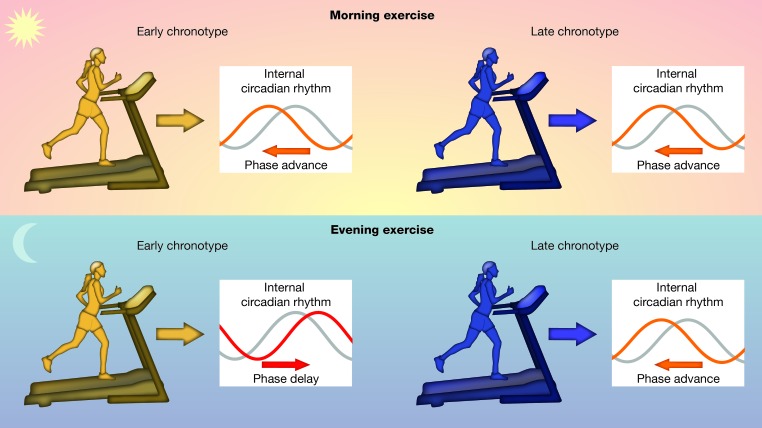
Luu指出,运动或许是调节生物钟的一种方式。有研究表明,对于夜型人而言,运动时间的选择较为灵活;而对于晨型人来说,则应尽量在清晨进行锻炼。
Luu said exercise may be one way to shift circadian rhythms, with some research suggesting if you’re an owl you have more flexibility to choose an exercise time but if you are a lark you should prioritize exercise earlier in the day.
到了晚上,他会调暗灯光,尽可能避开蓝光,也不进行其他容易使人兴奋的活动。
At night, he dims the lights, avoids blue light whenever possible and avoids other stimulating activities.
出差时,他不会一次性大幅调整作息,而是每隔几天将时间提前15分钟左右。“这些方法真的帮助我扭转了人生,”Luu说道。
When he travels he tries not to shift too aggressively at one time, opting instead for 15 minutes every few days. “That really helped me turn my life around,” Luu said.