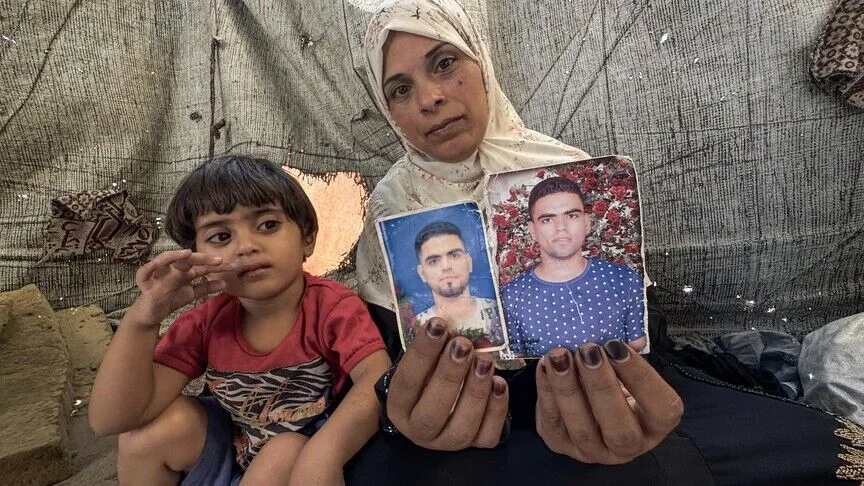
随着加沙战争步入第四年,成千上万的巴勒斯坦家庭依然无法得知那些在三年来的以军袭击与破坏中失踪的亲人的下落。这项工作的难度之大难以想象。
As the Gaza war enters its fourth year, thousands of Palestinian families remain without answers about loved ones who disappeared amid three years of Israeli attacks and destruction. The scale of the task is immense.
联合国估计,这场战争在加沙留下了数百万吨的废墟残骸;而巴勒斯坦民防部门则称,仍有超过8000人埋在瓦砾之下下落不明。
The UN estimates the war has generated millions of tonnes of debris across Gaza, while Palestinian Civil Defense estimates that more than 8,000 people remain missing beneath the rubble.
对许多家庭而言,甚至连该去哪里寻找都无从知晓。失踪的亲人可能被埋在倒塌的建筑物下,也可能遭到扣押或下落不明,这使得家属既无法为他们举行葬礼,也不确定是否还应期待他们归来。
For many families, even knowing where to search is impossible. Missing relatives could be buried beneath destroyed buildings, detained or otherwise unaccounted for, leaving families unable to hold a burial or know whether to keep hoping for their return.
红十字国际委员会驻耶路撒冷发言人帕特·格里菲斯描述道,每当载有获释巴勒斯坦被拘留者的巴士抵达加沙时,总有许多家庭聚集在医院门口。
Pat Griffiths, spokesperson for the International Committee of the Red Cross (ICRC) in Jerusalem, described seeing families gather at hospitals when buses carrying released Palestinian detainees arrive in Gaza.
这些家属手中拿着失踪亲人的照片,却不知道他们寻找的人是被拘留了还是已经遇害。
Some hold photographs of missing relatives, not knowing whether the person they are searching for has been detained or killed.
红十字国际委员会的心理专家将这些家庭的遭遇称为“模糊性丧失”。格里菲斯对阿纳多卢通讯社说道:“你不知道许久没有音讯的亲人是活着还是已经去世,也不知道他们是否被扣押。”
ICRC psychologists describe what those families experience as "ambiguous loss.”"You don't know if your loved one you haven't heard from ... is alive or if they've been killed. You don't know if they're detained or not," he told Anadolu.
“成千上万的人生活在这种茫然无措的状态中。他们痛苦不堪,不知道该做些什么、该作何感受,只能困在原地。”红十字国际委员会驻加沙发言人阿玛尼·纳乌克表示,许多家庭反复向该组织提出同一个问题。
"Thousands of people live with this limbo. This pain of not knowing what to do or how to feel exactly. They're stuck." Amani Al Naouq, ICRC spokesperson in Gaza, said families repeatedly bring the organization the same question.
“我们只想知道他们到底怎么样了,”她回忆起家属们的话,“‘如果他们已经去世,我们也能安心了。可现在既不知道他们是死是活’——这对他们来说是最难以承受的痛苦。”纳乌克告诉阿纳多卢通讯社,即便明知短期内得不到答案,仍有一些家庭坚持联系红十字国际委员会,只因他们需要一个倾诉心声的渠道。
"We just want to know what happened to them," she recalled them saying. "'If they are dead, we can be relieved. But the fact that we don't know if they are dead or alive' – that's one of the most difficult things for them." Al Naouq told Anadolu that some families keep contacting the ICRC even when they know there may be no immediate answer, simply because they need somewhere to share what is weighing on them.
她还称,另一些家庭虽然没有得到任何确认信息,却最终慢慢接受了亲人已经去世的事实。
Others, she said, eventually begin to accept that a missing relative is dead despite having no confirmation.
在巨大的重建挑战中,不确定性正在不断显现:加沙的大片建筑环境已被摧毁或损坏,废墟中据信仍有人类遗骸,以及未爆炸的弹药、危险物质,还有可能与国际罪行调查相关的证据。
The uncertainty is unfolding amid an enormous recovery challenge, with much of Gaza's built environment destroyed or damaged and human remains believed to lie within the ruins alongside unexploded ordnance, hazardous materials and potential evidence relevant to investigations into international crimes.
根据欧盟、联合国和世界银行于2026年4月发布的《加沙地带快速损害与需求评估报告》,清理和管理加沙超过6800万吨废墟的成本将超过17亿美元。
The cost of removing and managing more than 68 million metric tons of debris in Gaza exceeds $1.7 billion, according to the April 2026 Gaza Strip Rapid Damage and Needs Assessment by the European Union, UN and World Bank.
这项工作还需要重型机械和专业设备,以及稳定的燃料供应——而这些条件目前远未满足。
The effort also requires access to heavy machinery and specialized equipment, along with consistent fuel supplies – conditions that are currently far from being met.
Al Naouq表示,救援队拥有的重型机械极其有限,有时只能依赖从私人供应商处租赁的一两台挖掘机,而大部分工作则依靠小型设备和人力完成。
Al Naouq said recovery teams have extremely limited heavy machinery, sometimes relying on one or two excavators contracted from private suppliers, while much of the work is carried out with small equipment and by hand.
由于能力有限,救援队严重依赖家属提供亲人最后被看到的具体位置——包括具体建筑、房间以及当时与他们在一起的人。Al Naouq说,这迫使家属不得不重新经历那些无法找到或救下亲人时的痛苦时刻。“这对这些家庭来说,实际上又是一道重新裂开的伤口,”她说。
With limited capacity, teams depend heavily on families to pinpoint where relatives were last seen – the building, the room and who was with them. That forces families to relive moments when they were unable to reach or save their loved ones, Al Naouq said. "It's actually back again an open wound for these families," she said.
Griffiths最近曾在加沙待了一周,他形容自己看到的是“绵延数公里、如同山脉般的废墟”,其中许多废墟因战争遗留的未爆炸物而充满危险。
Griffiths, who recently spent a week in Gaza, described seeing "kilometers and kilometers just mountains of rubble," much of it posing dangers from unexploded remnants of war.
他表示,国际红十字会(ICRC)支持为救援队租赁两台挖掘机,但这“只是杯水车薪”。
The ICRC supports the rental of two excavators for recovery teams, he said, but that is "a drop in the ocean."
Griffiths说:“他们面前任务的规模令人望而生畏,极其庞大。”他还指出,进入限制进一步加剧了问题,搜救和救援团队无法抵达加沙地带的许多区域,从而无法安全开展工作。根据国际红十字会的说法,加沙目前也无法进行DNA检测。
"The scale of the task ahead of them – it's daunting. It's huge." Griffiths said the problem is compounded by access restrictions, with search-and-recovery teams unable to reach much of the Gaza Strip to carry out their work safely. DNA testing is also currently unavailable in Gaza, according to the ICRC.
法医团队则依赖包括年龄、性别、身高、过往伤势、牙齿信息、衣物、个人物品以及遗骸发现地点在内的信息。
Forensic teams instead rely on information including age, sex, height, previous injuries, dental information, clothing, personal belongings and where remains were recovered.
然而,时间可能通过分解和骨骼化过程抹去这些线索,而移动废墟则可能将遗骸与其原始位置分离。格里菲斯表示:“时间流逝得越久,确认死者身份就越困难。”
But time can erase those clues through decomposition and skeletonization, while moving rubble can separate remains from their original location. "The more time passes, the harder identifying the deceased gets," Griffiths said.
他提到,根据红十字国际委员会在叙利亚、伊拉克、阿富汗和巴尔干地区等冲突中的经验,搜寻失踪人员的行动可能持续数年甚至数十年。他说:“这是武装冲突带来的悲剧之一。”
Drawing on ICRC experience in conflicts including Syria, Iraq, Afghanistan and the Balkans, he said searches for missing people can continue for years or even decades. "It's one of the tragedies of armed conflict," he said.
联合国人权事务办公室驻被占领的巴勒斯坦领土代表马伊·谢赫回忆道,她曾采访过一名37岁的残疾女性。2023年,她的丈夫在加沙北部家中遭遇袭击后一直下落不明。这对夫妻有一个5岁的儿子。
Mayy El Sheikh, of the UN Human Rights Office in the occupied Palestinian territory, recalled interviewing a 37-year-old woman with a disability whose husband remained missing after an attack on his family home in northern Gaza in 2023. The couple have a 5-year-old son.
谢赫表示,这名女性丈夫的家人几乎全部遇害。部分遗体已被找到,但她的丈夫却不在其中。
Almost every member of her husband's family was killed, El Sheikh said. Some were recovered, but her husband was not.
这名女性认为自己知道丈夫所在的废墟堆位置,但由于该区域位于以色列军队部署线——即所谓的“黄线”——之外,她无法抵达。
The woman believes she knows the mound of rubble containing him but cannot reach it because it lies beyond the deployment line for Israeli forces – the so-called "yellow line."
谢赫说,回忆这一切对这名女性而言“痛苦难忍”。“她感到自己无法好好支持儿子康复,因为儿子没有坟墓可以祭拜;她也觉得自己辜负了丈夫,无法为他尽孝。”她补充道,“对她来说,战争直到找到丈夫才算结束。”
Recalling all of this was "excruciatingly painful" for her, El Sheikh said. "She felt that she couldn't support her son recovering as well because he has no grave to visit, and that she failed her husband, that she was not able to honor him." "For her, the war is not over until her husband is found," she added.
谢赫还表示,其他一些家庭曾以为失踪的亲人已经死亡,但后来却在以色列监狱的影像或视频中认出他们还活着。
Other families have believed missing relatives were dead only to later recognize them alive in images or videos from Israeli prisons, El Sheikh said.
她说:“这种不确定性令人难以承受,甚至不知道自己的亲人是生是死。”
"It's that level of uncertainty, not knowing even if your loved one is alive or dead," she said.
联合国被占领巴勒斯坦领土问题特别报告员弗朗西斯卡·阿尔巴内塞最近对加沙废墟中潜在证据的命运表示担忧。她警告称,在以色列军方控制地区移除、碾压和转移废墟,可能会破坏人类遗骸以及可能证明所谓国际罪行的证据。
Concerns over the fate of potential evidence within Gaza's rubble have recently been raised by UN Special Rapporteur on the Occupied Palestinian Territory Francesca Albanese, who warned that the removal, crushing and relocation of debris in areas under Israeli military control could destroy human remains and potential evidence of alleged international crimes.
埃尔·谢赫也警告称,随着加沙废墟遭到扰动,某些东西可能正在消失。
El Sheikh also warned about what may be disappearing as Gaza's ruins are disturbed.
“在我们说话时,证据几乎不可避免地正在被丢失、损坏或遭到扰动,”她说,并提到了破坏的规模、进入限制、已报告的废墟清理和碾压情况,以及重型机械和法医鉴定能力的短缺。
"It is almost inevitable that evidence is being lost, damaged, or disturbed as we speak," she said, citing the scale of destruction, access restrictions, reported rubble removal and crushing, and shortages of heavy machinery and forensic identification capacity.
她表示,加沙的大部分地区仍然无法让独立观察员和调查人员进入,尤其是以色列军方控制下的区域,这使得难以确定那里的人类遗骸和潜在证据正在发生什么。
She said large parts of Gaza remain inaccessible to independent observers and investigators, particularly areas under Israeli military control, making it difficult to establish what is happening to human remains and potential evidence there.
埃尔·谢赫还说,自停火宣布以来,已有反复报告称,遗骸被归还给巴勒斯坦当局,但并未提供对身份识别和查明事件经过至关重要的信息。
El Sheikh said there have also been repeated reports since the announcement of the ceasefire of remains being returned to Palestinian authorities without information that could be critical to identification and establishing what happened.
“他们将遗骸归还给了巴勒斯坦当局,有时甚至只是部分遗骸,既没有身份识别信息,也不清楚这些遗骸是在哪里发现的,或者受害者是如何遇难的,”她说。
"They have returned remains to the Palestinian authorities, sometimes even partial remains with no identification and no clarity on where they were recovered or how they were killed," she said.
格里菲斯表示,如果遗骸与废墟一同被转移,其原始位置——这一重要的身份识别证据——就可能被丢失,同时遗骸也可能变得支离破碎。联合国关于被占领巴勒斯坦领土(包括东耶路撒冷)和以色列问题独立国际调查委员会主席斯里尼瓦桑·穆拉利达尔表示,该委员会已收到有关废墟被清理以及证据可能被破坏的报告。“我们担心,清理废墟可能导致证据永远消失,”他说。
Griffiths said that if remains are moved with rubble, their original location – an important piece of identification evidence – can be lost, while remains may also become fragmented, Srinivasan Muralidhar, chair of the UN Independent International Commission of Inquiry on the Occupied Palestinian Territory, including East Jerusalem, and Israel, said the commission has received reports of rubble removal and the possibility of evidence being destroyed. "We are concerned that the removal of rubble could result in evidence getting lost forever," he said.
穆拉利达尔将证据收集比作拼凑拼图,指出从废墟中找到的物品能够补充目击者证词以及医学与法医证据。
Muralidhar compared evidence gathering to assembling a jigsaw puzzle, saying material recovered from the rubble could complement witness testimony and medical and forensic evidence.
他表示,即便失去这些物品,调查人员仍能认定涉嫌犯罪行为,但可能会导致重要信息出现缺失。穆拉利达尔补充道,这些物品的重要性还不止于可能的司法起诉。
Its loss would not prevent investigators from establishing alleged crimes, he said, but could leave important gaps. Its importance goes beyond potential prosecutions, Muralidhar added.
“在国际法中,有一个广为人知的概念,即‘了解真相的权利’。每个家庭都想知道究竟发生了什么。”他说,对于那些多年苦苦等待却始终未能找回亲人的家属而言,关于事件经过的信息“作为一段记忆而言极其珍贵,更重要的是能帮助他们获得心理上的释怀”。
"In international law, there is a known concept of the right to the truth. Every family wants to know what exactly happened." For relatives who have waited years without recovering their loved ones, information about what happened can be "very, very valuable as a piece of memory and most importantly for closure," he said.
格里菲斯指出,要查明加沙失踪人员的下落,就必须扩大人道主义准入范围,并为搜寻与遗体回收团队提供更多资源。
Griffiths said that resolving the fate of Gaza's missing will require greater humanitarian access and significantly more resources for search-and-recovery teams.
他呼吁允许更多重型机械,包括挖掘机进入加沙,以便团队扩大回收作业规模;同时强调必须确保这些团队能够安全进入目前无法抵达的区域。
He called for more heavy machinery, including excavators, to be allowed into Gaza so teams can scale up recovery operations, while also stressing the need for safe access to areas they currently cannot reach.
“为开展搜寻与回收工作而提供人道主义准入同样至关重要,”他说。穆拉利达尔也呼吁加强国际合作以加快这一进程。
"Humanitarian access for the purpose of search and recovery work – it's also really important," he said. Muralidhar also called for international cooperation to accelerate the process.
“各国必须通力合作,才能更快清理废墟,”他说,并强调避免产生更多废墟的重要性。
"We have to have cooperation across countries to help clear the rubble quicker," he said, stressing the importance of not creating more rubble.
“这是摆在我们面前的一项艰巨任务;如果袭击现在仍不停止,情况可能会进一步恶化,最终发展到我们只能束手无策、眼睁睁看着一切发生的地步,”他警告道。
“This is a huge task right in front of us, and if the attacks do not stop now, things might get further worse and go beyond a point when we'll all be just shrugging our shoulders and watching helplessly,” he warned.
对于格里菲斯与阿尔·纳乌克走访过的某个家庭而言,他们最终得到了答案。
For one family encountered by Griffiths and Al Naouq, that answer eventually came.
红十字国际委员会协助在代尔拜拉赫建立了一处无名死者公墓,此举旨在妥善保存那些暂时无法确认身份的遗体相关信息。
The ICRC has supported the establishment of a cemetery for unidentified dead in Deir al-Balah, part of efforts to preserve information about remains that cannot immediately be identified.
格里菲斯说,一旦遗骨被找到,法医团队会尽可能收集更多的身份信息并建立相应的文件。当无法确定身份时,这些遗骨可以在带有唯一编号的个人墓穴中安葬,该编号与相关信息相连。
Griffiths said that after remains are recovered, forensic teams seek to collect as much identifying information as possible and create a corresponding file. When identification is not possible, the remains can be laid to rest in an individual grave marked with a unique serial number linked to that information.
国际红十字会也在支持建立恢复团队、法医机构和管理公墓方人员之间的信息共享系统,以确保收集到的有关遗骨的信息得以保存,以便将来可能进行身份确认。
The ICRC is also supporting efforts to establish an information-sharing system between recovery teams, forensic authorities and those managing cemeteries so that information collected about remains is preserved for possible future identification.
其目标是既尊重逝者的尊严,又保留未来可能确认其身份的可能性,包括如果大马士革陷入以后DNA检测技术最终可用的情况。
The aim is to preserve both the dignity of the dead and the possibility of identifying them in the future, including if DNA testing eventually becomes available in Gaza.
在对迪尔·阿尔-巴拉赫一座收容无名尸体的公墓进行访问时,他们遇见一位年轻女子,她的丈夫的遗骨最终通过大马士革当地可用的法医方法确认了身份。格里菲斯回忆起她最终拥有一座坟墓意味着什么。
During a visit to a cemetery for unidentified dead in Deir al-Balah, they met a young woman whose husband's remains had eventually been identified through forensic methods available in Gaza. Griffiths recalled what finally having a grave meant to her.
“她可以去祭扫丈夫的坟墓,她可以在丈夫的坟墓前站着,靠近他,”他说。
"She could visit his grave, she could stand at his grave, to be near him," he said.
这给她带来“一种结束的感觉,一种哀悼的方式”。对于数千个家庭来说,他们仍在寻找在战争中失踪的人,甚至这也还远远不可及。
It gave her "a sense of closure, a way to mourn." For thousands of families still searching for someone who disappeared during the war, even that remains out of reach.