
乔纳森·莱文报道 消费者信心正在崩溃,招聘疲软,住房市场基本冻结。所有这些都凸显出美国经济之所以还能支撑,仅靠人工智能的繁荣和老龄化人口在医疗保健上的日益增长支出。虽然前者如今似乎吸引了全部关注,后者却正成为日益突出的脆弱点。风险在于不可持续的联邦预算赤字将迫使一次清算,政府削减医疗保险资金,从而对经济造成毁灭性打击。
Consumer confidence is collapsing, hiring is weak and the housing market is largely frozen. All of which serves to underscore that the US economy is only holding up because of the boom in artificial intelligence and an aging population spending ever more on healthcare. Although the former seems to garner all the attention these days, the latter is becoming a rising source of vulnerability. The risk is that unsustainable federal budget deficits will force a reckoning, with the government throttling Medicare funding and delivering a devastating blow to the economy in the process.
我们之所以走到这一步,部分原因是人口结构的变化。美国65岁以上的人口已激增至占总人口的18%,约6300万人,过去十年增加了1700万。老年人对医疗保健的需求远高于其他人群,并通过医疗保险(Medicare)来支付费用。医疗保险是美国于1965年设立的健康保险计划,旨在帮助老年人负担医疗费用。这一切为医疗行业的各类主体带来了巨额利润,包括医生、药企以及销售医疗保险计划的保险公司。
We got to this point, in part, due to demographics. Americans 65-and-over cohort have exploded to 18% of the population, or 63 million people and an increase of 17 million in the past decade. Seniors consume much more healthcare than the rest of the population, and pay for it through Medicare, the US health-insurance program created in 1965 to help older Americans afford their medical bills. This has all meant major profits for the medical community in all its forms, from physicians to drugmakers, as well as insurers that peddle Medicare plans.
截至本财政年度,医疗保险支出已上升约8%,按年化计算约为1.1万亿美元——这是一种显而易见的经济风险。医疗保险信托基金主要来源于指定的工资税。按照目前趋势,明年起医疗保险的支出速度将超过收入,基金预计将在2033年耗尽。届时决策者必须提出解决方案(提高工资税、削减福利或寻找其他资源),否则对医院的付款可能被削减至每美元约89美分。
Medicare outlays are up around 8% in the fiscal year to date, and they’re running at an annualized rate of some $1.1 trillion — an economic risk hiding in plain sight. One Medicare trust fundcomes mainly from a designated payroll tax. Starting next year, current trends suggest Medicare will spend that money faster than it brings it in, with the fund depleted by 2033. That’s a deadline by which policymakers need to come up with a fix (raise the payroll tax, cut benefits or find resources elsewhere), or payments to hospitals could be cut to about 89 cents on the dollar.
另一部分医疗保险资金来自一般税收和债务,随着政府利息支出已达约每年1万亿美元并持续上升,政治人物将面临更大压力来遏制这些成本。
Another bucket of Medicare funding comes from general tax revenue and debt, and politicians will face increased pressure to rein in those costs as government interest expense, which has reached about $1 trillion annually, continues to climb.
这一切都应该让人感到一种奇特的熟悉感。与医疗行业类似,人工智能的发展浪潮也搭上了超大规模数据中心运营商借贷狂潮的便车,这些资金用于资助来自亚马逊、微软、字母表、Meta平台和甲骨文公司总计约8000亿美元的资本支出。
This should all feel strangely familiar. Similar to healthcare, the AI story is riding on the back of a hyperscaler borrowing binge to help finance roughly $800 billion in capital expenditures from Amazon.com Inc., Microsoft Corp., Alphabet Inc., Meta Platforms Inc. and Oracle Corp.
巨额债务支撑着经济的各个支柱;只不过一边的债务是私营部门的,另一边是由财政部发行的。
A mountain of debt is behind each leg of the economy; it’s just that one stack is private and the other is issued by the Treasury Department.
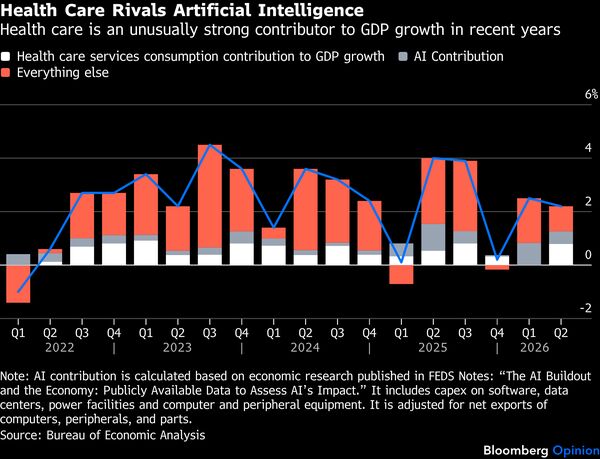
就目前而言,医疗行业是经济的东风。在过去一年里,医疗经济创造了37.2万个就业岗位,约占美国整体非农就业新增岗位49.6万个的75%。在周三更新的第二季度国内生产总值(GDP)报告中,医疗消费占第二季度2.2%年化增长率的三分之一以上——甚至超过了人工智能投资。
For now, healthcare is an economic tailwind. The health economy has created 372,000 positions in the past year, or about 75% of the 496,000 nonfarm payroll additions in the US overall. In the second-quarter gross domestic product report updated Wednesday, healthcare consumption accounted for well over a third of the 2.2% annualized expansion in the second quarter — more than AI investment.
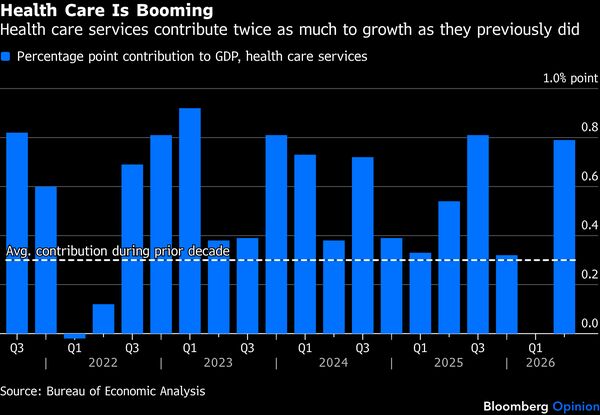
医疗行业在经济中一直举足轻重,但它近年来的贡献大约是前十年平均水平的两倍。
Healthcare has always been a big deal in the economy, but its contribution in recent years is roughly twice as large as it had been in the prior decade.
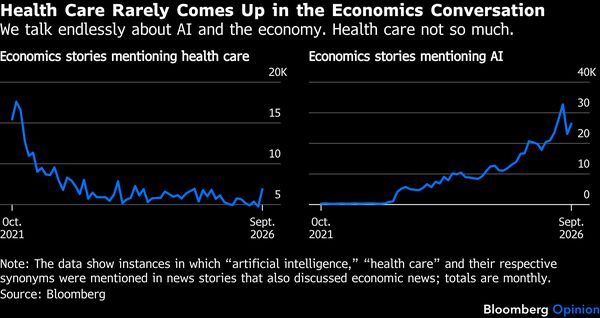
我们对人工智能的讨论远多于医疗经济,这并不令人意外。前者是一个百年一遇的经济奇迹,它推动标普500指数节节攀升,并在自2022年底ChatGPT发布以来,帮助美国家庭净资产增加了约52万亿美元。而后者则是美国人口结构中一种具有惯性的特征。医疗经济的强劲是我们习以为常的特征,但如果政府管理不善将其变成令人不快的软肋,我们将对其怀念不已。
It’s no shock that we discuss AI much more than the healthcare economy. The former is a once-in-a-century economic surprise that’s catapulted the S&P 500 Index higher and helped add about $52 trillion to American households’ net worth since the release of ChatGPT in late 2022. The latter is an inertial feature of America’s demographic profile. The strength of the healthcare economy is a feature we take for granted, but one we’d miss terribly if government mismanagement transforms it into an unwelcome weakness.
美国的经济扩张有赖于这样一种解决方案:它既能解决严峻的预算收支问题,又不会对最脆弱的联邦医疗保险(Medicare)使用者强加紧缩政策,也不会压垮医疗消费。这意味着必须着手堵住漏洞并消除效率低下。
America’s economic expansion depends on a resolution that addresses the hard budgetary math without forcing austerity on the most vulnerable Medicare users and crushing healthcare consumption. The means tackling loopholes and inefficiencies.
美国立法者应考虑一系列改革措施,包括对“优势医疗计划”(Medicare Advantage)进行调整,该计划是借助私营公司作为中介的医疗计划。根据独立机构“医疗支付顾问委员会”(MedPAC)的数据,在考虑人口特征和健康状况等因素后,传统医疗计划(Medicare)人均支出为100美元时,优势医疗计划的人均支出则高达114美元。这在一定程度上源于人为夸大诊断的扭曲激励,必须予以纠正。
US lawmakers should consider a suite of reforms, including tweaks to Medicare Advantage, the version of Medicare that uses private company middlemen. Medicare pays Medicare Advantage plans 14% more per person — adjusting for demographics and health status — than what it spends under traditional Medicare, according to the independent Medicare Payment Advisory Commission, or MedPAC. That’s in part due to a perverse incentive to inflate diagnoses, and it demands fixing.
另一个问题是,通过“穿透型企业”(passthrough businesses)获得收入的个体,可以对其收入的大部分免于缴纳医疗工资税,这一漏洞主要使收入最高的1%人群受益。第三个可解决的问题是,医疗计划在不同医疗场景下的支付标准存在不一致。MedPAC举了一个例子:对于完全相同的硬膜外类固醇注射(用于缓解背痛),医疗计划向医院门诊部门支付741美元,而在医生诊所则仅支付256美元。
Another issue is that individuals that earn income through passthrough businesses can avoid the Medicare payroll tax on much of their income, a loophole that mostly benefits the top 1% of earners. And a third addressable concern is the inconsistency in what Medicare pays in different settings. One example from MedPAC: Medicare pays a hospital outpatient department $741 for the same exact epidural steroid injection (for back pain) that it pays $256 for in a physician’s office.
因此,医院系统正在大量收购医生诊所,并将其重新归类为门诊部门。医疗计划应采用所谓的“地点中立支付”方式。随着人口老龄化,医疗计划在未来几十年内可能需要采取更激进、也更具政治挑战性的解决方案。但这些提议至少是一个开端。
As a result, hospitals systems are buying up physicians’ offices and reclassifying them as outpatient departments. Medicare should adopt so-called site-neutral payments. Medicare will probably require even bolder — and politically trickier — solutions to get through the next few decades as the population ages. But those ideas are a start.
在一个由双引擎驱动的经济体中,我们既不能忽视医疗体系,也不能低估科技巨头的力量。如果超大规模科技公司削减对人工智能的投资,医疗体系将成为维持经济扩张的唯一屏障。然而,我们的领导者未能采取行动确保其可持续性,正使其面临风险。
In a twin-engine economy, we can’t take either one for granted. Healthcare will be the only bulwark protecting the expansion if the hyperscalers pull back on AI investment. And our leaders put it at risk by failing to act to ensure its viability.