由于上半年经济增长超出预期,强劲的出口和政府支出的激增抵消了疲软的消费活动,德国将今年的增长预测上调至原来的两倍多。
Germany more than doubled its growth forecast for this year after a stronger-than-expected first half, as robust exports and a surge in government spending outweighed weak consumer activity.
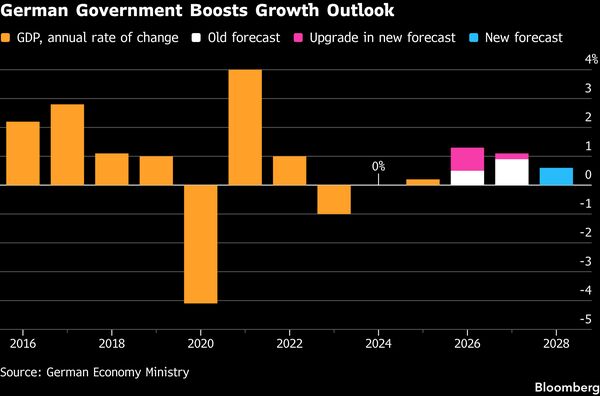
经济部在秋季预测报告中表示,预计2026年国内生产总值(GDP)将增长1.3%,为2017年以来的最快增速;2027年则将增长1.1%。这一预测与此前估计的0.5%和0.9%相比明显上调。报告同时认为,此后经济增长将放缓,2028年预计增长0.6%,因为经济仍受地缘政治动荡的影响,而地缘政治紧张局势已推高能源价格。
Gross domestic product is expected to expand by 1.3% in 2026 — the fastest jump since 2017 — and 1.1%in 2027, the Economy Ministry said in its autumn projection. That compares with previous estimates 0.5% and 0.9%, respectively. It sees the advance slowing after, with 0.6% growthin 2028 as the economy remains subject to volatile geopolitics that have driven up energy prices.
经济部周四在一份声明中表示:“德国经济正走在增长轨道上,并且比预期更具韧性。未来的经济发展在很大程度上取决于中东和乌克兰地缘政治冲突的走势。”该预测显示,欧洲最大的经济体比预期更能承受中东战争带来的冲击,尤其是在核心制造业领域。经济部指出,为应对全球供应链限制,企业增加德国制造的能源密集型商品库存,意外地推动了经济增长。
“The German economy is on a growth trajectory and has proven to be more resilient than expected,” the ministry said in a statement on Thursday. “Future economic developments depend largely on the course of geopolitical conflicts in the Middle East and Ukraine.”The forecast showed that Europe’s largest economy withstood the blow of war in the Middle East better than had been anticipated, particularly in its core manufacturing sector. Companies building up inventories of German-made energy-intensive goods in response to global supply constraints offered an unexpected boost, the ministry said.
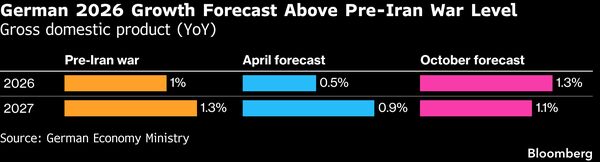
为应对美国主导的对伊朗战争及其可能引发的能源中断,德国政府曾在4月份将2026年的增长预测下调至一半。而1月份的预测曾为1%的增长。
Bracing for the impact of the US-led war on Iran and energy disruptions, the government halved its growth forecast for 2026 in April. The projection in January had been for 1% growth.
尽管如此,此次预测上调仍为总理弗里德里希·默茨提供了有限的喘息空间。过去三年,德国经济几乎未实现增长,而上个月接连遭遇三次惨痛的州选举失利后,针对其不受欢迎的政府的压力也日益加剧。这些选举中,极右翼政党“德国选择党”的支持率大幅上升。
Still, the upgrade offers Chancellor Friedrich Merz limited breathing room. Germany’s economy has barely grown over the past three years, and pressure on his unpopular government has intensified after three bruising state election defeats last month that saw a surge in support for the far-right Alternative for Germany.
与此同时,在初步推动之后,为实现可持续复苏所必需的各项改革也陷入停滞。默茨领导的联合政府在周三晚些时候于柏林举行会议时达成共识,决定继续推进一系列改革措施。
At the same time, reforms needed to put the recovery on a sustainable footing have stalled after an initial push. Merz’s coalition agreed in a meeting in Berlin late Wednesday to grind ahead in its effort to push through a raft of measures.
最新数据显示,陷入困境的制造业部门已出现一定程度的稳定。尽管莱茵河水位较低,但8月份工业产值仍增长了2%,而订单量也在增加,这在一定程度上得益于德国的再军事化进程。
Recent data have pointed to some stabilization in the struggling manufacturing sector. Industrial production rose 2% in August despite low water levels on the Rhine, while order books have been filling up thanks in part to Germany’s rearmament.
经济部表示,预计今年对外贸易将推动经济势头增强,因为库存的积累带来了积极影响。该部还指出,政府通过债务融资在基础设施和国防领域的支出,在未来几年也将继续发挥积极作用。
The Economy Ministry said it expects momentum this year to be boosted by foreign trade, which benefited from a buildup of inventories. It added that the government’s debt-financed spending on infrastructure and defense will also continue to help in the coming years.
然而,由于物价上涨,私人消费预计将保持低迷,而私人投资也只会逐步复苏。
Private consumption should remain subdued due to rising prices, however, and private investment is expected to recover only gradually, it said.
声明称,解决地缘政治危机的持久方案“将加速经济复苏”。“相反,商品和能源价格持续高企,可能会给企业和家庭带来更重的负担。”除了这些威胁之外,德国以出口为导向的工业部门还面临着美国的贸易壁垒以及来自中国日益激烈的竞争。企业也多次指出,税收、监管、劳动力成本以及冗长的审批程序是投资的障碍。
A lasting solution to geopolitical crises “would accelerate the recovery,” according to the statement. “Conversely, persistently high commodity and energy prices could place a greater burden on businesses and households.”Apart from these threats, Germany’s export-oriented industrial sector has been struggling with trade barriers in the US and intensifying competition from China. Companies have also repeatedly cited taxation, regulation, labor costs and lengthy approval procedures as obstacles to investment.
德国工业联合会(DIHK)执行主任海伦娜·梅尔尼科夫表示:“这次经济复苏的代价很高。”“如果没有实质性的经济改革,这种复苏将是短暂的。”这些修订后的预测是税收估算的基础,与德国主要经济研究机构上个月发布的预测基本一致。
“This economic upswing comes at a high cost,” said Helena Melnikov, managing director of the DIHK industry lobby group. “Without substantial economic reforms, this recovery will be short-lived.”The revised forecasts, which serve as the basis for tax estimates, are broadly in line with projections published last month by Germany’s leading economic institutes.