果“愚蠢至极”的定义是反复做同一件事却期待不同结果,那么欧盟与中国之间日益升温的贸易摩擦中,最新出现的种种举措又该作何解读呢?
If the definition of madness is doing the same thing again and again and expecting a different result, what are we to make of the latest broadsides in the trade war brewing between the European Union and China?
法德两国最新提出的方案表面上看是为了让欧盟拥有与特朗普政府时期美国所采用的类似手段,用以扶持本国产业。在本周致欧盟委员会主席乌尔苏拉·冯德莱恩的信中,两国呼吁修改相关规则,允许欧盟在多数成员国无异议的情况下限制来自特定国家的进口。从最激进的层面来看,这一提议甚至比唐纳德·特朗普总统曾考虑过的任何措施都要强硬。
The ostensible purpose of the latest proposals from France and Germany is to give Brussels tools for supporting domestic industries, as strong as those employed by Washington since the first Trump administration. In their letter this week to European Commission President Ursula von der Leyen, they called for rule changes allowing Brussels to go as far as cutting off imports from targeted countries unless a majority of member states object. In its fullest form, that’s a more radical proposal than anything President Donald Trump has contemplated.
美国的贸易政策固然强硬,但若以实际效果来衡量,却是一场可耻的失败。正如我的同事斯科特·林西科姆所写,美国的种种举措几乎未能实现任何重要目标。它们非但未能削弱中国的贸易实力,反而促使其进一步增强。虽然关税措施减少了中国制成品的进口量,但仅仅去除产品上的“中国制造”标签其实收效甚微:进入美国市场的商品中,中国原材料的占比几乎没有变化。
US trade policy has certainly been muscular, but measure it by its real-world effects and it has been an ignominious failure. As my colleague Scott Lincicome has written, the US actions have failed to achieve almost every significant goal. Far from damaging China’s trading prowess, they’ve enhanced it. While the restrictions have reduced imports of Chinese finished goods, removing a Made-in-China label has only a superficial effect: The amount of Chinese content in goods coming into the US has barely moved.
关税提高了美国家庭的支出负担,也阻碍了他们购买中国擅长的各类清洁技术产品。更糟糕的是:美国的汽车制造商并未借政府保护之机发展未来产业,反而继续大力生产那些仅能在封闭的国内市场销售的过时燃油车。
Tariffs have raised costs on American households and deterred them from buying the clean technologies in which China specializes. Worse still: Rather than taking the opportunity of government protection to catch up in developing future industries, America’s auto manufacturers have doubled down on building obsolete gas guzzlers for a walled-off domestic market.
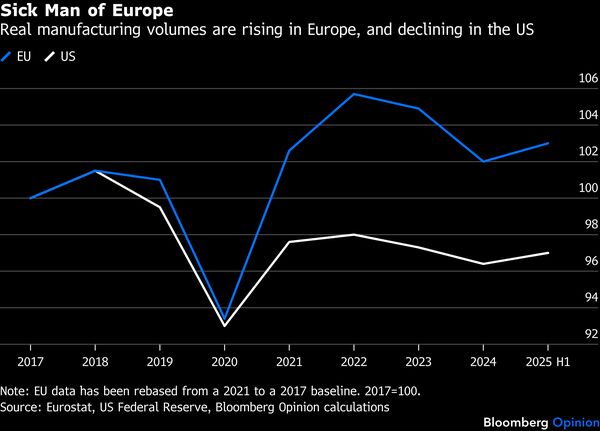
与欧洲整体情况相比,这一数据显得尤为令人沮丧。欧盟未能培育出类似美国那样的科技产业,这对其经济发展造成了严重阻碍;不过在制造业领域,欧洲的表现实际上要优于美国。十年来实施的贸易限制措施使得美国制造业规模至今仍停留在2017年的水平。欧洲制造业虽算不上蓬勃发展,但至少保持着增长态势。
It’s a particularly dispiriting record when you compare it to Europe itself. The EU’s failure to establish anything resembling the US technology industry is a serious drag on its economy, but in manufacturing it has actually outperformed. A decade of trade restrictions have left the US with a factory sector than it had in 2017. Europe hasn’t exactly boomed, but it is at least growing.
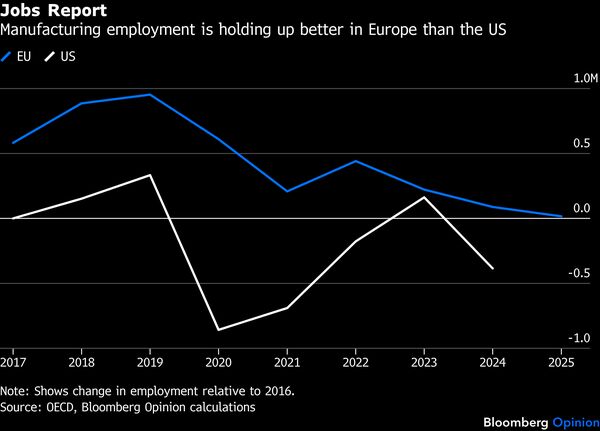
就业情况也呈现出同样的趋势。新冠疫情期间,美国制造业就业人数骤降且始终未能恢复;而在欧盟,这一降幅则要温和得多。目前欧盟制造业从业人员总数接近3200万人,这一数字是美国1500万制造业就业人数的两倍有余。
The same pattern shows up in jobs. US factory employment collapsed during the Covid-19 pandemic and never really recovered. In the EU, the decline has been far more gentle. The total manufacturing workforce, of nearly 32 million people, is more than twice the 15 million in the US.
尤其是“核心欧洲”国家,尤其是德国,确实遭受了更为严重的冲击——不过这是因为大量就业岗位正转移至欧盟其他经济蓬勃发展的地区,比如西班牙和波兰。
“Core Europe,” in particular Germany, has certainly suffered a disproportionate hit — but that’s because jobs have been migrating to booming corners elsewhere in the bloc, such as Spain and Poland.
误读这段历史所带来的风险在于:若仅以少数几家汽车制造商的困境来代表整个制造业的状况,欧洲可能会高估自身面临的中国威胁程度,也会高估在局势恶化至全面对抗时自己所能动用的应对能力。
The danger in misreading this recent history is that by mistaking the problems of a handful of automakers for the state of manufacturing as a whole, Europe may be overestimating how much it’s threatened by China, and how much firepower it would be able to bring to bear if things deteriorate to an all-out battle.
在主要经济体中,美国属于特例:其出口部门相对于整体经济而言十分疲软。商品与服务出口仅占国内生产总值的11%,这一比例甚至低于塔吉克斯坦和喀麦隆——这两个国家根本算不上主要贸易大国。正因如此,美国比大多数国家更能从容应对糟糕的贸易政策所带来的负面影响。
The US is unusual among major economies in the weakness of its export sector relative to the entire economy. Exports of goods and services make up just 11% of gross domestic product. That’s a smaller share than Tajikistan or Cameroon, neither of which would turn up on anyone’s list of major trading powers. As a result, it’s able to shrug off the effects of a disastrous trade policy better than most other countries.
欧盟则处于另一个极端:出口占其国内生产总值的23%,这一比重甚至高于中国(中国为21%)。
The EU lies at the opposite end of the spectrum: At 23% of GDP, exports from the bloc are more important to the economy than in even China, which comes in at 21%.
法德两国提出的方案恰恰存在这样的风险:其所提议的进口限制措施非但无法提振欧洲工业,反而会成为一次极具破坏性的自我伤害行为。
Therein lies the danger in the Franco-German proposal. The kill switch it proposes on imports won’t strengthen European industry — it would instead represent a devastating act of self-harm.
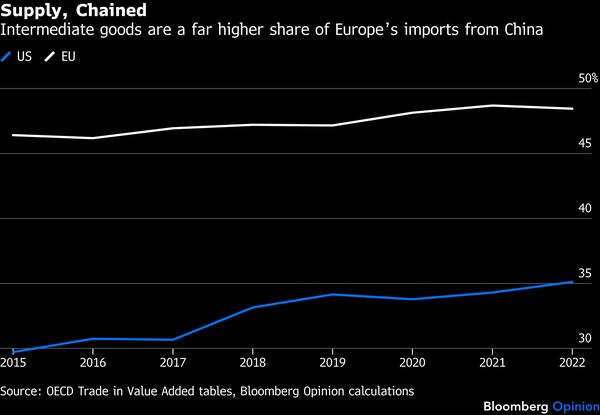
这是因为近年来中欧贸易中增长的部分,并非带有“中国制造”标签的消费品,而是欧洲企业购买并用于生产自身产品的中小型设备和零部件,而这些产品中的许多最终又被出口出去。欧洲从中国进口的商品中,近一半属于此类中间品,而在特朗普于2018年发起第一轮贸易战时,美国这一比例尚不足三分之一。
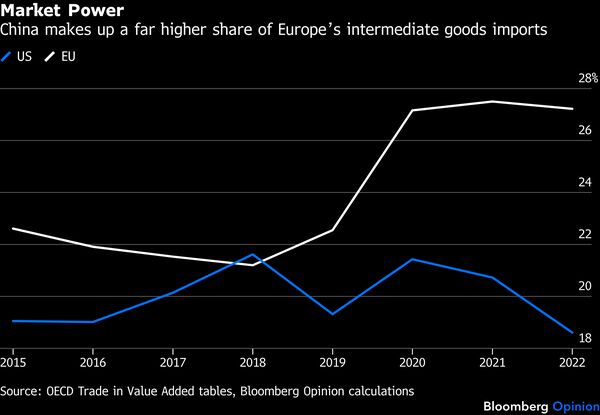
That’s because the bit of China-EU trade that’s been growing in recent years hasn’t been consumer goods with “Made in China” stamped on them, but smaller equipment and parts bought by European businesses and used to manufacture their own products, many of which are in turn exported. Nearly half of Europe’s imports from China are such intermediate goods, compared to less than a third in the US at the time Trump started the first round of trade wars in 2018.
如果切断进口,将对本地产业造成比其中国同行更严重的损害。欧洲超过27%的中间品进口来自中国,这一水平远高于美国曾经达到的程度。生产线的正常运转离不开对关键零部件和投入品的自由获取,而当前的法德提案正可能危及这一点。
Cut off imports, and you’re going to do far more harm to local industries than their Chinese counterparts. More than 27% of Europe’s imports of intermediate goods comes from China, a much higher level than the US ever reached. Production lines can’t run unless they have free access to essential parts and inputs, which the current Franco-German proposal would put in jeopardy.
回想去年,当中国因与华盛顿的贸易争端而暂停向全球出口稀土磁铁时,所造成的混乱便可见一斑。再想象一下,如果同样的混乱波及更广泛的产品范围,而这次引发者并非北京,而是布鲁塞尔,情形又将如何?
Think of the havoc last year when China shut off global exports of rare-earth magnets amid a trade dispute with Washington. Then imagine the same chaos across a far wider range of products, and this time provoked not by Beijing but by Brussels.
欧洲与中国的贸易关系远比仅凭丹麦道路上小鹏汽车的数量所能衡量得更加深入和一体化。如果欧洲领导人真正关心就业和竞争力,而非面子与头条新闻,那么在追随美国那条灾难性的道路之前,他们应当三思而后行。
The trading relationship between Europe and China is a lot deeper and more integrated than you can measure by just counting the number of XPeng Inc. cars on the road in Denmark. If European leaders really care about jobs and competitiveness rather than pride and headlines, they’ll think twice before following America’s disastrous path. OPIN