海伦·凯勒去世已超过50年,但她的身影至今仍在人工智能的讨论中频繁出现。这位又聋又盲的美国作家在沟通方面取得的突破,常被用作证据,证明语言是创造与人类同等智能机器的最佳途径。
More than 50 years after her death, Helen Keller still turns up in artificial intelligence debates. The communication breakthroughs of the American writer, who was deaf and blind, are often cited as evidence that language is the best path to creating machines that are as intelligent as humans.
尽管早期曾有不少人提出强烈质疑,但大型语言模型——当今绝大多数人工智能投资所依赖的技术——已被证明远比批评者预期的更为务实。计算机无法真正将脚伸入海洋,但它能够识别整个互联网文本中的足够多模式,从而模仿出对“脚被水浸湿”这一体验的理解。我们对大型语言模型的痴迷,延续了将语言与智能相联系的传统。
Despite loud early doubters, large language models — the technology underpinning the vast majority of today’s AI investment — have proven far more grounded than critics expected. A computer can’t dip its toes in the ocean, but it can recognize enough patterns in the writings of the entire internet to mimic an understanding of what it means to get your feet wet. Our obsession with LLMs follows a long tradition of affiliating language with intelligence.
然而,凯勒本人对著名“w-a-t-e-r”里程碑事件的描述,其意义并不仅仅在于词语本身。当她的老师安妮·沙利文将字母拼写在她的手掌上时,凯勒也感受到一种“奇妙而清凉的东西”流过她的手。她并非只是将一个词与另一个词建立联系,而是将语言与一种身体感受连接了起来。
Yet Keller’s own retelling of the famous “w-a-t-e-r” milestone was about more than words. As her teacher Anne Sullivan spelled out the letters on her palm, Keller also felt a “wonderful cool something” flowing over her hand. She wasn’t simply relating one word to another, she was connecting language to a physical sensation.
当从英伟达公司首席执行官黄仁勋到中国领导人习近平,所有人都开始展望物理人工智能时代时,这一区别显得尤为重要。在这场技术革命的下一阶段,由人工智能驱动的机器人将在现实世界中行动,大型语言模型的局限性将越来越难以被忽视。了解所有关于使用筷子或系鞋带的句子,与能够自己进食或走出家门,是截然不同的两回事。
That distinction matters as everyone from Nvidia Corp. Chief Executive Officer Jensen Huang to Chinese President Xi Jinping heralds the physical AI era. In the next phase of this tech revolution, marked by AI-powered robots navigating the real world, the limits of LLMs are becoming harder to dismiss. Knowing every sentence ever written about using chopsticks or tying shoelaces is different from being able to feed yourself or get out the door.

我曾写道,制造实用人形机器人的两大主要障碍是“双手”(灵巧性)和“大脑”(能够驱动现实世界行动的人工智能模型)。解决这两个问题,或许能开启摩根士丹利预测的、到2050年将达到5万亿美元规模的市场。但如果这些问题比我们想象的更加相互关联呢?
I’ve written before that the two biggest barriers to useful humanoid robots are the hands (dexterity) and the “brains” (AI models that can power real-world actions). Solving both could unlock what Morgan Stanley forecasts will become a $5 trillion market by 2050. But what if those problems are more interconnected than we thought?
去年发表在《自然》杂志上的一篇论文指出,研究人类祖先化石的生物学家发现,灵长类动物的灵巧性和大脑发育在数代演化中同步发展。这表明,智力的形成不仅源于对世界的观察,更源于在物理世界中的实际行动。
Biologists studying hominin fossils found that primate dexterity and brain development evolved hand-in-hand over generations, suggesting intelligence was shaped not just by observing the world, but by physically acting in it, according to a Nature paper published last year.
RLWRLD的首席执行官Ryu Junghee告诉我,机器实现通用人工智能(AGI)的过程或许与此并无太大不同。RLWRLD是一家总部位于首尔、旧金山和东京的物理人工智能初创公司。该公司正在为机器人开发基础模型,以实现五指灵巧操作。他认为,机器人“大脑”和“双手”的硬件与软件必须协同进化。今年早些时候,RLWRLD宣布与英伟达合作,开发一项用于灵巧操作的新基准测试。
Achieving Artificial General Intelligence in machines might not be all that different, Junghee Ryu, the chief executive officer of RLWRLD, a physical AI startup with offices in Seoul, San Francisco and Tokyo, told me. His company is developing foundation models for robots that can crack five-finger dexterity, and he argues that the hardware and software for robot brains and hands must co-evolve. Earlier this year, RLWRLD announced a collaboration with Nvidia to develop a new benchmark for dexterous manipulation.
Ryu表示,大型语言模型(LLM)在理解自身处境和规划行动方面表现出色,但它们仍然无法完成任何需要灵巧性的工作,这使得它们在劳动市场的广泛领域中都毫无用武之地。在他看来,这一事实足以对近期那些声称我们已经达到AGI的说法泼冷水——AGI这一神话般的目标,指的是经济可行性堪比人类的系统。
LLMs are very good at understanding their circumstances and planning actions, Ryu says, but they still can’t perform any jobs requiring dexterity, making them useless across vast swaths of the labor market. To him, that should throw cold water on recent claims that we’ve reached AGI, the mythical goalpost marking systems that is as economically viable as humans.
他并非唯一持此观点的人。韩国投资证券公司在今年早些时候发布的一份行业报告中指出,类人灵巧性,尤其是机器人手的灵巧性,是“实现AGI的最后关键组件”。报告称,双手与大脑运动皮质的25%以及感觉皮质的30%相连,因此对于人类感知和响应外部信息至关重要。
He’s not alone. Human-like dexterity, particularly with robotic hands, is the “final component making AGI possible,” analysts at the Korea Investment & Securities Co. wrote in an industry report earlier this year. Hands are connected to 25% of the brain motor cortex and 30% of the sensory cortex, they said, making them crucial to how humans perceive and act on external information.
然而,尽管专家们不断预测我们正逐步接近AGI,但他们普遍认为,机器完成基础物理任务的目标却越来越遥远。在一项持续多年的针对数百名人工智能研究人员的调查中,2016年的受访者认为,能够折叠衣物或组装任何乐高套装的机器分别会在2022年和2025年左右出现。但在最新的2024年调查中,这两个里程碑被推迟到了2030年和2031年。
Yet even as experts continuously forecast that we’re inching closer to AGI, they tend to think we’re getting further from machines completing basic physical tasks. In a long-running survey of hundreds of AI researchers, respondents in 2016 thought machines that could fold laundry or assemble any Lego set better than humans would arrive by about 2022 and 2025, respectively. In the latest 2024 iteration, those milestones slipped back to 2030 and 2031.
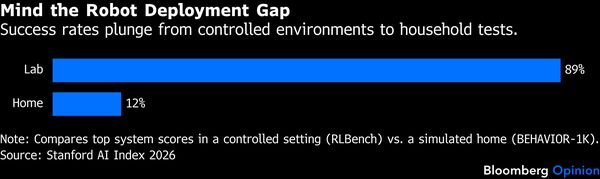
斯坦福大学最新的《AI指数》报告指出,考虑到那些对人工智能而言依然最具挑战性的基准任务,往往涉及在真实世界中行动——而真实世界的特点是环境不可预测,且错误会引发物理后果,这一结论并不令人意外。研究人员将机器人在受控实验室中的表现与模拟家庭环境中的表现进行了比较,发现两者之间存在巨大差距。这既是一次令人清醒的现实检验,也表明问题根源在于机器人灵活性的不足,正如Ryu等研究人员所认为的那样。
It makes sense given that the benchmarks that still prove hardest for AI involve acting in the real world, marked by unpredictable environments and where mistakes have physical consequences, Stanford’s latest AI Index report noted. Comparing robot performance in controlled labs versus simulated households, the researchers found a vast gap. It’s a sobering reality check, and one that researchers like Ryu think comes down to a lack of dexterity.
这对中国而言同样是一个警钟。北京方面已意识到人口结构的变化,并将实体人工智能发展列为政策优先事项。根据总部位于美国的Smart Analytics Global的数据,中国公司在今年上半年的全球人形机器人出货量中占比超过97%,似乎已经占据领先优势。然而,在那些光鲜亮丽的演示背后,能力的表象却经不起推敲。
It’s also a wake-up call for China. Aware of demographic shifts, Beijing has made physical AI a policy priority. The nation already seems to have a leg up in humanoids, with Chinese companies accounting for more than 97% of global shipments in the first half of this year, according to US-based Smart Analytics Global. But beneath the flashy demos, the illusion of capability breaks down.
这为其他参与者提供了机会,让他们能够着手解决让机器人真正实用化过程中最困难的部分。这一过程很可能将继续揭示单纯构建更大语言模型的局限性。此外,投资者对大型语言模型(LLM)的狂热也加剧了资金流入速度超过科学进展的风险。去年接受调查的人工智能研究人员中,约有76%认为,“扩大当前人工智能方法”不太可能或极不可能实现通用人工智能(AGI)。
This provides an opening for others to tackle the most difficult parts of making robots useful. Doing so will likely continue to reveal the limits of just building bigger language models. The investor mania for LLMs also heightens the risk that the money is piling in faster than the science is advancing. Some 76% of AI researchers polled last year assert that “scaling up current AI approaches” is unlikely or very unlikely to achieve AGI.
语言及其操控能力的局限性,在我们试图为通用人工智能寻找定义性词语的集体努力中体现得尤为明显。通往真实世界中类人智能的道路,最终或许会更像Keller所设想的那样——不仅需要语言,还需要触觉。
Nowhere are the limits of language and our ability to manipulate it more apparent than in our collective efforts to even find the words to define AGI. The route toward human-like intelligence in the real world may end up looking more like Keller’s, requiring not just words, but touch.