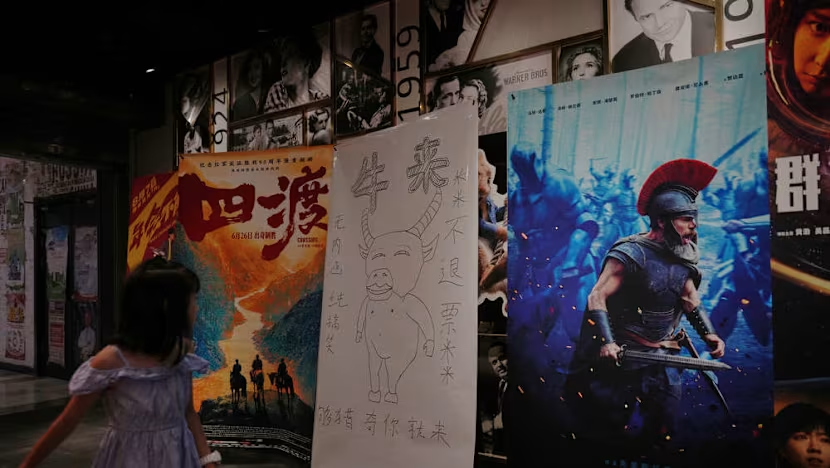
伦敦讯:在这个充斥着制作精良的大片与耗资数百万美元的营销活动的时代,一部动画粗糙、讲述小牛梦想之旅的电影却意外成为了中国票房黑马。
LONDON: In an era of polished blockbusters and multi-million-dollar marketing campaigns, a crudely animated film about a calf's dream journey became one of China's most unlikely box office sensations.
这部名为《牛来》的影片由一对母子耗时五年制作完成,据称制作成本仅为2万至3万元人民币(约合3000至4500美元)。影片于8月5日上映,起初反响寥寥,前十天票房仅略超7000元。
Niu Lai, or Here Comes The Bull, was crafted over five years by a mother-son duo on a budget reportedly as little as 20,000 to 30,000 yuan (US$3,000 to US$4,500). It debuted on Aug 5 to crickets, earning just over 7,000 yuan in its first 10 days.
随后,中国网友发现了这部电影。短短几天内,其票房便突破3000万元,甚至与克里斯托弗·诺兰执导的《奥德赛》以及《蜘蛛侠:全新之日》等大片分庭抗礼。
Then Chinese internet found it. Within days, it raked in more than 30 million yuan, and it jostled for screen time with Christopher Nolan's The Odyssey and Spider-Man: Brand New Day.
不过,若仅仅将《牛来》视为一部“烂得有趣”的电影,那就完全误解了它的意义。《牛来》是一场属于观众的狂欢盛宴;它将个体独自观影的行为转化为了一种集体体验。
But to say this is just a story of a “so bad it’s good” movie would be to miss the point entirely. Niu Lai is a carnival for viewers; it transforms the individual act of watching a movie into a collective one.
带着喜爱去“吐槽式观看” 在2026年发表的一篇论文中,媒体学者傅鹏飞与赵文君将这类观众行为称为“辱追”——字面意思即“带着嘲讽的追随”,用英语圈粉丝的话来说就是“带着恶搞心态观看”。这类粉丝会毫不留情地调侃影片,却又乐此不疲地买票观看、制作相关梗图。
HATE-WATCHING WITH LOVE In a paper published in 2026, media scholars Fu Pengfei and Wenjun Zhao described this kind of audience behaviour as ruzhui – literally “derisive following”, or what English-speaking fans might call “hate-watching”. Such fans mock something relentlessly but keep showing up, buying tickets and making memes about it.
对于《牛来》而言,观众们并非仅仅在看电影,他们更是在参与一场在影院中实时展开的集体玩笑。
In the case of Niu Lai, the audience is not just watching a movie. They are participating in a shared joke that unfolds in real time inside the theatre.
早在观众们买好爆米花之前,网络上的梗图便已大量涌现,使得整场观影变成了一场充满共同发现与内部笑点的集体活动。其中讨论度最高的梗便是影片的结局——那个“一切都是一场梦”的转折令观众们既困惑又捧腹。
The online memes start long before the moviegoers get their popcorn ready, turning the screening into a shared event of discovery and inside jokes. The most well-discussed inside joke revolves around the film’s ending – an “it was all a dream” twist that viewers find both bewildering and hilarious.
只有当身处满是陌生人的影院中,大家同时领会到这个笑点之时,这种幽默才能真正生效:众人齐刷刷的倒吸一口气、笑声如涟漪般扩散,还有观众低声向身旁的朋友念出相关梗语——那一刻,欢乐才真正达到顶峰。
The joke only lands fully when sitting in a theatre full of strangers who are all simultaneously getting it – the shared gasp, the ripple of laughter, a fellow audience member whispering the meme to their friend.
在网上,这个梗不过是一张图片而已;而在影院里,它则变成了鲜活生动的笑点。这是一种集体体验——观众与影片本身一样,都是演出的一部分。
Online, the joke is just an image. In the theatre, it becomes a living, breathing punchline. It’s a communal experience where the audience is as much a part of the show as the film itself.
促使观众追捧《牛赖》的并非对电影艺术品质的追求,而是想要参与并融入其中的渴望。
PARTICIPATE AND APPROPRIATE What drives viewers to Niu Lai isn’t a desire for cinematic excellence – it’s the desire to participate and appropriate.
从某种意义上说,《牛赖》可以被视作“山寨”文化的产物。所谓“山寨”,是中国刚对外开放时期对仿冒商品的委婉说法。21世纪初,该词常用来指代香港和深圳那些由处于法律灰色地带的小作坊生产的仿制手机。
Niu Lai can be seen through the lens of shanzhai a euphemism for copycat goods when China was newly opened. In the early 2000s, the term was used to refer to Hong Kong and Shenzhen’s knock-off mobile phones, made by small workshops operating in a legal grey zone.
在《牛赖》的例子中,这种“山寨”现象源于一对毫无电影行业经验的母子决定联手拍片。
In Niu Lai’s case, the shanzhai emerges from a mother and son who decided to make a film despite having no industry expertise.
这部影片在技术层面可谓粗糙至极,却具有强大的文化影响力。它之所以被称为“山寨”,并非因为它是仿冒品,而是因为它未经授权、不属于正规制作体系。关键在于,正是这种特质让它深受大众喜爱。
The result is technically crude, to say the least, but culturally potent. It is shanzhai not in the sense of being counterfeit, but in the sense of being unlicensed, unauthorised and made outside the system. Crucially, it is loved for exactly that perception.
《牛赖》的走红折射出一种转变:从“中国制造”到“中国创造”,再到“主动走出去做点什么”。这种趋势在后疫情时代显得尤为突出。
Niu Lai’s fame reflects a shift from “made in China” to “created in China” and “going out and doing something”, a sentiment that feels particularly potent in the post-COVID era.
这一现象也呼应了近期人们对经典动漫的怀旧热潮。2023年,《灌篮高手》在中国上映时出现了令人瞩目的现象:全国各大城市的午夜场门票全部售罄——购买者并非青少年,而是三四十岁的成年人,他们中的许多人早在上世纪90年代就接触过这部作品。
It echoes the recent nostalgia-driven viewing of classic anime. In 2023, when The First Slam Dunk was released in China, something remarkable happened. Midnight screenings in cities across the country sold out – not to teenagers, but to adults in their 30s and 40s, many of whom had first encountered the series in the 1990s.
这些观众并非单纯为了看电影而来。他们是在重温共同的记忆——那段因原版动画1996年完结后近三十年才推出电影而一度中断的青春时光。
Movie-goers were not there just to watch a movie. They were reclaiming a shared memory – a collective moment of youth that had been interrupted by the long gap between the original television series ending in 1996 and the film’s release nearly three decades later.
对于《牛来了》而言,观众的情绪已从认真投入转变为带有讽刺意味的参与。观看《灌篮高手》时,观众为剧中角色流泪欢呼;而观看《牛来了》时,大家则是笑着看这部电影——同时也是在彼此间共同欢笑。两者的情感体验截然不同:《灌篮高手》带来的是情感宣泄,而《牛来了》则营造出一种集体性的荒诞氛围。
In the case of Niu Lai, the mood has shifted from earnest completion to ironic participation. While the Slam Dunk crowds came to cry and cheer for the show’s characters, the Niu Lai crowds come to laugh at the film – but also to laugh together. The emotional is different: Where Slam Dunk offered catharsis, Niu Lai offers collective absurdity.
在AI生成内容日益泛滥的当下,《牛来了》那种显而易见的“手工制作”特质反倒成了优势。它虽未必是有意为之,却算是对泛滥的AI劣质内容的一种反抗。
IMPERFECTION IN THE FACE OF AI SLOP In a world increasingly dominated by slick, AI-generated content, the visibly “handmade” quality of Niu Lai is an advantage. It stands as a defiant, if perhaps unintentional, rebuttal to AI slop.
据悉,小红书等平台已加强了对AI生成内容的审核力度,重点管控那些被认定为“伪造”或“冒充真人”的内容。在此背景下,《牛来了》的种种“不完美”恰恰成了真实性的证明。
Platforms such as Xiaohongshu have reportedly tightened their moderation of AI-generated content, targeting content deemed “fabricated” and “impersonating real people”. In this context, Niu Lai’s imperfections are a sign of authenticity.
《牛来了》为观众提供了一个另类的空间:在这里,电影行业与文化消费的常规规则统统失效。但这样的空间究竟意味着什么呢?
Niu Lai gives viewers an alternative space where the normal rules of the film industry and cultural consumption are suspended. But what kind of space is it?
观众们并非仅仅在嘲笑这部电影,他们是在与电影一同笑,也在与彼此一同笑。他们参与了一场共同营造的、带有讽刺意味的玩笑,而这场玩笑如今已演变为一种文化现象。
Audiences are not just laughing at the film. They are laughing with it, and with each other. They are participating in a shared, ironic joke that has become a cultural phenomenon.
《牛来了》的官方微博甚至也承认,这部电影并未达到行业标准,但同时也感谢观众们给出的“积极反馈”。这种有趣的互动机制让观众们仿佛也成了这场“狂欢”的共同缔造者。
Niu Lai’s official Weibo account even acknowledged this, stating the film didn’t meet industry standards while thanking viewers for their “positive reaction”. This intriguing feedback loop gives viewers co-ownership of the carnival.
《牛来了》那种混乱且略显业余的呈现方式,恰恰传递出一种未经修饰、源自普通大众的自主力量。在这个空间里,网友们觉得自己能够集体决定什么才算有价值——即便这种“价值”恰恰体现在其极度缺乏价值这一点上。
The chaotic, amateurish spectacle of Niu Lai offers a sense of unfiltered, grassroots agency. It’s a space where netizens feel they can collectively decide what has value, even if that value is defined by the spectacular lack of it.
陈卓(Troy Chen)是宁波诺丁汉大学媒体与文化研究系副教授。
Troy Chen is Associate Professor of Media and Cultural Studies at the University of Nottingham Ningbo China.