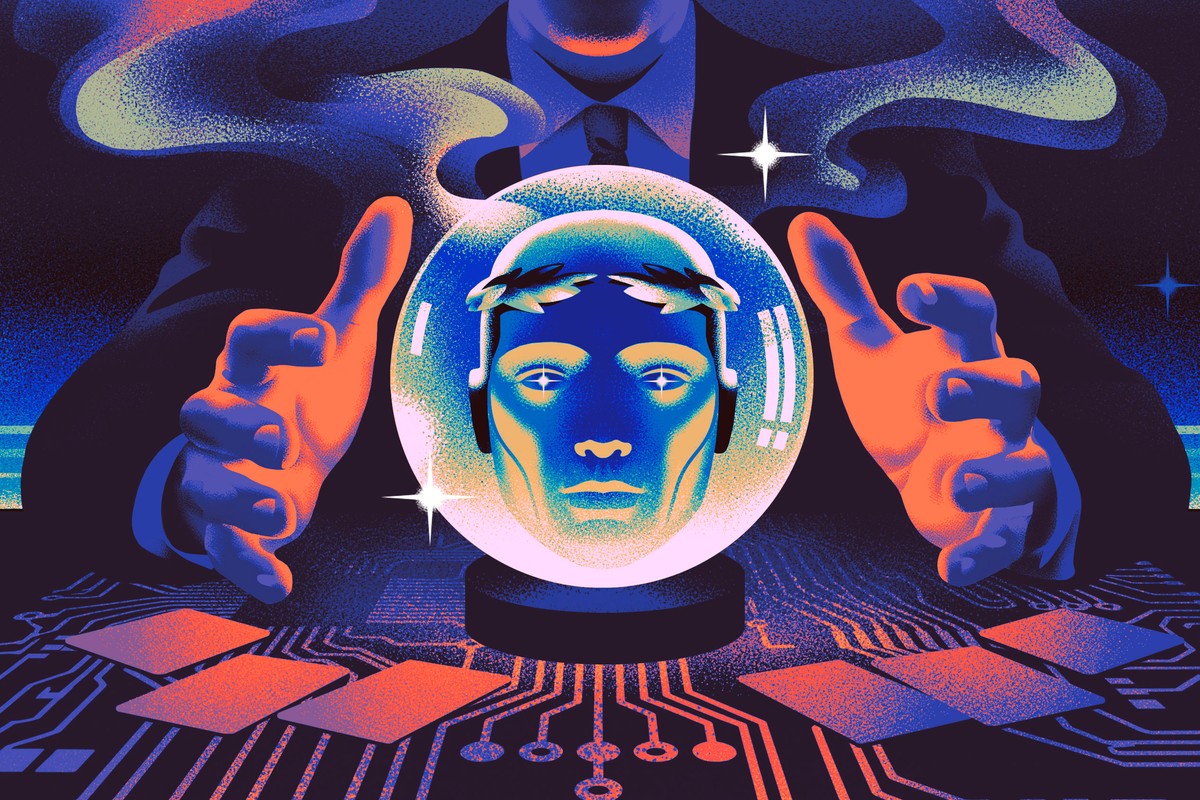
科技行业各大巨头的掌门人始终不愿承认:他们实际上掌控着整个行业的发展走向。
The leaders of tech’s biggest companies refuse to admit they’re in control.
作者:马泰奥·黄。在OpenAI旧总部的二层,每个房间都有特定的主题。这些房间的名字均取自人类历史上最具里程碑意义的发明:“钟表”“火”,当然还有“通用人工智能”(AGI)。这一幕发生在2024年春天,当时我正在采访该公司的研究人员,了解近期的技术进展。那时,ChatGPT仍会犯下一些令人尴尬的算术错误,人们也普遍怀疑这款机器人能否真正具备与人类相匹敌的智力水平。然而,在旧金山这座由旧蛋黄酱工厂改造而成的建筑里,通用人工智能的到来似乎已是命中注定。
By Matteo Wong The second floor of OpenAI’s old headquarters had a theme. Each room was named after one of the most important inventions in human history: “Clock,” “Fire,” and, of course, “AGI,” or artificial general intelligence. I saw this in the spring of 2024, when I was interviewing some of the company’s researchers about recent technical advances. At the time, ChatGPT was still making embarrassing arithmetic errors, and the notion that the bot would ever rival human intelligence was dubious. But here, in the renovated shell of a former mayonnaise factory in San Francisco, AGI’s arrival was predestined.
对通用人工智能的坚信——即开发出能力可媲美甚至超越人类思维的计算机程序——正是谷歌DeepMind、OpenAI以及Anthropic这三家全球最具影响力的人工智能企业的核心使命。科技记者、《大西洋月刊》撰稿人凯文·鲁斯在其新著《通用人工智能编年史》中详细记述了这一目标的实现过程。他称这本书旨在记录“人类对高级智能的垄断就此终结、一个全新世界由此诞生的十年”。
This belief in AGI—a computer program with capabilities that rival or even exceed those of the human mind—is foundational to the mission of Google DeepMind, OpenAI, and Anthropic, three of the most influential AI companies in the world. And the pursuit of that milestone is the subject of The AGI Chronicles, a new book by the tech reporter and Atlantic contributing writer Kevin Roose, which he describes as his attempt to document the decade “when the human monopoly on advanced intelligence ended, and a new world was born.”
作为人工智能热潮中的重要评论家,鲁斯以极其细致且有时近乎深入内部的视角,描绘了这些前沿AI企业内部的复杂生态。基于对150多位参与技术研发的研究人员、企业高管、投资者及政策制定者的采访,《通用人工智能编年史》梳理了2015年至2026年初期间这三家企业的关键发展节点,试图解答我们是如何走到如今这个混乱不堪的人工智能发展阶段的,以及谁该为未来的走向负责。
Roose, a prominent and well-connected commenter on the AI boom, follows the internecine world of the frontier AI companies in remarkable, at times almost insular, detail. Based on interviews with more than 150 researchers, executives, investors, and policy makers close to the technology’s development, The AGI Chronicles traces crucial moments across DeepMind, OpenAI, and Anthropic from 2015 through early 2026 to figure out how we got to this very messy moment in AI, and who’s responsible for what happens next.
纵观Anthropic首席执行官达里奥·阿莫迪和OpenAI首席执行官萨姆·奥尔特曼等业界领袖的言论,不难发现他们对人工智能的崛起抱有一种宿命论的态度。去年我与阿莫迪交谈时,他将人工智能的开发过程比作驾驶一辆失控的巴士:这辆车无法被停下甚至减速,但或许还能加以引导。在上个月的一次采访中,奥尔特曼称人工智能的出现是“必然趋势”。
If you scan statements from executives such as Anthropic CEO Dario Amodei and OpenAI CEO Sam Altman, there is a sense of fatalism about the rise of AI. In my conversation with Amodei last year, he likened developing AI to operating an out-of-control bus: It can’t be stopped or even slowed, but perhaps it can be steered. In an interview last month, Altman called AI “an inevitability.”
按照这种观点,这些人工智能领域的领军人物不过是“列车长”,竭尽全力为这个无论如何都会向我们袭来的新时代设定规则。鲁斯所著的这本书促使我思考一个在快节奏的新闻环境中常被忽视的问题:这些领先的人工智能企业是否真如它们所宣称的那样,只是在顺应这项技术的必然发展进程?还是说它们实际上在主导着这一进程?这个问题的答案将对我们如何界定各方在塑造未来世界过程中的责任产生深远影响。
According to this framing, AI executives are simply conductors, doing their best to provide guardrails for an era that’s careering our way, whether anyone likes it or not. Roose’s book prompted me to consider a question that is often neglected in the mile-a-minute news cycle: Are the leading AI companies simply heralding an inevitable evolution of this technology, as many of them claim, or are they directing that advancement? The answer will have tremendous bearing on how we assign responsibility for the world taking shape around us.
《AGI编年史》在这一问题上呈现出矛盾的态度。一方面,鲁斯明确指出,他记录的只是少数人群所做的决策。他写道:“AGI的出现并非必然,而是由几百人共同发明、开发并实现商业化的产物。”另一方面,书中有时又像是一部自然史,描述了一连串不受任何特定群体控制的事件——这些事件宛如一股地质力量般席卷全球,促成了“一个新世界的诞生”。
The AGI Chronicles is of both minds on the topic. On the one hand, Roose is very explicit that he is archiving decisions made by a small group of people. “AGI was not inevitable,” he writes, but “invented, developed, and commercialized by a few hundred people.”On the other hand, sometimes the book reads like a natural history, describing a procession of events outside the control of any specific group of people, an almost geologic force sweeping the planet as “a new world was born.”
他还指出,多年来众多企业和官员始终未能“清醒过来”。到了2024年,他写道:“想要回到过去那个时代的想法,其实比指望技术呈指数级发展还要不切实际。”在某些地方,鲁斯的论述与众多AI行业高管所表达的无力感如出一辙。当然,任何单一结果的“必然性”都不过是自利性的臆造罢了。绝不可能出现这样的情况:少数几家硅谷企业自行制定规则,无视版权法与环境法规,还强行向原本稳定的互联网服务中添加用户根本不需要的AI功能,却能几乎不受任何约束地肆意妄为。
He notes how, throughout the years, various companies and officials had yet to “wake up.”By 2024, he writes, “the idea of going back to the old world, to a time before all this, seemed more delusional than expecting the exponential to continue.”At times, Roose’s book echoes the loss of agency professed by AI executives. Of course, the inevitability of any one outcome is a self-serving fabrication. There is no prophecy that a handful of Silicon Valley companies dictating their own rules, running roughshod over copyright law and environmental regulations while mucking up once-reliableinternet services with AI features nobody asked for, will operate largely unencumbered.
产业形态的形成,取决于个体参与者与投资者的决策、公众的集体意愿,以及监管机构的作为或不作为。
Industries take shape through decisions made by individual actors and investors, the collective desire of the public, and the action or inaction of regulators.
以19世纪末为例,当时人们很可能认为电动汽车会在下个世纪主导市场。1897年,美国最畅销的汽车就是电动车;20世纪10年代,亨利·福特还曾与托马斯·爱迪生联手试图研发电动车。然而,一系列技术瓶颈以及人类的各种决策——包括诸多财务失误以及汽油车支持者的猛烈抨击——改变了历史的走向,留下了至今仍影响着我们的影响。
If you look to the late 1800s, for example, it would have seemed likely that electric cars would dominate the market in the following century. America’s best-selling car in 1897 was electric, and in the 1910s, Henry Ford was trying to develop an electric car with Thomas Edison. But a series of technological limitations and human decisions—including various financial missteps and harsh criticism from advocates of petrol-powered cars—changed the course of history, leaving a legacy that we’re reckoning with more than a century later.
20世纪50年代,核反应堆似乎注定要遍布全国,为未来提供动力。但一系列政治运动与惊人失误——反核运动、三里岛事故、切尔诺贝利事件——在核时代真正开始之前,就将其扼杀了。此外,还有太空时代和超音速飞行——似乎有很多看似不可避免的技术时代最终并未实现,这与其说是技术本身的问题,不如说是政治与经济选择的结果。
In the 1950s, it seemed as if nuclear reactors were destined to dot the nation and power the future. But a series of political campaigns and spectacular errors—the anti-nuclear movement, Three Mile Island, Chernobyl—crushed the nuclear age before it ever really started. Then there was the Space Age and supersonic flight—there are so many seemingly inevitable technological eras that never quite made it, not so much because of technology itself as because of political and economic choices.
同样地,也有许多企业巨头——标准石油、柯达、贝尔斯登——因监管、自满或欺诈而分崩离析。反过来看,许多如今被视为必然出现的技术和公司也是如此:不同的监管环境、国际协议或五角大楼实验室的研究重点,本可能阻止开放、全球化的互联网、智能手机和社交媒体的发展。
There are, similarly, so many corporate behemoths—Standard Oil, Kodak, Bear Stearns—that, because of regulation or complacency or fraud, unraveled. The inverse holds for many technologies and companies considered inevitable today: Different regulatory environments, international agreements, or priorities for Pentagon labs could have stopped the development of an open and global internet, smartphones, social media.
最近,当我致电鲁斯讨论他的新书,并询问他对业界频繁出现的预言式论调有何看法时,他起初告诉我,他相信“这一切并非不可避免。这些都是人们做出的决定。”但他随后表示,他想“把问题复杂化”:“一旦扩展Transformer模型取得成功,一旦扩展定律被记录下来,”鲁斯说,“我认为,制造这些东西的公司不可避免地会尽可能将其推向极致。”我想进一步复杂化这一观点。
When I recently called Roose to discuss his book and ask what he made of the industry’s frequently prophetic tone, he initially told me he believes that “nothing about this was inevitable. These were decisions made by people.”But he then said that he wanted to “complicate” that: “Once scaling the transformer worked, and once the scaling laws were documented,” Roose said, “I think it was inevitable that the companies building this stuff would push it as far as they possibly could.”I’d like to further complicate that view.
除了测试任何技术极限并攫取巨额利润的冲动之外,这个行业还受到非常人性化的决策的塑造。人工智能研究人员选择在未经许可的情况下,用大量受版权保护的作品来训练他们的模型,导致无数创作者突然被排除在经济等式之外。OpenAI选择在2022年底匆忙将免费使用的ChatGPT推向市场,引发了一轮炒作周期和随后的投资狂潮。
Beyond the urge to test the bounds of any technology and reap enormous profits, the industry has been shaped by very human decisions. AI researchers chose to train their models on troves of copyrighted works without seeking permission, leading to countless creators suddenly getting left out of the economic equation. OpenAI chose to rush a free-to-use ChatGPT to the market in late 2022, kicking off a hype cycle and a subsequent investment bonanza.
风险投资、私募股权和科技公司选择将数十亿美元投入一项仍不盈利的技术。数据中心开发商选择放弃太阳能电池板,转而使用燃气轮机,因为他们认为后者更快、更可靠。在政府方面,唐纳德·特朗普选择忽视或取消任何实质性的联邦人工智能监管。一个谈判版权费、优先考虑清洁能源、给自己更长开发周期,或面临严格联邦监管的行业,可能会呈现出完全不同的面貌。
Venture-capital, private-equity, and tech firms chose to sink untold billions into a still-unprofitable technology. Data-center developers chose to eschew solar panels in favor of combustion turbines, which they perceive as faster and more reliable. On the government side, Donald Trump has chosen to ignore or eliminate any substantive federal regulation of AI. An industry that negotiated royalty payments, prioritized clean energy, gave itself longer development cycles, or faced serious federal regulation might look entirely different.
“必然性与责任”这个问题听起来或许深奥难懂,但它确实会产生实际影响。在旧金山湾区,人们对人工智能必然性的神话怀有一种近乎精神崇拜的执着:“感谢机器,也感谢现实的结构,让我们得以对世界的理解更进一步。”阿尔茨曼本周在X上写道。你越是把人工智能视为必然,它就越像一种宇宙力量,而非工业和商业设计选择所催生的产物。
The question of inevitability and responsibility may sound arcane, but it has real ramifications. In the Bay Area, tied up with the myth of AI’s inevitability is a sort of spiritual devotion: “Thank you to the machines, and the structure of reality, for letting us understand a little more,” Altman wrote on X this week. The more you treat AI as inevitable, the more it seems like a cosmic force rather than a product resulting from industrial and commercial design choices.
你越是将其视为必然,就越难以让任何公司或个人对事情出错负责。按照这种观点,这些高管在决定未来走向时,比我们拥有的权力也仅多出一小部分;更重要的是,其他人也都必须觉醒。正如阿尔茨曼本月早些时候对《政治报》所说:“为了这项技术带来的益处,世界应当接受一些负面事件的发生。”
The more you treat AI as inevitable, the less you can hold any company or person responsible for things going wrong. The executives, in this view, are only fractionally more empowered than us in deciding what happens next; more important, everyone else needs to wake up. As Altman put it to Politico earlier this month, “The world should accept some bad things happening for the benefits of this technology.”
自鲁斯完成报道以来的几个月里,人工智能行业及其产品在全球范围内获得了更广泛的关注,也引发了更强烈的担忧。当我问他,如果当时仍在继续写作,会加入哪些新的篇章时,鲁斯表示,他会让这本书以白宫最近举行的新闻发布会作结——在那场发布会上,特朗普、阿莫迪、OpenAI总裁格雷格·布罗克曼、埃隆·马斯克以及多位科技界高管共同探讨了人工智能安全问题。
In the months since Roose concluded his reporting, the AI industry and its products have risen to still-greater global prominence and triggered even greater fears. When I asked him what new chapters he might add if he were still writing, Roose said that he would end the book with the recent White House press conference in which Trump, Amodei, OpenAI President Greg Brockman, Elon Musk, and several other tech executives addressed AI-safety concerns.
他回忆说,在Anthropic早期,阿莫迪曾发表过一篇演讲,阐述社会不同领域将如何逐步适应这项技术的变革性影响:从人工智能公司开始,最终延伸至国家层面。鲁斯告诉我,这让他感觉“仿佛预言已经应验”。
He recalled a speech Amodei gave in Anthropic’s early days about how different parts of society would gradually become attuned to the transformative effects of this technology, beginning with AI firms and ending with the state. It felt, Roose told me, “like the prophecy had been fulfilled.”