唐纳德·特朗普已近十年,英美世界的民粹主义革命也即将迎来十周年。自那时起,世界便发生了翻天覆地的变化。
The populist revolution in the Anglo world is about to turn 10, as we near a decade since the US election of Donald Trump. And the world hasn’t been quite the same since.
2016年6月,英国民众反抗亲欧盟的精英阶层并投票支持脱欧,由此开启了民粹主义的崛起浪潮。人们原本认为这一浪潮会加速全球化的终结。当时,移民数量激增以及制造业岗位减少等现象既是民粹运动的攻击目标,也被视作引发民众经济不满、进而促成这场社会反抗的根源。
The rise of the populists that started in June 2016, with the UK’s rebellion against its European Union-hugging elites and a vote for Brexit, was supposed to hasten the death of globalization. Its manifestations, including rising immigration and depleted factory jobs, were both a main target of the movement and identified as a cause of the economic disaffection fueling the revolt.
然而十年后的今天却出现了一个悖论:今年11月,当美国民众为中期选举投票时——唐纳德·特朗普依然是这场选举的核心人物——他们所身处的全球经济却比2016年时更加高度融合。他们将在唐纳德·特朗普力推的人工智能革命背景下投票,而这场革命恰恰高度依赖全球化;与此同时,全球债券市场也在应对疫情留下的巨额债务负担。尽管各国设置了诸多贸易壁垒,但从经济层面来看,一个持续存在甚至日益紧密相互依存的世界才是最稳妥的选择。
A decade on, there’s a paradox, though. This November, as Americans go to the polls for midterm elections in which Trump remains the leading character, they’ll do so in a global economy more integrated than it was in 2016. They’ll vote amid a Trump-endorsed artificial intelligence revolution that’s deeply reliant on globalization and in the shadow of bond markets responding to the mountain of debt left behind by a global pandemic. Despite all the trade barriers that have been erected, the safe economic wager increasingly looks like a world of enduring or even a deepening interdependence.
没错,这一结论似乎与当下的新闻头条相悖。从美国与加拿大、中国之间的贸易摩擦,到伊朗与乌克兰冲突不断,再到欧洲反移民政党的持续强势,种种迹象似乎都在表明全球秩序正在走向分裂。从诸多方面来看,2016年遭到攻击的、以规则为基础且由技术官僚主导的全球秩序如今也显得岌岌可危。不过,政治上的分裂与经济现实之间其实存在明显差异。
Yes, that conclusion seems at odds with the headlines. From US trade wars with Canada and China to the conflicts in Iran and Ukraine to the continuing strength of anti-immigration parties in Europe, the case for a fracturing global order remains strong. In many ways the rules-driven and technocrat-led global order targeted in 2016 looks fragile at best. But political fragmentation is different from what’s actually happened to the economy.
抛开外界的喧嚣,以长远的历史视角来看,全球化这一推动各国实现经济融合、促进思想与商品交流的力量——历经两千多年的起伏仍屹立不倒——如今其实呈现出相当良好的发展态势。全球贸易持续稳步发展,从绝对数值来看甚至有所增长。更重要的是,随着数字化与人工智能技术的深入应用,未来的全球一体化进程必将进一步加速。
Tune out the noise and take a long view of history, and the state of globalization — that force drawing people toward economic integration and the trading of ideas and goods, which has survived ups and downs for more than 2,000 years — actually looks remarkably healthy. Global trade has chugged along and, in absolute terms, even grown. More important, our increasingly digital and AI-powered lives promise only more global integration ahead.
即便是衡量“传统经济”的各项指标也显示出全球化依然具有强大生命力。过去十年间,全球商品贸易始终保持着极强的韧性。最有力的证据来自荷兰经济政策分析局每月发布的《世界贸易监测报告》:截至最新发布的7月份数据,全球商品贸易总量较2016年11月增长了约25%。过去十年里,该指数增速甚至高于此前十年。
Even measures of the “old economy” show that globalization has endured. Global trade in goods has remained remarkably resilient over the past 10 years. The strongest evidence comes from the Netherlands Bureau for Economic Policy Analysis’ monthly World Trade Monitor, which for July, the latest month available, documented a volume of shipments around the world 25% higher than in November 2016. Over the past decade, the index has actually grown faster than in the one before.
诚然,过去十年间实物商品贸易的扩张速度不及全球经济整体增速,这意味着它已不再像从前那样是拉动经济增长的主要引擎。但它也并未出现大幅萎缩。本周,世界贸易组织也预测称,今年全球贸易额有望实现3.9%的增长,增速仍将高于全球GDP增速。
To be fair, the trade in physical goods hasn’t expanded as fast as the overall global economy over the past decade, which means it isn’t the engine it once was. But neither has it collapsed. And the World Trade Organization this week said it actually expected that, at 3.9% this year, trade would again grow faster than global GDP.
在亚洲、欧洲及拉丁美洲,最引人瞩目的经济现象便是中国的出口规模较2016年有了显著提升,所谓的“中国冲击2.0”已然到来。今年7月,中国的月度出口额达到2016年11月的两倍。无论人们是否愿意承认,中国的电动汽车与电动自行车正迅速走向全球市场,这一趋势显然与“全球化退潮”的说法背道而驰。
In Asia, Europe and Latin America, the biggest economic story is that China is exporting far more than it was in 2016 and that what’s been called China Shock 2.0 has arrived. The country’s monthly exports in July were worth twice as much as they were in November 2016. Like it or not, Chinese electric cars and e-bikes are on their way to a ubiquity at odds with any notion of deglobalization.
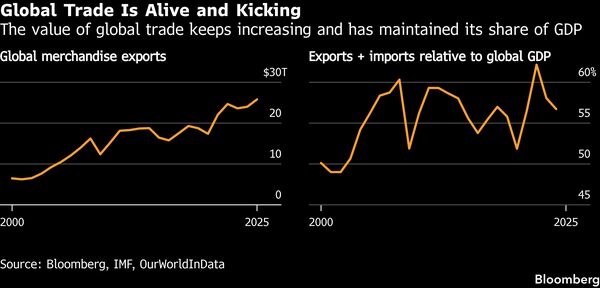
与此同时,美国的贸易规模也较以往有所扩大。尽管特朗普政府实施了多项关税措施,但今年前八个月,经通胀因素调整后,美国的进口总额仍比2016年同期多出5000亿美元。就占国内生产总值的比例而言,美国进口额也基本保持稳定,维持在11%至12%的水平。
America, meanwhile, is also trading more than it used to. Despite Trump’s tariffs, in the first eight months of this year the US imported $500 billion more by value in inflation-adjusted real terms than it did in the comparable period in 2016. As a share of US gross domestic product, imports have barely shifted, at 11% to 12%.
同样的情况也适用于资本。自2016年以来,外国持有的美国证券以及美国对海外资产的投资,无论是从价值还是占经济总量的比重来看,都在持续上升。如今,我们彼此市场之间的相互关联以及投机活动,都比十年前更加紧密。
The same story holds true for capital. Foreign holdings of US securities and American investment in overseas assets have both risen since 2016, in value and as a share of the economy. We’re more exposed to one another’s markets and speculation than we were a decade ago.
全球制造业产品中进口零部件的价值也保持在异常高的水平。根据经济合作与发展组织的数据,在最新有数据的2024年,涉及跨境供应链、因而包含进口零部件或服务的贸易,占全球GDP的比重高于2016年。特朗普最新的关税措施虽已生效,但迄今为止,企业们更倾向于承受进口税的成本,而非将生产转移至他处。当然,美国也只是众多参与者之一。
The value of imported components in manufactured goods around the world has also remained remarkably high. According to the Organization for Economic Cooperation and Development, trade involving cross-border supply chains and thus imported parts or services was higher as a share of global GDP in 2024, the most recent year for which data is available, than it was in 2016. Trump’s latest tariffs have since come into effect, but companies so far have been more willing to swallow the cost of import taxes than to shift production. And the US is only one participant, of course.
即便是特朗普政府,也在依赖外来资本。特朗普经常宣称,在其第二个任期内,外国政府以及美国本土和境外的私营企业已在美国投资超过20万亿美元;而他白宫内部的追踪数据则显示,这一数字为11.2万亿美元。他甚至曾考虑过让中国车企在美国建厂——这种对全球化的接纳,在2016年看来或许会显得格格不入。
Even the Trump administration is leaning on imported capital. Trump regularly boasts that foreign governments and both US and offshore private companies have committed more than $20 trillion in investment in the US during his second term; his own White House tracker puts the figure at $11.2 trillion. He’s even flirted with the idea of Chinese carmakers building US factories, an embrace of globalization that would have seemed odd in 2016.
但那只是旧时代的故事。真正的关键在于,我们的融合正日益数字化。
But that’s just the old-fashioned world. The real story is that our integration is increasingly digital.
我们的注意力范围已经全球化,而我们的智能和记忆也将很快随之而来。问题不仅在于我们手中的手机仍然是全球化的产物。为了满足人工智能对计算能力的巨大需求而正在建设的数据中心,同样依赖来自他处的芯片和其他零部件,以及跨越国界的比特与字节流量。
Our attention span has been globalized, soon to be followed by our intelligence and memory. It’s not just that the phone in our hands remains a product of globalization. The vast data centers being built to keep up with AI’s appetite for computing capacity rely on chips and other parts from somewhere else, as well as a traffic of bits and bytes that flows across borders.
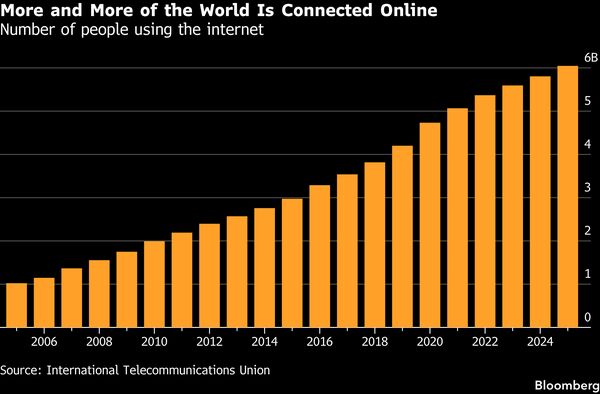
据国际电信联盟统计,自2016年以来,全球互联网用户数量几乎翻了一番,目前已超过60亿。该联盟仅公布了2019年以来的宽带流量数据,但此后固定宽带与移动宽带的总流量增长了近四倍,截至2025年底已达约8800艾字节。
Since 2016 the number of people using the internet around the world has almost doubled, to more than 6 billion, according to the International Telecommunications Union. The ITU publishes broadband traffic going back only to 2019, but since then combined fixed and mobile broadband traffic has almost quadrupled. It stood at roughly 8,800 exabytes at the end of 2025.
支撑这一数字贸易的基础设施正日益广泛地分布开来。数据中心相当于新时代的港口,服务器则是新的运输集装箱,海底光缆则堪称数字时代的“丝绸之路”。
The infrastructure for that digital trade is being distributed more widely. Data centers are the new ports, servers the new shipping containers and undersea cables the new silk roads.
过去人们常说,全球70%的互联网流量都要经过美国弗吉尼亚州北部。如今这一比例约为20%,虽然仍属可观,但对于身处伦敦、悉尼或吉隆坡的用户而言,他们的网络请求大多会在本地完成处理。从某种角度看,这反映出互联网生态的碎片化趋势以及美国对关键网络节点的控制力正在减弱;但另一方面,这也意味着全球数字互联的骨干网络正日益完善。
Once upon a time, the story was that 70% of the global internet flowed through northern Virginia. Nowadays the more accurate figure is around 20%. That’s still a lot. But if you’re in London, Sydney or Kuala Lumpur, chances are your online queries are staying closer to home. Read one way, that’s a story of fragmentation and the US losing control over valuable choke points. Yet it also points to the widening backbone of our digital integration.
当然,其中也不乏负面现象。过去十年间,以加密货币为交易媒介的暗网——这个充斥着被盗密码、违禁药品等各类非法商品的“反乌托邦式市场”——规模持续扩大。东南亚地区的诈骗产业同样愈演愈烈,犯罪活动已然成为一种高度全球化的产业形态。
Some of this is sinister, of course. The dark web — that dystopian crypto-fueled marketplace for everything from stolen passwords to opioids — has only grown in the past decade. So have the scam farms of Southeast Asia. Crime is an even more globalized industrial enterprise.
不过也有较为积极的例子。十年前,像TikTok这样由中国企业运营的社交媒体平台若要影响美国文化,会被视为对国家安全的巨大威胁。尽管美国国会曾试图禁止该应用,但它依然站稳了脚跟,如今更成为创作者经济体系中不可或缺的一环,催生了庞大的中产阶级群体。“中国文化热”已然成为一种潮流。此外,一个爱尔兰乡村的少年通过路边售卖鸡蛋并借助网络宣传,成功吸引了大量外国游客前来光顾。
There are more benign examples, though. A decade ago the idea of a Chinese-owned social media platform such as TikTok shaping American culture was a daunting national threat. But it has stuck around despite Congress’ attempt at a ban and is now a crucial piece of the creator economy with its own middle class. “Chinamaxxing” is a thing. A rural Irish boy starting a cottage business selling eggs from a roadside box and posting about it online inspires real visitors from another land.
不久前,阿森纳足球俱乐部赢得英超联赛冠军后,我坐在华盛顿的一场晚宴上,听一位演讲者高呼美国民族主义复兴,并猛烈抨击英国僵化不堪。当他滔滔不绝时,我脑海中浮现的全是那一周我在社交媒体上看到的帖子:身在肯尼亚等地的阿森纳球迷们在街头载歌载舞。软实力有时被高估了,体育影响力更是如此。但谁不想拥有阿森纳或其他任何英国俱乐部那样的全球品牌号召力呢?
Not long after football club Arsenal won the Premier League earlier this year, I sat in a Washington dinner and listened to a speaker hail a resurgent American nationalism and lambast a sclerotic Britain. All I could think of as he spoke was the sea of social media posts I’d watched that week of fellow Arsenal fans dancing in the streets in places like Kenya. Soft power is sometimes overrated, and that goes double for the influence of sports. But who wouldn’t want the global brand power of an Arsenal, or any other British club?
英超联赛现在对外资老板、外资资本以及满是外籍球员的阵容的依赖程度,甚至比英国人公投决定脱欧时还要高。事实上,除了曼城等财务违规问题外,它最大的麻烦是变得过于受全球欢迎,以至于英国本土球迷担心被挤出去。没有哪个领域比人工智能更能体现特朗普对全球化的妥协。
The Premier League is now even more dependent on foreign owners and capital and squads filled with imported talent than it was when Britons voted for Brexit. In fact its big problem, outside of financial rules violations à la Manchester City, is that it’s become so globally beloved that English fans fear getting crowded out. There’s no sector in which Trump’s accommodation of globalization is more evident than AI.
经济学家测算,正在进行的大规模投资热潮规模将超过美国19世纪的铁路建设热潮,而这依赖于进口零部件,首当其冲就是数据中心运行所需的高价值芯片和服务器。即使特朗普在其他地方加征关税,他也将这些芯片和服务器排除在关税之外。
The massive investment boom underway, which economists have calculated stands to be bigger than the US’s 19th century railway build-out, relies on imported parts, starting with the high-value chips and servers on which data centers run. And even as Trump has hiked duties elsewhere, he’s excluded those chips and servers from his tariffs.
实体建设热潮只是人工智能故事的开始。斯坦福大学胡佛研究所的研究人员在6月报告称,为中国DeepSeek模型奠基论文做出贡献的学者中,仅有一半一直隶属于中国机构。在确定的356位作者中,有80人曾在美国大学任职或学习,其中13人在美国大学的累计时长达119年。
The physical boom is only the start of the AI story. In June researchers at Stanford University’s Hoover Institution reported that only half of the academics whose work contributed to the foundational papers behind China’s DeepSeek models had been exclusively affiliated with Chinese institutions. Of the 356 authors they identified, 80 had spent time at US universities, including 13 who’d recorded a combined 119 years there.
但这并不仅限于学术研究层面。卡内基国际和平基金会上月发布报告指出,如今中国高校已成为顶尖人工智能研究人才的主要培养基地。不过,当这些人才步入职场后,美国依然是他们向往的目的地。事实上,美国的人工智能企业高度依赖海外引进的工程师;在该国最具影响力的AI初创企业中,有近三分之二的创始人都是移民。
But it goes beyond research. Chinese universities are now the leading producers of top AI researchers, the Carnegie Endowment for International Peace reported last month. Yet the US remains a major draw for that talent when it enters the workforce. The reality is that US AI companies depend heavily on imported engineers. Immigrants also make up almost two-thirds of the founders of the country’s leading AI startups.
在数据流动方面,各国间的边界也远比政策制定者期望的要宽松。在拜登执政期间,美国对先进AI芯片实施了严格的出口管制,旨在防止中国企业利用这些芯片开发相关模型。然而据称,中国企业通过在马来西亚等国租用芯片使用权限的方式规避了这些限制。
National borders are also more porous than policymakers would like when data is involved. During Joe Biden’s administration, the US placed strict export controls on advanced AI chips in an effort to keep Chinese companies from using them to develop models. And yet Chinese firms have allegedly circumvented the curbs by leasing access to chips in countries such as Malaysia.
这种现象并不仅限于人工智能领域,思想交流同样日益频繁。经合组织的数据显示,过去十年间,由不同国家学术机构人员共同撰写的论文数量不降反升。
The same pattern extends beyond AI. We’re trading more ideas too. The number of academic papers with co-authors at institutions in different countries has grown rather than shrunk over the past decade, according to OECD data.
就连宗教领域也呈现出全球化趋势——确切地说,各大宗教机构越来越依赖全球范围内的信众与人才。2024年夏天的一个下午,我在匹兹堡郊区与一位天主教主教交谈。他向我讲述了自己为安置乌克兰难民所做的努力,以及从尼日利亚和菲律宾引进神父以管理偏远教区的情况。他所在的教区位于特朗普的支持者聚居区,却依然要依靠移民神父来维持运转。
Even our faith is increasingly global, or rather, its institutions are increasingly dependent on global flocks and talent. One afternoon in the summer of 2024, I sat down with a Catholic bishop in the Pittsburgh exurbs as he described his efforts to resettle not just Ukrainian refugees but also the priests imported from Nigeria and the Philippines who tended to his rural parishes. His diocese was in Trump country. Yet it relied on immigrant priests.
我第一次意识到“全球化正在消亡”这一论调,是在2013年。当时我刚从编辑岗位转行,开始撰写有关全球贸易的文章——那时这一话题还鲜有人关注。当时人们认为全球化走向终结,主要基于全球金融危机的影响以及2008年前贸易的飞速增长势头出现放缓。然而危机过后,新的联结方式正在悄然形成。若当时便断言全球化已死,很可能会错失对其未来走向的准确判断。
The first time I confronted the idea of the death of globalization was in 2013, soon after I’d moved from an editing job to writing about what was then the sleepy topic of global trade. At that time the case for its demise lay in the aftermath of the global financial crisis and a slowdown in the breakneck growth in trade that preceded 2008. But from the ashes of that crisis, new types of connections were arising. Declaring the death of globalization then risked missing the shape that it was taking.
经济力量具有持久的威力,而政策制定者塑造全球经济这一无定形事物的能力是有限的。从逐利的企业到难以管控的消费者,参与者太多,无法完全控制。
There’s an enduring power to economic forces, and there are limits to policymakers’ ability to shape something as amorphous as the global economy. From profit-driven companies to unruly consumers, there are too many players to control.
过去十年世界发生了变化,未来还将有更多变革。一场大流行改变了经济核算。强权此消彼长。一个令人生畏的技术颠覆时代已然开启。人口结构正在扭曲我们经济的形态。气候变化正在索取代价并制造新风险。战争不仅沉重地压在卷入战火的人们身上,也压在全球获取资源的能力上。
The world has changed in the past decade, and there’s more change to come. A pandemic altered economic calculations. Powers are rising and falling. A daunting era of technological disruption has begun. Demographics are twisting the shapes of our economies. Climate change is exacting a toll and creating new risks. Wars weigh on not only those caught up in the fighting but also the world’s access to resources.
但就在民粹主义者以国家利益凌驾一切为由掌权十年后,我们比以往任何时候都更加紧密相连。全球化不仅依然活跃,而且仍在继续推进,无论我们喜不喜欢。
But a decade after the populists rose to power by asserting national interests over all else, we’re more connected than ever. Globalization is not merely alive. It remains on the march, whether we like it or not.