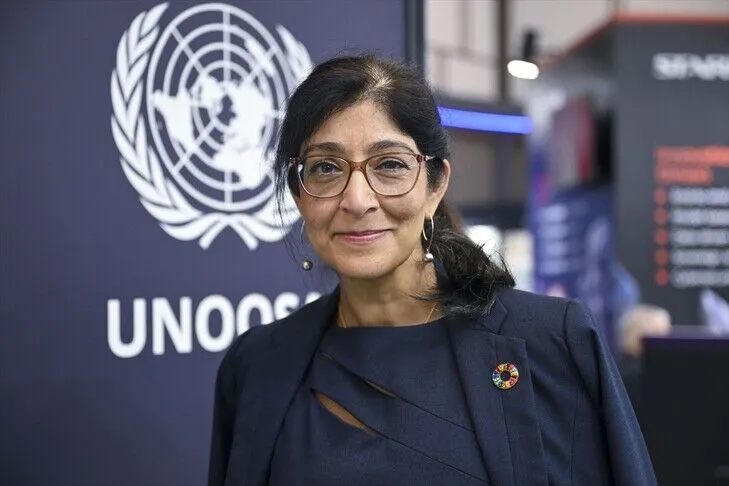
联合国外层空间事务办公室(UNOOSA)主任警告称,随着太空活动的增加,相关风险也在不断上升,呼吁加强协调并加快太空垃圾的清除工作。她强调:“我们必须确保人类在太空活动中继续发挥主导作用。”
UNOOSA director warns of risks of growing space traffic, calls for better coordination and debris removal‘We need to maintain human in the loop,’ she cautions on AI in space The US disclosure that it has deployed weapons in orbit does raise concerns over the safety and sustainability of an increasingly crowded space environment, even if the capabilities themselves are not new, according to the head of the UN’s space office.
据联合国外层空间事务办公室主任阿蒂·霍拉-马伊尼(Aarti Holla-Maini)表示,她的办公室主要负责监督太空活动的安全与可持续性问题;而相关安全事务实际上属于联合国裁军事务办公室的管辖范围。她在第77届国际宇航大会(IAC)期间对媒体表示:“原则上我们并不担心太空安全问题,但如果这些技术确实会影响太空活动的可持续性与安全性,那当然会引发我们的关注。”
Aarti Holla-Maini, director of the United Nations Office for Outer Space Affairs (UNOOSA), said her Vienna-based office deals with the safety and sustainability of space activities. Security, she said, falls under the UN Office for Disarmament Affairs. “So we are not concerned with security in principle. However, to the extent that these things can affect sustainability and safety, it is a concern,” she told Anadolu on the sidelines of the 77th International Astronautical Congress (IAC) in Antalya.
美国方面此前公开承认已在轨道上部署了武器,这一举动引发了人们对日益拥挤的太空环境安全性的担忧。尽管这些武器的技术本身并不新鲜,但美国的公开表态仍引发了国际社会的关注。
“I don’t believe that the US has put capabilities out there which do not already exist. The difference is that they have announced it.”On Sept. 14, US Air Force Secretary Troy Meink told a defense conference in Maryland that the US has “on-orbit space control weapons capable of defending the Joint Force against hostile adversary action.”
美国空军部长特洛伊·迈因克(Troy Meink)在马里兰州的一场国防会议上表示,美国拥有能够在轨道上拦截敌对势力攻击的太空防御武器。这是美国政府首次正式承认在轨部署了此类武器。不过,迈因克并未具体说明这些武器的具体类型。
It was the first official acknowledgment that Washington has weapons in orbit. Meink did not identify the systems.
美国太空军的一位发言人向国防新闻网站The War Zone表示,太空防御手段包括“动能与非动能方式”,旨在通过干扰、削弱甚至必要时的摧毁来破坏敌对势力的太空能力。
In a statement to The War Zone, a US defense news website, a Space Force spokesperson said space control involves “kinetic and non-kinetic means” to affect adversary capabilities “through disruption, degradation and even destruction, if necessary.”
中国外交部敦促美国“停止在外层空间扩大军事部署”。俄罗斯克里姆林宫发言人德米特里·佩斯科夫(Dmitry Peskov)表示,俄罗斯认为太空应该是一个没有武器的领域,并呼吁实现太空的完全非军事化。
China’s Foreign Ministry urged Washington “to stop expanding its military buildup in outer space.”Kremlin spokesman Dmitry Peskov said Moscow believes space should be free of weapons and called for its complete demilitarization.
土耳其总统雷杰普·塔伊普·埃尔多安于周一在安塔利亚举行的大会上警告称,应防止太空军事化;将武器部署到太空中或将太空变成军备竞赛的场所是“完全错误的”。欧洲航天局(ESA)局长约瑟夫·阿施巴赫也在大会上表示,欧洲并未在太空中部署武器,但正在“非常密切地”关注相关发展。
Opening the congress in Antalya on Monday, Turkish President Recep Tayyip Erdogan also warned against the militarization of space, saying that sending weapons there or turning it into an arena for an arms race would be “totally wrong.”European Space Agency (ESA) Director General Josef Aschbacher, also speaking to Anadolu at the congress, said Europe does not deploy weapons in space but is watching developments “very carefully.”
这场辩论的核心是1967年《外层空间条约》——该条约是国际空间法的基础,美国、俄罗斯和中国都是其缔约国。根据该条约,所有国家都享有探索和利用太空的权利。条约第四条规定,缔约国不得在轨道上放置核武器或其他大规模杀伤性武器,也不得在太空中任何地方部署此类武器;不过,条约并未禁止在地球轨道上部署常规武器。
What the law says At the center of the debate is the 1967 Outer Space Treaty, the foundation of international space law and a treaty to which the US, Russia and China are parties. The treaty declares space free for exploration and use by all states. Under its Article IV, parties may not place nuclear weapons or any other weapons of mass destruction in orbit or station them anywhere in space. The treaty does not, however, prohibit conventional weapons in Earth orbit.
纽约大学法律与政策期刊《Just Security》的撰稿人、国际法教授兼退役美国空军军事律师迈克尔·施密特在9月23日的文章中指出,将常规武器部署到轨道上本身并不违反国际法,但其合法性取决于这些武器的使用方式及部署背景。
Michael Schmitt, an international law professor and retired US Air Force military lawyer, wrote in Just Security, a law and policy journal based at New York University, on Sept. 23 that placing conventional weapons in orbit does not in itself violate international law.
长期以来,俄罗斯和中国一直推动制定禁止在太空中部署任何武器的条约,但美国对此持反对态度;目前,国际社会仍未就“太空武器”的定义达成一致。联合国关于防止外层空间军备竞赛的工作组计划于11月23日至27日在日内瓦召开会议。
He noted, however, that their legality depends on how they are used and the circumstances of their deployment. Russia and China have long pushed for a treaty banning all weapons in space, which the US rejects, and there is still no agreed definition of a “space weapon.”A UN working group on preventing an arms race in outer space is scheduled to meet next in Geneva on Nov. 23-27.
最引人注目的太空武器是反卫星(ASAT)系统,这类系统旨在破坏或摧毁卫星。迄今为止,只有美国、俄罗斯、中国和印度四个国家在试验中成功摧毁了轨道上的卫星。
The most visible weapons are anti-satellite (ASAT) systems, designed to disable or destroy satellites. Only four countries have destroyed satellites in orbit in tests: the US, Russia, China and India.
霍拉-马伊尼表示,当前太空治理中最紧迫的问题是太空活动的协调问题。
'Decision-making power is for member states' Holla-Maini said the most pressing issue in space governance today is the traffic coordination.
根据欧洲航天局的最新太空环境报告,仅2025年一年,就有超过300次发射任务将4000多个新载荷送入轨道,其中大部分是商业卫星星座项目。
According to the European Space Agency’s latest space environment report, more than 300 launches placed over 4,000 new payloads into orbit in 2025 alone, driven largely by commercial satellite constellations.
卫星之间的近距离碰撞现象日益频繁,但相关运营商往往不知道该联系谁来处理这些情况。
Close calls between satellites are increasingly common, and operators do not always know whom to contact.
“越来越多的物体被送入太空……由于太空环境日益拥挤,碰撞风险也在不断增加,”她说道。
"We have more and more objects being launched into space ... and it is increasing collision risk because of increased congestion," she said.
随着各国政府和私营企业纷纷准备开展更多的月球探测任务并探索月球资源,相关的治理挑战也在不断扩大。预计到2030年,将会有超过100次月球探测任务,其中大部分属于商业性质。霍拉-马伊尼(Holla-Maini)认为,联合国在制定相关规则方面并未落后;她提到了联合国和平利用外层空间委员会(COPUOS)下的三个工作小组:
The governance challenge is also extending to the Moon as governments and private companies prepare for more lunar missions and potential resource use. More than 100 lunar missions are expected by 2030, many of them commercial. Holla-Maini rejected the idea that the UN is falling behind in setting rules for them. She pointed to three tracks under the 104-member UN Committee on the Peaceful Uses of Outer Space (COPUOS).
- 月球活动咨询行动小组:该小组于2024年在罗马尼亚的倡议下成立,计划在2027年前制定关于各国应如何就月球探测任务进行协商的建议。
The first is the Action Team on Lunar Activities Consultation, set up in 2024 on Romania’s initiative. It is drafting recommendations through 2027 on how countries should consult each other on lunar missions.
- 太空资源工作组:该小组于2025年发布了初步的原则草案,这些规则将涵盖提取月球水冰、氦-3以及月球土壤等资源的相关活动。
The second is a working group on space resources, which released an initial draft set of principles in 2025. The rules would cover activities such as extracting water ice, helium-3 and lunar soil.
- 联合国支持的国际全球导航卫星系统委员会:该委员会正在研究月球导航技术及统一的月球时间标准(霍拉-马伊尼将其称为“月球上的‘时区’”)。美国政府曾在2024年要求NASA制定统一的月球时间标准。
The third is the UN-backed International Committee on Global Navigation Satellite Systems. Experts there are working on lunar navigation and a common lunar time standard, which Holla-Maini described as “effectively a time zone for the Moon.”Washington ordered NASA in 2024 to develop a Coordinated Lunar Time.
“这三个机制的共同努力,正是我们目前所需要的,以确保月球继续成为和平探索和利用的领域,”她强调。
“All of these three mechanisms combined and their work is absolutely what we need now, today, to make sure that the moon remains a domain for peaceful space exploration and activity,” she said.
据霍拉-马伊尼介绍,去年11月,联合国和平利用外层空间委员会在维也纳举办了一场关于商业月球探测项目的会议,约有40家公司向成员国展示了他们的计划。
Last November, UNOOSA hosted a conference in Vienna on the commercial lunar landscape, where around 40 companies presented their plans to member states, according to Holla-Maini.
“如果你不知道将会发生什么,就不能根据规则做决定,”霍拉-迈尼说,她在近二十年领导全球卫星运营商协会后,于2023年加入联合国。“我认为我们的责任是让行业参与对话,但不赋予他们决策权。决策权属于成员国。”人工智能需要“人在回路中”拥堵问题还延伸到一个新概念——将数据中心搬到太空。由于人工智能对能源的需求急剧上升,几家公司正在开发轨道计算平台,利用持续的太阳能供电。
“You cannot take decisions on rules if you don’t know what is going to happen,” said Holla-Maini, who joined the UN in 2023 after nearly two decades leading the Global Satellite Operators Association. "I think it's our responsible duty to bring industry into the dialogue without giving them decision-making power. That is for the member states." AI needs 'human in the loop' The congestion concern also extends to a newer idea, moving data centers into space. Driven by the soaring energy demands of AI, several companies are developing orbital computing platforms that would run on continuous solar power.
霍拉-迈尼表示,这一想法并不新鲜,但已获得更多关注。她形容它很有趣,因为可以利用太阳能和太空的低温进行散热。
Holla-Maini said the idea is not new but has gained visibility. She described it as interesting because it could draw on solar energy and on the cold of space for cooling.
“联合国方面的问题,无论是太空数据中心还是更多的太空卫星,都是拥堵,”她说。
“The problem from the UN side, whether it’s data centers in space, whether it’s more satellites in space, is congestion,” she said.
“我们担心有太多物体被送入太空,而不同参与者之间缺乏足够的协调和沟通……如果我们继续向太空投放更多物体,也必须开始关注碎片治理,清理太空。”人工智能已经嵌入太空运营,从分析卫星影像到操控飞船。SpaceX向美国监管机构报告称,其Starlink卫星在2025年执行了约30万次避碰机动,使用的是一套自主决定何时移动的机载系统。
“We worry about so many objects being launched into space and not enough coordination and communication between the different actors ... If we’re going to continue to put more objects into space, we also need to start looking at debris remediation, cleaning space.”AI is already embedded in space operations, from analyzing satellite imagery to steering spacecraft. SpaceX has reported to US regulators that its Starlink satellites performed about 300,000 collision-avoidance maneuvers in 2025, using an onboard autonomous system that decides when to move.
2025年9月,联合国外空事务办公室(UNOOSA)发布了《负责任的太空与地球观测人工智能政策简报》。该简报提出了五项目标,包括太空运营的透明人工智能以及数据完整性的保障。
In September 2025, UNOOSA published a policy brief on responsible AI in space and Earth observation. It sets out five objectives, including transparent AI for space operations and safeguards for data integrity.
霍拉-迈尼表示,这些保护措施对UNOOSA尤为重要,因为该机构在灾害期间向发展中国家提供卫星影像。
Holla-Maini said those protections are particularly important for UNOOSA because the office supplies satellite imagery to developing countries during disasters.
“我们提供的图像资料实际上被用于挽救生命的行动,因此绝不能允许其被人工智能或其他工具篡改或操纵,”她说道。她补充说,联合国外空事务办公室希望与各企业合作,开发一种数字指纹技术来验证此类图像的真实性。
“Because the imagery that we provide is literally used for life-saving activities, we cannot afford for it to be tampered with or manipulated using AI or other tools,” she said. She added that UNOOSA wants to work with companies on a digital fingerprint to authenticate such imagery.
她还警告称,不可过度依赖人工智能来进行碰撞规避,因为卫星的位置及机动计划并未对外公开。
She also cautioned against relying on AI for collision avoidance, since satellite locations and maneuver plans are not publicly available.
“对于尚未公开的信息,人工智能无法做出决策,这会带来问题。因此我们必须确保人类始终处于决策环节。”土耳其在该行业中的作用由国际宇航联合会主办、土耳其航天局承办、伊斯坦布尔SAHA协会协办的国际宇航大会,将于10月5日至9日在土耳其首次举行。
“AI cannot take a decision on something which is not public, and that is problematic. So we need to maintain human in the loop.”Türkiye’s role in the industry The International Astronautical Congress, organized by the International Astronautical Federation and hosted by the Turkish Space Agency, with SAHA Istanbul as co-host, is being held in Türkiye for the first time from Oct. 5-9.
谈及土耳其,霍拉-马伊尼回顾了该国在2023年土耳其-叙利亚地震灾害中的表现:当时多家土耳其企业提供了卫星图像与通信支持。她还特别提到了卫星运营商TURKSAT在该地区长期积累的卓越业绩。
On Türkiye, Holla-Maini recalled the country’s response to the 2023 Türkiye-Syria earthquakes, when Turkish companies provided satellite imagery and communications support. She also pointed to satellite operator TURKSAT’s long track record in the region.
她指出,安卡拉计划在索马里建设航天港,这也是土耳其不断拓展国际影响力的又一例证。
She highlighted Ankara’s plan to build a spaceport in Somalia as another example of its expanding international ambitions.
“这一举措传递出强烈的信号:土耳其致力于国际协作,并立志成为全球舞台上的重要参与者,”她说道。
“This is sending strong signals about international collaboration and cooperation and how Türkiye sees itself as a major player on the global stage,” she said.