如果美国像销售鸡蛋或汽油那样销售自来水,即每次消费时价格都直观地呈现在你面前,那么过去十年里我们关于通货膨胀的全国性争论可能会大不相同。
America sold tap water the way it sells, say, eggs or gasoline, with the price right there in your face every time you consume it, then our national argument about inflation might have looked much different over the past decade.
这是因为自来水并非免费,尽管当你去餐厅喝水、冲厕所或使用草坪喷灌系统时,它看起来似乎是免费的。事实上,根据非营利倡导组织“食品与水观察”(Food and Water Watch)的一份报告,2015年至2025年间,自来水的价格涨幅超过了鸡蛋,自来水价格上涨了62%,而鸡蛋价格仅上涨了28%。
That’s because tap water isn’t free, though it might seem that way whenever you drink it at a restaurant, flush a toilet or run a lawn sprinkler. In fact, the price of tap water soared more than that of eggs between 2015 and 2025, with the wet stuff up 62% and the, uh, eggy stuff up just 28%, according to a report from the nonprofit advocacy group Food and Water Watch.
就在几年前,我们还围绕鸡蛋价格的飙升进行了一场全美范围的选举讨论,当时鸡蛋价格为每打3.60美元,一个普通的三口美国家庭每年在这方面的支出约为240美元。该报告梳理了美国最大的500个社区供水系统(服务于总计1.55亿用户)的账单,结果显示,去年没有任何一个州的自来水价格有那么便宜。去年美国平均每户家庭6万加仑用水量的水费为531美元,这笔钱足以做很多份煎蛋卷了。
We ran a whole US election about the searing outrage of egg prices just a couple of years ago, when they were $3.60 a dozen, costing an average three-person US household maybe $240 a year. In no state was tap water that cheap last year, according to the report, which sifted through the bills of the 500 biggest community systems, serving 155 million total customers. The average US water bill last year was $531 for 60,000 gallons, enough money to make a lot of omelets.
美国年度水费最便宜的州是爱达荷州,平均每年285.61美元。最昂贵的是西弗吉尼亚州,每年高达1,382.27美元。这些价格差距合理吗?并不合理,这触及了美国在为这种日益珍贵的商品定价时所面临的巨大且不断增长的问题。
The country’s cheapest annual water bills were in Idaho, at an average of $285.61 a year. The most expensive were in West Virginia, at $1,382.27 a year. Do those price gaps make any sense? No, they don’t, which gets at large and growing problems with pricing an increasingly precious commodity in this country.
随着地球变暖导致水库和地下水逐渐枯竭,以及来自农业、工业、数据中心等领域的需求激增,水被理所当然地称为“新黄金”。但水与黄金的区别在于,你不需要黄金也能生存。获得可靠的安全饮用水是一项基本人权,收取高昂费用导致人们负担不起是不人道的,而这种情况在美国已经发生。与此同时,如果我们不通过定价来反映水资源日益稀缺和重要性的事实,我们将更快地耗尽水资源。
With reservoirs and groundwater disappearing because of a heating planet and demand surging from farms, industries, data centers and more, water has understandably been called the new gold. But the difference between water and gold is that you don’t need gold to survive. Reliable access to safe drinking water is a human right, and it’s inhumane to charge so much for it that people can’t afford it, as already happens in the US. At the same time, if we don’t price water to reflect its increasing scarcity and importance, then we will run out of it even more quickly.
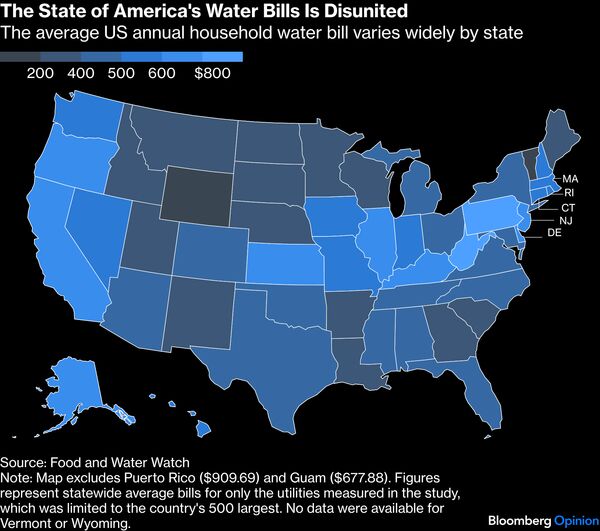
从某种角度来看,该国部分高昂的水费确实有其合理性。在25家收费最贵的供水公司中,超过一半位于加利福尼亚州,去年该州平均水费为693美元。过去十年间,加利福尼亚州的水费上涨了83%,远超美国其他地区。根据这份报告的标准,这对低收入加州居民来说并不公平,因为他们中的大多数人根本无力承担自来水费用。但也有人可能会认为,加利福尼亚州的水费更高是合理的,因为该州大部分水源来自科罗拉多河,而这条河流本世纪的水流量已经减少了20%。
Some of the country’s high water bills do make sense from a certain perspective. Of the 25 most expensive providers, more than half were in California, where the average water bill was $693 last year. California bills increased 83% over the past decade, outpacing the rest of the country. This is unfair to low-income Californians, most of whom are unable to afford their tap water, by the report’s measure. But you could argue California’s water be more expensive, given how much of it comes from the Colorado River, which has lost 20% of its flow this century.
不过,美国平均水费最高的10个地区中,有6个位于西弗吉尼亚州和宾夕法尼亚州,而这些地方并不以长期缺水而闻名。这6个地区的水费均由私营公司收取,而非地方政府。事实上,去年美国营利性私营供水系统的平均水费为823美元,而公共事业公司的平均水费仅为494.05美元,仅因销售主体的不同,前者就高出67%。在一些州,这种价格差异甚至更大。例如,伊利诺伊州和印第安纳州的私营供水公司收取的费用几乎是公共供水公司的两倍。
Then again, six of the 10 most expensive average water bills in the US were in West Virginia and Pennsylvania, places not exactly famous for decades-long water shortages. All six of those bills came from private companies rather than local governments. In fact, the average bill from a for-profit private water system in the US was $823 last year, compared with $494.05 for public utilities, a 67% increase based on nothing but who’s selling. In some states, that premium is even higher. Private water companies in Illinois and Indiana, for example, charge nearly double the rates of public providers.
即便在这些地区,较高的水费或许也有一定的合理性,因为仅基础设施的维护和维修就需要巨额投入。据水研究公司Bluefield Research的数据,公共事业公司输送的水中近20%在到达用户家中前就从管道中泄漏了,这每年给供水公司带来超过60亿美元的损失。而根据美国环保署的数据,即使水成功送达,家庭内部的漏水每年还会浪费另外9000亿加仑水,这些水量足以满足至少1100万户家庭的用水需求。
Even in these places, there may be some justification for higher water bills, given the massive and expensive need for infrastructure maintenance and repair alone. Nearly 20% of all the water pumped by utilities leaks from pipes before it ever reaches anybody’s home, costing those providers more than $6 billion a year, according to the water-research firm Bluefield Research. When the water does get delivered, household leaks shed another 900 billion gallons every year, according to the Environmental Protection Agency, enough to serve at least 11 million homes.
与此同时,蓝菲尔德指出,用于修复供水基础设施的资金正像科罗拉多河一样迅速干涸。特朗普最新的联邦政府预算计划,将在2026财年本已微薄的230亿美元拨款基础上,进一步削减至2027年的86亿美元。美国供水协会表示,这样的数字几乎无法填补未来25年间将高达2.1万亿美元的融资缺口。
Meanwhile, dollars for water-infrastructure repair are drying up as quickly as the Colorado, Bluefield notes. Trump’s latest federal government budget calls for slashing funding from an already paltry $23 billion in the 2026 fiscal year to $8.6 billion in 2027. Such numbers do little to fill a funding gap that will yawn to $2.1 trillion across the next quarter-century, according to the American Water Works Association.
一个恶性循环正在形成:漏水导致供水公司收入减少,而缺乏收入又让它们无法修复漏水问题。于是,漏水愈发严重,收入则持续下降。这种情况终究难以为继。而且,由于供水公司不像其他公共服务那样通过税收或收费获得资金,它们只能通过提高用户账单来增加收入。
You can see the vicious cycle developing: Leaks cost utilities revenue, but without revenue, they can’t fix leaks. So the leaks get bigger and the revenue gets lower. Something’s got to give. And because water utilities don’t get money from taxes or fees like other public services, they can only raise revenue by raising customers’ bills.
而这一负担正落在最无力承担的美国民众身上。在波多黎各,平均每年的水费为909.69美元,收入最低的家庭竟要将收入的20%用于支付水费,这几乎令人难以想象。在西弗吉尼亚州,这一比例为11%。根据非营利组织美国疾病控制与预防基金会的数据,估计有220万美国人无法使用安全的自来水——这多出来的220万人,实在太多了。
And that burden is falling on the Americans who can least afford it. In Puerto Rico, where the average water bill is $909.69 a year, the lowest-earning households pay an unthinkable 20% of their incomes on water alone. In West Virginia, that number is 11%. An estimated 2.2 million Americans don’t have safe running water, according to the CDC Foundation, a nonprofit group. That’s 2.2 million too many.
一个可能的解决方案是建立联邦层面的水市场,根据需求与支付能力来设定价格。理想情况下,这意味着大型科技公司建设耗水量巨大的数据中心,以及农民在沙漠中种植苜蓿出口到沙特阿拉伯(该国为节约用水已于2018年禁止种植苜蓿),都应承担其应负的责任。然而,鉴于我们目前的政府状况,这种情况短期内恐怕难以实现。
One possible solution would be a federal water marketplace that sets prices based on need and ability to pay. Ideally, that means big tech companies building thirsty data centers and farmers growing alfalfa in the desert to export to Saudi Arabia (which outlawed growing alfalfa in 2018, to save water) paying their fair share. Given our current government, that’s not happening anytime soon.
不过,地方政府在管理其供水系统方面拥有更大的灵活性。2023年,非营利组织“美国水联盟”对大辛辛那提供水公司的客户进行了模拟研究,调整水价以匹配不同家庭特征。研究结果表明,以房产价值为基础设定水价,既能降低大多数居民的水费,又能提高最富裕群体的水费,在所有定价方法中实现了最公平的结果。
Local governments have more leeway to manage their water systems, however. In 2023, the nonprofit US Water Alliance modeled adjusting water pricing to fit various household characteristics of customers of the Greater Cincinnati Water Works. It found that basing rates on property values cut water bills for most residents while raising them for the wealthiest, generating the fairest pricing of all methods.
这表明,我们大多数人实际上都在补贴美国最富有人群的大量用水。将水费与房产价值挂钩的一个复杂之处在于,这可能会被视作一种房产税,而这些富裕房主则有能力通过资金影响地方政治,以反对征收此类税款。这可能会成为一个备受争议的政治议题。
This suggests most of us are subsidizing the water guzzling of the wealthiest Americans. One complication of tying water bills to property values is that it could be seen as a property tax, and those wealthy homeowners have the money to sway local politics against such a levy. It could become a hot-button political issue.
但这未必是件坏事。鉴于水资源正变得愈发珍贵,围绕这一问题展开争论,显然比争论鸡蛋价格更有意义。
But that’s not necessarily a bad thing. Given how precious water is becoming, it’s certainly more useful to fight about that than the price of eggs.