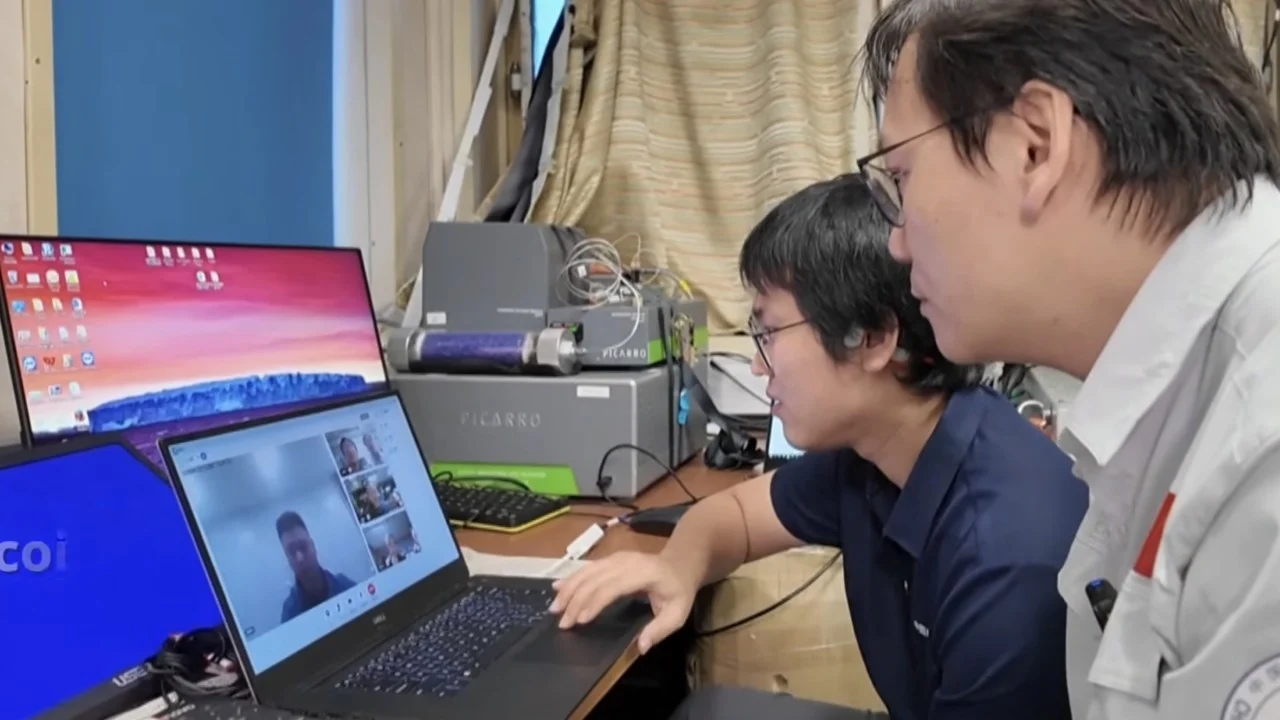
极地研究人员利用一家可能成为埃隆·马斯克星链(Starlink)中国竞争对手的公司,成功实现了北极与南极之间的卫星视频通话——这是“国网”(Guowang)卫星星座首次公开报道的测试。据官方媒体报道,此次通话凸显了中国卫星星座能力的不断提升。
Polar researchers have used a would-be Chinese rival to Elon Musk’s Starlink to make a satellite video call between the Arctic and Antarctic – the first publicly reported test of the Guowang constellation. The call highlights the growing capabilities of the country’s satellite constellations, according to state media.
近年来,北京一直在加速发展其低地球轨道卫星星座,尤其是在美国星链通过帮助乌克兰抵御俄罗斯全面入侵而展现出其战时价值之后。由于数据安全的担忧,中国已禁止外国卫星通信服务在其境内运营。
Beijing has been accelerating the development of its low-Earth-orbit constellations in recent years, particularly as the US-based Starlink showed its wartime value by helping Ukraine resist the full-scale Russian invasion. China has barred foreign satellite communications services from its territory over data security concerns.
据官方广播机构央视(CCTV)报道,此次近乎实时的通话于9月底进行,参与方包括三艘中国北极科考船——“雪龙号”“极地号”和“探索3号”上的研究人员,以及中国位于南极的秦岭站工作人员。据报道,通话延迟低于一秒。“国网”卫星星座由国家所有的中国卫星网络集团运营。
The near-real-time call took place in late September between researchers on three Chinese Arctic expedition ships – the Xuelong, the Jidi and the Tansuo-3 – and personnel at China’s Qinling Station in Antarctica, according to state broadcaster CCTV. The delay on the call was reportedly below one second. The Guowang constellation is operated by the state-owned China Satellite Network Group.
该网络的部署仍处于早期阶段——卫星发射始于2024年12月,目前已有180多颗卫星进入轨道,而计划总数为1.3万颗。
The network’s deployment is still at an early stage – satellite launches began in December 2024 and just over 180 satellites of a planned 13,000 are now in orbit.
北极研究人员还测试了“国网”支持科考船与中国国家海洋数据信息服务中心之间实时通信的能力,包括传输数据文件和航行日志。
The Arctic researchers also tested Guowang’s ability to support real-time communication between research vessels and China’s National Marine Data and Information Service, sending data files and voyage logs.
报告称,此次测试标志着“中国在实现极地地区独立可控通信方面迈出了重要一步,同时确保了数据留在国内并提升了数据安全水平”。
The test marked “a major step towards China achieving independent and controllable communications in the polar regions, while ensuring that data remains within the country and improving data security”, the report said.
根据报告,极地测试期间记录的最高上行和下行速度约为每秒30兆比特(Mbps)。相比之下,SpaceX的星链通常提供的下载速度在25Mbps至220Mbps之间,具体取决于地理位置和网络条件。
According to the report, the maximum uplink and downlink speeds recorded during the polar tests were around 30 megabits per second (Mbps). By comparison, SpaceX’s Starlink typically provides download speeds of between 25Mbps and 220Mbps, depending on location and network conditions.
据中国在线军事观察人士称,30Mbps的卫星链路足以满足大多数战术通信需求,甚至有可能支持无人系统的实时控制。
A 30Mbps satellite link would be enough for most tactical communication and could potentially support real-time control of uncrewed systems, according to Chinese online military observers.
然而,与拥有11000颗卫星的星链相比,由180颗卫星组成的“国网”网络在覆盖范围、总数据容量和可用性方面仍然有限。观察人士指出,该网络在网络弹性和抗干扰能力等对军事通信至关重要的能力上也存在不足。
However, the coverage, total data capacity and availability of the 180-satellite Guowang network remain limited compared with the 11,000-satellite Starlink. It also lagged behind in capabilities critical to military communications such as network resilience and resistance to jamming, observers said.
中国卫星网络集团计划到2027年底将轨道上的卫星数量增至400颗,以实现“国网”对中国全境的覆盖。从更长远的角度来看,该网络预计将在2029年底部署约1300颗卫星,并最终在2035年前达到12992颗。
China Satellite Network Group wants to have 400 satellites in orbit by the end of 2027 to provide Guowang coverage across China. In the longer term, the network is expected to deploy about 1,300 satellites by late 2029 and ultimately reach 12,992 satellites by 2035.
除了“国网”之外,中国还在开发“千帆”星座,目标是部署15000颗卫星。该网络于2024年8月开始发射卫星,截至上个月已有256颗卫星在轨运行。这家由国家支持运营商上海太空帆船技术有限公司表示,其目标是在今年年底将卫星数量提升至324颗。
Besides Guowang, China is also developing the Qianfan constellation, which aims to have 15,000 satellites. The network began launching satellites in August 2024, and there were 256 in orbit as of last month. The state-backed operator, Shanghai Spacesail Technologies, has said it aims to have 324 satellites in space by the end of this year.