要理解当前石油运输成本究竟有多高,不妨看看这个对比:如今从美国租用一艘油轮运往中国的费用,已经超过了将一枚火箭送入太空的成本。
For a sign of just how extraordinary oil shipping costs have become, consider this: It’s now more expensive to hire a tanker from the US to China than to launch a rocket into space.
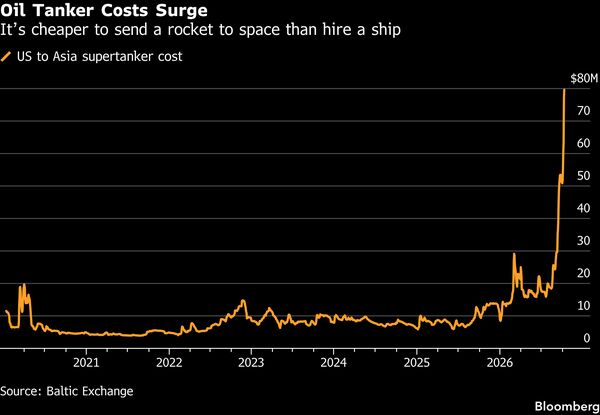
船舶经纪人Gibson本周表示,这段航程的费用约为8000万美元,而SpaceX一枚标准“猎鹰9号”火箭的发射成本则为7400万美元。今年早些时候,用同样数量的钱,甚至可以直接购买一艘几乎一模一样的油轮。
That journey costs about $80 million, compared with $74 million for a standard SpaceX Falcon 9 launch, shipbroker Gibson said this week. The same amount of money could have bought a near-identical tanker outright earlier this year.
如此惊人的价格,源于全球性的油轮短缺问题,而这一问题正随着每增加一桶通过霍尔木兹海峡的石油而愈发严重。数周以来,超大型油轮市场一直处于前所未有的繁荣之中,连行业资深人士都从未见过如此景象。经纪公司SSY表示,即便考虑通货膨胀因素,目前的运输费率仍创下自20世纪60年代首批超大型油轮投入全球海域以来的最高水平——甚至超过了20世纪80年代伊朗和伊拉克在波斯湾袭击商业船只的“油轮战争”时期。
The eye-watering prices are the result of a global tanker shortage that is getting worse with every additional barrel of oil flowing through the Strait of Hormuz. For weeks now, supertanker markets have been in the middle of a boom the likes of which industry veterans have never seen. Brokerage SSY says that, even after adjusting for inflation, rates are now the highest since the first supertankers hit the world’s oceans in the 1960s — surpassing the tanker wars of the 1980s, when Iran and Iraq attacked commercial shipping in the Persian Gulf.
“目前的运力确实不足以满足需求,”全球最大独立石油交易商Vitol Group的首席执行官Russell Hardy本周在一次会议上表示,“运输价格呈现出近乎抛物线的飙升。”
“There’s really not quite enough shipping to go around,” Russell Hardy, chief executive officer of Vitol Group, the world’s biggest independent oil trader, said at a conference this week. “We’ve had pretty parabolic pricing.”
这一价格暴涨,给已经花数月时间适应伊朗战争所引发的历史性市场动荡的石油行业带来了新的难题。运输成本的上升使得原油对买家而言更加昂贵,侵蚀了炼油企业的利润空间,并进一步加剧了能源市场的通胀压力。
The surge is a fresh complication for an oil market that has spent months adapting to the historic disruption caused by the Iran war. Higher shipping costs are making crude more expensive for buyers, eating into refining margins and adding to inflationary pressures in energy markets.
这一轮航运热潮的根源其实很简单:目前缺乏足够的油轮来高效运输所有需要运送的原油。随着伊朗战争重塑地区贸易格局,中东产油国越来越依赖将原油从霍尔木兹海峡转运至其他船只。这些转运过程有时会使单次航程延长约一周时间,进一步加剧了全球油轮资源的紧张状况。据业内高管透露,目前经霍尔木兹海峡的原油运输量已恢复至战前水平的80%左右,这一因素的影响也愈发显著。
At the heart of the boom is a simple problem: There aren’t enough tankers to efficiently carry all the barrels that need transporting. Middle Eastern producers have been increasingly reliant on shuttling oil out of Hormuz onto other ships as the Iran war rewires the region’s trade flows. Those journeys are at times adding about a week to each voyage, stretching out the global fleet. Their impact has grown as shipments through Hormuz recover to about 80% of pre-war levels, according to industry executives.
贸易流时断时续的特性使得油轮短缺问题愈发严重。霍尔木兹海峡运输量骤降时,大量油轮不得不空载从中东驶往世界各地寻找货源,这一过程往往耗时数周。如今随着海湾地区运输量逐步回升,这些船只又需重新调整位置,同样需要数周时间。此外,伊朗对华原油出口实际陷入停滞,也进一步加剧了供需矛盾:中国买家不得不从其他地方采购原油,从而推高了主流市场上对油轮的需求。
The stop-start nature of those trade flows has made the shortage even more acute. When traffic through Hormuz collapsed, tankers spent weeks sailing empty from the Middle East to other parts of the world in search of business. Now that Gulf shipments are recovering, vessels have to reposition again — a process that can take weeks. The effective pause in Iranian exports to China has added to the strain, forcing Chinese buyers to source more crude elsewhere and increasing demand for tankers operating in the mainstream market.
伊朗发动的袭击导致多艘船只需要维修,进一步压缩了可用运力;与此同时,为规避胡塞武装的袭击,不少船只不得不绕道非洲航行,使得航程增加了数千英里。
Iranian attacks that put ships out of service for repairs are tightening capacity further, while some vessels are adding thousands of miles to their journeys around Africa to avoid Houthi attacks.
“我们以前也见过异常活跃的航运市场,但此次行情上涨的速度、幅度及波及范围都堪称罕见,”船舶经纪公司MJLF & Associates的商业情报主管劳伦·加利纳里说道。
“We’ve certainly seen extraordinary freight markets before, but the speed, magnitude and breadth of this rally are remarkable,” said Lauren Gallinari, head of business intelligence at shipbroker MJLF & Associates.
如今,运输成本在原油总价中所占的比重已大幅上升。本周,有一笔从美国发运的原油运输订单达成,其运输成本相当于每桶41美元;而去年同一条航线的平均运输成本仅为4.50美元。这一数值约占周五西德克萨斯中质原油期货价格(约91美元/桶)的45%。
What was once a small midstream cost is now huge when measured relative to overall crude prices. This week, one booking was agreed from the US at a rate that equates to a transport cost of $41 a barrel, when the average for the same route last year was $4.50. That’s about 45% of the price of West Texas Intermediate futures, which traded near $91 a barrel on Friday.
对于油轮船东而言,飙升的运费正转化为一笔笔意外之财。这一涨势让少数掌控着市场的神秘船东赚得盆满钵满,其中包括一位行踪不定的韩国大亨,以及众多希腊家族和挪威富豪。本月早些时候,当运费再创新高时,油轮市场普遍认为这种涨势短期内不会结束。许多船东依然看好短期前景,而迄今为止,那些看空市场的人全都判断失误。
For tanker owners, those soaring freight costs are translating into a windfall. The rally is making millions for the narrow cadre of often-secretive shipowners who dominate the market, including an enigmatic South Korean tycoon as well as a pool of Greek families and Norwegian magnates. When rates hit new heights earlier this month, the mood in the tanker market was that there was little end in sight to the rally. Many owners are still bullish over the short term, and up to now, those who bet against them have been wrong.
“由于可新增的运力十分有限,运费的走势愈发取决于租船方能承受的支付水平,”克拉克森证券的分析师们写道。
“With little additional capacity available, freight becomes increasingly dependent on what charterers can afford to pay,” Clarksons Securities analysts wrote.
维托尔公司的哈迪指出,市场波动已变得极为剧烈,以至于交易商甚至难以将运输成本估算到每桶几美元的误差范围内。
The volatility has become so extreme that traders can struggle to estimate shipping costs within even several dollars a barrel, Vitol’s Hardy said.
整个行业也正在做出调整。以往通常由超大型油轮承运的西非和南美原油,如今被拆分后由两艘较小的苏伊士型油轮来运输;与此同时,石油生产商们也在积极购置船只或签订长期租约,以求规避市场波动带来的风险。近几周来,包括伊拉克、阿联酋和科威特在内的中东产油国纷纷进入市场采购油轮。
The industry is already adapting. Cargoes from West Africa and South America that would usually be shipped on a supertanker are being split onto two smaller Suezmax ships, while oil producers are looking to buy vessels or lock in long-term hires in a bid to shield themselves from the volatility. Middle Eastern producers including Iraq, the UAE and Kuwait have all been in the market to purchase tankers in recent weeks.
这些变通措施进一步加剧了市场紧张态势。目前,苏伊士型油轮的日均收益已升至68万美元以上,约为本月初水平的五倍。用于运输丙烷等气体的油轮运费也接近历史高位,自去年年底以来涨幅超过两倍。
Those workarounds are spreading the squeeze. Average daily earnings for Suezmax vessels have jumped to more than $680,000, about five times their level at the start of the month. Rates for ships hauling gases like propane are near records, having more than tripled since the end of last year.
通过购置船只来规避风险的成本同样水涨船高。据全球最大的船舶经纪公司旗下克拉克森研究服务有限公司的数据,二手市场上一艘新造油轮的售价已升至2.4亿美元,创下历史最高纪录,较去年年底的价格水平高出60%以上。
Buying a way out is increasingly costly as well. The value of a new oil tanker on the second-hand market has climbed to $240 million, the highest on record, according to Clarkson Research Services Ltd., a unit of the world’s largest shipbroker, and more than 60% above its level at the end of last year.
对于石油生产商而言,飙升的运输成本正开始改变原油具有价格竞争力可销往地区的经济格局。在西非地区,出口商高度依赖远在1万公里之外的中国炼油厂,如今由于卖家不得不大幅降价以抵消不断上涨的运输成本,当地原油价格正出现暴跌。
For oil producers, soaring freight costs are starting to reshape the economics of where their crude can competitively be sold. In West Africa, where exporters rely heavily on refiners about 10,000 miles away in China, crude values are tumbling as sellers discount cargoes to offset the rising cost of getting them there.
在本周发布的交易动态报告中,壳牌公司指出,在当前宏观经济环境下,“长期航运租赁合同中的可变费用有所上升”,这将对其第三季度业绩产生一定影响。今年早些时候该公司也曾作出类似说明。与此同时,全球规模最大的几家上市航运公司的市值也大幅攀升,目前均已创下逾700亿美元的新高。
In a trading update this week, Shell Plc said that some of its third-quarter results will see an effect from “an increase in variable components of long-term shipping leases in the current macro environment.”It made a similar disclosure earlier this year. Meanwhile, the value of the world’s largest listed shipping companies has soared to a fresh record north of $70 billion.
当前的关键问题是:航运价格还能继续上涨到何种程度?一旦涨幅过大,购买原油、将其运往全球各地并加工成燃料的整个产业链都将无利可图。
The key question now is how much further the rally can go before it makes the business of buying crude, shipping it across the world and turning it into fuels unprofitable.
目前,柴油供应短缺使得炼油利润率居高不下,但不断攀升的运输成本正开始削弱这一优势。虽然欧洲炼油企业雷普索尔报告称第三季度每吨原油的炼油利润达36美元,但加拿大皇家银行的分析师指出,受高昂的油轮运输成本影响,10月份这一数值已降至约15美元。倘若运输成本持续上涨,炼油企业最终可能会减少原油加工量。
At the moment, a shortage of diesel means refining margins are hefty, but surging freight is starting to erode that cushion. While European refiner Repsol reported margins of $36 a barrel in the third quarter, analysts at RBC say those numbers contracted in October to about $15, partly as a result of high tanker costs. If freight keeps climbing, refiners could eventually respond by cutting how much crude they process.
“航运市场正持续走强,”曾以航运交易员身份开启职业生涯的对冲基金Svelland Capital创始人托尔·斯韦兰德说道,“但一旦运输成本占原油价值的比重从5%升至50%,贸易流动就会陷入停滞。”
“The market is going from strength to strength,” said Tor Svelland, founder of hedge fund Svelland Capital, who began his career as a freight trader. “At a certain point, refineries can easily take a breather. When you go from 5% of the value of a cargo to 50%, trade flows will stop.”