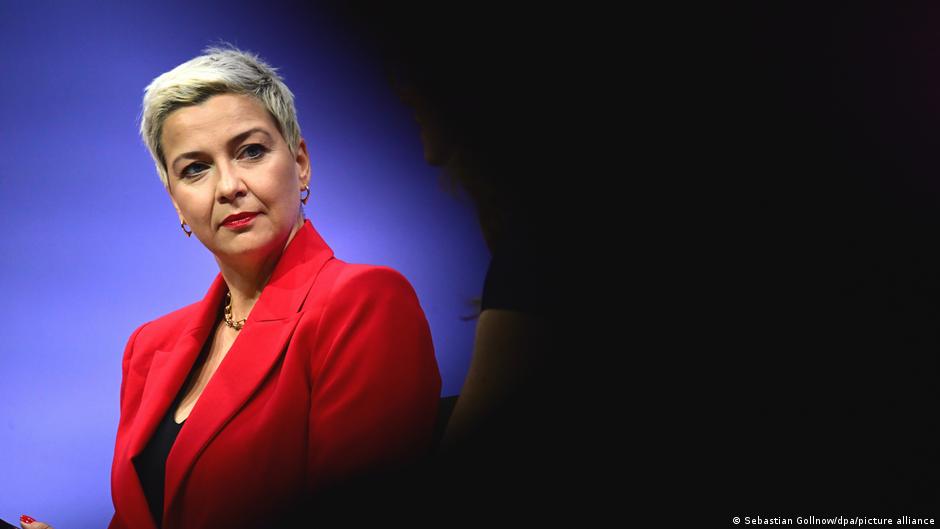
2026年10月9日,白俄罗斯音乐家兼人权活动家玛丽亚·卡列斯尼卡娃在波恩举行的2026年贝多芬音乐节上发表了关于艺术重要性的主旨演讲。她还访问了德国之声。
October 9, 2026 The Belarusian musician and civil rights activist Maria Kalesnikava held the keynote speech on the importance of art at the 2026 Beethovenfest in Bonn. She also visited DW.
玛丽亚·卡列斯尼卡娃持续为自由而战。她深知专制政权如何压制艺术:这位白俄罗斯长笛演奏家兼活动家曾被作为政治犯拘押五年,其中三年处于单独监禁。
Maria Kalesnikava continues to fight for freedom Maria Kalesnikava knows all too well how authoritarian regimes repress art: The Belarusian flautist and activist spent five years in detention as a political prisoner, three of which were in solitary confinement.
在今年的贝多芬音乐节上,她说道:“一个人的外在自由可能会被剥夺,有时甚至几乎完全丧失。他们的行动自由、与他人接触以及获取信息的渠道都可能受到限制。”但她指出,要控制那些已成为个人记忆、想象力和内心体验一部分的内容,则要困难得多。“正是在这一点上,我找到了文化为何对自由社会如此重要,以及为何专制体系常常对其持不信任态度的答案。”她在主旨演讲中总结道。
Speaking at this year's Beethovenfest she said: "A person's external freedom can be taken away, sometimes almost entirely. Their freedom of movement, contacts with other people, and access to information can be limited." She pointed out that it is, however, much harder to control what has already become part of one's memory, imagination and inner experience. "And it is precisely in this that I find the explanation for why culture is so important for a free society and why authoritarian systems so often view it with distrust" she concluded during the keynote speech.
2025年12月,德国联邦外交部长约翰·瓦德普尔在联邦外交部接待了玛丽亚·卡列斯尼卡娃。作为白俄罗斯反对派的重要人物,这位艺术家兼政治活动家于2020年夏季被亚历山大·卢卡申科政权逮捕,此前该政权以暴力手段镇压了争取民主与自由的和平革命。2020年8月9日备受争议的总统选举后,全国范围内爆发了大规模抗议活动和民主人权运动。
German Foreign Minister Johann Wadephul welcomed Maria Kolesnikova at the Federal Foreign Office in December 2025 A key figure of the Belarusian opposition, the artist and political activist was arrested by the regime of Alexander Lukashenko in the summer of 2020, after the regime had violently suppressed the peaceful revolution for democracy and freedom. Across the country, mass protests and a democratic civil rights movement took place after the controversial presidential election on August 9, 2020.
卡列斯尼卡娃回忆说,在监禁期间,她始终将内心的世界和经历带在身边。这让她得以保持自由,而不会觉得自己是受害者。对卡列斯尼卡娃而言,这正是艺术的力量,也是所有独裁者——无论是斯大林、希特勒,还是普京和卢卡申科——为何憎恨独立艺术与文化的原因,即便这些艺术和文化并不公开涉及政治。在波恩举行的一场小组讨论中,卡列斯尼科娃直接强调了这一点:“人们常常问:我们在乌克兰保卫什么?为什么我们需要那么多资金和新型武器?对我来说,这一点非常清楚:俄罗斯发动的这场战争不仅仅针对乌克兰。这是对欧洲价值观和欧洲文化的战争。这是对我们的文明的战争。”
Kalesnikava recalled how, during her imprisonment, she had carried her world and her experiences, with her all along. This enabled her to remain free, and not to feel like a victim. To Kalesnikava, this is precisely the power of art and also the reason why all dictators — whether Stalin, Hitler or Putin and Lukashenko — hate independent arts and culture, even if it's not overtly political. During a panel discussion in Bonn, Kalesnikava stressed this point directly: "The question often arises: what are we defending in Ukraine? Why do we need so much money and new weapons?
2022年2月,当卡列斯尼科娃还在狱中听到俄罗斯对乌克兰开战的消息时,她立刻就意识到了这一点。
For me, it is completely clear: the war Russia started is not just against Ukraine. It's a war against European values and European culture.
音乐拯救了她。卡列斯尼科娃获释后,如今已重获自由十个月了——这原本是她认为不可能发生的奇迹,也是国际外交努力的成果。能够以坚韧的姿态重新回归正常生活,部分要归功于贝多芬与巴赫的音乐。曾在明斯克和斯图加特学习长笛并获得早期音乐及现代音乐学位的卡列斯尼科娃回忆道:“我大部分时间都处于完全的寂静之中。但这种寂静几乎从不空虚,因为音乐始终在我脑海中回响。”
It is a war against our civilization." Kalesnikava realized this immediately when she heard about the Russian war against Ukraine in February 2022, while she was imprisoned. Music saved her Kalesnikava was released and has been living in freedom again for ten months now — a miracle that she didn't think was possible and an achievement of international diplomacy. The fact that she emerged and returned to her life full of resilience is thanks in part to Beethoven and Bach, as Kalesnikava, who studied the flute and earned a degree in early and new music in Minsk and Stuttgart, recalled. "I spent a lot of time in complete silence.
她在波恩说道:“我们音乐家都十分熟悉这种状态——有时一段旋律或乐句会深深印在脑海里,怎么也甩不掉。在日常生活中,这或许会令人烦恼;但在狱中,我第一次意识到这种状态能带来莫大的幸福。”2026年10月2日,玛丽亚·卡列斯尼科娃出现在德国之声俄语频道节目《DW Novosti》中。此次访问波恩期间,这位白俄罗斯活动家还造访了德国之声,并作为嘉宾参与了该台的俄语节目录制。
But this silence was almost never empty, because music constantly played in my head," Kalesnikava said in Bonn. "We musicians know this state very well — sometimes a melody or a musical phrase gets so stuck in your head that it's simply impossible to get rid of it. In normal life, this can even be annoying. In prison, I realized for the first time that this could bring great happiness." Maria Kolesnikova appeared on the Russian-language DW program "DW Novosti," on October 2, 2026 During her visit to Bonn, the Belarusian activist also visited DW and appeared as a guest on the DW Russian language show "DW Novosti."
应德国政府邀请,卡列斯尼科娃现居柏林,正在从曾经的痛苦经历中恢复。她认为自己有责任让世人了解白俄罗斯800多名政治犯的处境,以及自由艺术表达的重要性与脆弱性。2026年10月2日,在德国联邦文化基金会的支持下,她于波恩举行的贝多芬音乐节上发表了主题演讲,该演讲属于题为“文化活动能否成为政治空间?”的会议环节。
Kalesnikava currently lives in Berlin following an invitation by the German government, where she is also recovering from the horrors she experienced. She sees it as her responsibility to remind the world about what is happening to more than 800 political prisoners in Belarus, as well as the importance and fragility of free artistic expression. On October 2, 2026, she held her keynote speech at the Beethovenfest in Bonn as part of a conference titled "Cultural Events as Political Spaces?," organized with the support of the German Federal Cultural Foundation.
音乐厅:一个自由的空间来自德国各地的音乐机构和音乐节代表超过200人齐聚波恩新翻修的贝多芬音乐厅,参加今年贝多芬音乐节的最后一个周末活动。他们共同探讨了音乐的创新形式与模式,以及那些远超音乐行业范畴、鼓励人们跳出思维定式思考的议题。
The concert hall as a space for freedom More than 200 representatives from concert institutions and music festivals from across Germany came to the newly renovated Beethovenhalle in Bonn for the final weekend of this year's Beethovenfest. Together, they debated innovative forms and formats for music, as well as issues that stretch far beyond the music industry and urge on to think outside the box.
贝多芬音乐节艺术总监史蒂文·沃尔特在波恩的会议上谈及了音乐与自由的重要性。“艺术和文化并不负责采纳政党的特定观点,也不负责发表明确的政治声明,”贝多芬音乐节艺术总监兼会议主持人史蒂文·沃尔特在接受德国之声采访时说。“然而,艺术始终创造的是相遇的空间,是人们能够包容矛盾与多元观点的地方。而这正是我们社会中极为重要的一环,使我们能够共同创造集体体验。”
Steven Walter, artistic director of the Beethovenfest, spoke about the importance of music and freedom at the conference in Bonn "Arts and culture are not responsible for taking on specific opinions from political parties, or for making explicitly political statements," Steven Walter, artistic director of the Beethovenfest and host of the conference, told DW. "What art always creates, however, is spaces for encounter, and places where people can tolerate ambivalence. And that is such an important part of our society, that we're able to handle making collective experiences."
在沃尔特看来,这正是艺术与文化发挥作用之处:艺术家们创造了独立思考、主观诠释以及质疑的空间。“或许可以说,自由的基因确实存在于艺术的本质之中,”沃尔特在采访中解释道。近年来最成功的贝多芬音乐节2026年音乐节的闭幕庆典于10月3日举行,这一天也是德国统一日。在指挥家安雅·比尔迈尔的执棒下,英国广播公司爱乐乐团演奏了约翰内斯·勃拉姆斯的《德意志安魂曲》——这部象征和解与信任的经典作品。
To Walter, this is precisely where arts and culture come in, as artists create spaces for independent thought, subjective interpretations, as well as doubts. "Perhaps it's true that there is something like a DNA of freedom in the nature of art," Walter explained in an interview with DW. The most successful Beethovenfest in years The festive closing of the 2026 took place on 3 October, which is also German Unity Day. The BBC Philharmonic Orchestra, under the baton of conductor Anja Bihlmaier, performed Johannes Brahms' "A German Requiem," an iconic piece that evokes reconciliation and trust.
在贝多芬音乐节的闭幕音乐会上,安雅·比尔迈尔指挥英国广播公司爱乐乐团与奥迪青年合唱团学院共同演绎了勃拉姆斯的《安魂曲》。经过为期四周的2026年贝多芬音乐节,本届音乐节迎来了十年来最高的观众人数。约有3.5万人参加了超过100场音乐会和活动,共同体验、庆祝并探讨艺术。
At the closing concert of the Beethovenfest, Anja Bihlmaier conducted Brahms's Requiem with the BBC Philharmonic Orchestra and the Audi Youth Choir Academy After four weeks of Beethovenfest 2026, the festival recorded the highest number of visitors in a decade. Around 35,000 people came to experience, celebrate and discuss art together at more than 100 concerts and events.
本文由安德烈·戈列茨基撰写,由德语译出,莎拉·胡卡尔与丹增·塞孔负责编辑。
This article was written by Andrey Gorezky, translated from German and edited by Sarah Hucal and Tenzin Sekhon.