斯(John Authers)“在哪个平行宇宙里,5.6万亿美元(占GDP的17.5%)会被称作‘极低的税负’?”上个月,我在这版面上发表一篇评论文章,认为美国并未承受沉重的税负,而且完全可以通过提高税收来解决财政问题。一位读者在邮件中提出了上述疑问。这封来信值得大段引用:你所说的全都正确。但在这个宇宙(而非某个平行宇宙)里,说美国税负较低仍然合情合理。
By John Authers“In what alternate universe is $5.6 trillion (17.5% of GDP) a ‘very low tax burden’?”So asked a reader in an email after I wrote in an essay in this space last month that the US wasn’t heavily burdened by taxes and could easily raise them to deal with fiscal problems. It’s worth quoting that letter at length: All true. But in this universe (not an alternate one) it still makes sense to say that the US bears a low tax load.
与其他所有主要发达经济体相比,美国的税负无疑要轻得多。尽管“山姆大叔”征收的国内生产总值占比高于巴西、印度和墨西哥等一些大型经济体,但这些国家都迫切希望找到办法,从本国公民那里获取更多税收。
It’s more lightly taxed than any other leading developed economy, by far. And while Uncle Sam does collect a much higher share of gross domestic product than some big economies, such as Brazil, India and Mexico, all of them would dearly like to find a way to raise more revenue from their citizenry.
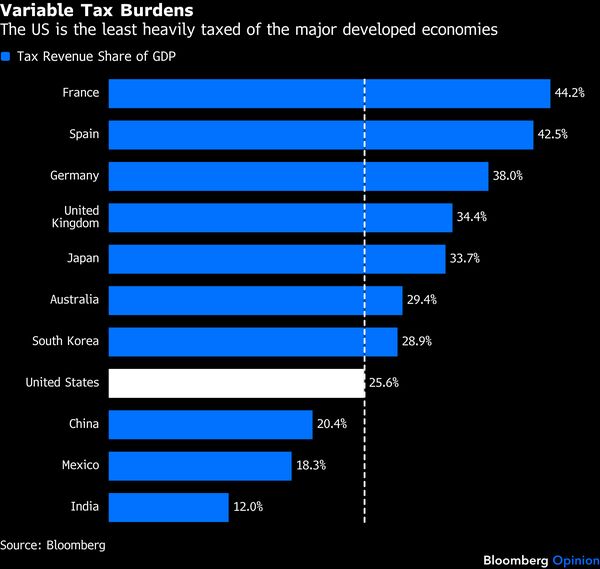
衡量税收收入时存在许多定义上的难题。彭博社的数据——其依据是经济合作与发展组织(OECD)的统计——显示,美国实际承担的税负更接近GDP的25%。具体排名如下:对此我们该如何理解?本月早些时候,《金融时报》首席经济评论员马丁·沃尔夫(Martin Wolf)在介绍国际金融协会(Institute of International Finance)的全球债务监测报告时,明确表达了这一观点:他将美国与欧洲主要国家——尤其是法国——区分开来。
There are many definitional problems in measuring tax take. Bloomberg data — using numbers from the Organization for Economic Cooperation and Development — suggests that the US pays more like 25% of GDP. This is the ranking: What to make of this? Presenting the Institute of International Finance’s global debt monitor earlier this month, the Financial Times chief economic commentator Martin Wolf put the argument strongly: He drew a distinction with the big European countries — particularly France — which fund expensive welfare systems, and whose high tax burdens make it difficultto raise revenues further.
欧洲这些国家需要为昂贵的福利体系提供资金,而高税负也使其难以进一步增加税收收入。在几十年间几乎“搭便车”地依赖美国国防开支之后,如今它们别无选择,只能进行痛苦的削减。
After effectively free-riding on US defense spending for decades, they now have little choice but to make painful cuts.
与沃尔夫的观点相反,也有人认为,尤其是法国,其税负高得荒谬——即便这些税收确实为该国带来了出色的医疗体系和公共交通。在经历了数十年美国政治上的“正统观念”之后——即沃尔夫所讽刺的“任何政治家一旦提高税收就难以生存”——美国真的有可能实施增税吗?或者,增税甚至会有所帮助吗?
Contrary to Wolf, it’s possible to argue that France, in particular, is ludicrously over-taxed — even if those revenues bought the country an impressive health service and public transport. After decades of US political orthodoxy, lampooned by Wolf, that no politician can ever raise taxes and survive, would American hikes really be possible, or even helpful? The US debate centers on a famous lunch in Washington in 1974 that included two officials in the White House of Gerald Ford, Donald Rumsfeld and Dick Cheney.
美国的这场争论围绕1974年华盛顿一次著名的午餐展开,当时杰拉尔德·福德的白宫中有两位官员——唐纳德·拉姆斯菲尔德和迪克·切尼也出席了。据说,阿瑟·拉弗当时在餐巾纸上画出了以他名字命名的曲线,用以说明减税可能带来的效果。
Arthur Laffer drew the curve that bears his name on a napkin, so the story goes, to show what tax cuts could achieve.
横轴代表税率,从0%到100%;纵轴代表税收总收入。拉弗认为,这条曲线会呈现一个倒“U”形:当税率为100%时(人们完全没有工作动力),或为0%时,税收收入都会归零。最高税收点应位于这两个极端之间的某个位置——而且最高的税收收入可能出现在税率低于当时水平的时候。
On the horizontal scale was the tax rate, from 0% to 100%; on the vertical scale was the total revenue from taxation. Laffer argued that it would be an inverted “U.”Rates of 100% (leaving no point in working) or 0% would result in zero tax take. The maximum would lie somewhere in between — and the highest revenue might come with a rate lower than it was at the time.
从理论上讲,这一点很难反驳。很少有人愿意生活在税率高达0%或100%的社会中。但从经验上看,要准确计算出何种税率能实现税收最大化,则要困难得多。受拉弗理念推动的罗纳德·里根总统的减税政策确实刺激了经济,但也导致财政赤字扩大。
Theoretically, it’s hard to argue with this. Few people would want to live in a society with 0% or 100% tax rates. But empirically, it’s far harder to work out exactly what rates would maximize returns. President Ronald Reagan’s tax cuts, driven by Laffer’s ideas, stimulated the economy. The deficit widened.
除了少数自由意志主义者艾茵·兰德或共产主义者卡尔·马克思(他在资本主义社会中反对一切税收)的支持者外,大多数人都会同意,税收是一种必要的恶。其他国家也提供了拉弗理论奏效的例证。尤其是在英国,20世纪60至70年代的最高边际税率曾高达95%(乔治·哈里森在披头士乐队的歌曲中曾愤慨地抱怨:“你拿1成,我拿19成”)。一旦惩罚性税收时代结束,公共财政状况便得到改善,经济也变得更加充满活力。
Apart from a few adherents of the libertarian Ayn Rand or the communist Karl Marx (who opposed all taxes in a capitalist society), most can agree that taxes are a necessary evil. Other countries provide examples where the Laffer idea worked. Notably in Britain, the top marginal rate reached 95% in the 1960s and 1970s (George Harrison bitterly complained that “It’s one for you, 19 for me” in The Beatles’ ). Public finances were stronger, and the economy much more vibrant, once the era of punitive taxation was over.
其他国家明显税负不足。至少30年来,墨西哥政府一直试图扩大税基,但接连尝试对药品和食品征收销售税的努力都遭到了拒绝。尽管该国几十年来宏观经济保持稳定,但其庞大的非正规经济部门仍然超出政府的管理范围(而且往往令人痛惜的是,完全处于贩毒集团的掌控之中),而银行试图引导民众减少使用现金的努力也基本失败。克劳迪娅·辛鲍姆政府目前正再次尝试通过数字化支付那些原本可以用现金支付的服务,将税收占GDP的比例提高到20%以上。
Other countries are blatantly under-taxed. For at least30 years, Mexican governments have tried to widen the tax base, but successive attempts to levy sales taxes on medicine and food have been rebuffed. Despite decades of macroeconomic stability, the country’s huge informal sector remains beyond the government’s reach (and often, tragically, firmly within the grasp of narco cartels), while efforts by banks to coax people away from using cash have largely failed. The administration of Claudia Sheinbaum is now making yet another attempt to lift the tax take above 20% of GDP through digitalizing payments for services that can currently be paid with cash.
鉴于墨西哥严峻的基础设施问题,显然该国税负不足,正如20世纪60年代的英国税负过重一样。而在美国,公共工程日益老化、赤字不断加剧,很难说其税负过高。
With its acute infrastructure problems, it’s clear that Mexico is under-taxed, just as 1960s Britain was over-taxed. In the US, with fraying publicworks and a growing deficit, it’s hard to say that taxes are too high.
这就引出了一个问题:美国“奇特”的政治环境是否允许提高税收?本世纪初,美国预算尚处盈余,但此后税率持续下降,而赤字则因这一原因及其他因素而不断加深。
This raises the question of whether the US’ “weird” politics would permit tax hikes. This century, which started with the budget in surplus, tax rates have fallen consistently — and the deficit, for this and other reasons, has persistently deepened.
普遍的观点是,提出增税建议无异于政治自杀。沃尔特·蒙代尔在1984年竞选期间曾承诺要增税,结果里根以压倒性优势赢得了49个州。乔治·H·W·布什在1988年以“不增税”的承诺赢得选举,但四年后却因部分背弃这一承诺而输给了克林顿。
Received wisdom is that proposing a tax hike is political suicide. Walter Mondale famously promised to raise taxes during the 1984 election campaign — and Reagan went on to win 49 states in a landslide. George H.W. Bush won in 1988 by promising “no new taxes” — and lost to Clinton four years later in large part because he reneged.
从那时起,共和党人乔治·W·布什和唐纳德·特朗普都将大幅减税作为其政策议程的核心——但民主党人巴拉克·奥巴马也以一种不太引人注目的方式做了同样的事。他提出的《美国复苏与再投资法案》(ARRA),即2009年为应对全球金融危机影响而推出的大规模刺激计划,在10年内预计将减少联邦税收2870亿美元。如今这项法案已鲜有人提及,但当时奥巴马政府曾决定将38%的刺激资金用于减税,试图以此说服国会中的共和党人支持该法案,但这一尝试最终未能成功。
Since then, the Republicans George W. Bush and Donald Trump have both put big tax cuts at the core of their agenda — but in rather less eye-catching fashion, the Democrat Barack Obama did so as well. His American Recovery and Reinvestment Act (ARRA), the big stimulus bill with which he attempted to fight the effects of the Global Financial Crisis in 2009, reduced federal taxes by an estimated $287 billion over 10 years. Little remembered now, the administration decided that 38% of the stimulus should be devoted to tax cuts in a failed attempt to persuade Congressional Republicans to support it.
乔·拜登推行了一套非常自由主义的经济议程,确实实施了6000亿美元的增税措施——同时也有6000亿美元的减税措施与之平衡。
Joe Biden, who pursued a very liberal economic agenda, did enact $600 billion in tax rises — balanced by $600 billion in cuts.
然而,反对增税的政治(以及经济)论据并不像表面看起来那样清晰。20世纪90年代初,在布什那次具有决定意义的增税以及比尔·克林顿1993年签署的《综合预算协调法案》(OBRA)之后,美国成功消除了财政赤字。该法案将最高边际税率从31%提高到39.6%。这项法案甚至获得了一些企业的支持,而克林顿也确实说服了一部分民众基于爱国情怀予以支持。
But the political (and economic) case against tax increases isn’t as clear as it appears. The country eliminated its deficit in the early 1990s, after the fateful Bush tax hike, and Bill Clinton’s OBRA (Omnibus Budget Reconciliation Act) of 1993, which raised the top marginal rate from 31% to 39.6%. It even achieved some corporate support, and Clinton did persuade a chunk of the population to back it on patriotic grounds.
例如,当时年薪500万美元的棒球投手查克·芬利曾对记者说:“就我个人而言,我知道要想生活在一个像这样的好国家里,就必须纳税。”随后,美国迎来了一场历史性的经济繁荣——因此很难说这次增税造成了多大伤害,而间接证据表明,美国在拉弗曲线上可能原本就处于税率过低的状态。
For example, the baseball pitcher Chuck Finley, then on a $5 million salary, told a reporter: “Personally, I know you've got to pay your taxes to live in a good country like this.”A historic economic boom ensued — so it’s hard to argue that the hike did much harm, and the circumstantial evidence suggests that the US had started from too low a tax rate on the Laffer Curve.
将这一历史事件与民意调查中逐渐显现的证据结合起来,政治家要赢得对增税的支持,其实未必那么困难。他们甚至可能不需要具备克林顿那样的政治能力。那些倾向于支持进步派甚至社会主义候选人的年轻选民表示,他们受到不平等现象以及他们认为不公平的税收制度的激励。而许多民粹主义右翼人士同样对针对不平等问题的增税措施持开放态度。
Combine that episode with the emerging evidence from opinion polls, and it needn’t be that hard for a politician to win approval for a tax hike. They might not even need Clinton-level skills. Younger voters attracted to progressive or even socialist candidates say they are motivated by inequality and what they see as an unfair tax system. Many on the populist right similarly have little inhibition about tax hikes aimed at attacking inequality.
BCA Research的首席投资策略师马尔科·帕皮奇指出,民主党正变得愈发具有竞争力——中期选举民调结果便印证了这一点。“该党还极为重视财富再分配,这意味着会提高税收并强化对企业的监管力度。”他进一步阐述道:民主党能否找到像克林顿那样能说服民众接受增税的人选,则是另一个问题。即便条件能像上世纪90年代那样有利,让他们彻底消除财政赤字,那也实属万幸。事实上,美国很可能已经处于拉弗曲线中税收效率最低的阶段。
Marko Papic, chief investment strategist at BCA Research, says the Democratic party is growing far more competitive (as shown by the midterm polls). “It is also laser-focused on redistribution, which means higher taxes and a more onerous corporate regulatory environment.”He argues: Whether the Democrats can find someone like Clinton to sell higher taxes is another question. And they would be lucky indeed if conditions combine as well as they did in the 1990s to allow them to end the deficit altogether. It’s plenty possible that the US will find it’s too far down on the Laffer Curve.
不过目前来看,美国的税负水平确实偏低,政治环境也似乎正朝着允许税负上升的方向发展。这一风险尚未引起足够重视,那些不希望出现这种情况的人如今就该开始发声了。
But at present, in this universe, the US tax burden does look low, and the country’s politics do indeed appear to be shifting toward allowing it to rise. It’s an underappreciated risk, and those who dislike such a prospect need to start making their case now.