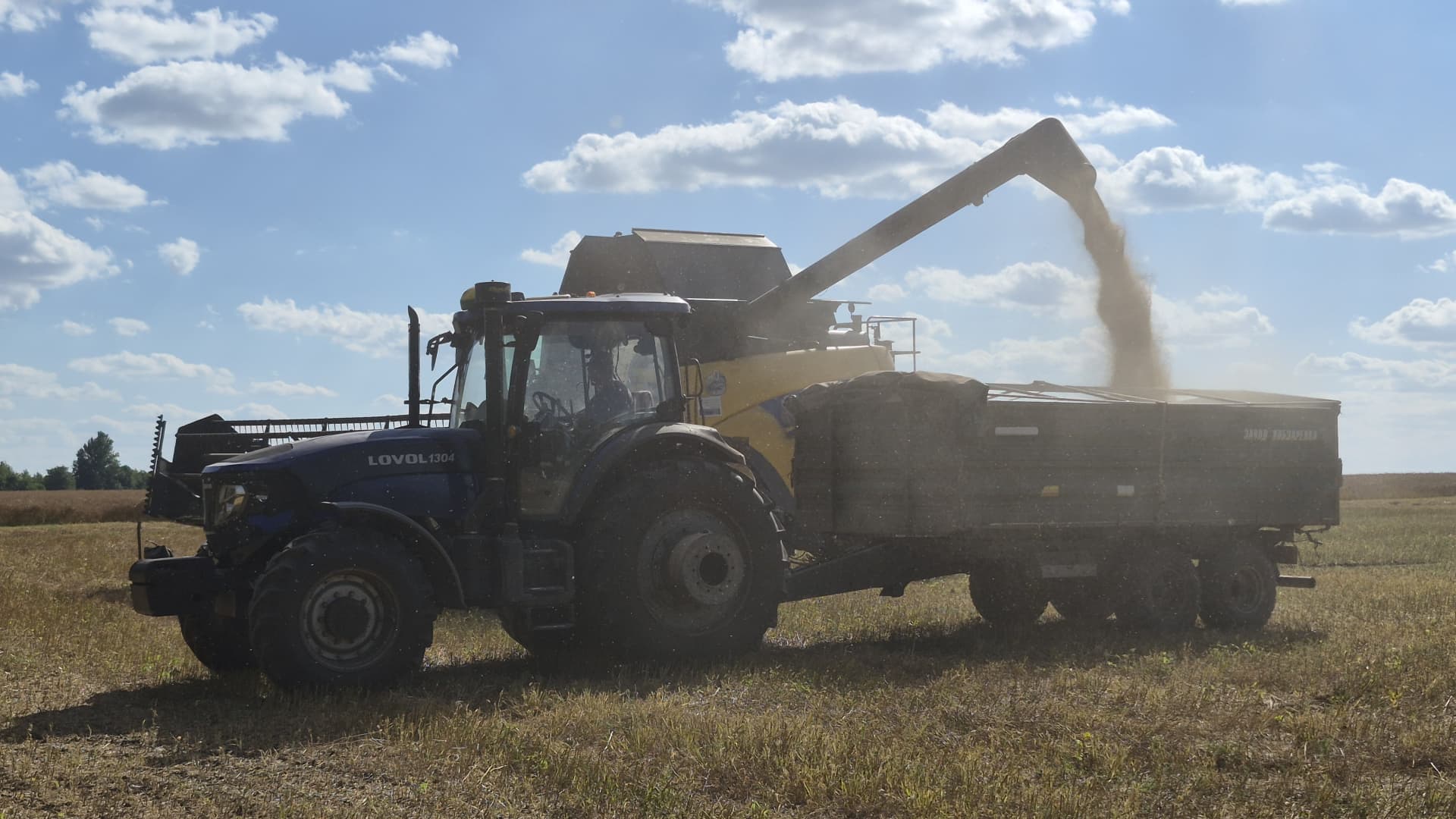
乌克兰的收获季正从小麦、大麦转向玉米、大豆和向日葵。目前,农民奥列克桑德尔·丘马克的收成情况良好,这本该是个好消息。
Ukraine's harvest season is moving from wheat and barley into corn, soybeans and sunflower, and farmer Oleksandr Chumak has had a strong yield so far. That should be good news.
然而,在乌克兰南部敖德萨地区种植各类作物11年后,丘马克终于忍无可忍。
Instead, after 11 years of growing a range of crops in the Odesa region of southern Ukraine, Chumak has had enough.
如今,乌克兰和俄罗斯的仓储设施中堆积着数百万吨农产品,这些农产品原本应运往欧洲、中东、亚洲和非洲,却因战争被困在两国境内。
Storage facilities across both Ukraine and Russia are filled with millions of tons of produce that would normally be sent to Europe, the Middle East, Asia and Africa — but are instead trapped in the warring countries.
今年夏季至秋季,俄罗斯对黑海地区的无人机与导弹袭击愈发频繁,导致商业船只无法获得保险保障。基辅方面的反击又使得俄罗斯的农产品出口也陷入停滞,进一步加剧了全球粮食供应紧张局面。
Russian drone and missile hits on Black Sea targets intensified over the summer and into fall, making it impossible to insure commercial ships. Kyiv's retaliatory attacks mean Russian exports are now also stuck, further squeezing global supply.
即便土耳其正加紧斡旋以促成协议,旨在防范全球粮食安全危机,但进入10月后黑海地区的致命袭击仍在持续,停火前景依然渺茫。
And with fatal Black Sea attacks continuing into October prospects of a ceasefire look slim, even as Turkey ramps up efforts to broker a deal due to the risk to global food security.
丘马克表示,目前他种植的谷物中约有80%无法以盈利价格售出,他手头也已没有现金可用。
Chumak says that around 80% of his grain cannot currently be sold at a profit, and he is out of cash.
国内粮价暴跌,使得包括他在内的众多农民在接下来的几个月里几乎没有动力种植2027年的作物。
A collapse in domestic prices is giving farmers like him little reason to sow for the 2027 crop in the coming months.
“对农民而言处境极为艰难:我们需要缴税、支付土地租金,但现在却什么都卖不出去,根本无力支付这些费用,”乌克兰农业理事会主席安德里·迪库恩说道。"我们唯一能卖出的作物是油菜籽和葵花籽。但即便如此,销量也不够……所以如果今天完全没有利润,我们为什么还要种植?""如果我们的库存已满,春季进行任何农事操作都毫无意义,因为那只是浪费时间和金钱。"
"For the farmers, it's very difficult because we need to pay taxes, we need to pay rent for land, and now we are not able to do this because we are not able to sell anything," said Andrii Dykun, chairman of the Ukrainian Agri Council. "The only crops we are able to sell are rapeseeds and sunflower seeds. But still, the volume is not enough... So why should we plant if today we have no profits at all?" "If our stocks will be full, it makes no sense to do any farm operations in the spring because then it's just a waste of time and money."
乌克兰最大贷款机构PrivatBank告诉CNBC,该行在6月至8月期间向农业企业发放了15.3亿格里夫纳(约合3420万美元)的流动资金贷款,是去年同期7.18亿格里夫纳的两倍多。中小型生产商占其农业贷款组合的70%。"资金实际上被困在粮食库存中,而农场仍需支付持续的运营开支,并为秋播和春播季融资," 国有PrivatBank首席企业及中小企业业务官叶夫根·扎伊格拉耶夫表示。"
PrivatBank, Ukraine's biggest lender, told CNBC that it had disbursed 1.53 billion hryvnia ($34.2 million) in working capital finance to agribusinesses between June and August, more than double the 718 million hryvnia lent in the same period last year. Small and medium-sized producers account for 70% of its agricultural loan book. "Funds effectively remain tied up in grain inventories, while farms still need to cover their ongoing operating expenses and secure financing for the autumn and spring sowing campaigns," said Yevhen Zaihraiev, chief corporate and SME business officer at state-owned PrivatBank.
我们看到客户采取了不同策略。一些农业生产商为了维持足够的运营流动性,选择更早出售农作物,即使价格不太有吸引力。另一些人,特别是拥有储存能力的人,则推迟销售,以期待更有利的市场价格," 他说道。乌克兰粮食和油料作物产量预计今年将从8000万吨增至8500万吨,但上一季的结转库存正给乌克兰的储存基础设施和物流带来压力,扎伊格拉耶夫指出。
"We are seeing different strategies among our clients. Some agricultural producers are selling their crops sooner, even at less attractive prices, in order to maintain sufficient operating liquidity. Others, particularly those with access to storage capacity, are postponing sales in anticipation of more favorable market prices," he said by Ukrainian production of grains and oilseeds is forecast to increase to 85 million tonnes from 80 million tonnes this year, but carry-over stocks from the previous season are pressuring Ukraine's storage infrastructure and logistics, Zaihraiev noted.
这些设施包括田间蜿蜒的长塑料筒仓袋和高耸的金属粮仓,后者本身也日益容易遭受军事打击。"我们还看到农业生产商正逐步修明年种植计划,转向油料作物和小众作物,因为这些作物的价格对物流成本的依赖较小," 扎伊格拉耶夫补充道。
Those facilities include long plastic silobags snaking across fields and towering metal grain elevators that are themselves increasingly vulnerable to military strikes. "We are also seeing agricultural producers gradually revise their planting plans for next year in favor of oilseeds and niche crops, whose prices are less dependent on logistics costs," Zaihraiev added.
今年冬季,全球粮食供应面临严峻挑战,谷物价格持续飙升。农民奥列克桑德尔·丘马克表示,他将采取相应措施:大幅缩减明年的种植面积,完全不再种植玉米和大麦,转而选择对化肥需求较低的作物。而由于美国、以色列与伊朗之间的冲突,全球化肥供应也日趋紧张。
'Perfect storm' brews for global food supply this winter as grain prices soar Farmer Oleksandr Chumak said he will follow that strategy, significantly scaling back planting for next year, avoiding corn and barley altogether, and instead opt for crops which require less fertilizer — which is also facing a global squeeze following amid the U.S.-Israeli war with Iran Meanwhile, for Ukrainian farmers — those not currently being drafted to serve — the war with Russia is ever-present.
对于尚未被征召入伍的乌克兰农民而言,与俄罗斯的战争始终如影随形。“我们生活并劳作在这样一个地方:随时都有可能遭到火箭弹或无人机的袭击,”丘马克在电话中说道,“我们睡觉时,周围300至1000米范围内都可能发生爆炸。”释放库存可迅速扭转市场局面自2022年初俄罗斯发动全面入侵以来,乌克兰农业部门便饱受农场被占领、地雷威胁以及劳动力短缺之苦。
"We are living and working in a place where any time you or your circle can be hit by [a] rocket or drone," Chumak said by phone. "We are sleeping in beds with explosions 300 to 1,000 metres around." Stock release would 'flip the market fast' Ukraine's agricultural sector has faced farm takeovers, mines and labor shortages ever since Russia's full-scale assault began in early 2022.
尽管各国际机构试图通过多项协议保障乌克兰的出口通道,比如后来宣告失败的黑海谷物倡议以及欧盟颇具争议的“团结通道”计划,但成效有限。如今,乌克兰国内局势及其对全球粮食供应链的影响已达到战争爆发以来的最严重程度。
International bodies have struggled to preserve its export routes through various agreements, including the collapsed Black Sea initiative and the European Union's politically contentious "Solidarity Lanes." Now, the situation inside the country and the consequences for global food chains are the most severe they have been since the war began.
联合国数据显示,在战争爆发前,乌克兰与俄罗斯合计向全球供应了超过一半的葵花籽油、近五分之一的大麦以及14%的小麦。乌克兰还是全球最大的玉米生产国之一,中国和欧盟均为其主要买家。
Between them, Ukraine and Russia supplied the world with more than half of its sunflower oil, nearly a fifth of its barley and 14% of its wheat in the years leading up to the war, according to the UN Ukraine is also one of the world's biggest growers of corn, with China and the European Union among its biggest buyers.
通常情况下,乌克兰约90%的主要农产品出口经由黑海进行。今年8月,该国谷物及豆类出口总量仅为98.1万吨,同比大幅减少约58%。
Around 90% of Ukraine's main agricultural exports typically run via the Black Sea. In August this year, its grain and legume exports totalled 981,000 tonnes, down about 58% year on year.
其他地区的减产也进一步加剧了这一风险。预计欧洲的玉米收成将格外糟糕,而此时其对饲料的需求依然旺盛,因此需要大量进口玉米。美国同样面临玉米产量下滑的困境。目前,加拿大、澳大利亚和阿根廷的小麦与大麦收成良好,中东和北非地区的农业产出也较为可观,这些都在一定程度上缓解了整体供应压力。
The risk is heightened by weakness elsewhere. Europe is expected to have a particularly poor corn harvest and needs larger imports just as its demand for feed remains high. The United States is also facing a weaker corn crop For now, better wheat and barley crops in Canada, Australia and Argentina, along with good harvests in the Middle East and North Africa, are cushioning the blow.
Expana公司的谷物与油籽分析高级经理贝努瓦·费奥德指出,运输通道的持续受阻虽然推高了俄罗斯和乌克兰以外地区的大宗商品价格,但一旦黑海港口重新开放,大量廉价农产品将涌入市场,从而“迅速扭转市场走势……且几乎不会提前发出任何预警”。
The continued blockage is supporting commodity prices outside of Russia and Ukraine, but the reopening of Black Sea ports would unleash a wave of cheap supply that would "flip the market fast... with little warning," said Benoit Fayaud, senior manager for grains and oilseeds analysis at Expana.
他向CNBC表示,若协议得以达成并恢复俄乌两国的农产品出口,其他产地的谷物价格可能会下降几十美元。“两国拥有庞大的库存量,这将对全球市场产生利空影响,”他补充道。
A deal which restores Ukrainian and Russian exports could see grains prices in other origins decrease by a few dozen dollars, he told CNBC. "They have such big stocks it will be bearish for the market all over the world," he added.
费奥德称,目前俄罗斯和乌克兰国内的小麦、大麦、油籽及其他农产品价格已降至极低水平,这促使各方争相寻找经由铁路、公路及内河运输的替代路径。不过,这些替代路线对两国而言都“实施困难且效率低下”。
Prices for Russian and Ukrainian wheat, barley, oilseeds and other products have become so low within the countries that it has intensified the scramble to find alternative routes via rail, road and river, according to Fayaud. But these alternative routes are "difficult and slow from both countries," he said.
由于担心农产品过剩会压低本国农产品需求,波兰、罗马尼亚等乌克兰的东欧邻国均反对让谷物暂时经由本国领土转运。
Ukraine's Eastern European neighbors such as Poland and Romania are resisting a push to allow grain to transit through them — even temporarily — due to concerns about a glut destroying demand for their own crops.
多瑙河运输路线则因水位偏低而难以使用;连接乌克兰的一条重要桥梁也遭到损坏。费奥德指出,虽然还有经波罗的海国家、通过格鲁吉亚陆路运往中东及中亚的出口途径,但这些路线仅能承担常规出口量的一小部分。
Another option via the Danube river has been hampered by low water levels; and a key bridge out of Ukraine has been damaged. There are options to export via the Baltic states and through Georgia by land into the Middle East and Central Asia, but this can only cover a small portion of typical flows, Fayaud said.
乌克兰农业委员会的安德里·迪库恩强调,就价格因素而言,黑海航线确实无可替代。
Andrii Dykun of the Ukrainian Agri Council stressed that there was no alternative to the Black Sea routes when it came to pricing.
“对我们来说,即使对乌克兰西部边境的农民而言,从黑海港口将谷物运往其他港口出售,成本也总是更低的,因为这对农民来说比通过边境向欧盟出售要更有利可图,”他说。“因此,如果没有黑海港口,对我们来说就完全行不通了。”
"It would always be cheaper for us, even for the farmers on the western border of Ukraine, to sell the grain to other ports from Black Sea ports because it's much more profitable for the farmers than to sell it via the border to [the] EU," he said. "So without Black Sea ports, it will not work for us at all."