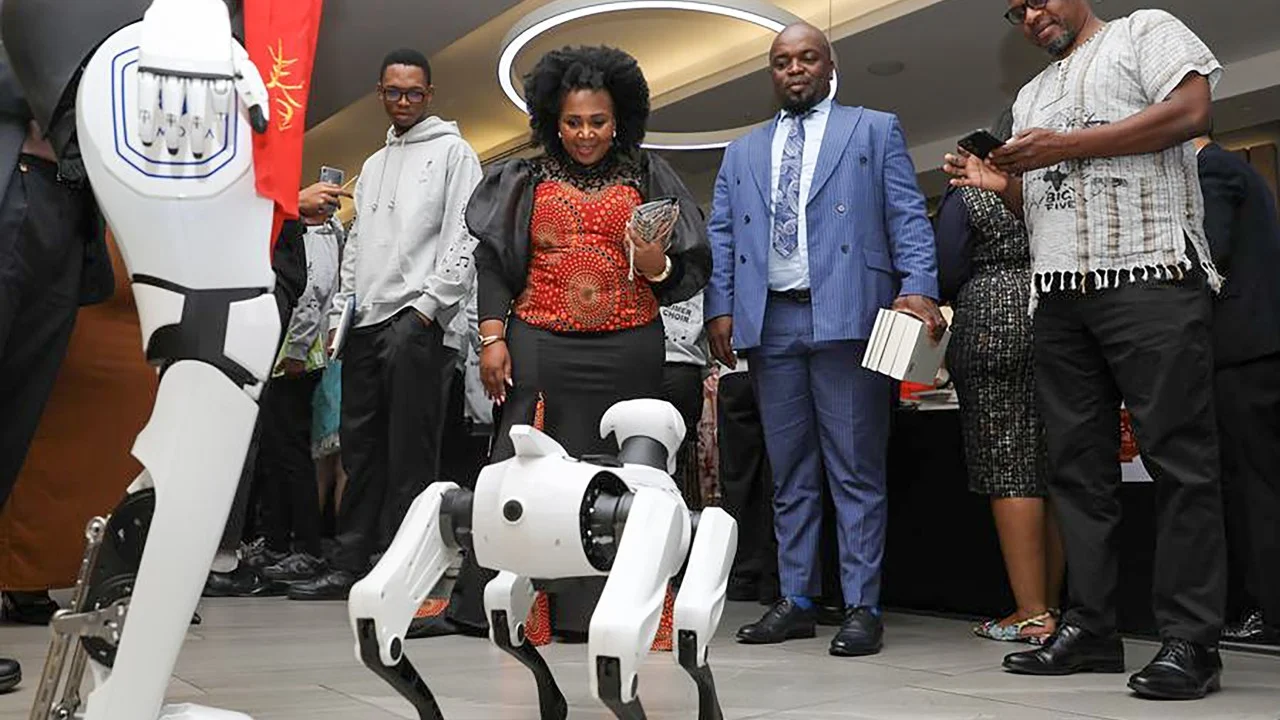
在10月1日庆祝中国国庆日的非洲活动中,机器人提供了娱乐。在安哥拉卢安达,跳舞的机器人逗乐了宾客,大使张斌称该行业是“中国经济向创新和高质量发展转变的一个小缩影”。
At events marking China’s National Day in Africa on October 1, robots provided the entertainment. In Luanda, Angola, dancing robots amused guests and ambassador Zhang Bin called the industry “a small snapshot of the Chinese economy’s move towards innovation and higher-quality development”.
在刚果布拉柴维尔,近400名宾客——包括刚果官员和中国商务代表——观看了一只机器狗的表演。
In Brazzaville, Congo, nearly 400 guests – including Congolese officials and Chinese business representatives – watched on as a robot dog performed.
宾客们还在2月于南非约翰内斯堡的中国新年招待会上与一只机器狗进行了互动。
Guests also interacted with a robot dog at a Chinese New Year reception in Johannesburg, South Africa in February.
分析人士表示,此类在非洲各地的外交和商业活动中的展示,象征着中国正推动成为该地区的技术伙伴。
Such displays at diplomatic and commercial events across Africa are symbolic of China’s push to become a technology partner in the region, according to analysts.
但他们表示,中国工业机器人在非洲工厂的更广泛应用,将取决于该技术是否能解决实际问题,以及当地技术人员是否能够安装和维护它。
But they said broader adoption of Chinese industrial robotics in African factories would depend on whether the technology could solve worthwhile problems – and whether local technicians could install and maintain it.
华盛顿乔治城大学助理教授布勒拉尼·吉利表示,除了表演之外,这些机器人展示旨在将中国呈现为先进技术的提供者,而不仅仅是掠夺性投资或低价商品的来源。
Bulelani Jili, an assistant professor at Georgetown University in Washington, said that – beyond the spectacle – the robot displays aimed to present China as a provider of advanced technology rather than just a source of extractive investment or low-cost goods.
他说,这些展示也是一种“技术外交”,将机器人置于中国在数字基础设施、人工智能和电信领域的产品之中。
He said they were also “a form of technology diplomacy” that put robotics alongside China’s offerings in digital infrastructure, artificial intelligence and telecoms.
中国汽车制造商奇瑞在7月于南非比勒陀利亚附近的罗斯林工厂开业时带来了两台机器人。其人形机器人摩尼与活动主持人互动,而其机器狗阿尔戈斯则出现在展览区。
Chinese carmaker Chery brought two robots to the July opening of its Rosslyn plant near Pretoria in South Africa. Its humanoid robot Mornine interacted with the presenter of the event, while its robotic dog Argos appeared in an exhibition area.
这两台机器人均属于奇瑞的机器人业务AiMOGA,该公司称其机器人已应用于50多个国家和100多种场景。
Both belong to Chery’s robotics business, AiMOGA, which says its robots are used in over 50 countries and 100 scenarios.
4月,在摩洛哥马拉喀什举办的GITEX Africa——一场科技和初创企业展——华为也展出了一台机器人,旁边还有用于金融、医疗和政府的技术。
In April, at GITEX Africa – a tech and start-up show held in Marrakech, Morocco – Huawei also had a robot on show, alongside technology for finance, healthcare and government.
格奥尔格·施蒂勒,施蒂勒技术与市场顾问公司亚洲区总经理表示,在如此活动中使用机器人,使中国作为技术合作伙伴的形象“变得具体”,而仅仅谈论工业能力的演讲则无法做到这一点。
Georg Stieler, managing director for Asia at Stieler Technology & Market Advisory, said having a robot at such events made China’s pitch as a technology partner “tangible in a way a speech about industrial capabilities does not”.
中国外交官此前也曾在其他场合让机器人登台亮相,包括在沙特阿拉伯利雅得的国庆日招待会上。当时的活动因人形机器人身着沙特服装、表演传统阿尔达剑舞的画面而成为新闻焦点。施蒂勒表示,这一切都与形象塑造有关。
Chinese diplomats have put robots on stage elsewhere, including at a National Day reception in Riyadh, Saudi Arabia. That event made headlines with images of humanoid robots dressed in Saudi clothing performing a traditional Ardah sword dance. It is all about image projection, according to Stieler.
“舞台上的机器人不一定是正在销售的产品;真正被推广的是中国作为技术合作伙伴的形象,”他说。
“The robot on stage is not necessarily the product being sold; what is being marketed is China as a technology partner,” he said.
他补充称,低廉的人力成本削弱了在某些非洲市场仅为替代工人而购买机器人的理由,而当地有限的安装和维护能力又增加了成本。
He added that low labour costs weakened the case for buying a robot simply to replace workers in some African markets, while limited local capacity to install and maintain them added to the expense.
施蒂勒预计,机器人技术的发展将追随已经在非洲运营的中国制造商。他表示,在非洲设有工厂的中国公司更有可能自动化自身生产线,而非通过外交表演来赢得新的机器人业务。
Stieler expected robotics to follow Chinese manufacturers that were already operating in Africa. He said Chinese companies with plants on the continent were more likely to automate their own lines than win new robotics business through diplomatic performances.
布鲁金斯学会约翰·L·桑顿中国中心研究员凯尔·陈表示,北京正试图利用其在人工智能和机器人领域的成功,将自己塑造为全球南方国家的技术领袖。
Kyle Chan, a fellow at the Brookings Institution’s John L. Thornton China Centre, said Beijing was trying to capitalise on its success with AI and robotics to present itself as a tech leader for the Global South.
他指出,中国已经在与全球南方国家合作开展诸如电池等技术项目——例如其在摩洛哥的投资——但尚不清楚它将如何与非洲国家在机器人领域展开合作。
He said China was already working with Global South nations on technology such as batteries – giving the example of its investment in Morocco – but that it was not clear how it might partner with African nations on robotics.
“真正的考验在于,中国是否会在非洲国家大规模投入研发和工程人才培养,”他说。
“The real test will be whether China will invest significantly in R&D and engineering talent development in African nations,” he said.
吉利表示,机器人展示可能带来试点项目或商业协议,但其对非洲国家的价值将取决于当地技能水平、非洲企业和研究人员的参与程度,以及维护和管理该技术的能力。
Jili said the robot displays could lead to pilot projects or commercial agreements, but their value to African countries would depend on local skills, the involvement of African firms and researchers, and the ability to maintain and govern the technology.
“关键问题不仅在于机器人是否能吸引注意力,还在于谁拥有、维护、管理并从它们引入的技术系统中获益,”他说。
“The salient question is not only whether robots attract attention, but also who owns, maintains, governs and benefits from the technological systems they introduce,” he said.