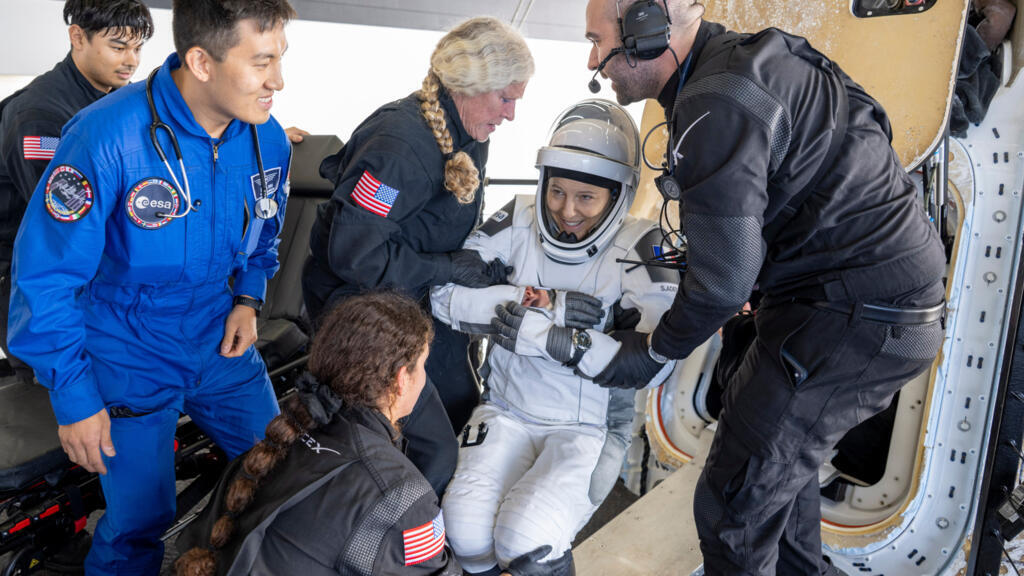
法国宇航员索菲·阿德诺在太空度过了八个月后,满怀“情感”地返回地球——打破了欧洲宇航员连续轨道停留时间的纪录。她将在德国科隆的欧洲航天局中心完成康复计划,随后返回法国。
French astronaut Sophie Adenot has returned back to earth full of "emotion" after spending eight months in space – breaking the record for the longest uninterrupted orbital stay by a European astronaut. She will complete a recovery programme at the European Space Agency centre in Cologne, Germany before returning to France.
阿德诺于周四乘坐载有Crew-12的龙飞船,在加利福尼亚州海岸外的太平洋溅落,从国际空间站(ISS)任务返回地球。
Adenot splashed down in the Pacific Ocean Thursday off the coast of California in the Dragon capsule that carried Crew-12, having returned to Earth from a mission on the International Space Station (ISS).
她与美国宇航员杰西卡·梅尔和杰克·哈瑟韦以及俄罗斯宇航员安德烈·费亚耶夫一同返回。
She was accompanied by fellow ISS colleagues Americans Jessica Meir and Jack Hathaway and the Russian Andrei Fedyaev.
在任务期间,阿德诺成为首位进行太空行走的法国女宇航员。她在8月18日、25日和9月1日共进行了三次太空行走。
During the mission, Adenot became the first French female astronaut to venture outside the space station for a spacewalk. In all, she undertook three spacewalks on 18 and 25 August and 1 September.
她在太空中累计停留了237天,打破了欧洲宇航员连续轨道停留时间的纪录。
She had spent a total of 237 days in space, breaking the record for the longest uninterrupted orbital stay by a European astronaut.
“从太空看,气候变化‘非常明显’”,法国宇航员索菲·阿德诺对RFI表示。距离地球400公里的高度,阿德诺看到的是“没有分界,没有边界”,而是“我们共同珍惜的星球”。她周六在德国科隆欧洲航天局(ESA)训练中心的停机坪上如此说道,时而泪流满面。
Climate change is ‘very visible from space’, France's Sophie Adenot tells RFI At 400 km away from Earth, Adenot could see there are "no divisions, no borders" but "just a precious planet that we all share," she said Saturday on the tarmac of the European Space Agency (ESA) training centre in Cologne, occasionally in tears.
这位44岁的宇航员抵达德国时明显虚弱,需由两名ESA医生搀扶。
The 44-year-old astronaut looked visibly weakened on her arrival in Germany and was assisted by two ESA physicians.
“这真是一种令人惊叹的情感交织,令人难以置信。能重返地球令人欣喜,但同时也伴随着诸多挑战,尤其是生理方面的挑战,”她在新闻发布会上说道。
"It's a cocktail of astonishing emotions, it's incredible. It's great to be back on Earth, but it also comes with its share of challenges, especially physiological ones," she told a press conference.
“失重后现在容易流泪;我已经不习惯了,”她开玩笑说。“我带着梦想进入太空,如今带着感激之情返回,”她补充道,赞扬“那些选择团结一致的人们之间的那种团结感”。阿德诺现在必须开始为期约三周的强化康复计划,以恢复到飞行前的状态。
"Tears follow weightlessness now; I wasn't used to that anymore," she joked. "I went into space full of dreams, and I returned full of gratitude," she added, hailing "that sense of unity among people who have decided to be united." Adenot must now begin an intensive recovery program of about three weeks to regain her pre-flight condition.
在太空中,人体会适应失重状态,这会导致骨质流失、肌肉萎缩、心血管功能退化,甚至出现视力问题。
In space, the body adapts to the absence of gravity, which leads to bone loss, muscle wasting, cardiovascular deconditioning and even visual problems.
她描述了周四溅落时的“艰难”时刻,当时将她团队四名宇航员送回地球的胶囊不得不忍受“25分钟的巨浪冲击”。
She described the "difficult" moment of Thursday's splashdown, when the capsule bringing back the four astronauts on her team had to endure "a lot of waves for 25 minutes".
“当消防队员把我从舱内拉出来时,我对他们说的第一句话是:‘请把我送回太空!’在那边要容易得多,”她补充道。
"And when the commandos pulled me out of the capsule, the first thing I said to them was, 'Send me back to space, please!' It was much easier up there," she added.
随着卫星需求激增,欧洲将在2030年前面临火箭短缺问题。除了进行太空行走外,阿德诺特在国际空间站上还进行了约200项法国和国际科学实验,涵盖健康研究、材料科学、生物学、流体物理学、辐射物理学和基础科学等多个领域。
Europe faces rocket shortage by 2030 as satellite demand surges As well as conducting spacewalks, Adenot conducted around 200 French and international scientific experiments aboard the ISS, spanning fields from health research to materials science, biology, fluid physics, radiation physics and fundamental science.
在太空中,微重力使得一些在地球上因重力干扰而无法观察到的物理现象得以显现。
In space, microgravity makes it possible to reveal physical phenomena that cannot be observed on Earth due to gravity.
效仿她的法国前辈托马斯·佩斯凯——这位首次广泛利用社交媒体记录太空生活的法国宇航员——阿德诺特选择制作了一系列名为《周日早晨科学》的视频短片。这个每周两分钟的科学普及栏目让她以有趣且引人入胜的方式解释物理定律或太空生活的影响。
Following in the footsteps of her French predecessor, Thomas Pesquet – the first French astronaut to make extensive use of social media to document his time in space – Adenot opted for a series of video clips titled "Sunday Morning Science." This weekly two-minute segment on science communication allowed her to explain the laws of physics or the effects of life in space in a fun and engaging way.