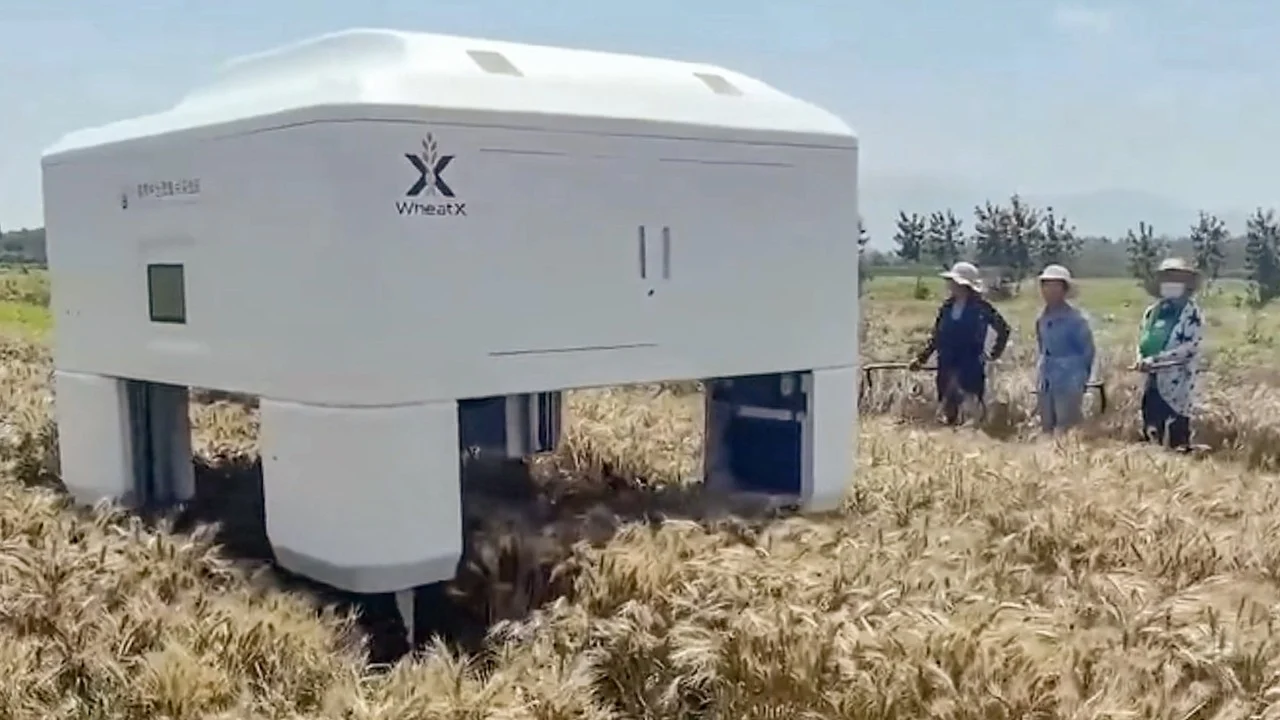
中国推出了一款智能机器人原型,旨在协助小麦育种,这是其持续推进农业技术、保障粮食安全的最新进展。
China has unveiled a smart robot prototype designed to assist with wheat breeding in the latest step in its ongoing drive to advance agricultural technology and bolster food security.
该机器人于近期小麦育种研讨会上首次亮相,中国科学日报周五报道了这一消息。
The robot made its public debut at a recent seminar on wheat breeding, state-run China Science Daily reported on Friday.
传统小麦育种者依赖丰富的经验积累,从数以万计的杂交后代中筛选出性状优良的品种。
Traditional wheat breeders rely on a wealth of accumulated experience to identify and select strains with superior traits from tens of thousands of hybrid offspring.
但这一过程需要在田间进行人工评估——既费时费力,又带有主观性。
But this requires manual assessment in the field – a process that is both labour intensive and subjective.
该机器人通过先进的导航系统、高清摄像头和视觉算法,旨在减轻这一工作负担。
The robots are designed to reduce this workload using an advanced navigation system, high-definition cameras and vision algorithms.
关键的是,该机器人不仅仅是一个被动扫描仪。据研究团队介绍,它已被训练具备类似人类育种者的自主判断能力。
Crucially, the robot is not merely a passive scanner. According to the research team, it has been trained to exercise autonomous judgment similar to that of a human breeder.
研讨会透露,在试验中,这款长宽高均超过2米(6.5英尺)的智能机器人成功在待检作物前方停下。
The seminar heard that in trials the smart machine – measuring over 2 metres (6.5 feet) in length, width and height – had successfully halted in front of the crop it was inspecting.
随后,它使用机械臂将单穗小麦包裹,使得八个微型摄像头能够从多个角度捕捉详细图像。
It then used its robotic arm to envelop a single wheat ear, allowing eight micro-cameras to capture detailed images from multiple angles.
片刻之后,系统生成了一套完整的定量数据,包括粒数和穗长等指标。
Moments later, a full suite of quantitative data, including grain count and ear length, was generated.
山东农业大学国家重点实验室小麦育种方向的科学家、项目共同负责人王宏伟向该报表示,该机器人的一个显著特点是将“大量育种者经验”融入其训练模型。
Wang Hongwei, a scientist at Shandong Agricultural University’s state key laboratory of wheat breeding and co-leader of the project, told the newspaper that a defining feature of the robot was the integration of “a vast amount of breeder experience” into its training model.
为实现这一目标,研究团队在多种不同环境中种植了2000份多样化的小麦遗传材料。
To achieve this, the research team planted 2,000 diverse wheat genetic materials in a range of different environments.
每株植物均被单独拍摄,随后育种专家被邀请对这些图像进行评分和评估。这些结果被输入系统并转换为机器可读的数据。
Each plant was photographed individually and breeding specialists were then brought in to score and assess the images. The results were then fed into the system and translated into machine-readable data.
这些信息随后被用于为机器人构建智能决策模型,该模型能够进行快速、大规模的筛选,并对可用于未来育种的作物进行评估和标记。
This information was then used to build an intelligent decision-making model for the robot, which carried out rapid, large-scale screening as well as the evaluation and marking of crops that could be used for future breeding.
该模型及其先进的成像系统首次用于在田间对单个植株进行初步筛选,识别出值得进一步调查的候选植株。随后,它在待检查的目标植株上喷涂油漆,以便人工进行检查。
This model and its advanced imaging system were first used to carry out the preliminary screening of individual plants in the field, identifying candidates worthy of further investigation. Then it sprayed paint on the target plants to be inspected by a human.
据报道,研究团队已与山东济智生物科技有限公司达成初步协议,该公司专注于基因技术和智能育种应用,双方将共同开发商用化AI小麦育种机器人。
The research team has reached a preliminary agreement with Shandong Jizhi Biotech, a firm specialising in gene technology and intelligent breeding applications, to develop a commercialised AI wheat-breeding robot, the report said.
今年早些时候,中央政府发布了蓝图,计划在未来五年利用尖端技术对中国广阔的农业部门进行改革。
Earlier this year, the central government unveiled a blueprint for overhauling China’s vast agricultural sector over the next five years using cutting-edge technology.
国务院即中国内阁承诺将大幅加强该领域的研发力度,并设定目标,以提高技术进步对农业产出的贡献。
The State Council, China’s cabinet, pledged to significantly strengthen research and development within the sector and set targets for increasing the contribution of technological advances to farm output.
该文件呼吁在农业中更广泛地采用人工智能(AI),规划利用该技术进行作物育种、病虫害检测以及作物产量预测。
The document called for the wider adoption of artificial intelligence (AI) in agriculture, outlining plans to use the technology for crop breeding, detecting pests and diseases, and forecasting crop yields.